
FOCAL POINT
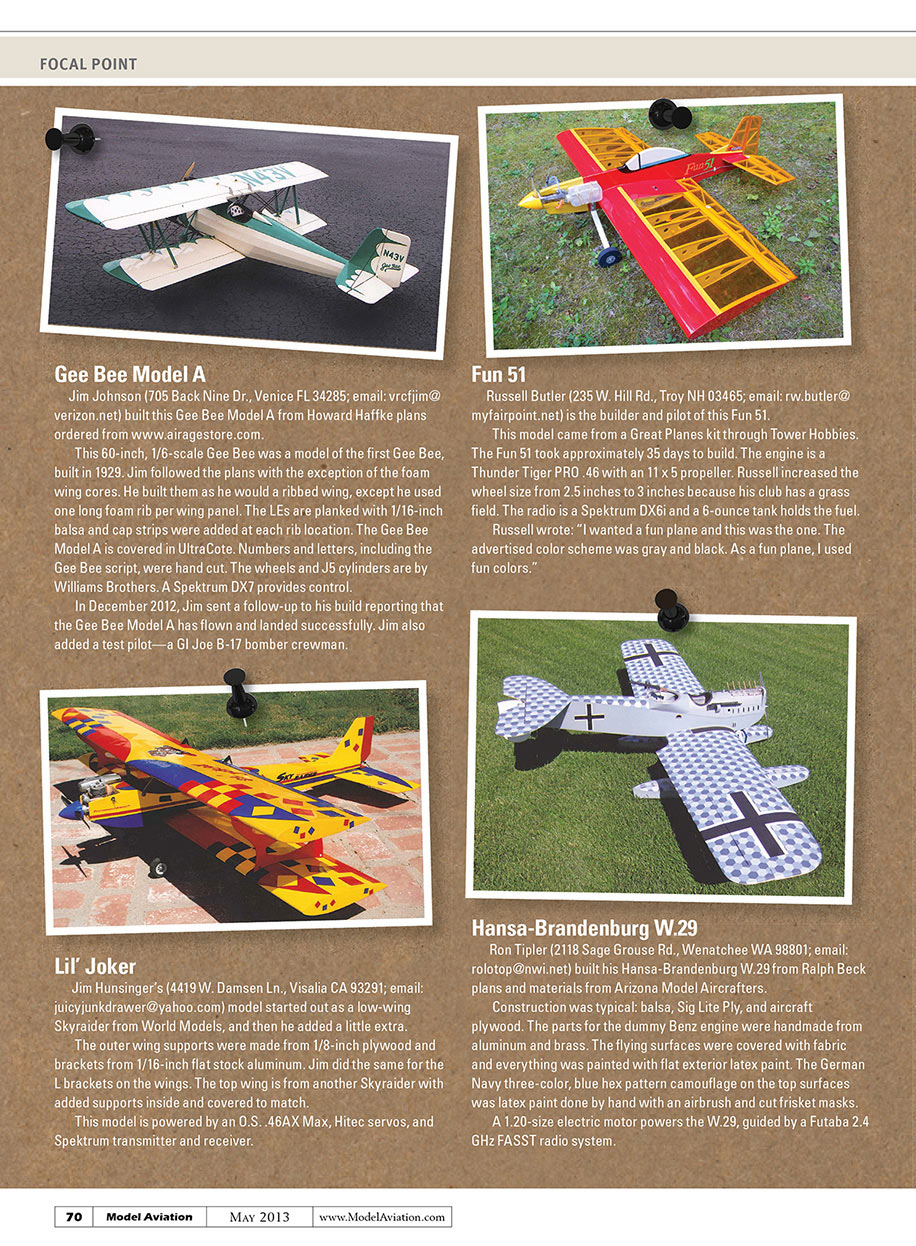
Gee Bee Model A
Jim Johnson (<REDACTED>) built this Gee Bee Model A from Howard Haffke plans ordered from www.airagestore.com.
This 60-inch, 1/6-scale Gee Bee was a model of the first Gee Bee, built in 1929. Jim followed the plans with the exception of the foam wing cores. He built them as he would a ribbed wing, except he used one long foam rib per wing panel. The LE's are planked with 1/16-inch balsa and cap strips were added at each rib location. The Gee Bee Model A is covered in UltraCote. Numbers and letters, including the Gee Bee script, were hand cut. The wheels and J5 cylinders are by Williams Brothers. A Spektrum DX7 provides control.
In December 2012, Jim sent a follow-up to his build reporting that the Gee Bee Model A has flown and landed successfully. Jim also added a test pilot—a GI Joe B-17 bomber crewman.
Fun 51
Russell Butler (<REDACTED>) is the builder and pilot of this Fun 51.
This model came from a Great Planes kit through Tower Hobbies. The Fun 51 took approximately 35 days to build. The engine is a Thunder Tiger PRO .46 with an 11 x 5 propeller. Russell increased the wheel size from 2.5 inches to 3 inches because his club has a grass field. The radio is a Spektrum DX6i and a 6-ounce tank holds the fuel.
Russell wrote: "I wanted a fun plane and this was the one. The advertised color scheme was gray and black. As a fun plane, I used fun colors."
Lil' Joker
Jim Hunsinger's (<REDACTED>) model started out as a low-wing Skyraider from World Models, and then he added a little extra.
The outer wing supports were made from 1/8-inch plywood and brackets from 1/16-inch flat stock aluminum. Jim did the same for the L brackets on the wings. The top wing is from another Skyraider with added supports inside and covered to match.
This model is powered by an O.S. .46AX Max, Hitec servos, and Spektrum transmitter and receiver.
Hansa-Brandenburg W.29
Ron Tipler (<REDACTED>) built his Hansa-Brandenburg W.29 from Ralph Beck plans and materials from Arizona Model Aircrafters.
Construction was typical: balsa, Sig Lite Ply, and aircraft plywood. The parts for the dummy Benz engine were handmade from aluminum and brass. The flying surfaces were covered with fabric and everything was painted with flat exterior latex paint. The German Navy three-color, blue hex pattern camouflage on the top surfaces was latex paint done by hand with an airbrush and cut/frisket masks.
A 1.20-size electric motor powers the W.29, guided by a Futaba 2.4 GHz FASST radio system.
Focal Point
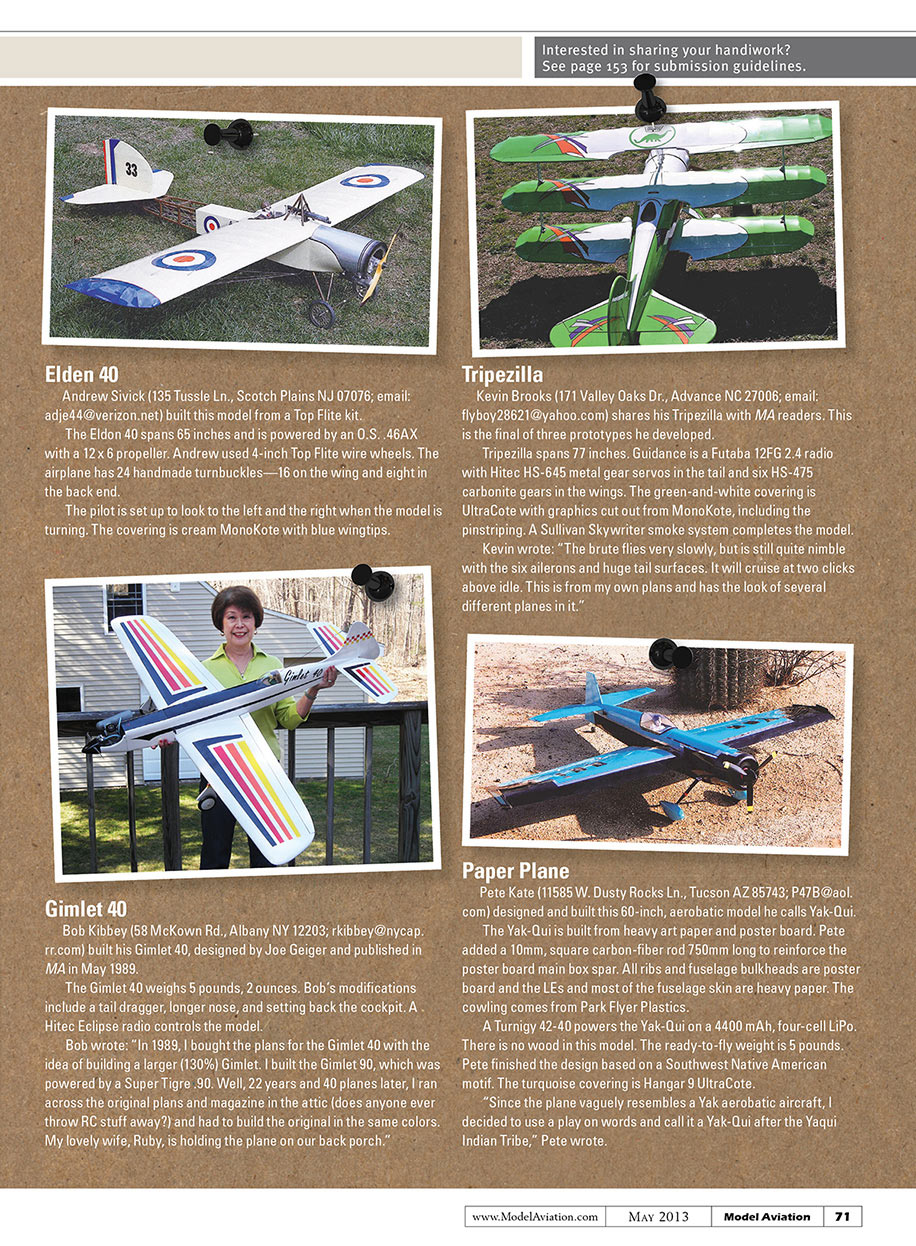
Elden 40
Andrew Sivick (<REDACTED>) built this model from a Top Flite kit.
The Elden 40 spans 65 inches and is powered by an O.S. .46AX with a 12 x 6 propeller. Andrew used 4-inch Top Flite wire wheels. The airplane has 24 hand made turnbuckles—16 on the wing and eight in the back end.
The pilot is set up to look to the left and the right when the model is turning. The covering is cream MonoKote with blue wingtips.
Tripezilla
Kevin Brooks (<REDACTED>) shares his Tripezilla with MA readers. This is the final of three prototypes he developed.
Tripezilla spans 77 inches. Guidance is a Futaba 12FG 2.4 radio with Hitec HS-645 metal gear servos in the tail and six HS-475 carbonite gears in the wings. The green-and-white covering is UltraCote with graphics cut out from MonoKote, including the pinstriping. A Sullivan Skywriter smoke system completes the model.
Kevin wrote: "The brute flies very slowly, but is still quite nimble with the six ailerons and huge tail surfaces. It will cruise at two clicks above idle. This is from my own plans and has the look of several different planes in it."
Gimlet 40
Bob Kibbey (<REDACTED>) built his Gimlet 40, designed by Joe Geiger and published in MA in May 1989.
The Gimlet 40 weighs 5 pounds, 2 ounces. Bob's modifications include a tail dragger, longer nose, and setting back the cockpit. A Hitec Eclipse radio controls the model.
Bob wrote: "In 1989, I bought the plans for the Gimlet 40 with the idea of building a larger (130%) Gimlet. I built the Gimlet 90, which was powered by a Super Tigre .90. Well, 22 years and 40 planes later, I ran across the original plans and magazine in the attic (does anyone ever throw RC stuff away?) and had to build the original in the same colors. My lovely wife, Ruby, is holding the plane on our back porch."
Paper Plane
Pete Kate (<REDACTED>) designed and built this 60-inch, aerobatic model he calls Yak-Qui.
The Yak-Qui is built from heavy art paper and poster board. Pete added a 10mm, square carbon-fiber rod 750mm long to reinforce the poster board main box spar. All ribs and fuselage bulkheads are poster board and the LEs and most of the fuselage skin are heavy paper. The cowlings come from Park Flyer Plastics.
A Turnigy 42-40 powers the Yak-Qui on a 4400 mAh, four-cell LiPo. There is no wood in this model. The ready-to-fly weight is 5 pounds.
Pete finished the design based on a Southwest Native American motif. The turquoise covering is Hangar 9 UltraCote.
"Since the plane vaguely resembles a Yak aerobatic aircraft, I decided to use a play on words and call it a Yak-Qui after the Yaqui Indian Tribe," Pete wrote.
Transcribed from original scans by AI. Minor OCR errors may remain.

