
FOCAL POINT
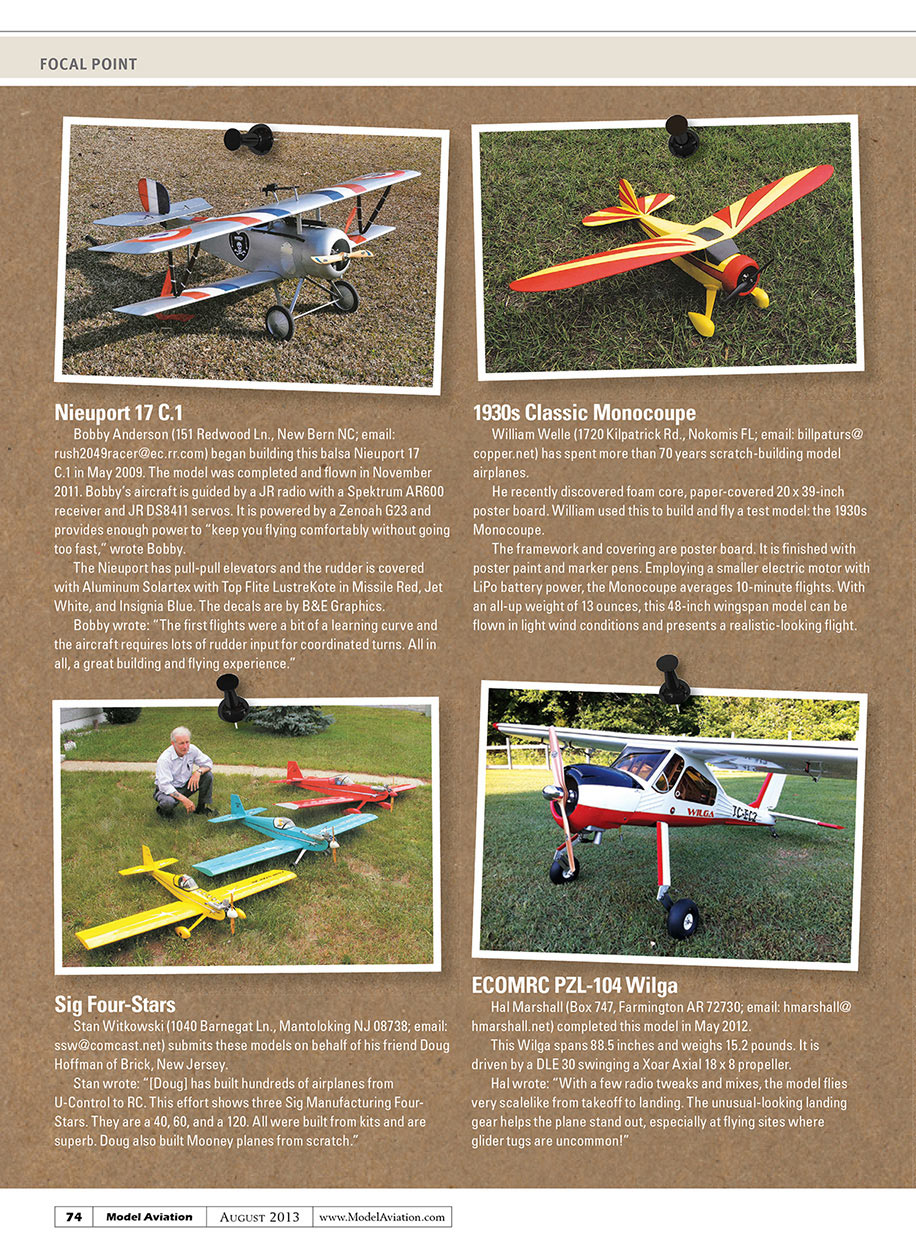
Nieuport 17 C.1
Bobby Anderson (<REDACTED>; email: <REDACTED>) began building this balsa Nieuport 17 C.1 in May 2009. The model was completed and flown in November 2011. Bobby's aircraft is guided by a JR radio with a Spektrum AR600 receiver and JR DS8411 servos. It is powered by a Zenoah G23 and provides enough power to "keep you flying comfortably without going too fast," wrote Bobby.
The Nieuport has pull-pull elevators and the rudder is covered with Aluminum Solartex with Top Flite LustreKote in Missile Red, Jet White, and Insignia Blue. The decals are by B&E Graphics.
Bobby wrote: "The first flights were a bit of a learning curve and the aircraft requires lots of rudder input for coordinated turns. All in all, a great building and flying experience."
1930s Classic Monocoupe
William Welle (<REDACTED>; email: <REDACTED>) has spent more than 70 years scratch-building model airplanes.
He recently discovered foam core, paper-covered 20 x 39-inch poster board. William used this to build and fly a test model: the 1930s Monocoupe.
The framework and covering are poster board. It is finished with poster paint and marker pens. Employing a smaller electric motor with LiPo battery power, the Monocoupe averages 10-minute flights. With an all-up weight of 13 ounces, this 48-inch wingspan model can be flown in light wind conditions and presents a realistic-looking flight.
Sig Four-Stars
Stan Witkowski (<REDACTED>; email: <REDACTED>) submits these models on behalf of his friend Doug Hoffman of Brick, New Jersey.
Stan wrote: "[Doug] has built hundreds of airplanes from U-Control to RC. This effort shows three Sig Manufacturing Four-Stars. They are a 40, 60, and a 120. All were built from kits and are superb. Doug also built Mooney planes from scratch."
ECOMRC PZL-104 Wilga
Hal Marshall (<REDACTED>; email: <REDACTED>) completed this model in May 2012.
This Wilga spans 88.5 inches and weighs 15.2 pounds. It is driven by a DLE 30 swinging a Xoar Axial 18 x 8 propeller.
Hal wrote: "With a few radio tweaks and mixes, the model flies very scale-like from takeoff to landing. The unusual-looking landing gear helps the plane stand out, especially at flying sites where glider tugs are uncommon!"
Focal Point
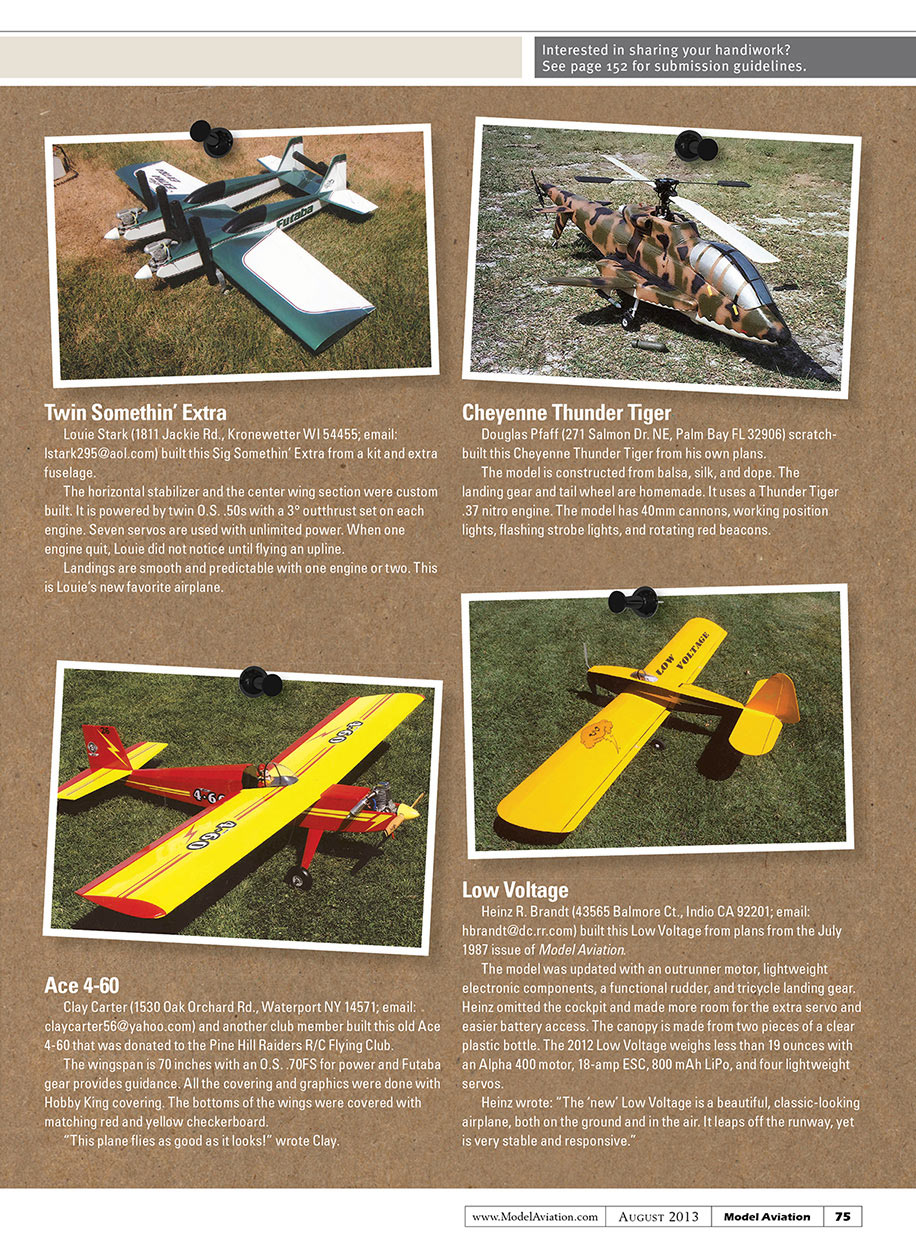
Twin Somethin' Extra
Louie Stark (<REDACTED>; email: <REDACTED>) built this Sig Somethin' Extra from a kit and extra fuselage. The horizontal stabilizer and the center wing section were custom built. It is powered by twin O.S. .50s with a 3° outthrust set on each engine. Seven servos are used with unlimited power. When one engine quit, Louie did not notice until flying an upline. Landings are smooth and predictable with one engine or two. This is Louie's new favorite airplane.
Cheyenne Thunder Tiger
Douglas Pfaff (<REDACTED>) scratch-built this Cheyenne Thunder Tiger from his own plans. The model is constructed from balsa, silk, and dope. The landing gear and tail wheel are homemade. It uses a Thunder Tiger .37 nitro engine. The model has 40mm cannons, working position lights, flashing strobe lights, and rotating red beacons.
Ace 4-60
Clay Carter (<REDACTED>; email: <REDACTED>) and another club member built this old Ace 4-60 that was donated to the Pine Hill Raiders R/C Flying Club. The wingspan is 70 inches with an O.S. .70FS for power and Futaba gear provides guidance. All the covering and graphics were done with Hobby King covering. The bottoms of the wings were covered with matching red and yellow checkerboard. "This plane flies as good as it looks!" wrote Clay.
Low Voltage
Heinz R. Brandt (<REDACTED>; email: <REDACTED>) built this Low Voltage from plans from the July 1987 issue of Model Aviation. The model was updated with an outrunner motor, lightweight electronic components, a functional rudder, and tricycle landing gear. Heinz omitted the cockpit and made more room for the extra servo and easier battery access. The canopy is made from two pieces of a clear plastic bottle. The 2012 Low Voltage weighs less than 19 ounces with an Alpha 400 motor, 18-amp ESC, 800 mAh LiPo, and four lightweight servos. Heinz wrote: "The 'new' Low Voltage is a beautiful, classic-looking airplane, both on the ground and in the air. It leaps off the runway, yet is very stable and responsive."
Transcribed from original scans by AI. Minor OCR errors may remain.

