
Focal Point
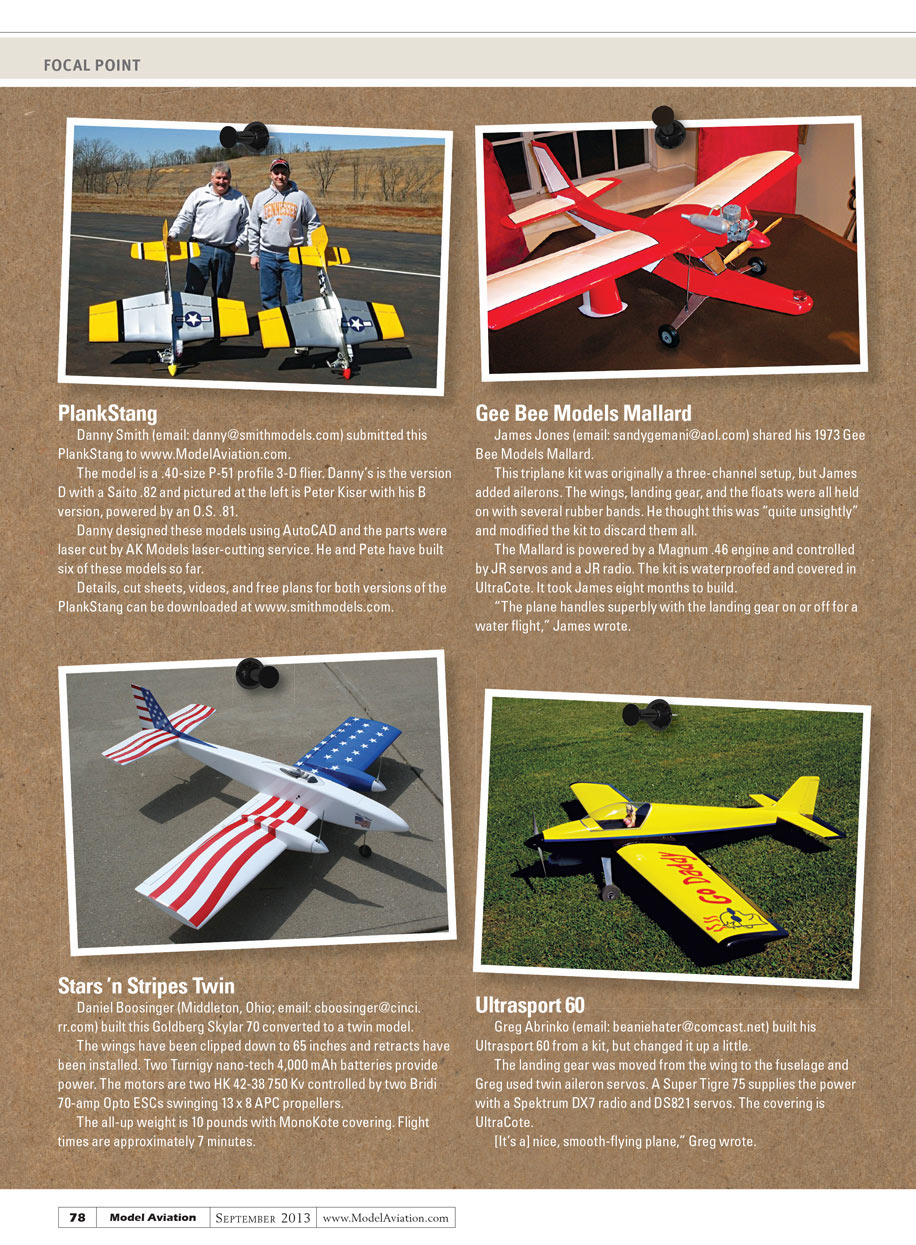
PlankStang
Danny Smith (email: [email protected]) submitted this PlankStang to www.ModelAviation.com.
The model is a .40-size P-51 profile 3-D flier. Danny's is the version D with a Saito .82 and pictured at the left is Peter Kiser with his B version, powered by an O.S. .81.
Danny designed these models using AutoCAD and the parts were laser cut by AK Models laser-cutting service. He and Pete have built six of these models so far.
Details, cut sheets, videos, and free plans for both versions of the PlankStang can be downloaded at www.smithmodels.com.
Gee Bee Models Mallard
James Jones (email: [email protected]) shared his 1973 Gee Bee Models Mallard.
This triplane kit was originally a three-channel setup, but James added ailerons. The wings, landing gear, and the floats were all held on with several rubber bands. He thought this was "quite unsightly" and modified the kit to discard them all.
The Mallard is powered by a Magnum .46 engine and controlled by JR servos and a JR radio. The kit is waterproofed and covered in UltraCote. It took James eight months to build.
"The plane handles superbly with the landing gear on or off for a water flight," James wrote.
Stars 'n Stripes Twin
Daniel Boosinger (Middleton, Ohio; email: [email protected]) built this Goldberg Skylar 70 converted to a twin model.
The wings have been clipped down to 65 inches and retracts have been installed. Two Turnigy nano-tech 4,000 mAh batteries provide power. The motors are two HK 42-38 750 Kv controlled by two Bridi 70-amp Opto ESCs swinging 13 x 8 APC propellers.
The all-up weight is 10 pounds with MonoKote covering. Flight times are approximately 7 minutes.
Ultrasport 60
Greg Abrinko (email: [email protected]) built his Ultrasport 60 from a kit, but changed it up a little.
The landing gear was moved from the wing to the fuselage and Greg used twin aileron servos. A Super Tigre .75 supplies the power with a Spektrum DX7 radio and DS821 servos. The covering is UltraCote.
"[It's a] nice, smooth-flying plane," Greg wrote.
Focal Point
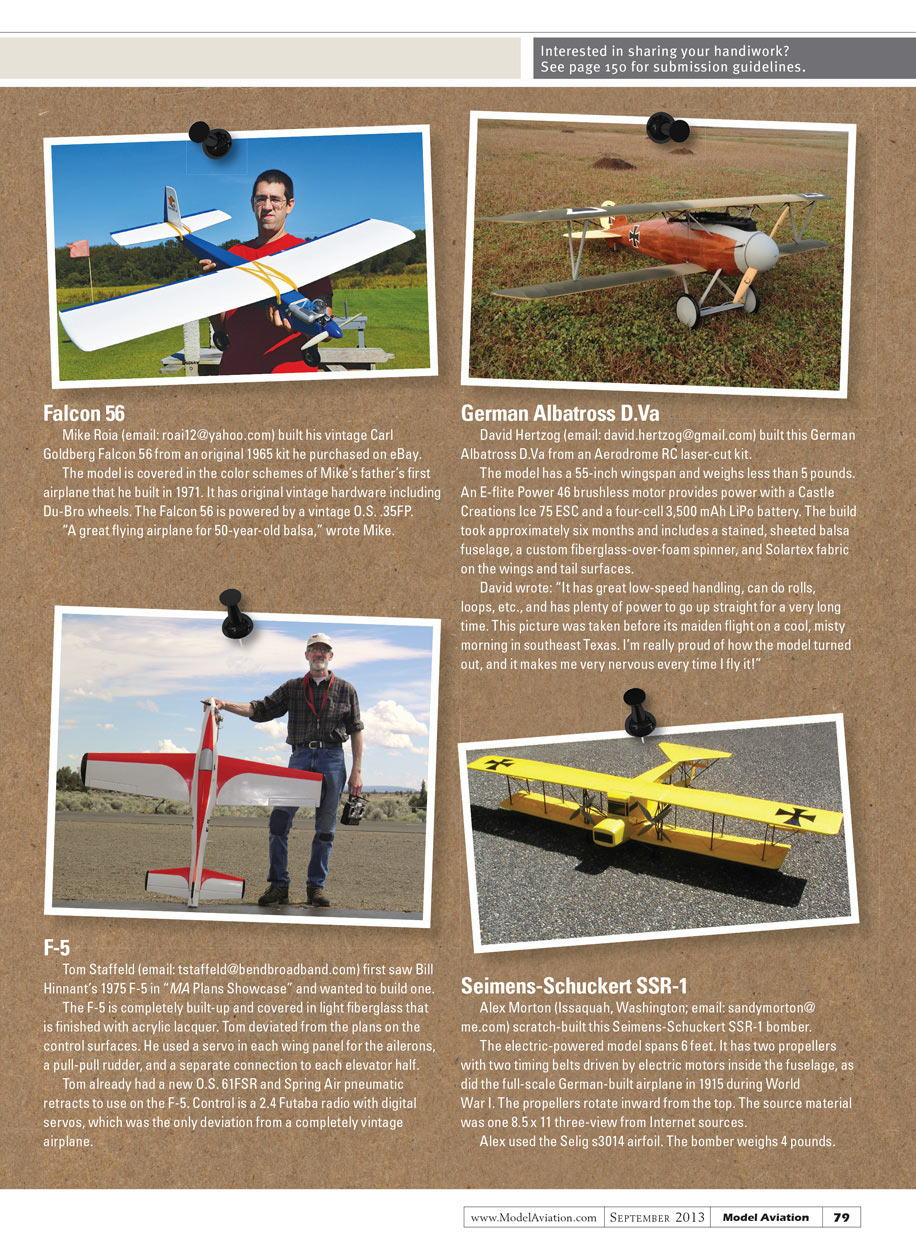
Falcon 56 Mike Roia (email: [email protected]) built his vintage Carl Goldberg Falcon 56 from an original 1965 kit he purchased on eBay. The model is covered in the color schemes of Mike’s father’s first airplane that he built in 1971. It has original vintage hardware including Du-Bro wheels. The Falcon 56 is powered by a vintage O.S. .35FP. “A great flying airplane for 50-year-old balsa,” wrote Mike.
German Albatross D.Va David Hertzog (email: [email protected]) built this German Albatross D.Va from an Aerodrome RC laser-cut kit. The model has a 55-inch wingspan and weighs less than 5 pounds. An E-flite Power 46 brushless motor provides power with a Castle Creations Ice 75 ESC and a four-cell 3,500 mAh LiPo battery. The build took approximately six months and includes a stained, sheeted balsa fuselage, a custom fiberglass-over-foam spinner, and Solartex fabric on the wings and tail surfaces. David wrote: “It has great low-speed handling, can do rolls, loops, etc., and has plenty of power to go up straight for a very long time. This picture was taken before its maiden flight on a cool, misty morning in southeast Texas. I’m really proud of how the model turned out, and it makes me very nervous every time I fly it!”
F-5 Tom Staffeld (email: [email protected]) first saw Bill Hinnant’s 1975 F-5 in “MA Plans Showcase” and wanted to build one. The F-5 is completely built-up and covered in light fiberglass that is finished with acrylic lacquer. Tom deviated from the plans on the control surfaces. He used a servo in each wing panel for the ailerons, a pull-pull rudder, and a separate connection to each elevator half. Tom already had a new O.S. 61FSR and Spring Air pneumatic retracts to use on the F-5. Control is a 2.4 Futaba radio with digital servos, which was the only deviation from a completely vintage airplane.
Siemens-Schuckert SSR-1 Alex Morton (Issaquah, Washington; email: [email protected]) scratch-built this Siemens-Schuckert SSR-1 bomber. The electric-powered model spans 6 feet. It has two propellers with two timing belts driven by electric motors inside the fuselage, as did the full-scale German-built airplane in 1915 during World War I. The propellers rotate inward from the top. The source material was one 8.5 x 11 three-view from Internet sources. Alex used the Selig s3014 airfoil. The bomber weighs 4 pounds.
Transcribed from original scans by AI. Minor OCR errors may remain.

