
FOCAL POINT
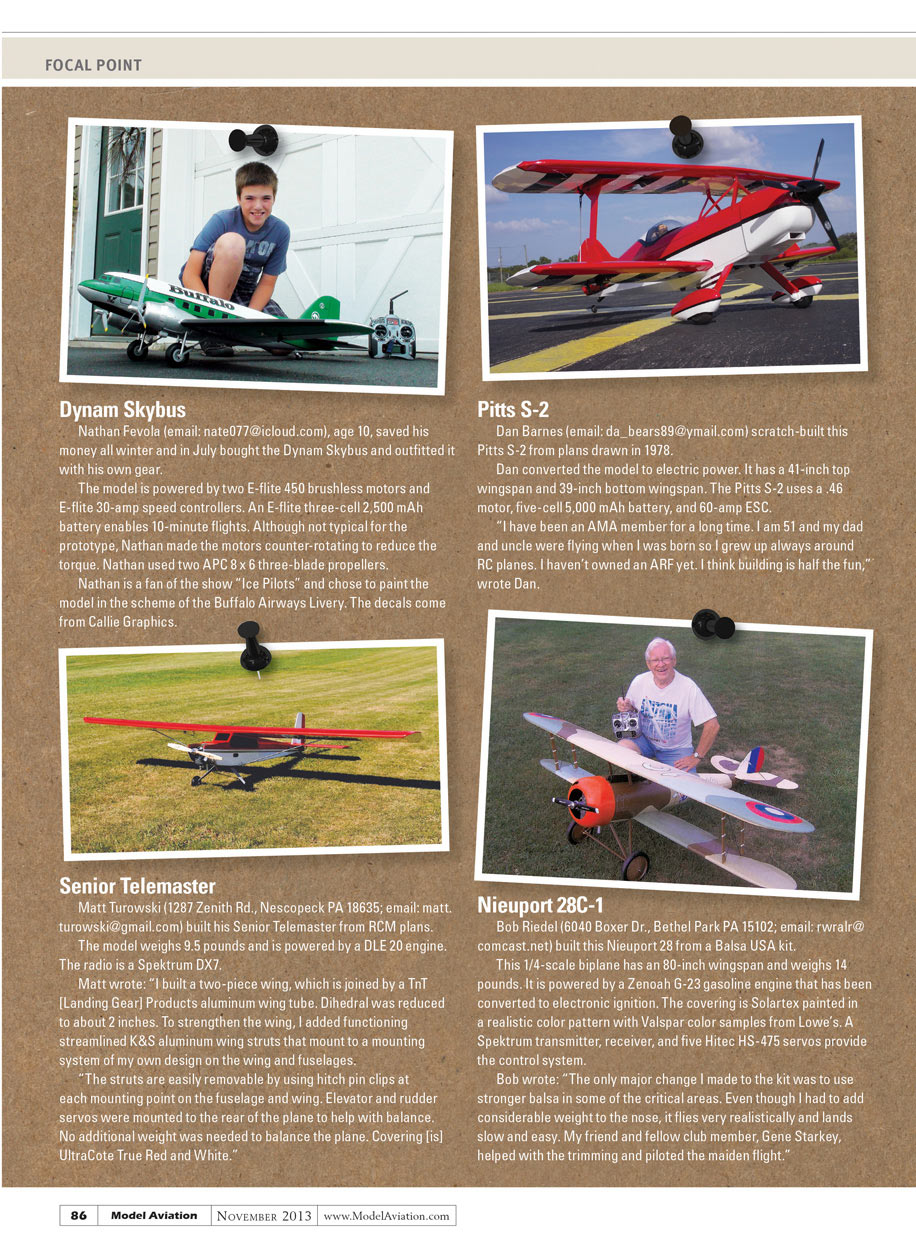
Dynam Skybus
Nathan Fevola (email: [email protected]), age 10, saved his money all winter and in July bought the Dynam Skybus and outfitted it with his own gear.
The model is powered by two E-flite 450 brushless motors and E-flite 30-amp speed controllers. An E-flite three-cell 2,500 mAh battery enables 10-minute flights. Although not typical for the prototype, Nathan made the motors counter-rotating to reduce the torque. Nathan used two APC 8 x 6 three-blade propellers.
Nathan is a fan of the show “Ice Pilots” and chose to paint the model in the scheme of the Buffalo Airways Livery. The decals come from Callie Graphics.
Pitts S-2
Dan Barnes (email: [email protected]) scratch-built this Pitts S-2 from plans drawn in 1978.
Dan converted the model to electric power. It has a 41-inch top wingspan and 39-inch bottom wingspan. The Pitts S-2 uses a .46 motor, five-cell 5,000 mAh battery, and 60-amp ESC.
“I have been an AMA member for a long time. I am 51 and my dad and uncle were flying when I was born so I grew up always around RC planes. I haven’t owned an ARF yet. I think building is half the fun,” wrote Dan.
Senior Telemaster
Matt Turowski (1287 Zenith Rd., Nescopeck PA 18635; email: [email protected]) built his Senior Telemaster from RCM plans.
The model weighs 9.5 pounds and is powered by a DLE 20 engine. The radio is a Spektrum DX7.
Matt wrote: “I built a two-piece wing, which is joined by a TnT [Landing Gear] Products aluminum wing tube. Dihedral was reduced to about 2 inches. To strengthen the wing, I added functioning streamlined K&S aluminum wing struts that mount to a mounting system of my own design on the wing and fuselages.
“The struts are easily removable by using hitch pin clips at each mounting point on the fuselage and wing. Elevator and rudder servos were mounted to the rear of the plane to help with balance. No additional weight was needed to balance the plane. Covering [is] UltraCote True Red and White.”
Nieuport 28C-1
Bob Riedel (6040 Boxer Dr., Bethel Park PA 15102; email: [email protected]) built this Nieuport 28 from a Balsa USA kit.
This 1/4-scale biplane has an 80-inch wingspan and weighs 14 pounds. It is powered by a Zenoah G-23 gasoline engine that has been converted to electronic ignition. The covering is Solartex painted in a realistic color pattern with Valspar color samples from Lowe’s. A Spektrum transmitter, receiver, and five Hitec HS-475 servos provide the control system.
Bob wrote: “The only major change I made to the kit was to use stronger balsa in some of the critical areas. Even though I had to add considerable weight to the nose, it flies very realistically and lands slow and easy. My friend and fellow club member, Gene Starkey, helped with the trimming and piloted the maiden flight.”
Focal Point
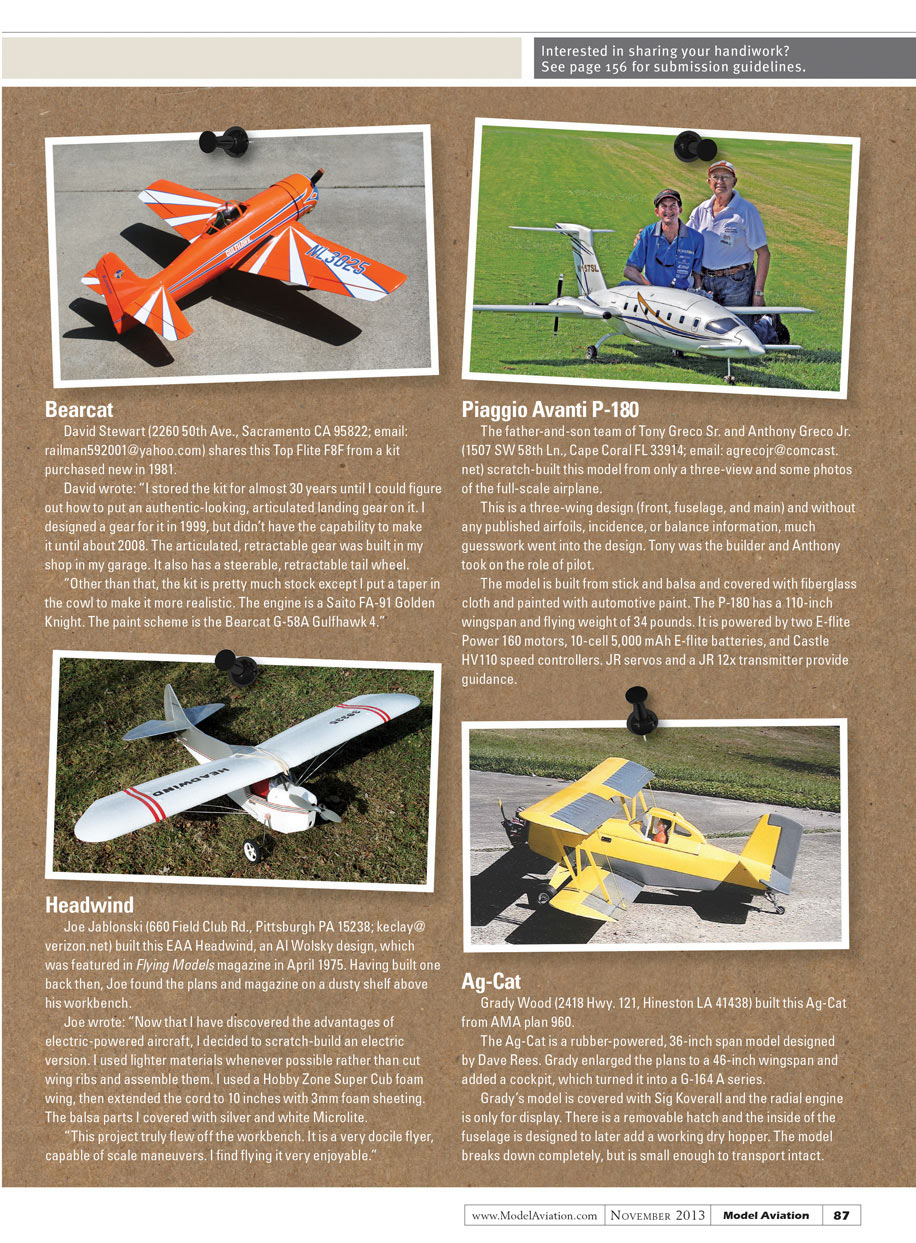
Bearcat
David Stewart (2260 50th Ave., Sacramento CA 95822; email: [email protected]) shares this Top Flite F8F from a kit purchased new in 1981.
David wrote: “I stored the kit for almost 30 years until I could figure out how to put an authentic-looking, articulated landing gear on it. I designed a gear for it in 1999, but didn’t have the capability to make it until about 2008. The articulated, retractable gear was built in my shop in my garage. It also has a steerable, retractable tail wheel.
“Other than that, the kit is pretty much stock except I put a taper in the cowl to make it more realistic. The engine is a Saito FA-91 Golden Knight. The paint scheme is the Bearcat G-58A Gulfhawk 4.”
Piaggio Avanti P-180
The father-and-son team of Tony Greco Sr. and Anthony Greco Jr. (1507 SW 58th Ln., Cape Coral FL 33914; email: [email protected]) scratch-built this model from only a three-view and some photos of the full-scale airplane.
This is a three-wing design (front, fuselage, and main) and without any published airfoils, incidence, or balance information, much guesswork went into the design. Tony was the builder and Anthony took on the role of pilot.
The model is built from stick and balsa and covered with fiberglass cloth and painted with automotive paint. The P-180 has a 110-inch wingspan and flying weight of 34 pounds. It is powered by two E-flite Power 160 motors, 10-cell 5,000 mAh E-flite batteries, and Castle HV110 speed controllers. JR servos and a JR 12x transmitter provide guidance.
Headwind
Joe Jablonski (660 Field Club Rd., Pittsburgh PA 15238; [email protected]) built this EAA Headwind, an Al Wolski design, which was featured in Flying Models magazine in April 1975. Having built one back then, Joe found the plans and magazine on a dusty shelf above his workbench.
Joe wrote: “Now that I have discovered the advantages of electric-powered aircraft, I decided to scratch-build an electric version. I used lighter materials wherever possible rather than cutting ribs and assembling them. I used a Hobby Zone Super Cub foam wing, then extended the cord to 10 inches with 3mm foam sheeting. The balsa parts I covered with silver and white Microlite.
“This project truly flew off the workbench. It is a very docile flyer, capable of scale maneuvers. I find flying it very enjoyable.”
Ag-Cat
Grady Wood (2418 Hwy. 121, Hineston LA 71438) built this Ag-Cat from AMA plan 960.
The Ag-Cat is a rubber-powered, 36-inch span model designed by Dave Rees. Grady enlarged the plans to a 46-inch wingspan and added a cockpit, which turned it into a G-164 A series.
Grady’s model is covered with Sig Koverall and the radial engine is only for display. There is a removable hatch and the inside of the fuselage is designed to later add a working dry hopper. The model breaks down completely, but is small enough to transport intact.
Transcribed from original scans by AI. Minor OCR errors may remain.

