
Focal Point
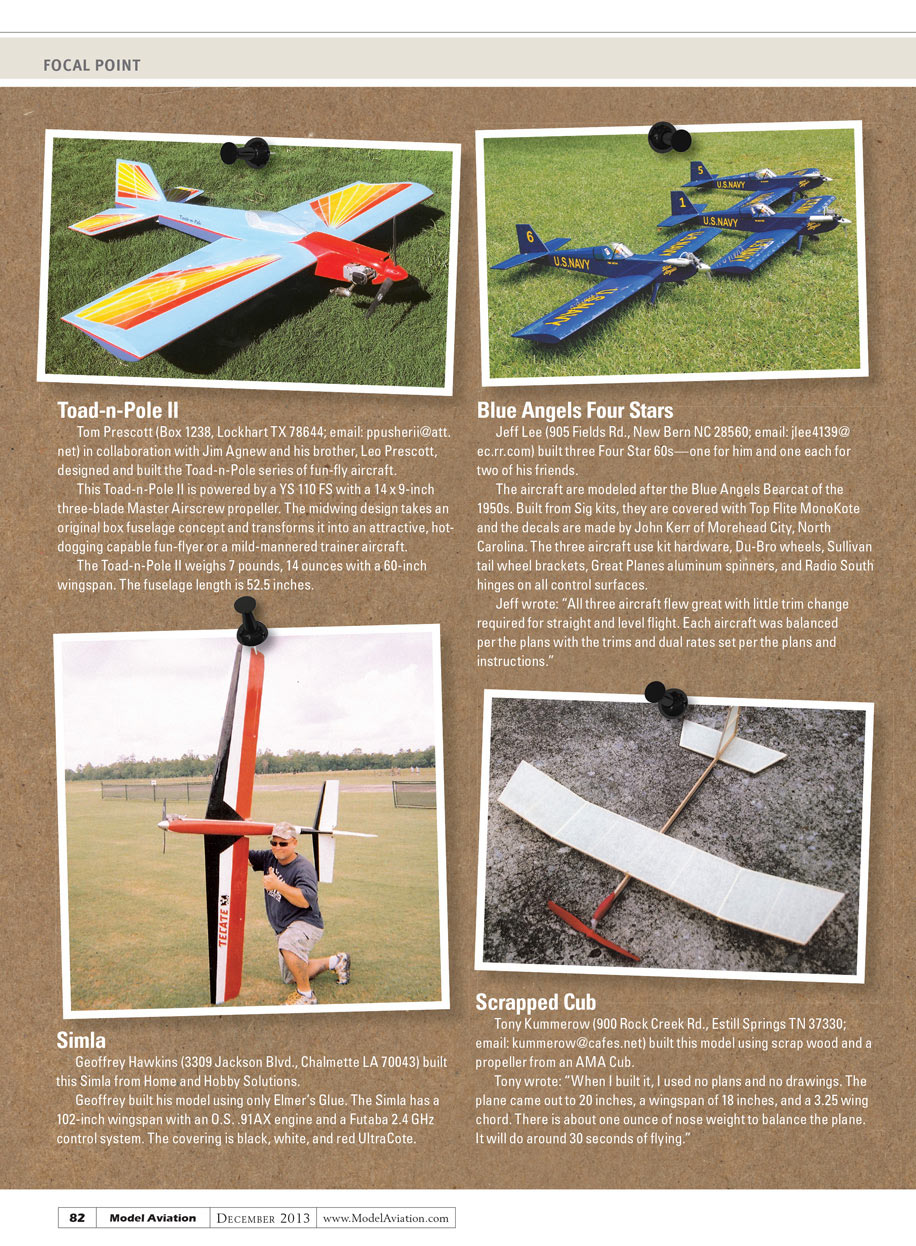
Toad-n-Pole II
Tom Prescott (Box 1238, Lockhart TX 78644; email: [email protected]) in collaboration with Jim Agnew and his brother, Leo Prescott, designed and built the Toad-n-Pole series of fun-fly aircraft.
This Toad-n-Pole II is powered by a YS 110 FS with a 14 x 9-inch three-blade Master Airscrew propeller. The midwing design takes an original box fuselage concept and transforms it into an attractive, hot-dogging capable fun-flyer or a mild-mannered trainer aircraft.
The Toad-n-Pole II weighs 7 pounds, 14 ounces with a 60-inch wingspan. The fuselage length is 52.5 inches.
Blue Angels Four Stars
Jeff Lee (905 Fields Rd., New Bern NC 28560; email: [email protected]) built three Four Star 60s — one for him and one each for two of his friends.
The aircraft are modeled after the Blue Angels Bearcat of the 1950s. Built from Sig kits, they are covered with Top Flite MonoKote and the decals are made by John Kerr of Morehead City, North Carolina. The three aircraft use kit hardware, Du-Bro wheels, Sullivan tail wheel brackets, Great Planes aluminum spinners, and Radio South hinges on all control surfaces.
Jeff wrote: “All three aircraft flew great with little trim change required for straight and level flight. Each aircraft was balanced per the plans with the trims and dual rates set per the plans and instructions.”
Simla
Geoffrey Hawkins (3309 Jackson Blvd., Chalmette LA 70043) built this Simla from Home and Hobby Solutions.
Geoffrey built his model using only Elmer’s Glue. The Simla has a 102-inch wingspan with an O.S. .91AX engine and a Futaba 2.4 GHz control system. The covering is black, white, and red UltraCote.
Scrapped Cub
Tony Kummerow (900 Rock Creek Rd., Estill Springs TN 37330; email: [email protected]) built this model using scrap wood and a propeller from an AMA Cub.
Tony wrote: “When I built it, I used no plans and no drawings. The plane came out to 20 inches, a wingspan of 18 inches, and a 3.25 wing chord. There is about one ounce of nose weight to balance the plane. It will do around 30 seconds of flying.”
Focal Point
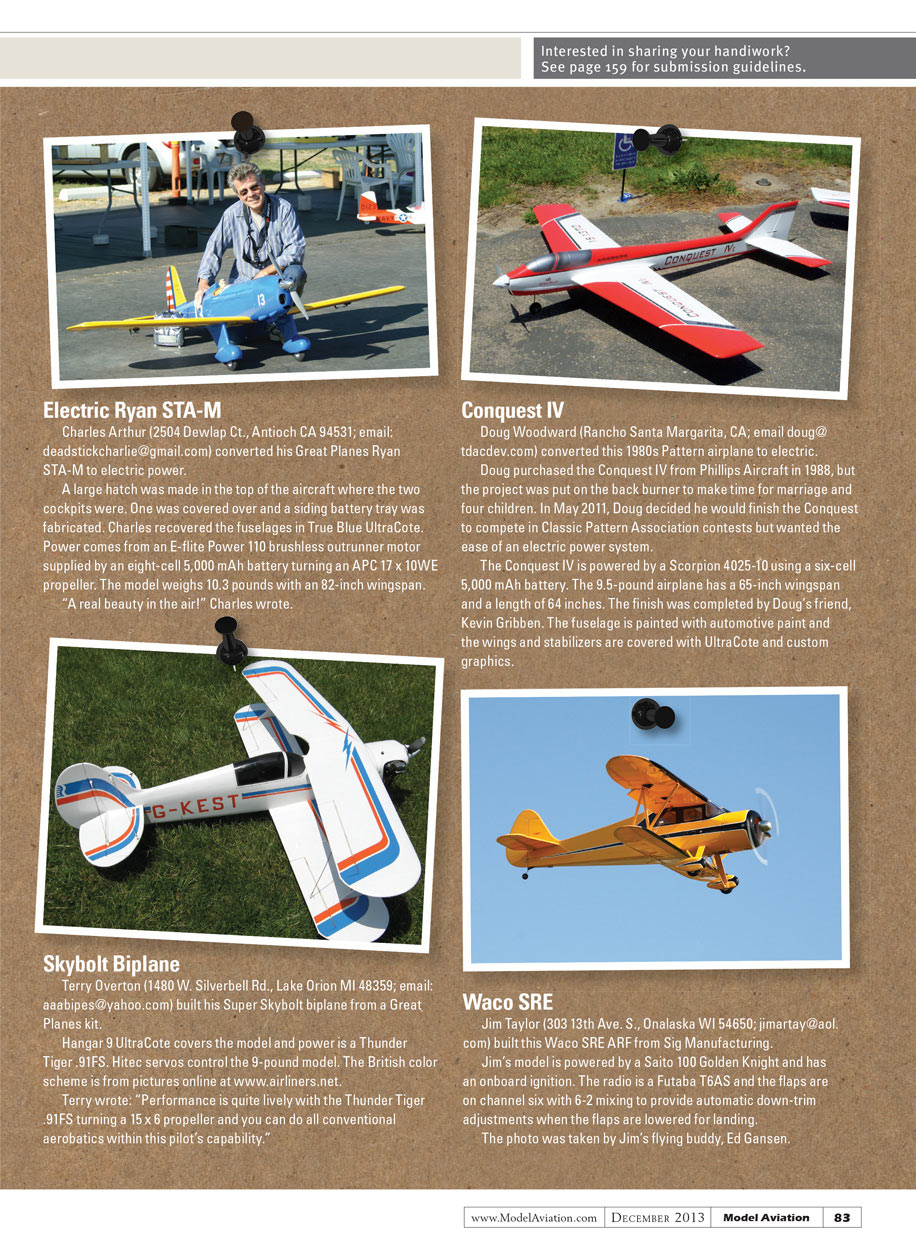
Electric Ryan STA-M
Charles Arthur (2504 Dewlap Ct., Antioch CA 94531; email: [email protected]) converted his Great Planes Ryan STA-M to electric power.
A large hatch was made in the top of the aircraft where the two cockpits were. One was covered over and a sliding battery tray was fabricated. Charles recovered the fuselages in True Blue UltraCote. Power comes from an E-flite Power 110 brushless outrunner motor supplied by an eight-cell 5,000 mAh battery turning an APC 17 x 10WE propeller. The model weighs 10.3 pounds with an 82-inch wingspan.
“A real beauty in the air!” Charles wrote.
Conquest IV
Doug Woodward (Rancho Santa Margarita, CA; email: [email protected]) converted this 1980s Pattern airplane to electric.
Doug purchased the Conquest IV from Phillips Aircraft in 1988, but the project was put on the back burner to make time for marriage and four children. In May 2011, Doug decided he would finish the Conquest to compete in Classic Pattern Association contests but wanted the ease of an electric power system.
The Conquest IV is powered by a Scorpion 4025-10 using a six-cell 5,000 mAh battery. The 9.5-pound airplane has a 65-inch wingspan and a length of 64 inches. The finish was completed by Doug’s friend, Kevin Gribben. The fuselage is painted with automotive paint and the wings and stabilizers are covered with UltraCote and custom graphics.
Skybolt Biplane
Terry Overton (1480 W. Silverbell Rd., Lake Orion MI 48359; email: [email protected]) built his Super Skybolt biplane from a Great Planes kit.
Hangar 9 UltraCote covers the model and power is a Thunder Tiger .91FS. Hitec servos control the 9-pound model. The British color scheme is from pictures online at www.airliners.net.
Terry wrote: “Performance is quite lively with the Thunder Tiger .91FS turning a 15 x 6 propeller and you can do all conventional aerobatics within this pilot’s capability.”
Waco SRE
Jim Taylor (303 13th Ave. S., Onalaska WI 54650; [email protected]) built this Waco SRE ARF from Sig Manufacturing.
Jim’s model is powered by a Saito 100 Golden Knight and has an onboard ignition. The radio is a Futaba T6AS and the flaps are on channel six with 6-2 mixing to provide automatic down-trim adjustments when the flaps are lowered for landing.
The photo was taken by Jim’s flying buddy, Ed Gansen.
Transcribed from original scans by AI. Minor OCR errors may remain.

