
Focus on Competition - 2004/04
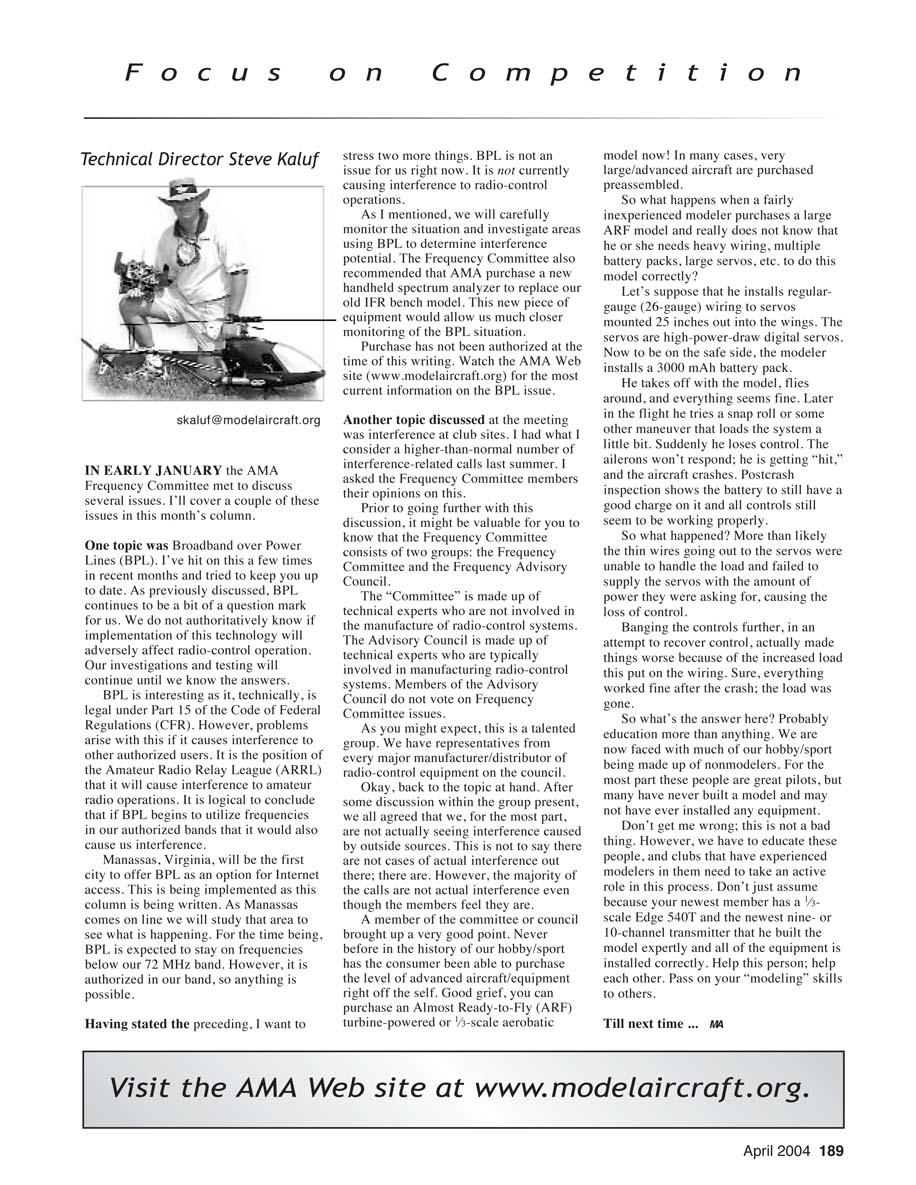
Technical Director
Steve Kaluf [email protected]
In early January the AMA Frequency Committee met to discuss several issues. I’ll cover a couple of these in this month’s column.
Broadband over Power Lines (BPL)
One topic was Broadband over Power Lines (BPL). I’ve mentioned this several times in recent months and have tried to keep you up to date. As previously discussed, BPL continues to be a bit of a question mark for us. We do not yet know authoritatively if implementation of this technology will adversely affect radio-control operation. Our investigations and testing will continue until we know the answers.
Key points about BPL:
- Technically, BPL is legal under Part 15 of the Code of Federal Regulations (CFR).
- Problems arise if BPL causes interference to other authorized users. The Amateur Radio Relay League (ARRL) believes it will cause interference to amateur radio operations.
- If BPL begins to utilize frequencies in our authorized bands, it is logical to conclude that it could also cause interference to radio-control systems.
- Manassas, Virginia, will be the first city to offer BPL as an Internet-access option; this was being implemented as this column was written. As Manassas comes on line we will study that area to see what is happening.
- For the time being, BPL is expected to stay on frequencies below our 72 MHz band. However, it is authorized in our band, so anything is possible.
Two additional points:
- BPL is not an issue for us right now. It is not currently causing interference to radio-control operations.
- We will carefully monitor the situation and investigate areas using BPL to determine interference potential.
The Frequency Committee also recommended that AMA purchase a new handheld spectrum analyzer to replace our old IFR bench model. This new equipment would allow much closer monitoring of the BPL situation. Purchase had not been authorized at the time of this writing. Watch the AMA website (www.modelaircraft.org) for the most current information on the BPL issue.
Interference at Club Sites
Another topic discussed at the meeting was interference at club sites. I received what I consider a higher-than-normal number of interference-related calls last summer, so I asked Frequency Committee members for their opinions.
Prior to going further, it may be valuable to understand the Frequency Committee structure:
- The Frequency Committee is made up of technical experts who are not involved in the manufacture of radio-control systems.
- The Frequency Advisory Council is made up of technical experts who are typically involved in manufacturing radio-control systems.
- Members of the Advisory Council do not vote on Frequency Committee issues.
- The group includes representatives from every major manufacturer/distributor of radio-control equipment.
After discussion, we agreed that, for the most part, we are not actually seeing interference caused by outside sources. This is not to say there are no actual interference cases; there are. However, the majority of the calls were not due to external interference even though the callers felt they were.
A committee member made a very good point: never before in the history of our hobby/sport has the consumer been able to purchase such advanced aircraft and equipment right off the shelf. You can now buy Almost Ready-to-Fly (ARF) turbine-powered or 1/3-scale aerobatic models, often preassembled. Many buyers are relatively inexperienced and may not know that certain installations require heavy wiring, multiple battery packs, larger servos, etc.
Example scenario: wiring and power issues
Consider this scenario:
- An inexperienced modeler purchases a large ARF model.
- They install regular-gauge (26-gauge) wiring to servos mounted 25 inches out in the wings.
- The servos are high-power-draw digital servos.
- To be on the safe side the modeler installs a 3000 mAh battery pack.
During flight everything seems fine initially. Later, when the pilot attempts a snap roll or another high-load maneuver, control suddenly is lost: the ailerons won’t respond, and the aircraft crashes. Post-crash inspection shows the battery still has a good charge and controls appear to work normally.
What likely happened: the thin wires to the servos were unable to handle the load and could not supply the current the servos required, causing loss of control. Further inputs by the pilot increased the load and worsened the situation. After the crash the load was gone, so everything appeared functional.
Recommendations — education and club involvement
The likely solution is education more than anything else. Much of our hobby/sport is now made up of newcomers who have not built models or done equipment installations. This is not a bad thing, but clubs and experienced modelers need to take an active role in helping them.
Practical recommendations:
- Don’t assume a new member’s large ARF model is properly built or that the equipment is installed correctly.
- Check wiring gauge and routing; use adequate wire for long runs and high-current servos.
- Ensure appropriate battery configuration (capacity and number of packs) for the power demands.
- Verify servos and mounts are suitable for the control surfaces and loads expected.
- Encourage experienced club members to mentor newcomers and pass on modeling skills.
Help each other. Pass on your modeling skills to others.
Till next time ... MA
Transcribed from original scans by AI. Minor OCR errors may remain.

