
Focus on Competition - 2004/05
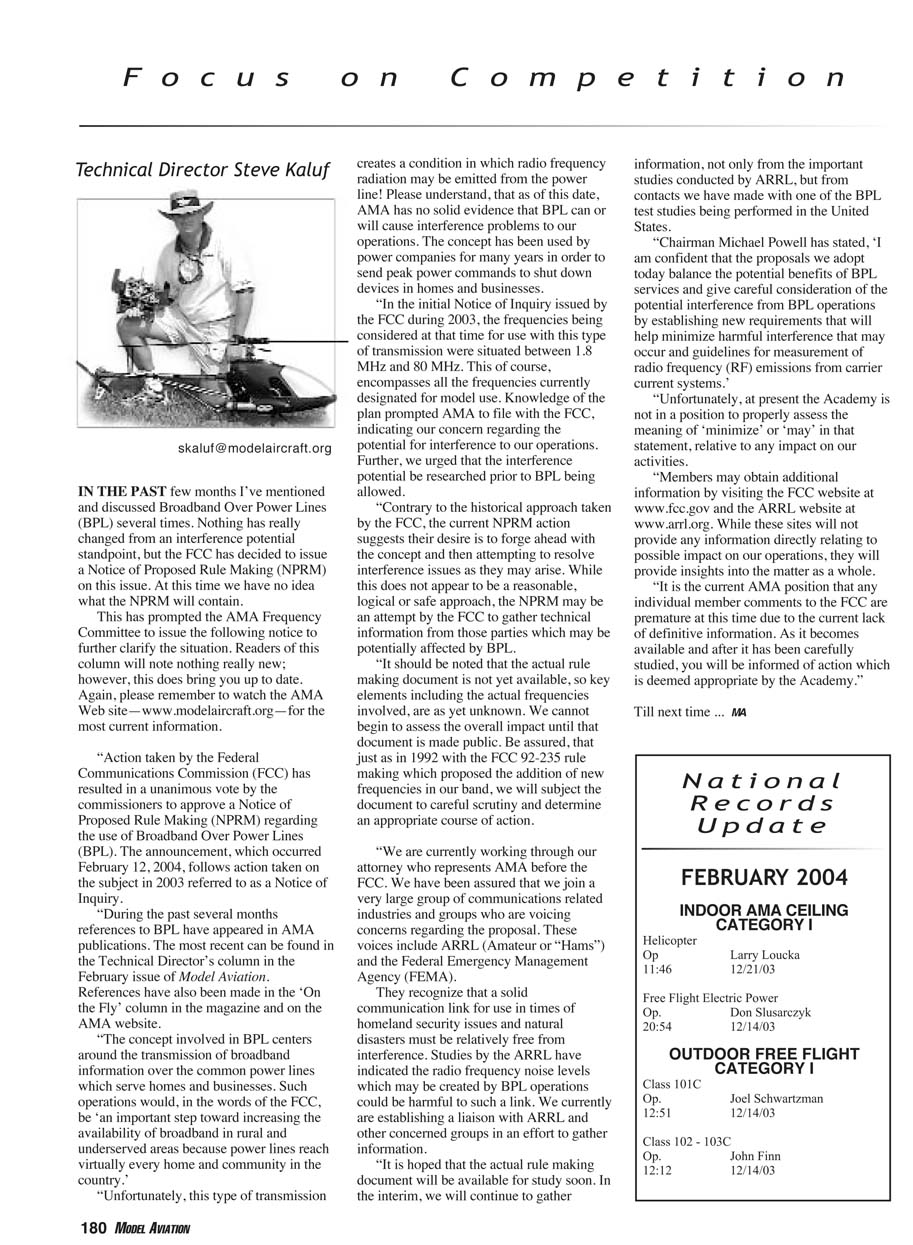
Technical Director Steve Kaluf [email protected]
In the past few months I’ve mentioned and discussed Broadband Over Power Lines (BPL) several times. Nothing has really changed from an interference-potential standpoint, but the FCC has decided to issue a Notice of Proposed Rule Making (NPRM) on this issue. At this time we have no idea what the NPRM will contain. This has prompted the AMA Frequency Committee to issue the following notice to further clarify the situation. Readers of this column will note nothing really new; however, this does bring you up to date. Again, please remember to watch the AMA website — www.modelaircraft.org — for the most current information.
Action taken by the Federal Communications Commission (FCC) has resulted in a unanimous vote by the commissioners to approve a Notice of Proposed Rule Making (NPRM) regarding the use of Broadband Over Power Lines (BPL). The announcement, which occurred February 12, 2004, follows action taken on the subject in 2003 referred to as a Notice of Inquiry.
During the past several months references to BPL have appeared in AMA publications. The most recent can be found in the Technical Director’s column in the February issue of Model Aviation. References have also been made in the “On the Fly” column in the magazine and on the AMA website.
The concept involved in BPL centers around the transmission of broadband information over the common power lines which serve homes and businesses. Such operations would, in the words of the FCC, be “an important step toward increasing the availability of broadband in rural and underserved areas because power lines reach virtually every home and community in the country.”
Unfortunately, this type of transmission creates a condition in which radio-frequency radiation may be emitted from the power line. Please understand that, as of this date, AMA has no solid evidence that BPL can or will cause interference problems to our operations. The concept has been used by power companies for many years in order to send peak-power commands to shut down devices in homes and businesses.
In the initial Notice of Inquiry issued by the FCC during 2003, the frequencies being considered at that time for use with this type of transmission were situated between 1.8 MHz and 80 MHz. This, of course, encompasses all the frequencies currently designated for model use. Knowledge of the plan prompted AMA to file with the FCC, indicating our concern regarding the potential for interference to our operations. Further, we urged that the interference potential be researched prior to BPL being allowed.
Contrary to the historical approach taken by the FCC, the current NPRM action suggests their desire is to forge ahead with the concept and then attempt to resolve interference issues as they may arise. While this does not appear to be a reasonable, logical or safe approach, the NPRM may be an attempt by the FCC to gather technical information from those parties which may be potentially affected by BPL.
It should be noted that the actual rule-making document is not yet available, so key elements — including the actual frequencies involved — are as yet unknown. We cannot begin to assess the overall impact until that document is made public. Be assured that, just as in 1992 with the FCC 92-235 rule making which proposed the addition of new frequencies in our band, we will subject the document to careful scrutiny and determine an appropriate course of action.
We are currently working through our attorney who represents AMA before the FCC. We have been assured that we join a very large group of communications-related industries and groups who are voicing concerns regarding the proposal. These voices include ARRL (Amateur Radio “Hams”) and the Federal Emergency Management Agency (FEMA). They recognize that a solid communication link for use in times of homeland security issues and natural disasters must be relatively free from interference. Studies by the ARRL have indicated the radio-frequency noise levels which may be created by BPL operations could be harmful to such a link. We currently are establishing a liaison with ARRL and other concerned groups in an effort to gather information, not only from the important studies conducted by ARRL, but from contacts we have made with one of the BPL test studies being performed in the United States.
Chairman Michael Powell has stated, “I am confident that the proposals we adopt today balance the potential benefits of BPL services and give careful consideration of the potential interference from BPL operations by establishing new requirements that will help minimize harmful interference that may occur and guidelines for measurement of radio frequency (RF) emissions from carrier current systems.”
Unfortunately, at present the Academy is not in a position to properly assess the meaning of “minimize” or “may” in that statement relative to any impact on our activities.
Members may obtain additional information by visiting the FCC website at www.fcc.gov and the ARRL website at www.arrl.org. While these sites will not provide any information directly relating to possible impact on our operations, they will provide insight into the matter as a whole.
It is the current AMA position that any individual member comments to the FCC are premature at this time due to the current lack of definitive information. As it becomes available and after it has been carefully studied, you will be informed of action which is deemed appropriate by the Academy.
Till next time... MA
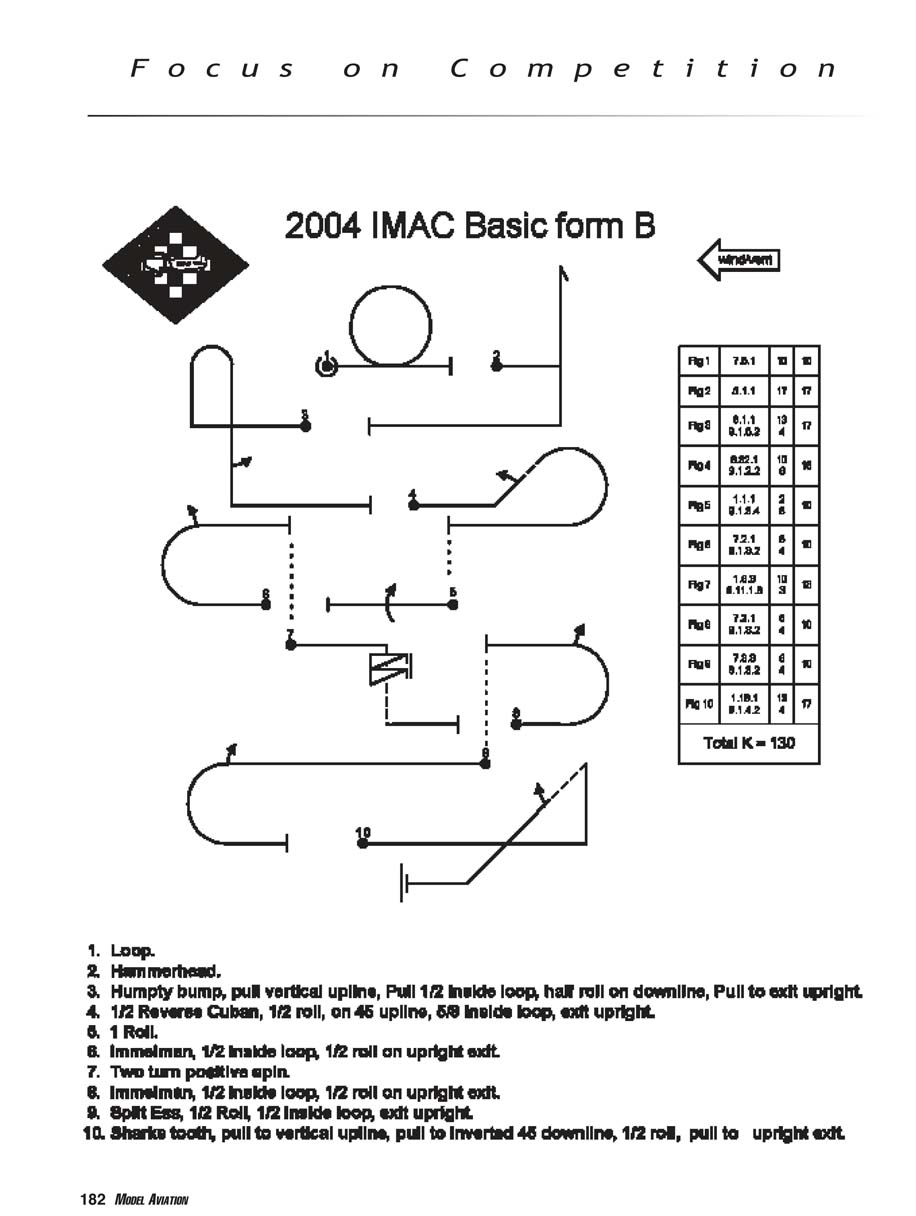
2004 IMAC Basic — Form B
- Loop.
- Hammerhead.
- Humpty bump, pull vertical upline, pull 1/2 inside loop, half roll on downline, pull to exit upright.
- 1/2 Reverse Cuban, 1/2 roll on 45 upline, 5/8 inside loop, exit upright.
- 1 Roll.
- Immelmann, 1/2 inside loop, 1/2 roll on upright exit.
- Two-turn positive spin.
- Split S, 1/2 roll, 1/2 inside loop, exit upright.
- Shark’s tooth, pull to vertical upline, pull to inverted 45 downline, 1/2 roll, pull to upright exit.
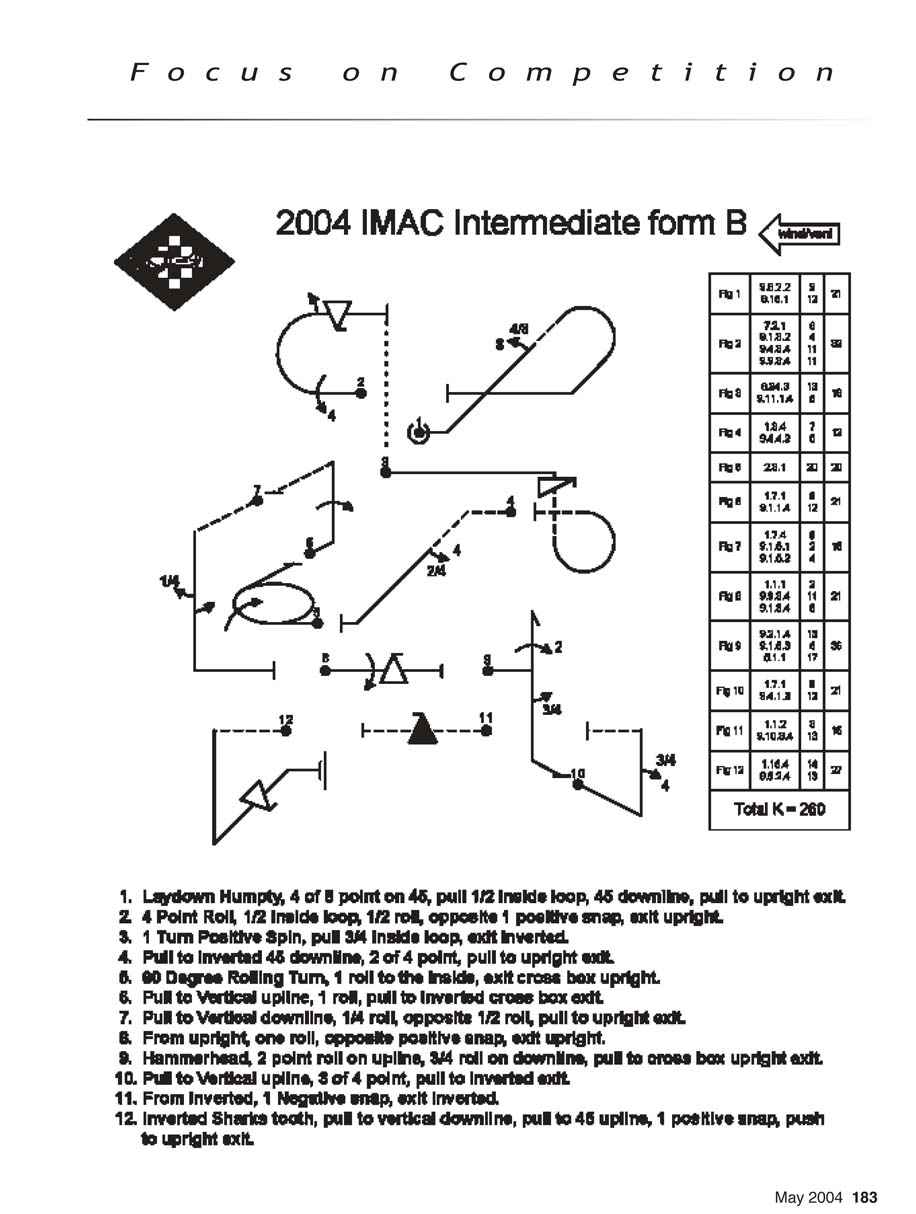
2004 IMAC Intermediate — Form B
- Laydown Humpty, 4 of 8 point on 45, pull 1/2 inside loop, 45 downline, pull to upright exit.
- 4-point roll, 1/2 inside loop, 1/2 roll, opposite 1 positive snap, exit upright.
- 1-turn positive spin, pull 3/4 inside loop, exit inverted.
- Pull to inverted 45 downline, 2 of 4 point, pull to upright exit.
- 90-degree rolling turn, 1 roll to the inside, exit cross-box upright.
- Pull to vertical upline, 1 roll, pull to inverted cross-box exit.
- Pull to vertical downline, 1/4 roll, opposite 1/2 roll, pull to upright exit.
- From upright, one roll, opposite positive snap, exit upright.
- Hammerhead, 2-point roll on upline, 3/4 roll on downline, pull to cross-box upright exit.
- Pull to vertical upline, 3 of 4 point, pull to inverted exit.
- From inverted, 1 negative snap, exit inverted.
- Inverted shark’s tooth, pull to vertical downline, pull to 45 upline, 1 positive snap, push to upright exit.
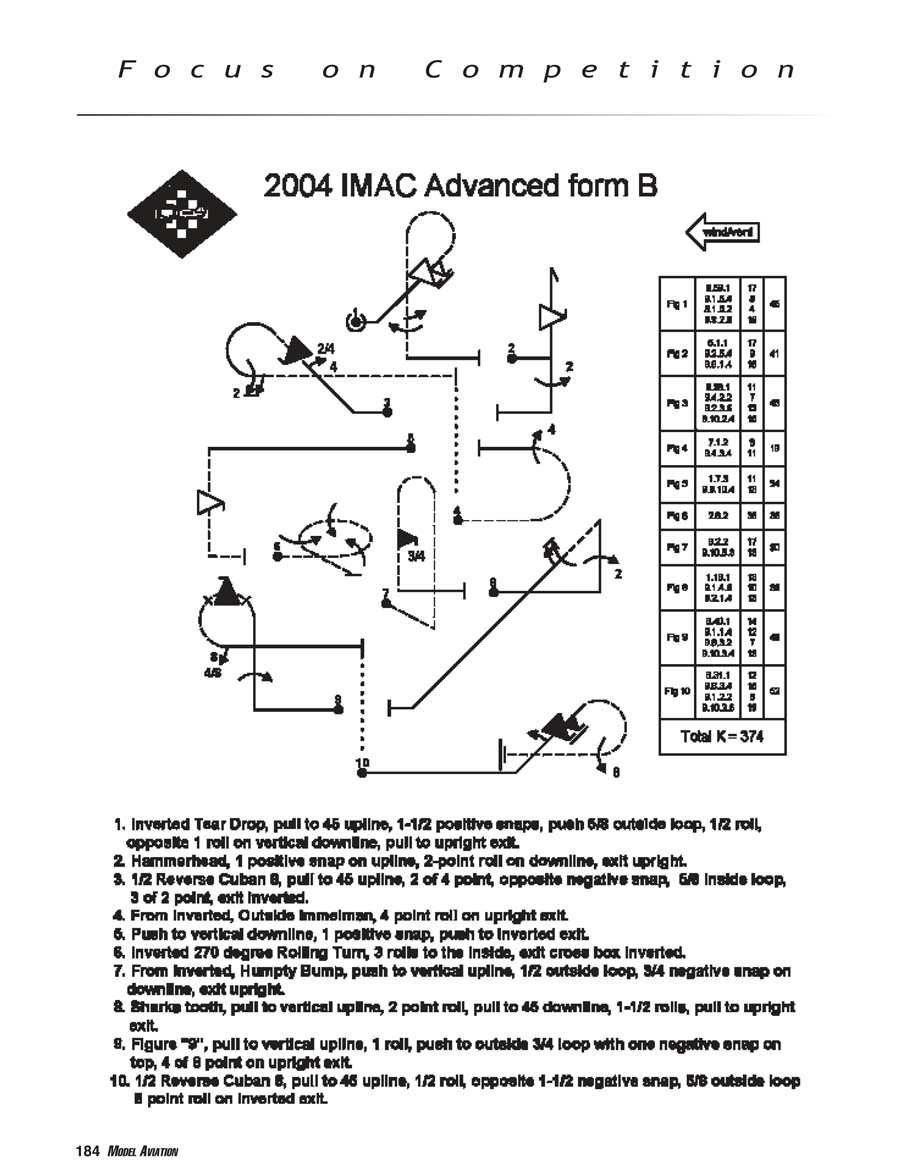
2004 IMAC Advanced — Form B
- Inverted teardrop, pull to 45 upline, 1-1/2 positive snaps, push 5/8 outside loop, 1/2 roll, opposite 1 roll on vertical downline, pull to upright exit.
- Hammerhead, 1 positive snap on upline, 2-point roll on downline, exit upright.
- 1/2 Reverse Cuban 8, pull to 45 upline, 2 of 4 point, opposite negative snap, 2 of 4 point, exit inverted.
- From inverted, outside Immelmann, 4-point roll on upright exit.
- Push to vertical downline, 1 positive snap, push to inverted exit.
- Inverted 270-degree rolling turn, 3 rolls to the inside, exit cross-box inverted.
- From inverted, Humpty bump, push to vertical upline, 1/2 outside loop, 3/4 negative snap on downline, exit upright.
- Shark’s tooth, pull to vertical upline, 2-point roll, pull to 45 downline, 1-1/2 roll, pull to upright exit.
- Figure “9”, pull to vertical upline, 1 roll, push to outside 3/4 loop with one negative snap on top, 4 of 8 point on upright exit.
- 1/2 Reverse Cuban 8, pull to 45 upline, 1/2 roll, opposite 1-1/2 negative snap, 5/8 outside loop, 1-point roll on inverted exit.
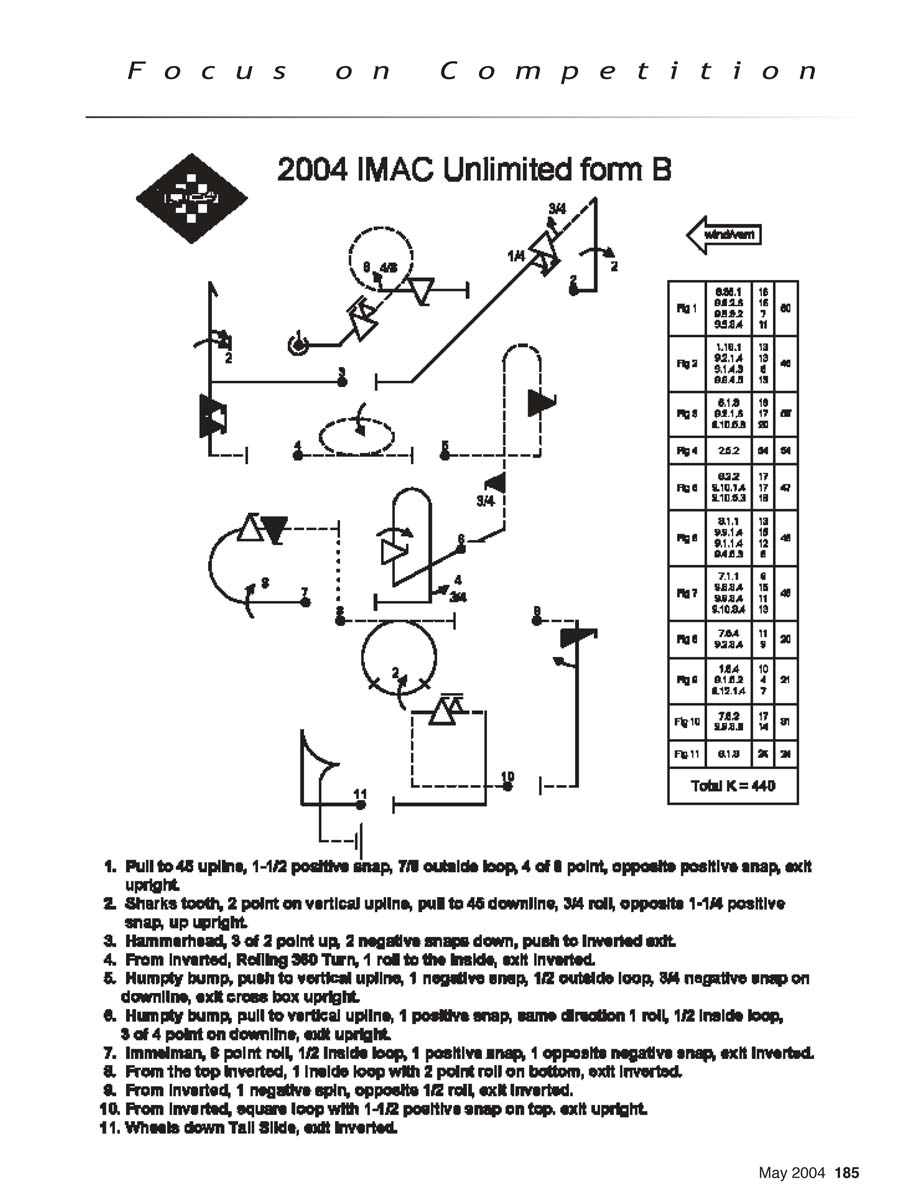
2004 IMAC Unlimited — Form B
- Pull to 45 upline, 1-1/2 positive snaps, 7/8 outside loop, 4 of 8 point, opposite positive snap, exit upright.
- Shark’s tooth, 2-point on vertical upline, pull to 45 downline, 3/4 roll, opposite 1-1/4 positive snap, exit upright.
- Hammerhead, 3 of 4 point up, 2 negative snaps down, push to inverted exit.
- From inverted, rolling 360 turn, 1 roll to the inside, exit inverted.
- Humpty bump, push to vertical upline, 1 negative snap, 1/2 outside loop, 3/4 negative snap on downline, exit cross-box upright.
- Humpty bump, pull to vertical upline, 1 positive snap, same direction 1 roll, 1/2 inside loop, 3 of 4 point on downline, exit upright.
- Immelmann, 8-point roll, 1/2 inside loop, 1 positive snap, 1 opposite negative snap, exit inverted.
- From the top inverted, 1 inside loop with 2-point roll on bottom, exit inverted.
- From inverted, 1 negative spin, opposite 1/2 roll, exit inverted.
- From inverted, square loop with 1-1/2 positive snap on top, exit upright.
- Wheels-down tall slide, exit inverted.
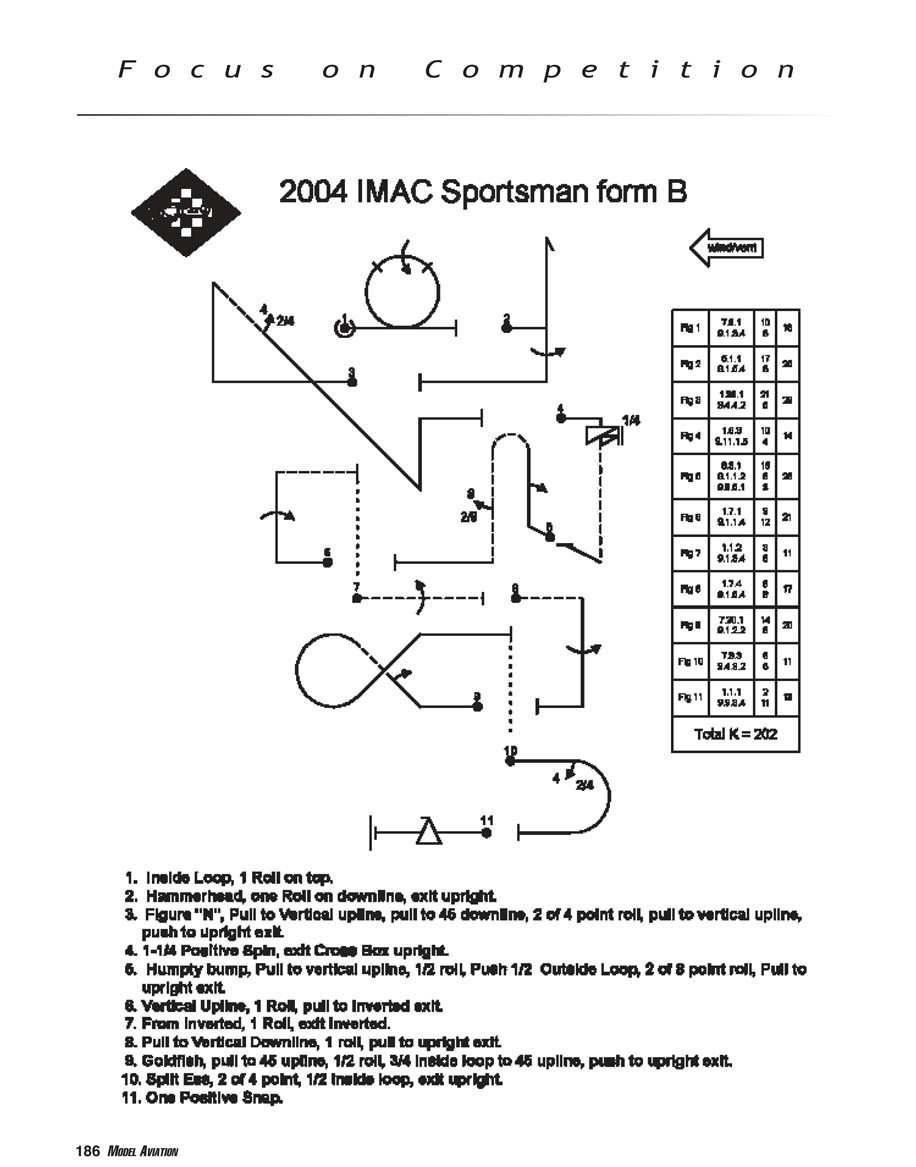
2004 IMAC Sportsman — Form B
- Inside loop, 1 roll on top.
- Hammerhead, one roll on downline, exit upright.
- Figure “N”, pull to vertical upline, pull to 45 downline, 2 of 4 point roll, pull to vertical upline, push to upright exit.
- 1-1/4 positive spin, exit cross-box upright.
- Humpty bump, pull to vertical upline, 1/2 roll, push 1/2 outside loop, 2 of 8 point roll, pull to upright exit.
- Vertical upline, 1 roll, pull to inverted exit.
- From inverted, 1 roll, exit inverted.
- Pull to vertical downline, 1 roll, pull to upright exit.
- Goldfish, pull to 45 upline, 1/2 roll, 3/4 inside loop to 45 upline, push to upright exit.
- Split S, 2 of 4 point, 1/2 inside loop, exit upright.
- One positive snap.
Transcribed from original scans by AI. Minor OCR errors may remain.

