
Focus on Competition
Technical Director
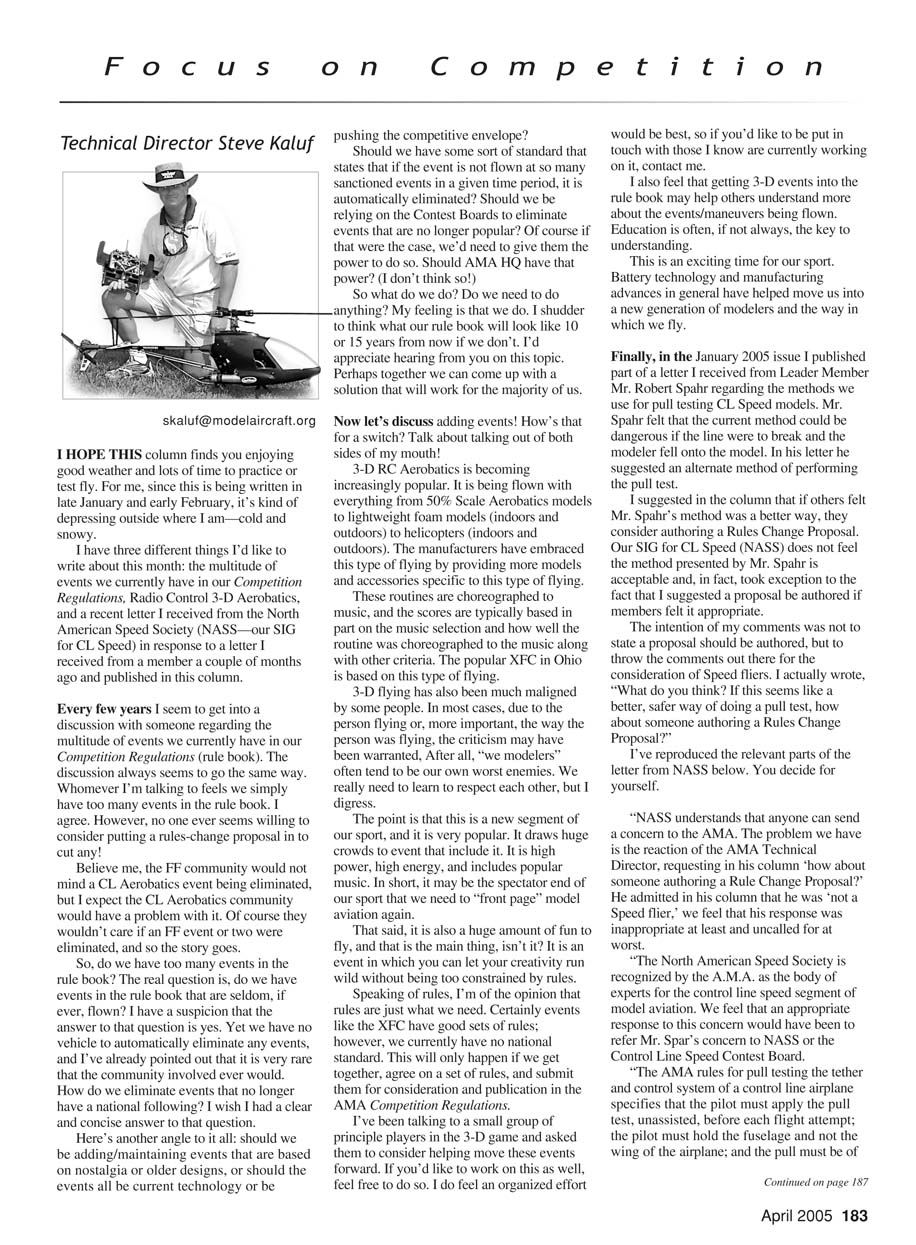
Steve Kaluf [email protected]
I hope this column finds you enjoying good weather and lots of time to practice or test fly. For me, since this is being written in late January and early February, it's kind of depressing outside where I am—cold and snowy.
I have three different things I'd like to write about this month:
- The multitude of events we currently have in our Competition Regulations (rule book).
- Radio Control 3‑D Aerobatics.
- A recent letter I received from the North American Speed Society (NASS—our SIG for CL Speed) in response to a letter I received from a member a couple of months ago and published in this column.
Too Many Events in the Rule Book?
Every few years I seem to get into a discussion with someone regarding the multitude of events we currently have in our Competition Regulations. The discussion always seems to go the same way. Whomever I'm talking to feels we simply have too many events in the rule book. I agree. However, no one ever seems willing to consider putting a rules‑change proposal in to cut any!
Believe me, the FF community would not mind a CL Aerobatics event being eliminated, but I expect the CL Aerobatics community would have a problem with it. Of course they wouldn't care if an FF event or two were eliminated, and so the story goes.
So, do we have too many events in the rule book? The real question is, do we have events in the rule book that are seldom, if ever, flown? I have a suspicion that the answer to that question is yes. Yet we have no vehicle to automatically eliminate any events, and I've already pointed out that it is very rare that the community involved ever would. How do we eliminate events that no longer have a national following? I wish I had a clear and concise answer to that question.
Here's another angle to it all: should we be adding/maintaining events that are based on nostalgia or older designs, or should the events all be current technology or be pushing the competitive envelope? Should we have some sort of standard that states that if the event is not flown at so many sanctioned events in a given time period, it is automatically eliminated? Should we be relying on the Contest Boards to eliminate events that are no longer popular? Of course if that were the case, we'd need to give them the power to do so. Should AMA HQ have that power? (I don't think so!)
So what do we do? Do we need to do anything? My feeling is that we do. I shudder to think what our rule book will look like 10 or 15 years from now if we don't. I'd appreciate hearing from you on this topic. Perhaps together we can come up with a solution that will work for the majority of us.
Adding Events: 3‑D RC Aerobatics
Now let's discuss adding events! Talk about talking out of both sides of my mouth!
3‑D RC Aerobatics is becoming increasingly popular. It is being flown with everything from 50% scale aerobatic models to lightweight foam models (indoors and outdoors) to helicopters (indoors and outdoors). The manufacturers have embraced this type of flying by providing more models and accessories specific to this style. These routines are choreographed to music, and the scores are typically based in part on the music selection and how well the routine was choreographed to the music along with other criteria. The popular XFC in Ohio is based on this type of flying.
3‑D flying has also been much maligned by some people. In most cases, due to the person flying or, more important, the way the person was flying, the criticism may have been warranted. After all, we modelers often tend to be our own worst enemies. We really need to learn to respect each other, but I digress. The point is that this is a new segment of our sport, and it is very popular. It draws huge crowds to events that include it. It is high power, high energy, and includes popular music. In short, it may be the spectator end of our sport that we need to "front‑page" model aviation again. That said, getting formal recognition and standardized rules for 3‑D events in the rule book would be best, so if you'd like to be put in touch with those I know are currently working on it, contact me.
I also feel that getting 3‑D events into the rule book may help others understand more about the events and maneuvers being flown. Education is often, if not always, the key to understanding.
This is an exciting time for our sport. Battery technology and advances in manufacturing have helped move us into a new generation of modelers and changed the way we fly.
Control Line Speed Pull‑Test Letter
Finally, in the January 2005 issue I published part of a letter I received from Leader Member Mr. Robert Spahr regarding the methods we use for pull testing CL Speed models. Mr. Spahr felt that the current method could be dangerous if the line were to break and the modeler fell onto the model. In his letter he suggested an alternate method of performing the pull test.
I suggested in the column that if others felt Mr. Spahr's method was a better way, they consider authoring a Rules Change Proposal. Our SIG for CL Speed (NASS) does not feel the method presented by Mr. Spahr is acceptable and, in fact, took exception to the fact that I suggested a proposal be authored if members felt it appropriate.
The intention of my comments was not to state a proposal should be authored, but to throw the comments out there for the consideration of Speed fliers. I actually wrote, "What do you think? If this seems like a better, safer way of doing a pull test, how about someone authoring a Rules Change Proposal?"
I've reproduced the relevant parts of the letter from NASS below. You decide for yourself.
"NASS understands that anyone can send a concern to the AMA. The problem we have is the reaction of the AMA Technical Director, requesting in his column how about someone authoring a Rule Change Proposal? He admitted in his column that he was not a Speed flier; we feel that his response was inappropriate at best and uncalled for at worst.
"The North American Speed Society is recognized by the A.M.A. as the body of experts for the control line speed segment of model aviation. We feel that an appropriate response to this concern would have been to refer Mr. Spahr's concern to NASS or the Control Line Speed Contest Board.
"The AMA rules for pull testing the tether and control system of a control line airplane specify that the pilot must apply the pull to the fuselage or appropriate attachment point, that the pull be applied by hand and unassisted, and that the pilot be clear of the propeller arc. Mr. Spahr's alternative method, which appears to involve anchoring the pilot or attaching the pull in a manner different from the current requirement, could introduce additional hazards and therefore is not an acceptable substitute. For these reasons, NASS would not support authoring a Rules Change Proposal to adopt Mr. Spahr's method.
"Because of required high pull loads, especially with the larger classes of Control Line Speed airplanes, pull test scales are not held by an official but are affixed to a solid object or post to register the amount specified under the rules. The official cannot simply relieve a hand‑held load at the specified value on the scale, but must communicate with the pilot pulling the model as to when the specified load is reached.
"It is very important that pull tests do not exceed the specified load, so the pilot must be told when to relieve the load. This is usually done with hand signals. Shouting to the pilot as much as 70 feet away is not safe as contests are usually noisy and the command may not be heard. Therefore the pilot must face the scales and the official to see the hand signals to stop the pull.
"The proper way for the pilot to perform a pull test is to face down the lines to the control handle and the pull test scale, hold the airplane steady with hands and arms, place one foot behind the other, keep the body low, and pull with the legs and lower body. If a part of the control system and tether breaks, you simply keep your balance with the span of your foot placement.
"After observing many years of pull tests at AMA sanctioned contests, and several line breaks during pull tests, we have never seen an airplane be pulled into a pilot’s chest. We have very rarely seen a pilot fall down.
"The North American Speed Society sees no need for a rules change proposal. Instead we suggest oversight of pilots to ensure the pull test is performed properly and safely. This will ensure the integrity of the tether and control system of an airplane."
Till next time ... MA
Transcribed from original scans by AI. Minor OCR errors may remain.

