
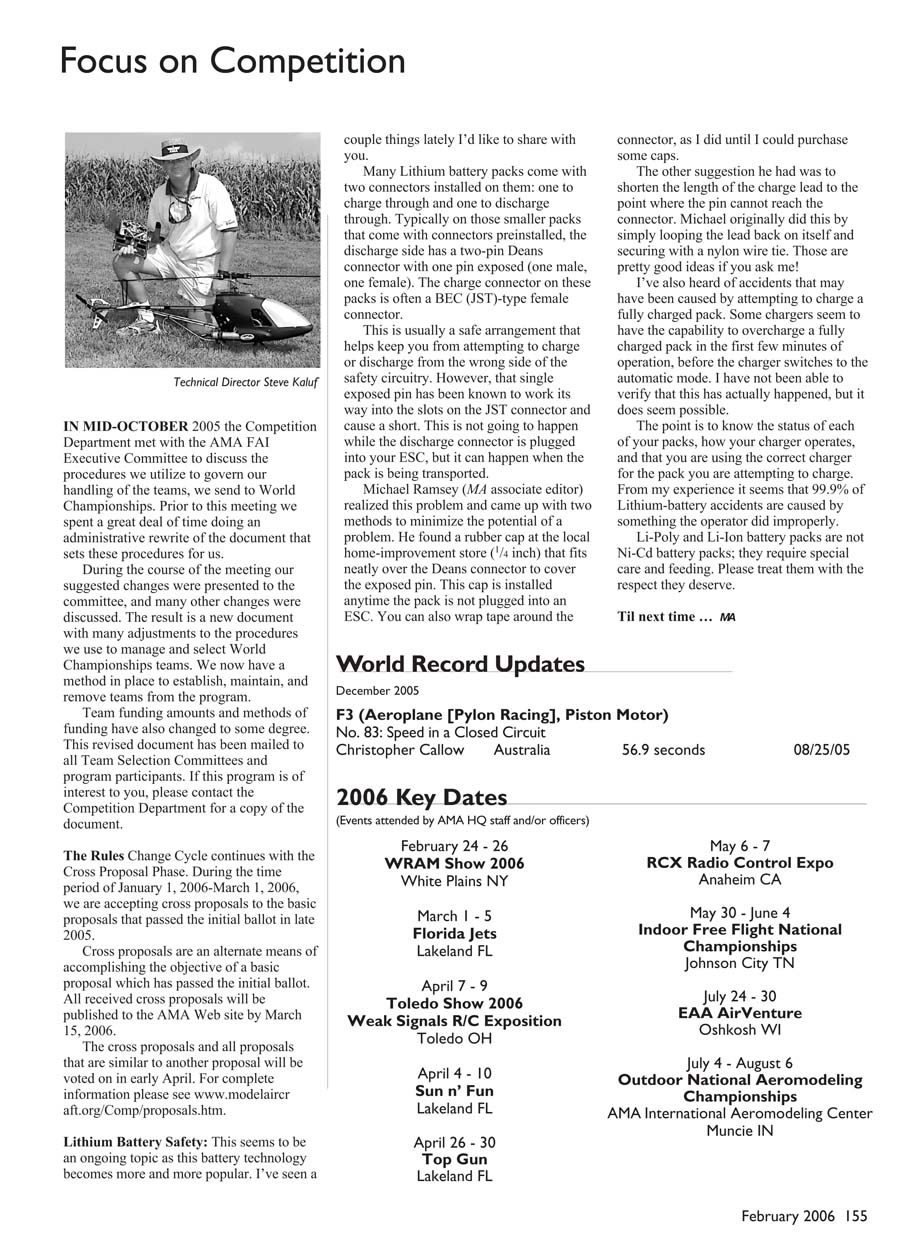
Focus on Competition - 2006/02
In mid-October 2005 the Competition Department met with the AMA FAI Executive Committee to discuss the procedures we utilize to govern our handling of the teams we send to World Championships. Prior to this meeting we spent a great deal of time doing an administrative rewrite of the document that sets these procedures.
During the course of the meeting our suggested changes were presented to the committee, and many other changes were discussed. The result is a new document with many adjustments to the procedures we use to manage and select World Championships teams. We now have a method in place to establish, maintain, and remove teams from the program.
Team funding amounts and methods of funding have also changed to some degree. This revised document has been mailed to all Team Selection Committees and program participants. If this program is of interest to you, please contact the Competition Department for a copy of the document.
The Rules Change Cycle continues with the Cross Proposal Phase. During the period January 1, 2006–March 1, 2006, we are accepting cross proposals to the basic proposals that passed the initial ballot in late 2005.
Cross proposals are an alternate means of accomplishing the objective of a basic proposal which has passed the initial ballot. All received cross proposals will be published to the AMA website by March 15, 2006.
The cross proposals and all proposals that are similar to another proposal will be voted on in early April. For complete information please see www.modelaircraft.org/Comp/proposals.htm.
Lithium Battery Safety
This continues to be a frequent topic as lithium battery technology becomes more popular. I've seen a couple of issues lately I'd like to share.
Many lithium battery packs come with two connectors installed on them: one for charging and one for discharging. Typically on those smaller packs that come with connectors preinstalled, the discharge side has a two-pin Deans connector with one pin exposed (one male, one female). The charge connector on these packs is often a BEC (JST)-type female connector.
This is usually a safe arrangement that helps keep you from attempting to charge or discharge through the wrong side of the safety circuitry. However, that single exposed pin has been known to work its way into the slots on the JST connector and cause a short. This is not likely to happen while the discharge connector is plugged into your ESC, but it can happen when the pack is being transported.
Michael Ramsey (MA associate editor) recognized this problem and came up with two methods to minimize the potential for a problem:
- Use a rubber cap (about 1/4 inch) that fits neatly over the Deans connector to cover the exposed pin. Install this cap anytime the pack is not plugged into an ESC.
- Shorten the length of the charge lead so the pin cannot reach the connector (Michael originally did this by looping the lead back on itself and securing it with a nylon wire tie).
You can also wrap tape around the connector as a temporary measure until you can get caps.
I've also heard of accidents that may have been caused by attempting to charge a fully charged pack. Some chargers seem capable of overcharging a fully charged pack in the first few minutes of operation before the charger switches to automatic mode. I have not been able to verify that this has actually happened, but it does seem possible. The point is to know the status of each of your packs, understand how your charger operates, and be certain you are using the correct charger for the pack you are attempting to charge.
From my experience it seems that 99.9% of lithium-battery accidents are caused by something the operator did improperly.
Li-Poly and Li-Ion battery packs are not Ni-Cd battery packs; they require special care and feeding. Please treat them with the respect they deserve.
Til next time ... MA
Transcribed from original scans by AI. Minor OCR errors may remain.

