
Focus on Competition - 2006/07
Technical Update
If you've been following my last couple of columns, you have read about the possible formation of a standards group that has been discussed since the February Frequency Committee (now ETC — Electronic Technology Committee) meeting and the RCMA (Radio Control Manufacturers Association) meeting in March.
We are making some progress toward this concept. On April 28, following a conference call/meeting with some key individuals, AMA President Dave Brown established a subcommittee of the ETC to develop and implement this program.
The first step in implementation of this program is staffing the subcommittee. This is being done initially from volunteers within the existing ETC and members of the industry who serve on that committee in an advisory capacity.
- Staff the subcommittee with volunteers from the ETC and industry advisors.
- Develop the scope of the program — what the program will be charged with accomplishing, the methods we will use, and the overall range of the program.
- Develop a product list to be handled first, establish priority, assign projects, and begin implementation.
- Invite subject-matter experts to work on specific projects with the core group as needed; the make-up of the group may change over time.
So what is the concept for this Standards Subcommittee? Much of this still has to be developed, but, in general, this group will help develop standardized testing and labeling for certain aeromodeling-related products. We will not be dictating how products are manufactured, nor will this group create standards to which a product is required to be built.
For example, the manner in which manufacturers determine servo output torque would benefit from a standardized method of measurement. There is currently more than one way to measure torque, and these different methods can produce different specifications for output torque. None are necessarily wrong; however, this means you could purchase a servo marked 120 ounce-inch from one manufacturer, and that same servo, if tested by another manufacturer using a different method, may only measure 100 ounce-inch.
The subcommittee’s goal would be to develop a standard method by which servos are tested for output torque. Therefore, if you purchased two servos from two different manufacturers that both indicate they meet the AMA testing standard, you would know the torque ratings are comparable. Manufacturers would voluntarily comply with this program and affix or print a label on the packaging so you know the product meets the standard.
Labeling on certain products is also likely to be addressed. For example, there currently seems to be a huge discrepancy in the information found on Li-Poly (LiPo) battery packs: some have almost no information on them; others have a large amount of information. This too needs to be standardized so that a minimum amount of necessary information is displayed. That will help you know better what you are purchasing and, most important, should allow you to operate the pack in a safer manner.
I hope you see the huge benefit this program will provide to all AMA members. Look for more information about the program as it is kicked off more formally.
Till next time ... MA
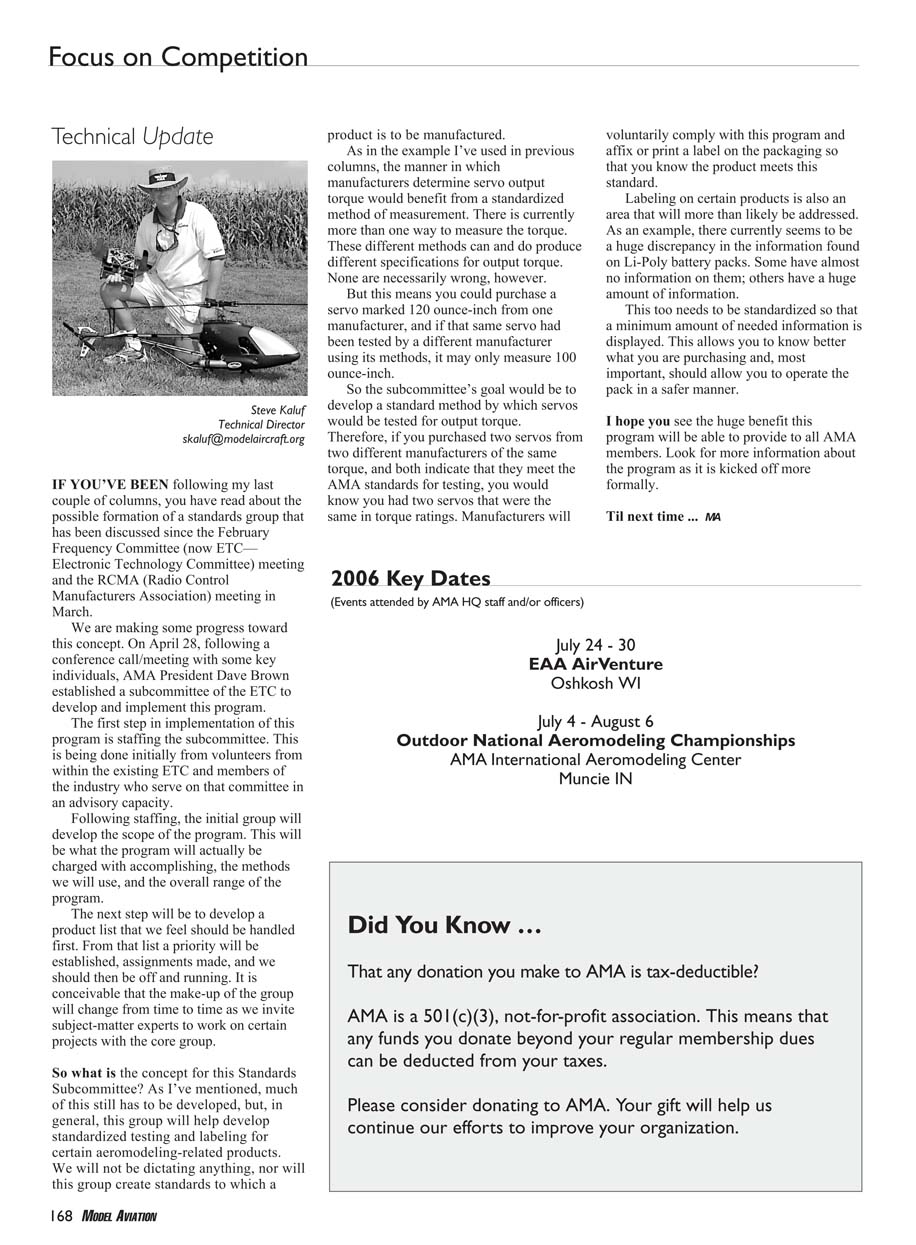
Steve Kaluf Technical Director [email protected]
Transcribed from original scans by AI. Minor OCR errors may remain.

