
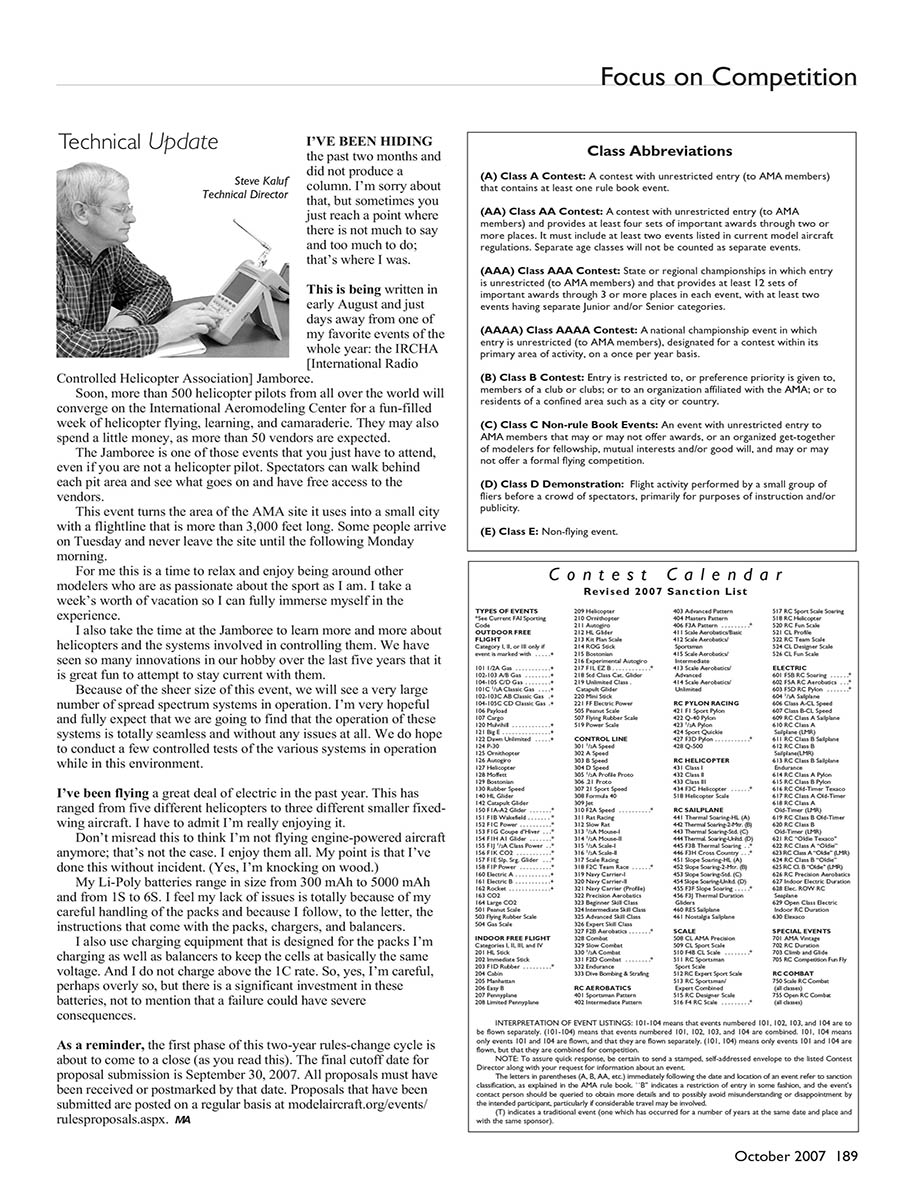
Technical Update
Steve Kaluf
Technical Director
I've been hiding for the past two months and did not produce a column. I'm sorry about that, but sometimes you just reach a point where there is not much to say and too much to do; that's where I was.
This is being written in early August and just days away from one of my favorite events of the whole year: the IRCHA (International Radio Controlled Helicopter Association) Jamboree.
Soon, more than 500 helicopter pilots from all over the world will converge on the International Aeromodeling Center for a fun-filled week of helicopter flying, learning, and camaraderie. They may also spend a little money, as more than 50 vendors are expected.
The Jamboree is one of those events that you just have to attend, even if you are not a helicopter pilot. Spectators can walk behind each pit area, see what goes on, and have free access to the vendors.
This event turns the area of the AMA site it uses into a small city with a flightline that is more than 3,000 feet long. Some people arrive on Tuesday and never leave the site until the following Monday morning.
For me, this is a time to relax and enjoy being around other modelers who are as passionate about the sport as I am. I take a week's worth of vacation so I can fully immerse myself in the experience.
I also take the time at the Jamboree to learn more and more about helicopters and the systems involved in controlling them. We have seen many innovations in our hobby over the last five years, and it is great fun to attempt to stay current with them.
Because of the sheer size of this event, we will see a very large number of spread-spectrum systems in operation. I'm hopeful and fully expect that we are going to find the operation of these systems to be totally seamless and without any issues at all. We do hope to conduct a few controlled tests of the various systems in operation while in this environment.
I've been flying a great deal of electric in the past year. This has ranged from five different helicopters to three different smaller fixed-wing aircraft. I have to admit I'm really enjoying it.
Don't misunderstand me—I am still flying engine-powered aircraft; that's not the case. I enjoy them all. My point is that I've done this without incident. (Yes, I'm knocking on wood.)
My Li-Poly (lithium polymer) batteries range in size from 300 mAh to 5,000 mAh and from 1S to 6S. I feel my lack of issues is entirely because of my careful handling of the packs and because I follow, to the letter, the instructions that come with the packs, chargers, and balancers.
I also use charging equipment that is designed for the packs I'm charging, as well as balancers to keep the cells at essentially the same voltage. And I do not charge above the 1C rate. So, yes, I'm careful—perhaps overly so—but there is a significant investment in these batteries, not to mention that a failure could have severe consequences.
As a reminder, the first phase of this two-year rules-change cycle is about to come to a close. The final cutoff date for proposal submission is September 30, 2007. All proposals must have been received or postmarked by that date. Proposals that have been submitted are posted on a regular basis at: http://modelaircraft.org/events/rulesproposals.aspx
Transcribed from original scans by AI. Minor OCR errors may remain.

