
Focus on Competition
Technically Speaking ...
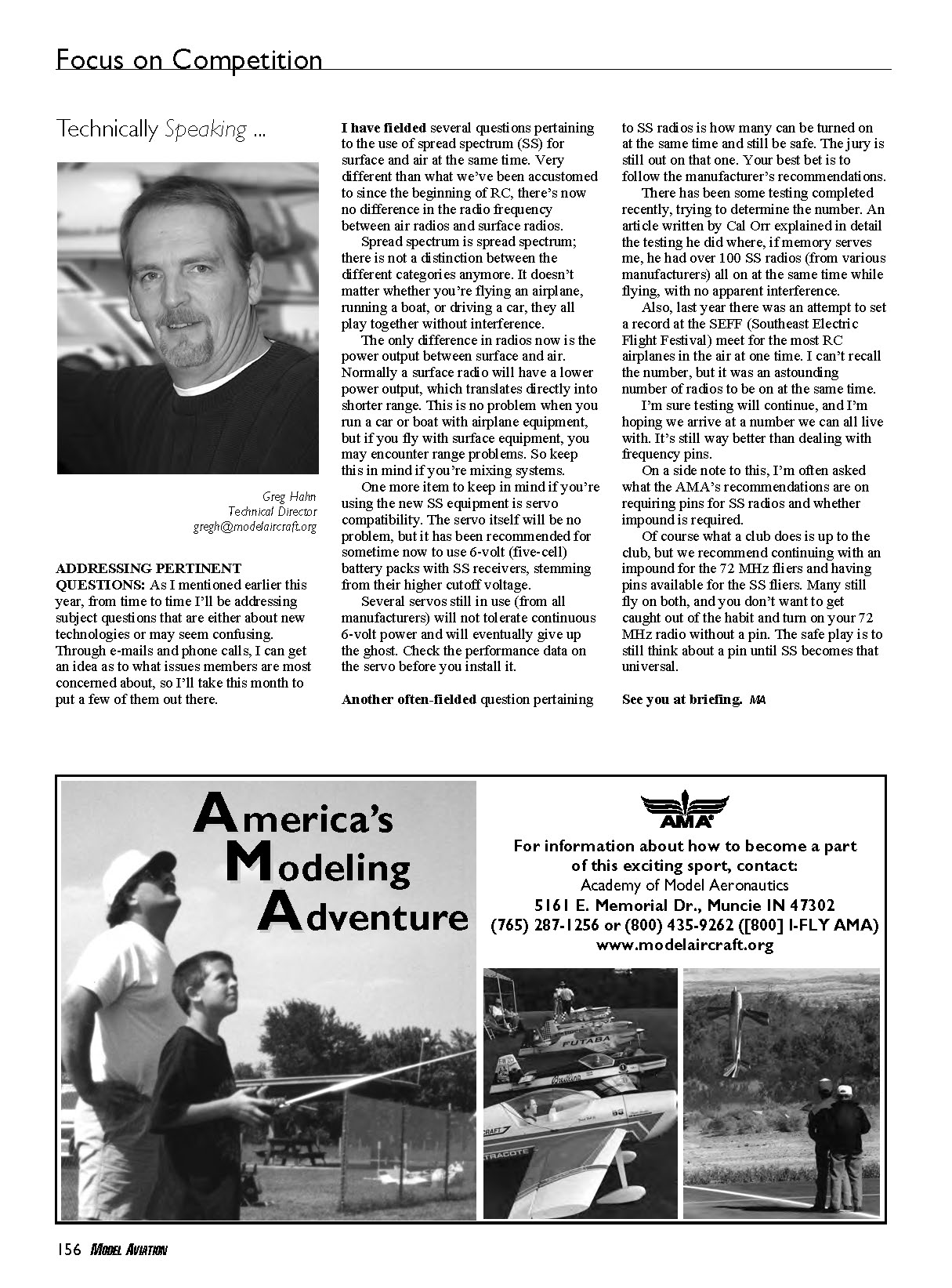
Greg Hahn Technical Director [email protected]
As I mentioned earlier this year, from time to time I’ll be addressing subject questions that are either about new technologies or may seem confusing. Through e-mails and phone calls, I can get an idea as to what issues members are most concerned about, so I’ll take this month to put a few of them out there.
I have fielded several questions pertaining to the use of spread spectrum (SS) for surface and air at the same time. Very different from what we’ve been accustomed to since the beginning of RC, there’s now no difference in the radio frequency between air radios and surface radios.
Spread spectrum is spread spectrum; there is not a distinction between the different categories anymore. It doesn’t matter whether you’re flying an airplane, running a boat, or driving a car — they all play together without interference.
The only difference in radios now is the power output between surface and air. Normally a surface radio will have a lower power output, which translates directly into shorter range. This is no problem when you run a car or boat with airplane equipment, but if you fly with surface equipment you may encounter range problems. Keep this in mind if you’re mixing systems.
One more item to keep in mind if you’re using the new SS equipment is servo compatibility. The servo itself will be no problem, but it has been recommended for some time now to use 6-volt (five-cell) battery packs with SS receivers, stemming from their higher cutoff voltage. Several servos still in use (from all manufacturers) will not tolerate continuous 6-volt power and will eventually give up the ghost. Check the performance data on the servo before you install it.
Another often-fielded question pertaining to SS radios is how many can be turned on at the same time and still be safe. The jury is still out on that one. Your best bet is to follow the manufacturer’s recommendations.
There has been some testing completed recently trying to determine the number. An article written by Cal Orr explained in detail the testing he did where, if memory serves me, he had over 100 SS radios (from various manufacturers) all on at the same time while flying, with no apparent interference.
Also, last year there was an attempt to set a record at the SEFF (Southeast Electric Flight Festival) meet for the most RC airplanes in the air at one time. I can’t recall the number, but it was an astounding number of radios to be on at the same time. I’m sure testing will continue, and I’m hoping we arrive at a number we can all live with. It’s still way better than dealing with frequency pins.
On a side note to this, I’m often asked what the AMA’s recommendations are on requiring pins for SS radios and whether impound is required.
Of course what a club does is up to the club, but we recommend continuing with an impound for the 72 MHz fliers and having pins available for the SS fliers. Many still fly on both, and you don’t want to get caught out of the habit and turn on your 72 MHz radio without a pin. The safe play is to still think about a pin until SS becomes that universal.
See you at briefing. MA
For information about how to become a part of this exciting sport, contact:
- Academy of Model Aeronautics
- 5161 E. Memorial Dr., Muncie, IN 47302
- (765) 287-1256 or (800) 435-9262 (800 I-FLY AMA)
- www.modelaircraft.org
- America’s Modeling Adventure
Transcribed from original scans by AI. Minor OCR errors may remain.

