
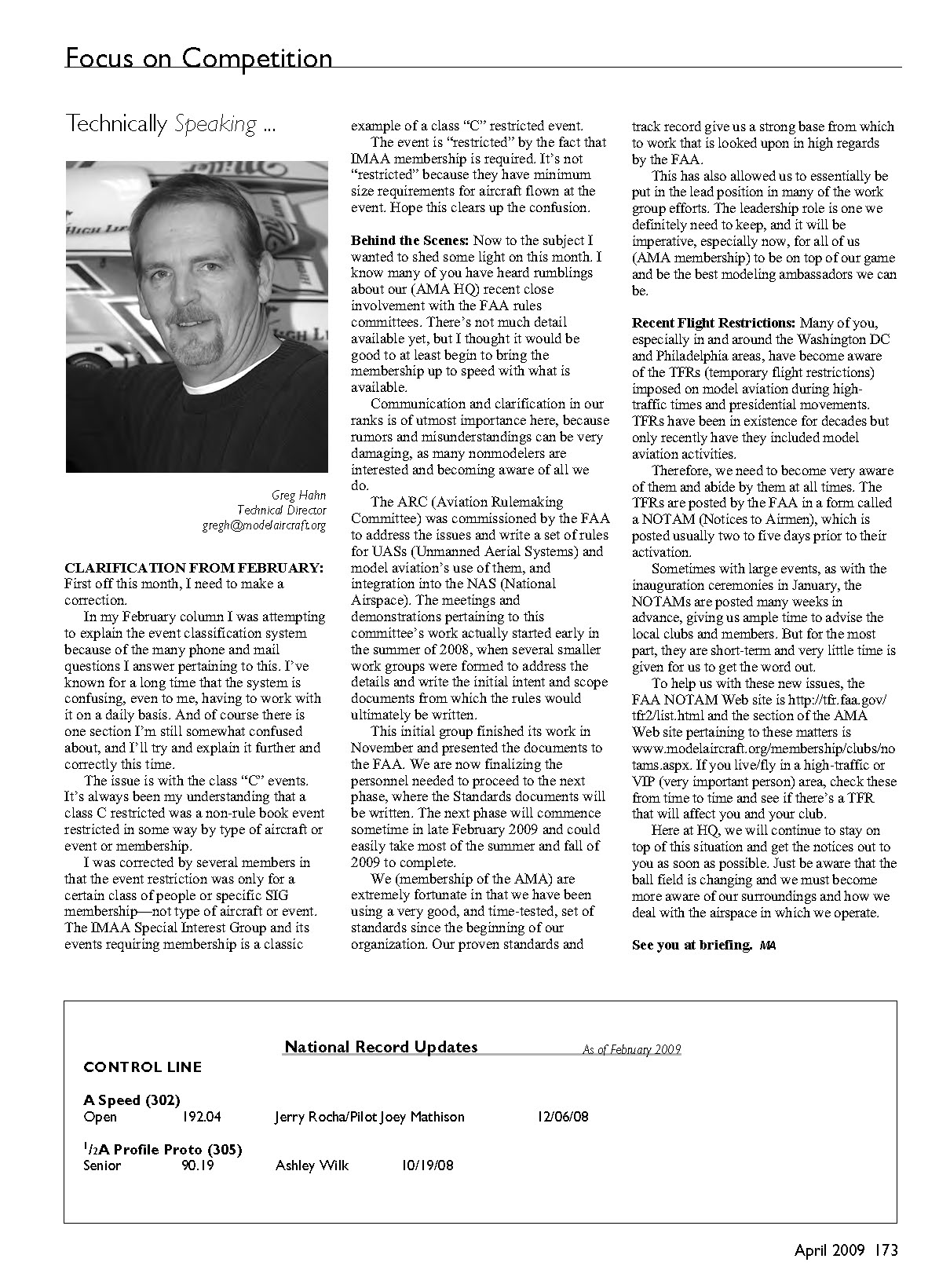
Technically Speaking ...
Greg Hahn Technical Director [email protected]
CLARIFICATION FROM FEBRUARY
First off this month, I need to make a correction.
In my February column I was attempting to explain the event classification system because of the many phone and mail questions I answer pertaining to this. I’ve known for a long time that the system is confusing, even to me, having to work with it on a daily basis. And of course there is one section I’m still somewhat confused about, and I’ll try and explain it further and correctly this time.
The issue is with the class “C” events. It’s always been my understanding that a class C restricted was a non-rule-book event restricted in some way by type of aircraft or event or membership.
I was corrected by several members that the event restriction was only for a certain class of people or specific SIG membership — not type of aircraft or event. The IMAA Special Interest Group and its events requiring membership is a classic example of a class “C” restricted event. The event is “restricted” by the fact that IMAA membership is required. It’s not “restricted” because they have minimum size requirements for aircraft flown at the event. Hope this clears up the confusion.
Behind the Scenes
Now to the subject I wanted to shed some light on this month. I know many of you have heard rumblings about our (AMA HQ’s) recent close involvement with the FAA rules committees. There’s not much detail available yet, but I thought it would be good to at least begin to bring the membership up to speed with what is available.
Communication and clarification in our ranks is of utmost importance here, because rumors and misunderstandings can be very damaging, as many nonmodelers are interested and becoming aware of all we do.
The ARC (Aviation Rulemaking Committee) was commissioned by the FAA to address the issues and write a set of rules for UASs (Unmanned Aerial Systems), model aviation’s use of them, and their integration into the NAS (National Airspace). The meetings and demonstrations pertaining to this committee’s work actually started early in the summer of 2008, when several smaller work groups were formed to address the details and write the initial intent and scope documents from which the rules would ultimately be written. This initial group finished its work in November and presented the documents to the FAA. We are now finalizing the personnel needed to proceed to the next phase, where the standards documents will be written. The next phase will commence sometime in late February 2009 and could easily take most of the summer and fall of 2009 to complete.
We (the membership of the AMA) are extremely fortunate in that we have been using a very good, time-tested set of standards since the beginning of our organization. Our proven standards and track record give us a strong base from which to work that is looked upon in high regard by the FAA.
This has also allowed us to essentially be put in the lead position in many of the work-group efforts. The leadership role is one we definitely need to keep, and it will be imperative, especially now, for all of us (AMA membership) to be on top of our game and be the best modeling ambassadors we can be.
Recent Flight Restrictions
Many of you, especially in and around the Washington, D.C., and Philadelphia areas, have become aware of the TFRs (temporary flight restrictions) imposed on model aviation during high-traffic times and presidential movements. TFRs have been in existence for decades but only recently have they included model aviation activities. Therefore, we need to become very aware of them and abide by them at all times. The TFRs are posted by the FAA in a form called a NOTAM (Notice to Airmen), which is posted usually two to five days prior to their activation.
Sometimes with large events, as with the inauguration ceremonies in January, the NOTAMs are posted many weeks in advance, giving us ample time to advise the local clubs and members. But for the most part, they are short-term and very little time is given for us to get the word out.
To help us with these new issues, the FAA NOTAM web site is http://tfr.faa.gov/tfr2/list.html and the section of the AMA web site pertaining to these matters is http://www.modelaircraft.org/membership/clubs/notams.aspx. If you live or fly in a high-traffic or VIP (very important person) area, check these from time to time and see if there’s a TFR that will affect you and your club.
Here at HQ, we will continue to stay on top of this situation and get the notices out to you as soon as possible. Just be aware that the ball field is changing and we must become more aware of our surroundings and how we deal with the airspace in which we operate.
See you at briefing. MA
Transcribed from original scans by AI. Minor OCR errors may remain.

