
Focus on Competition
Technically Speaking ...
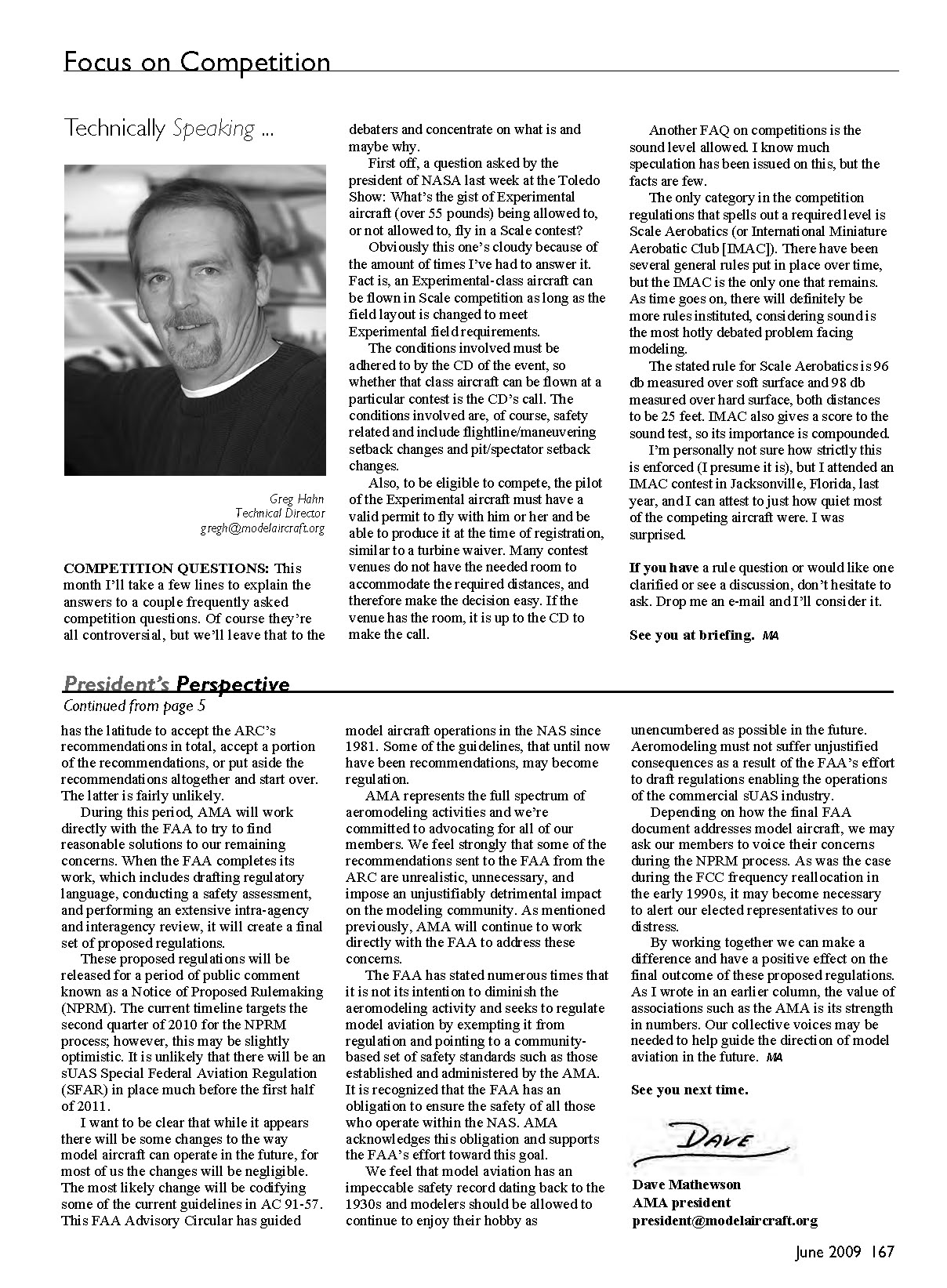
Greg Hahn Technical Director [email protected]
COMPETITION QUESTIONS: This month I'll take a few lines to explain the answers to a couple frequently asked competition questions. Of course they're all controversial, but we'll leave that to the debaters and concentrate on what is and maybe why.
First off, a question asked by the president of NASA last week at the Toledo Show: what's the gist of Experimental aircraft (over 55 pounds) being allowed to, or not allowed to, fly in a Scale contest?
Obviously this one's cloudy because of the number of times I've had to answer it. The fact is, an Experimental-class aircraft can be flown in Scale competition as long as the field layout is changed to meet Experimental field requirements.
The conditions involved must be adhered to by the contest director (CD) of the event, so whether that class of aircraft can be flown at a particular contest is the CD's call. The conditions involved are, of course, safety related, and include:
- flightline / maneuvering setback changes
- pit / spectator setback changes
Also, to be eligible to compete, the pilot of the Experimental aircraft must have a valid permit to fly and be able to produce it at the time of registration, similar to a turbine waiver. Many contest venues do not have the needed room to accommodate the required distances, and therefore make the decision easy. If the venue has the room, it is up to the CD to make the call.
Another FAQ on competitions is the sound level allowed. I know much speculation has been issued on this, but the facts are few.
The only category in the competition regulations that spells out a required level is Scale Aerobatics (or International Miniature Aerobatic Club, IMAC). There have been several general rules put in place over time, but IMAC is the only one that remains. As time goes on, there will definitely be more rules instituted, considering sound is the most hotly debated problem facing modeling.
The stated rule for Scale Aerobatics is:
- 96 dB measured over soft surface at 25 feet
- 98 dB measured over hard surface at 25 feet
IMAC also gives a score to the sound test, so its importance is compounded.
I'm personally not sure how strictly this is enforced (I presume it is), but I attended an IMAC contest in Jacksonville, Florida, last year, and I can attest to just how quiet most of the competing aircraft were. I was surprised.
If you have a rule question or would like one clarified or see a discussion, don't hesitate to ask. Drop me an e-mail and I'll consider it.
See you at briefing.
Transcribed from original scans by AI. Minor OCR errors may remain.

