
Focus on Education - 2003/04
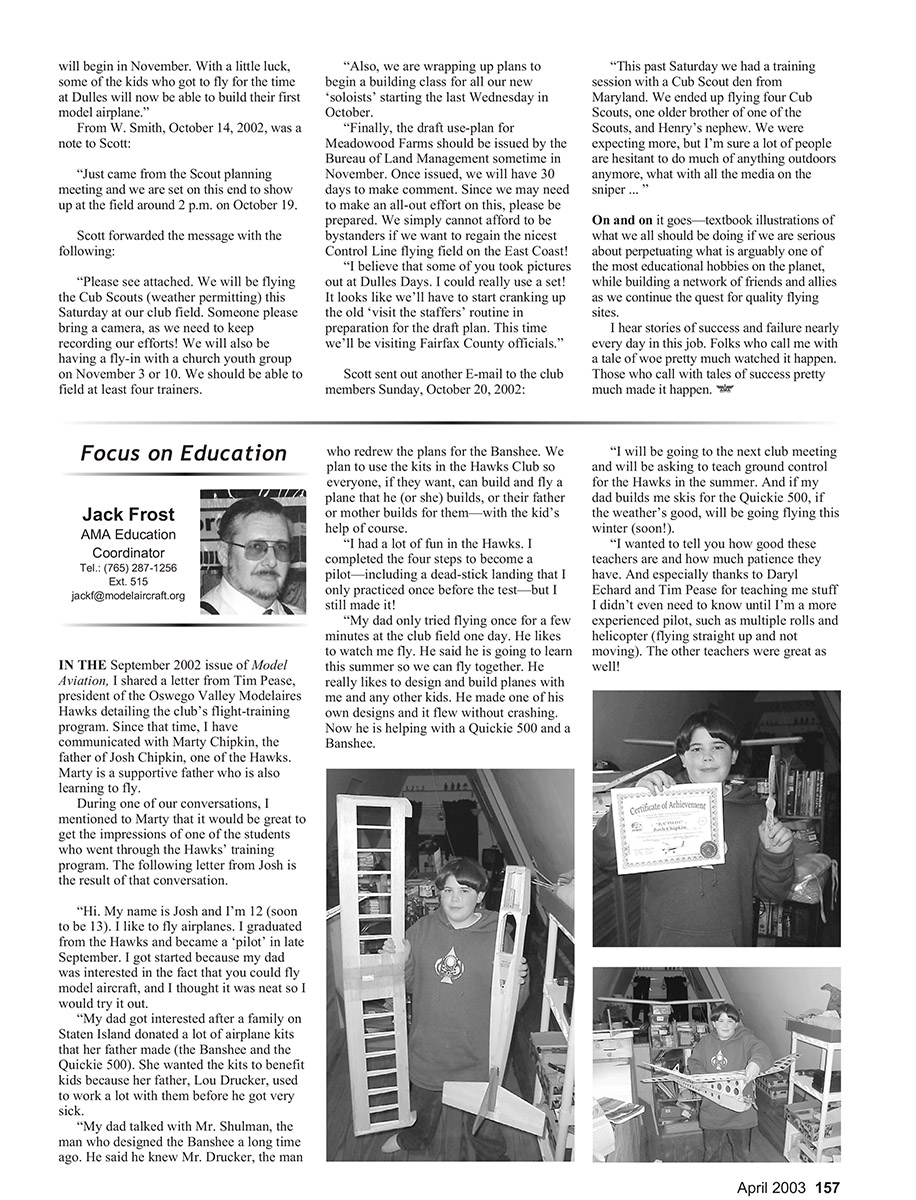
Jack Frost
- AMA Education Coordinator
- Tel.: (765) 287-1256, Ext. 515
- [email protected]
In the September 2002 issue of Model Aviation, I shared a letter from Tim Pease, president of the Oswego Valley Modelaires Hawks, detailing the club’s flight-training program. Since that time I have communicated with Marty Chipkin, the father of Josh Chipkin, one of the Hawks. Marty is a supportive father who is also learning to fly.
During one of our conversations I mentioned to Marty that it would be great to get the impressions of one of the students who went through the Hawks’ training program. The following letter from Josh is the result of that conversation.
Letter from Josh Chipkin
Hi. My name is Josh and I’m 12 (soon to be 13). I like to fly airplanes. I graduated from the Hawks and became a “pilot” in late September. I got started because my dad was interested in the fact that you could fly model aircraft, and I thought it was neat so I would try it out.
My dad got interested after a family on Staten Island donated a lot of airplane kits that her father made (the Banshee and the Quickie 500). She wanted the kits to benefit kids because her father, Lou Drucker, used to work a lot with them before he got very sick.
My dad talked with Mr. Shulman, the man who designed the Banshee a long time ago. He said he knew Mr. Drucker, the man who redrew the plans for the Banshee. We plan to use the kits in the Hawks Club so everyone, if they want, can build and fly a plane that he (or she) builds, or their father or mother builds for them—with the kid’s help, of course.
I had a lot of fun in the Hawks. I completed the four steps to become a pilot—including a dead-stick landing that I only practiced once before the test—but I still made it!
My dad only tried flying once for a few minutes at the club field one day. He likes to watch me fly. He said he is going to learn this summer so we can fly together. He really likes to design and build planes with me and any other kids. He made one of his own designs and it flew without crashing. Now he is helping with a Quickie 500 and a Banshee.
I will be going to the next club meeting and will be asking to teach ground control for the Hawks in the summer. And if my dad builds me skis for the Quickie 500, if the weather’s good, we’ll be going flying this winter (soon!).
I wanted to tell you how good these teachers are and how much patience they have. And especially thanks to Daryl Echard and Tim Pease for teaching me stuff I didn’t even need to know until I’m a more experienced pilot, such as multiple rolls and helicopter (flying straight up and not moving). The other teachers were great as well!
I also wanted to say thanks to Mr. Drucker’s family for helping a lot of us kids get started building planes. I don’t think we would be doing any of this without the help we are getting like this.
Thanks for taking the time to read this letter and looking at the pictures. I sent pictures of a Banshee and Quickie 500, almost ready for covering. Also, pictures of my certificate and the prop that I used in my test. And it didn’t break! Please write back.
You can bet that I will write back to Josh! Does he sound just a little excited? If you have more success stories to share, I want to hear from you!
On the benefits of model aviation (from Bill Kuhl)
Bill Kuhl sent a letter that I want to share. As you might already know, Bill has a very impressive Delta Dart web site (http://www.luminet.net/~bkuhl/Dart.htm) containing tons of information.
The benefits of model aviation are not as direct as other activities begun at a young age. For example, I was reading biographies of National Geographic photographers, and in many cases their start in photography was sparked when they were given a camera as a child. Chances are that not many children given model airplane kits grow up to be model airplane designers, although many aeronautical engineers and astronauts had an interest in model aviation as youngsters.
So what is the importance of model aviation? Modelers and modeling organizations normally promote model aviation to young people in hopes that they will become modelers and enjoy the hobby for much of their life. Nothing wrong with this, but I believe there can be great benefits to exposing every child to model aviation even if they have no interest in taking it up as a hobby.
That could probably be said of many activities, and I believe that as well, but model aviation has advantages over many activities. Yet just giving a child a model airplane kit can be a waste of money.
Why would I say that? The chances that the child will successfully build the model and get the model (rubber-powered airplane) to fly for very long are not good. I say this because of my experience and that of many other modelers who did not have much success getting their first planes flying well. This has always been true, but in the past children did not have so many activities, so their attention was not lost elsewhere so quickly. Also, with more kids flying model planes in the past, there was greater peer pressure motivating them to continue (more of their buddies built models).
Model aviation is a great activity when combined with mentoring. What makes modeling airplanes better than many other mentored activities is that the degree of success is easily measured with a stopwatch. Compare this with the child who takes a picture, writes an essay, or plays a musical instrument—success in those is somewhat subjective to the opinions of other people. Not that having quantifiable results is all that matters, but at times it is good to be able to measure our progress by more than an opinion.
Another plus for model aviation is that it is a good activity in which to teach the skill of refinement. With most activities in school the child does the activity, receives a grade, and must move on to something else; there is not enough time to perfect the results. I remember back to college when students who could not get computer programs to function were able to write up what the program was supposed to do and get partial credit. I don’t think that would have worked on my first computer programming job.
Like computer work, model aviation can be very technical and certain aspects can be critical. Often with model planes, a small warp or not having the correct rubber motor size can be the difference between a plane that flies well and one that does a fast descent to the ground.
Accuracy is a big part of success in model aviation, but just as important is learning to evaluate failure and learning to correct a bad situation. If your rubber motor is bunching up on the motor stick and the propeller is stopping, you need to take corrective action.
It would be easy for me to go on and on about why model aviation is a great hobby and educational as well. There are many dedicated individuals who are working to promote model aviation as an activity for young people, but there is room for more. Our future depends on it.
I want to thank Bill and Josh for taking the time to write. I hope more of you will share your thoughts.
Transcribed from original scans by AI. Minor OCR errors may remain.

