
Focus on Education - 2004/08
By Gordon Schimmel, Chairperson, AMA Education Committee
Gordon Schimmel is taking this opportunity to profile David Gee, an AMA member who has demonstrated extraordinary leadership and brought the joy of aeromodeling to newcomers.
As with many lifelong modelers, David Gee came to modeling by way of an influential mentor—his father, a charter member of one of the most colorfully named AMA clubs, the Old Farts Flying Club (OFFC). His father continues a lifelong interest in the hobby as an expert stick-and-tissue builder and as a flier of indoor and outdoor rubber-powered models. David currently schedules his work week so he can attend the Wednesday morning meetings of the OFFC and join his father in an interest they share.
Dave started with simple indoor models and moved into flying control-line (CL) and radio-control (RC) as the hobby expanded in the 1950s and 1960s. However, he remains true to his indoor stick-and-tissue roots when he works with children, something he does for fun. He has conducted a number of classroom demonstrations, often tailoring each presentation to the models he has chosen for his audience.
When presenting in elementary or secondary classrooms, Dave will build different World War I and II semi-scale profile models depending on the class. His primary goal is to make the presentation interesting, but he believes it must also be relevant to the teacher’s curricular topics.
There are some constants that run through all of his lessons:
- He usually opens with a simple rise-off-ground (ROG) model. “Everyone wants to see an airplane take off and land. When a small, lightweight indoor model does this successfully, everyone is amazed.”
- He brings a collection of slow-flying indoor models—No-Cals and Pennyplanes—as well as various biplanes, canards, helicopters, and an ornithopter. “Teachers as well as their students are surprised to see something fly so slowly—and so well!”
- He uses inevitable crashes as teaching moments to emphasize that, unlike many toys, the model can be easily repaired.
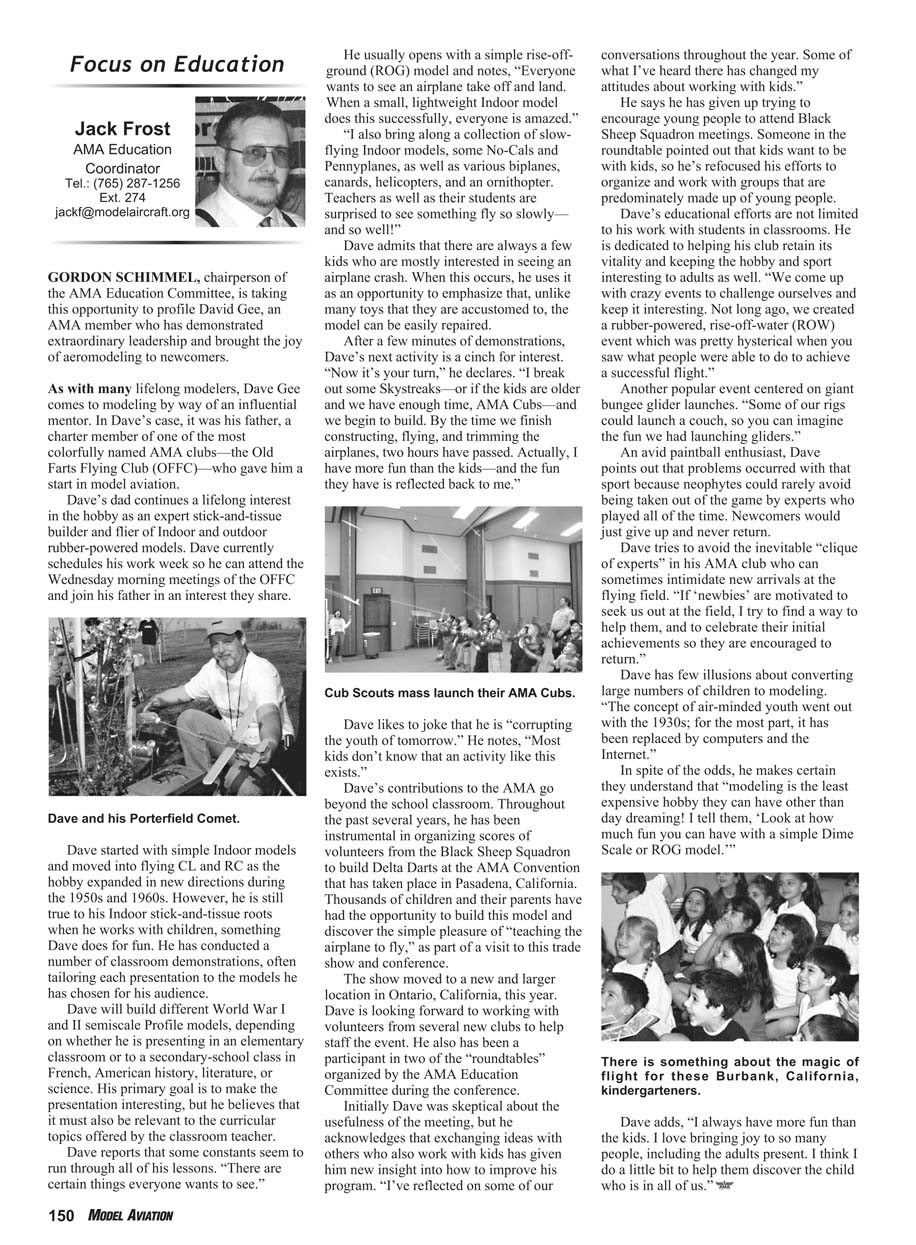
After a few minutes of demonstration, Dave moves to hands-on building. “Now it’s your turn,” he declares. He breaks out some Skystreaks—or, if the kids are older and there is enough time, AMA Cubs—and they begin to build. By the time they finish constructing, flying, and trimming the airplanes, two hours have passed. “Actually, I have more fun than the kids—and the fun they have is reflected back to me.”
Dave likes to joke that he is “corrupting the youth of tomorrow.” He notes, “Most kids don't know that an activity like this exists.”
Dave’s contributions to the AMA go beyond the classroom. For several years he has been instrumental in organizing scores of volunteers from the Black Sheep Squadron to build Delta Darts at the AMA Convention in Pasadena, California. Thousands of children and their parents have had the opportunity to build this model and discover the simple pleasure of “teaching the airplane to fly” as part of a visit to the trade show and conference.
The show moved to a larger location in Ontario, California, this year. Dave is looking forward to working with volunteers from several new clubs to help staff the event. He has also participated in two of the “roundtables” organized by the AMA Education Committee during the conference. Initially skeptical about the usefulness of the meeting, he acknowledges that exchanging ideas with others who also work with kids has given him new insight into how to improve his program. “I've reflected on some of our conversations throughout the year. Some of what I've heard there has changed my attitudes about working with kids.”
One outcome of those conversations: he has given up trying to encourage young people to attend Black Sheep Squadron meetings. Someone in the roundtable pointed out that kids want to be with kids, so he’s refocused his efforts to organize and work with groups that are predominantly made up of young people.
Dave’s educational efforts are not limited to school programs. He is dedicated to helping his club retain its vitality and to keeping the hobby interesting for adults as well. They come up with crazy events to challenge themselves and keep it interesting. Recent examples include:
- A rubber-powered, rise-off-water (ROW) event that produced hysterical and inventive attempts to achieve successful flights.
- Giant bungee glider launches—some rigs could launch a couch, so you can imagine the fun they had launching gliders.
An avid paintball enthusiast, Dave points out that sport suffered because neophytes were often quickly eliminated by experts who played all the time; newcomers would give up and never return. He tries to avoid the inevitable “clique of experts” in his AMA club who can intimidate new arrivals at the flying field. “If 'newbies' are motivated to seek us out at the field, I try to find a way to help them, and to celebrate their initial achievements so they are encouraged to return.”
Dave has few illusions about converting large numbers of children to modeling. “The concept of air-minded youth went out with the 1930s; for the most part, it has been replaced by computers and the Internet.” In spite of the odds, he makes certain they understand that modeling is the least expensive hobby they can have other than daydreaming. “I tell them, ‘Look at how much fun you can have with a simple Dime Scale or ROG model.’”
Dave adds, “I always have more fun than the kids. I love bringing joy to so many people, including the adults present. I think I do a little bit to help them discover the child who is in all of us.”
Transcribed from original scans by AI. Minor OCR errors may remain.

