
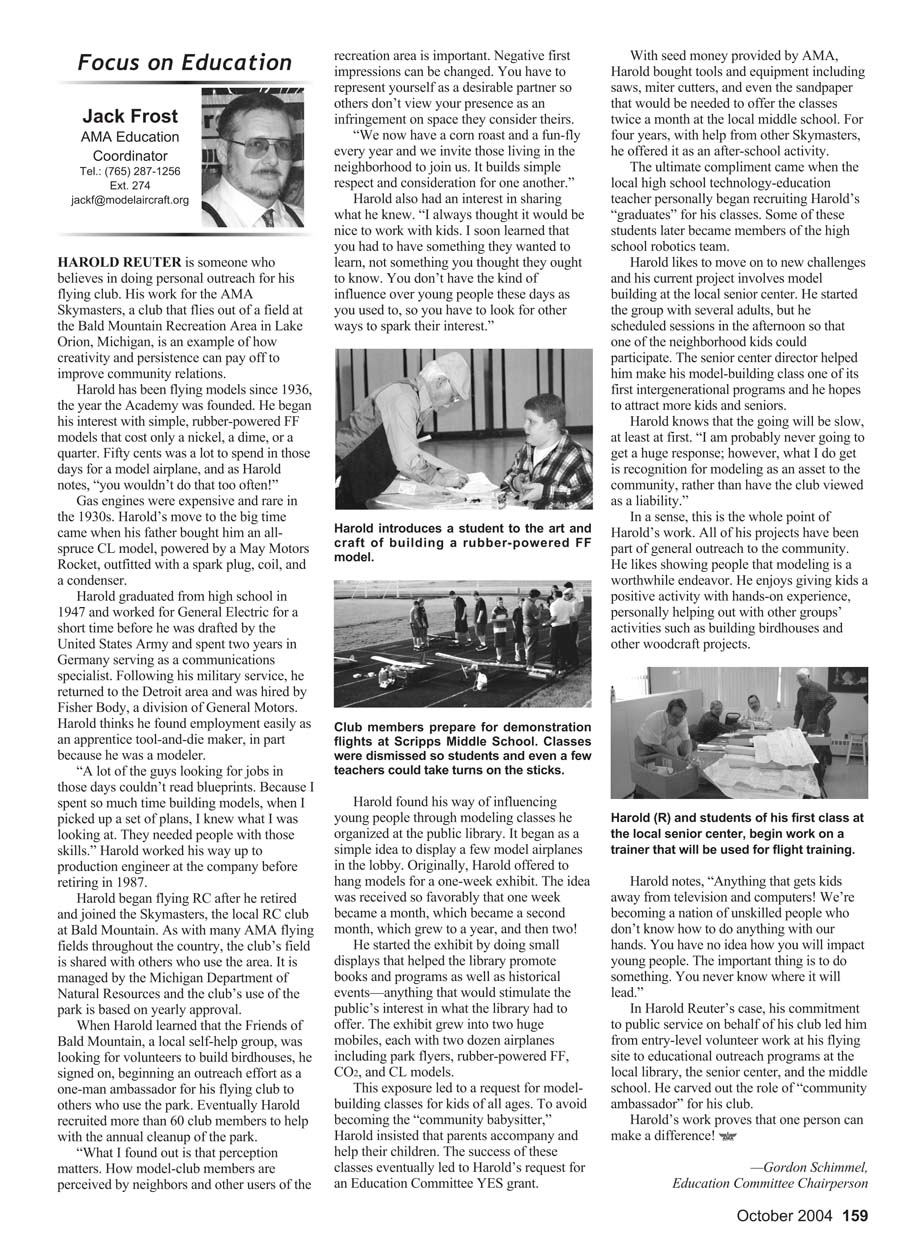
Focus on Education
Harold Reuter
Harold Reuter believes in doing personal outreach for his flying club. His work for the AMA Skymasters, a club that flies out of a field at the Bald Mountain Recreation Area in Lake Orion, Michigan, is an example of how creativity and persistence can pay off to improve community relations.
Early interest in modeling
Harold has been flying models since 1936, the year the Academy was founded. He began with simple rubber-powered free-flight (FF) models that cost only a nickel, a dime, or a quarter. Fifty cents was a lot to spend in those days for a model airplane, and as Harold notes, "you wouldn’t do that too often!" Gas engines were expensive and rare in the 1930s. Harold’s move to the big time came when his father bought him an all-spruce control-line (CL) model, powered by a May Motors Rocket and outfitted with a spark plug, coil, and condenser.
Career and military service
Harold graduated from high school in 1947 and worked for General Electric for a short time before he was drafted by the United States Army and spent two years in Germany serving as a communications specialist. After his military service, he returned to the Detroit area and was hired by Fisher Body, a division of General Motors. Harold thinks he found employment easily as an apprentice tool-and-die maker, in part because he was a modeler: "A lot of the guys looking for jobs in those days couldn’t read blueprints. Because I spent so much time building models, when I picked up a set of plans, I knew what I was looking at. They needed people with those skills." Harold worked his way up to production engineer before retiring in 1987.
Club involvement and community outreach
Harold began flying radio control (RC) after he retired and joined the Skymasters, the local RC club at Bald Mountain. As with many AMA flying fields throughout the country, the club’s field is shared with others who use the area. The park is managed by the Michigan Department of Natural Resources, and the club’s use of the park is based on yearly approval.
When Harold learned that the Friends of Bald Mountain, a local self-help group, was looking for volunteers to build birdhouses, he signed on and began an outreach effort as a one-man ambassador for his flying club. Eventually Harold recruited more than 60 club members to help with the annual cleanup of the park. He discovered that perception matters: how model-club members are perceived by neighbors and other users of the recreation area is important. Negative first impressions can be changed. "You have to represent yourself as a desirable partner so others don’t view your presence as an infringement on space they consider theirs."
Harold’s outreach also includes:
- Helping with park cleanups and birdhouse building
- Organizing a corn roast and an annual fun-fly that invites neighborhood residents
- Displaying models in the library to promote community interest
Education and youth programs
Harold was interested in sharing his knowledge with kids. He learned that to reach young people you must offer something they want to learn, not just what you think they ought to know. He started by displaying a few model airplanes in the public library lobby. What began as a one-week exhibit grew to a month, then a second month, then a year, and eventually two years. The displays promoted books, programs, and historical events and grew into two large mobiles, each with two dozen airplanes including park flyers, rubber-powered FF models, CO2-powered models, and CL models.
The library exposure led to a request for modeling classes for children of all ages. To avoid becoming the "community babysitter," Harold insisted that parents accompany and help their children. The success of the classes led Harold to request an Education Committee YES grant from the AMA.
With seed money provided by AMA, Harold bought tools and equipment and offered classes twice a month at the local middle school for four years, with help from other Skymasters. Items purchased included:
- Saws
- Miter cutters
- Sandpaper
- Basic hand tools and classroom supplies
The ultimate compliment came when the local high school technology-education teacher began recruiting Harold’s "graduates" for his classes. Some students later became members of the high school robotics team.
Senior center and intergenerational work
Harold moved on to a new challenge: model building at the local senior center. He started with several adults but scheduled sessions in the afternoon so a neighborhood kid could participate. The senior center director helped make the model-building class one of its first intergenerational programs. Harold hopes to attract more kids and seniors over time.
Harold knows the going will be slow at first. "I am probably never going to get a huge response; however, what I do get is recognition for modeling as an asset to the community, rather than have the club viewed as a liability."
Impact
All of Harold’s projects are part of general outreach to the community. He shows people that modeling is a worthwhile endeavor and provides kids with a positive, hands-on activity. He also personally helps out with other groups’ activities such as building birdhouses and other woodcraft projects. Harold’s work proves that one person can make a difference.
— Gordon Schimmel, Education Committee Chairperson
Transcribed from original scans by AI. Minor OCR errors may remain.

