

Fokker Universal
Jack Humphreys
The Fokker Universal was designed by Robert Noorduyn in 1925. It was the first airplane produced by Fokker USA. Bush operators had been clamoring for a more efficient airplane than the surplus warplanes then available.
The Universal is the only Fokker with wing struts. It has been reported that Noorduyn and Fokker did not get along, and that the struts had a lot to do with it.
The Universal was designed around the 220 hp Wright Whirlwind—the same engine made famous by Charles Lindbergh two years later—and was a six-placer, carrying five passengers (four in the cabin and one next to the pilot in an open cockpit up front).
The first operator of the Fokker Universal was Western Canada Airways. WCA was formed in 1926 by grain trader James Richardson in Winnipeg, Manitoba. This was the first step in what is now Canadian Airlines.
The carrying capacity of the Universal, coupled with the reliability of the Whirlwind, made it the most successful bush airplane of its time. It had a 50-foot wingspan and was usually operated with skis or floats in Canada's north.
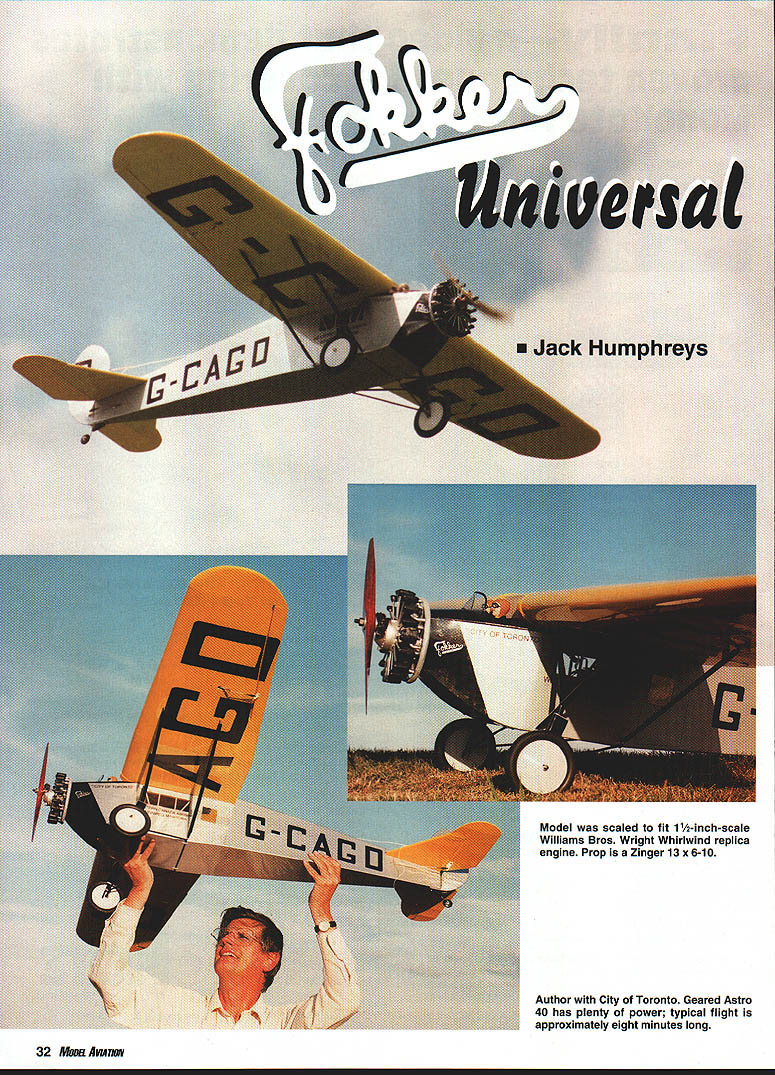
Western's first Fokker Universal, the fourth one built, christened City of Winnipeg, was delivered on Christmas Day 1926 and registered G-CAFU. Their second, construction #6, was called City of Toronto, registered G-CAGD, and delivered February 26, 1927. (Canada was part of the British Empire at that time and used the British G for Great Britain followed by CA for Canada.)
The GD was the 186th airplane on the Canadian civil registry. Western kept it until 1931, when they sold it to Grant McConnachie, who used it to start his first company on the way to becoming the president of Canadian Pacific Airlines. The first pilot of GD was Bernt Balchen, who achieved immortality in 1929 by flying Admiral Byrd to the South Pole.
Construction
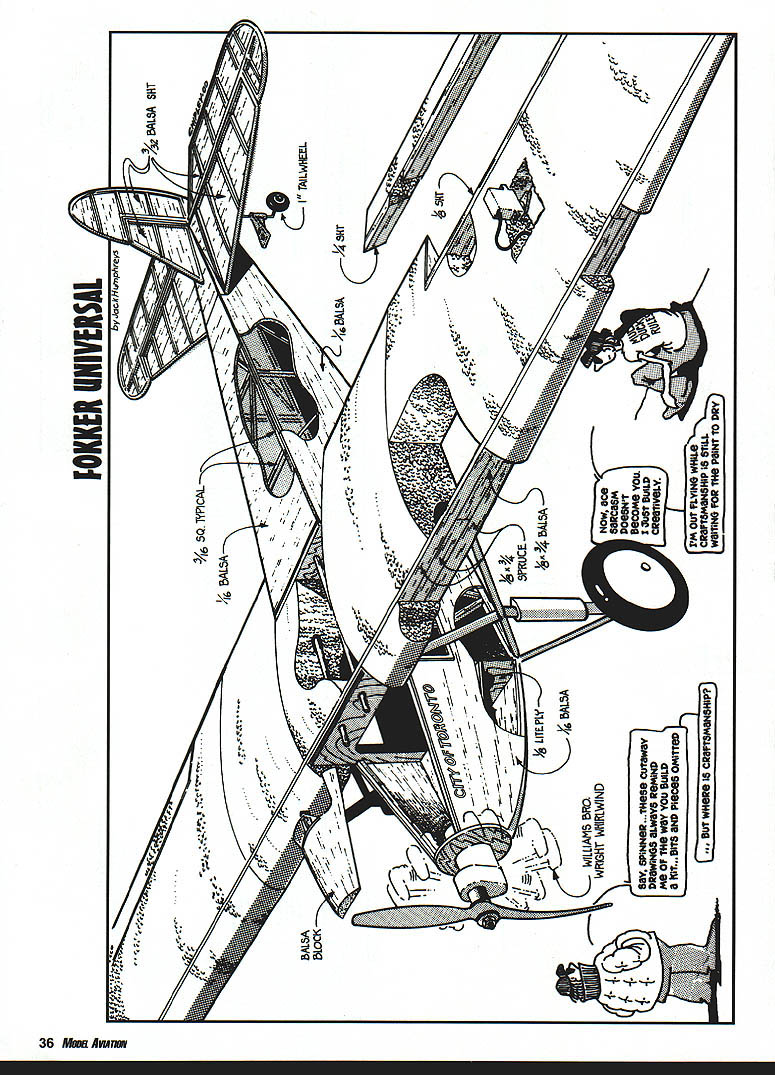
#### Scale and Dummy Engine With its exposed engine, a model like this requires a dummy engine. The scale of the model was determined by the size of the Wright Whirlwind engine models available from Williams Bros. Their 2-inch-scale engine would require a 100-inch model, which seemed large; the 1/2-inch scale makes a six-foot model, which is much easier to transport.
The choice of power was also driven by the dummy engine, because it is difficult to hide a two- or four-stroke engine without cutting away two or three cylinders. An electric motor fits right in the crankcase, leaving all cylinders intact. It says a lot for improvements in electric technology that their use is now a matter of practicality rather than experimentation.
#### Power and Radio I used a geared Astro 40 with eighteen 2,000 mAh cells and a Jeti 60 controller. A Zinger 13 x 6–10 prop draws 30 amps for takeoff, but the airplane flies on less than 10 amps. I normally fly for eight minutes, and this leaves time for a couple of missed approaches.
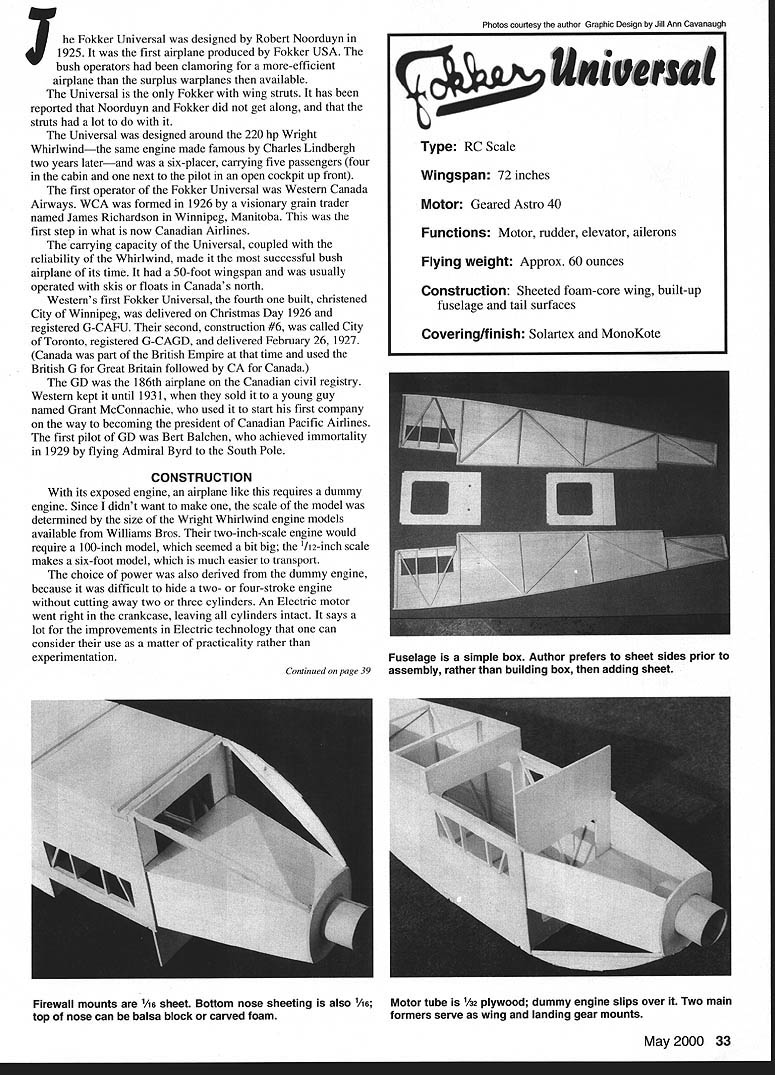
#### Fuselage The fuselage is a square box. Construction of the rear part is straightforward; I prefer to make the sides first and then glue the internal stiffeners to the sides, rather than making a box of strips and gluing the sides to the box.
The two main formers must be parallel, and both must be square to the sides, because they are both wing and landing gear mounts.
The motor tube is laminated from 1/32" plywood by wrapping it around the motor and gluing with slow cyanoacrylate (CyA). Plastic wrap or waxed paper around the motor will prevent it from becoming a permanent part of the airplane. The motor tube is glued halfway through the firewall. The notches for the brushes will prevent it from turning.
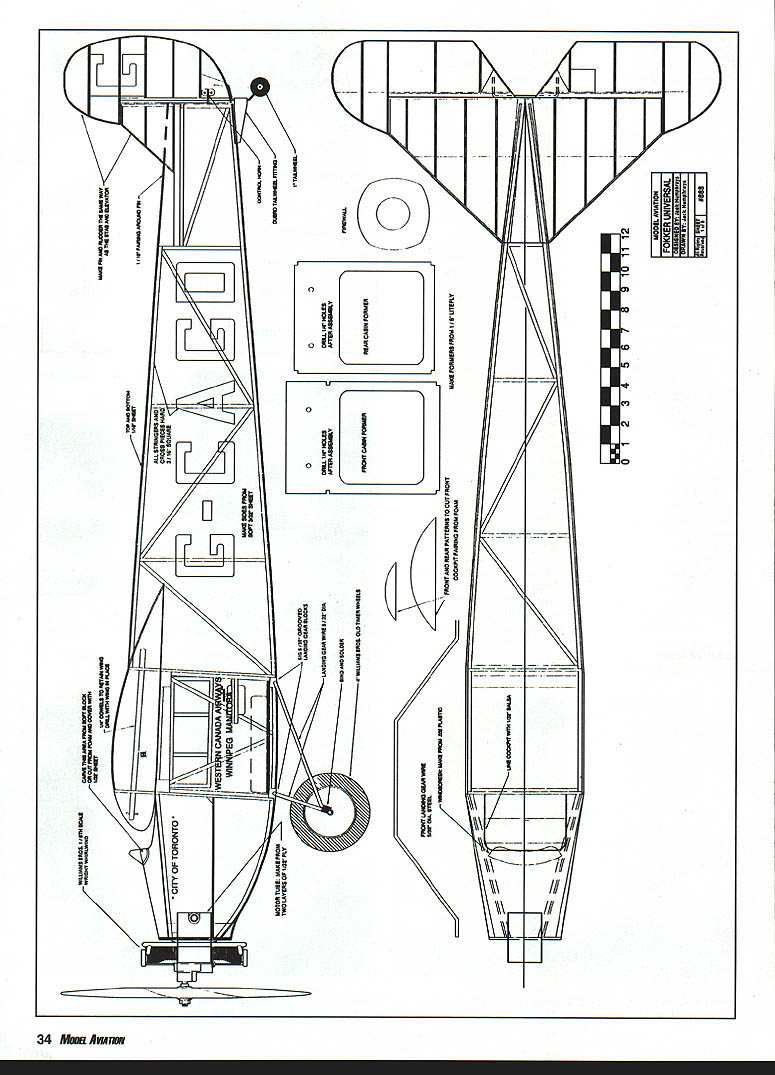
The firewall is mounted to the rear fuselage with the two diagonal pieces of 1/16" sheet shown on the plans. The backs of these pieces should be 1/16" in from the outside edge, to allow for the 1/16" outer sheet. The dummy engine slips over the front half of the motor tube and is held on by the gearbox.
The slight curves on the sides and bottom are made by bending the outside sheets to match the firewall. The curve on the top front, which contains the cockpit, can be cut in foam and sheeted with 1/32" balsa, or you can carve it from soft block. This top deck is removable for access to the speed control and the back of the motor.
A piece of 1/16" balsa across the bottom of the cockpit allows you to mount two servos.
Wing
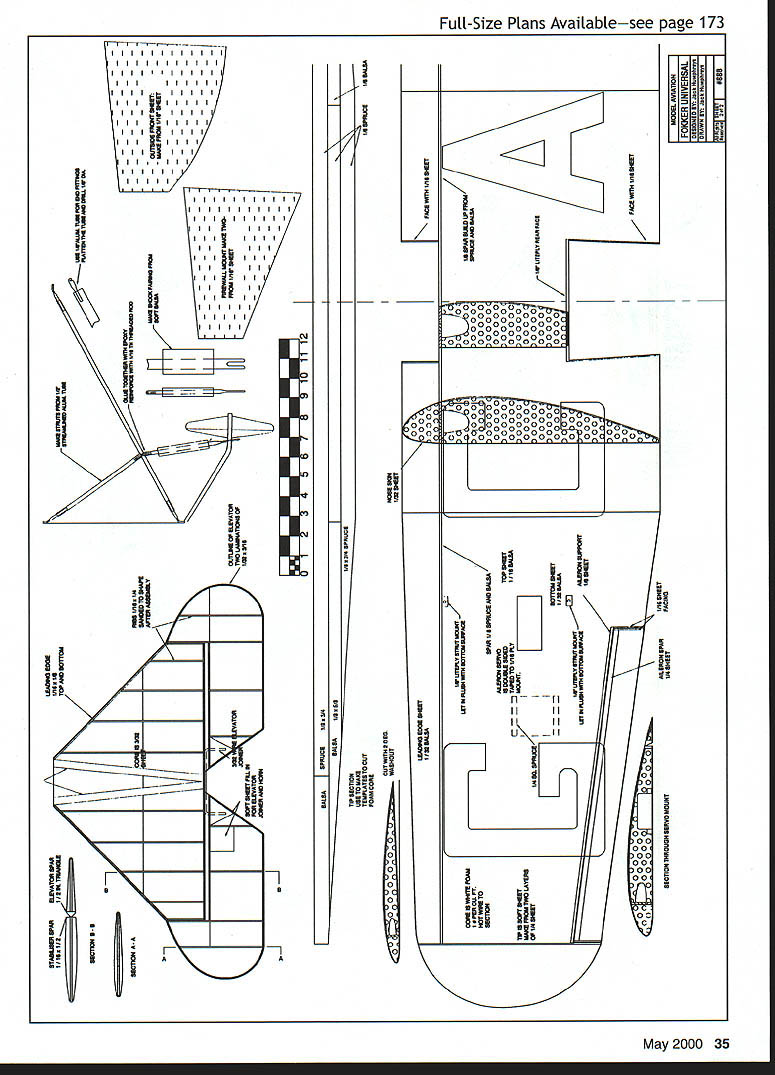
The wing is built around a full-depth 1/8" spar. It is solid spruce at the center, spruce-and-balsa partway out, and solid balsa at the tip. I cut the foam for the leading edge and sheeted it with 1/32" balsa, wrapping the sheet right around the front. This is easy at the center, but you may need to wet it near the tip. The sheeted foam is glued to the spar.
The main portion of the wing is done the same way—sheet first, then glue to the spar. The top is sheeted with 1/16" balsa and the bottom with 1/32". Don't forget to put in the wiring for the servos before gluing to the spar. The wing slides down between the two main fuselage formers. When you are satisfied with the position, drill two 1/4" holes from front to back for the hold-down dowels.
Empennage
The tail is made in the manner popular with English scale modelers. Cut the outline from 3/32" balsa and add spars, ribs, and a laminated outline for the covering to attach cleanly.
Gear and Struts
The landing gear is made from 1/32" wire. The front pattern is shown on the plan. Bend the rear to fit the front, then bind and solder them together.
Wing struts and the rest of the landing-gear struts are not functional. They are made from 1/2" streamline aluminum tube with 1/8" tube inserts as shown on the plan.
The fork in the gear strut allows the gear to flex without bending the tube. The open holes allow them to be snapped into place on #2 servo-mounting screws.
Covering
I used Solartex silver on the fuselage, and shiny yellow MonoKote on the wings and tail. Don't be afraid to use shiny covering; the wings and tail of these old airplanes were very heavily doped to protect them from the elements, since they were usually stored outside.
The struts and the front of the nose were sprayed black. The markings were cut from vinyl.
Flying
The model flies like any normal high-winger. It takes off in about 50 feet, and the initial climbout is brisk.
With the speed control it is fun to make deadstick passes—too high to land but too low to go around—and just when you have everyone's attention, turn on the motor again.
The ailerons are not overly effective, but the rudder is very powerful. Aileron turns look sloppy, but if you put in some rudder, the whole look of the airplane changes for the better as the turns become clean and crisp. Be careful to get the nose down quickly when throttling back, because the Universal has a lot of drag and will slow down very quickly if you let it.
Jack Humphreys 2830 Midland Ave. #3 Scarborough, Ontario Canada M1S 1S4
Transcribed from original scans by AI. Minor OCR errors may remain.

