
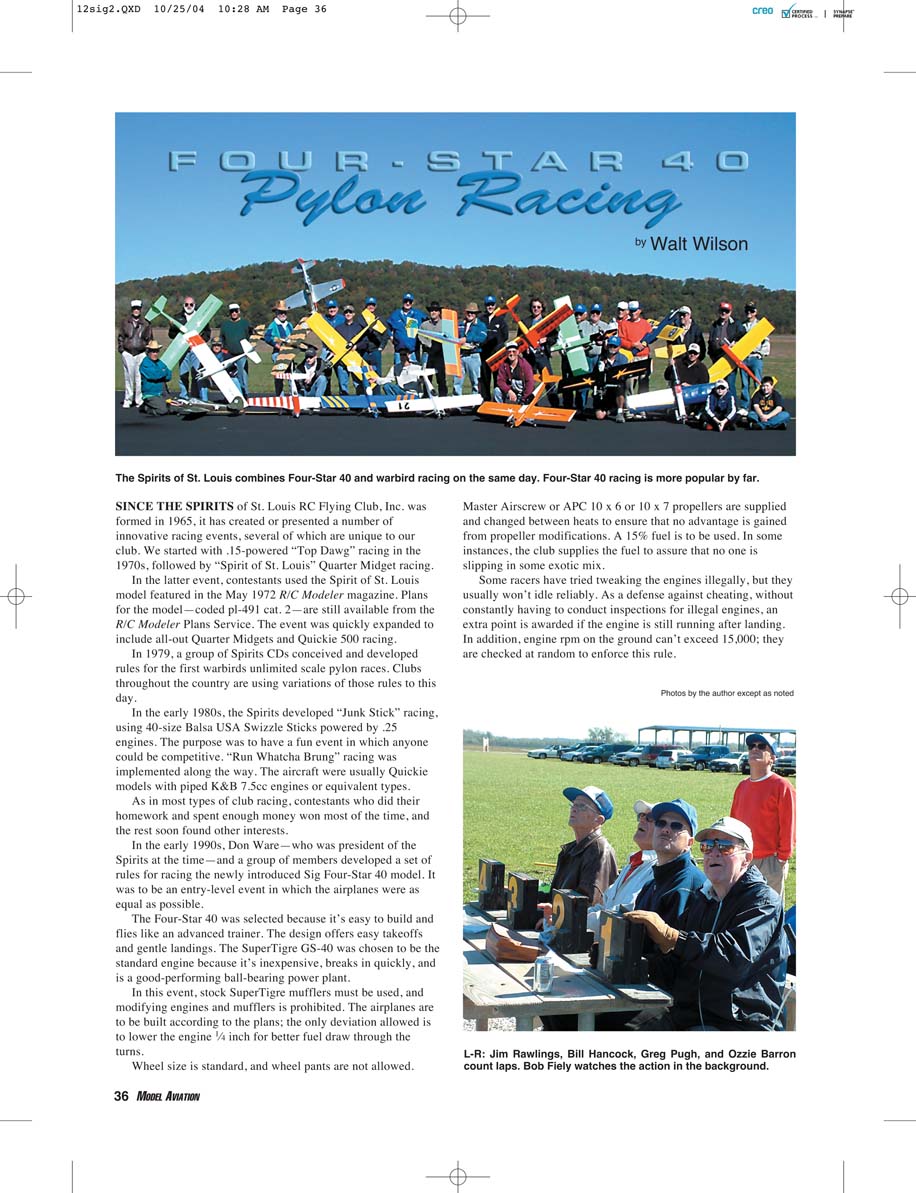
Four-Star 40 Pylon Racing
by Walt Wilson
Since the Spirits of St. Louis RC Flying Club, Inc. was formed in 1965, it has created and presented a number of innovative racing events, several of which are unique to the club. The club started with .15‑powered "Top Dawg" racing in the 1970s, followed by the "Spirit of St. Louis" Quarter Midget event.
In that latter event contestants used the Spirit of St. Louis model featured in the May 1972 R/C Modeler magazine. Plans for the model—coded PL‑491, Cat. 2—are still available from the R/C Modeler Plans Service. The event was quickly expanded to include all‑out Quarter Midgets and Quickie 500 racing.
In 1979 a group of Spirits contest directors conceived and developed rules for the first warbirds unlimited scale pylon races. Clubs throughout the country still use variations of those rules.
In the early 1980s the Spirits developed "Junk Stick" racing, using 40‑size Balsa USA Swizzle Sticks powered by .25 engines. The purpose was to have a fun event in which anyone could be competitive. "Run Whatcha Brung" racing was implemented along the way. The aircraft were usually Quickie models with piped K&B 7.5cc engines or equivalent types.
As in most types of club racing, contestants who did their homework and spent enough money won most of the time; the rest soon found other interests.
In the early 1990s Don Ware—then president of the Spirits—and a group of members developed a set of rules for racing the newly introduced Sig Four‑Star 40 model. The event was intended as an entry‑level class in which the airplanes would be as equal as possible.
The Four‑Star 40 was selected because it is easy to build and flies like an advanced trainer: easy takeoffs and gentle landings. The SuperTigre GS‑40 was chosen as the standard engine because it is inexpensive, breaks in quickly, and is a good‑performing ball‑bearing powerplant.
Rules and equipment
- Stock SuperTigre mufflers must be used. Modifying engines or mufflers is prohibited.
- Airplanes are to be built according to the plans; the only permitted deviation is lowering the engine 1/4 inch for better fuel draw through turns.
- Wheel size is standard; wheel pants are not allowed.
- Master Airscrew or APC 10×6 or 10×7 props are supplied and changed between heats to prevent advantages from propeller modifications.
- A 15% fuel mix is to be used. In some events the club supplies the fuel to ensure compliance.
- An extra point is awarded if the engine is still running after landing (a deterrent to illegal engine tweaking).
- Ground engine rpm cannot exceed 15,000; rpm checks are made at random to enforce this rule.
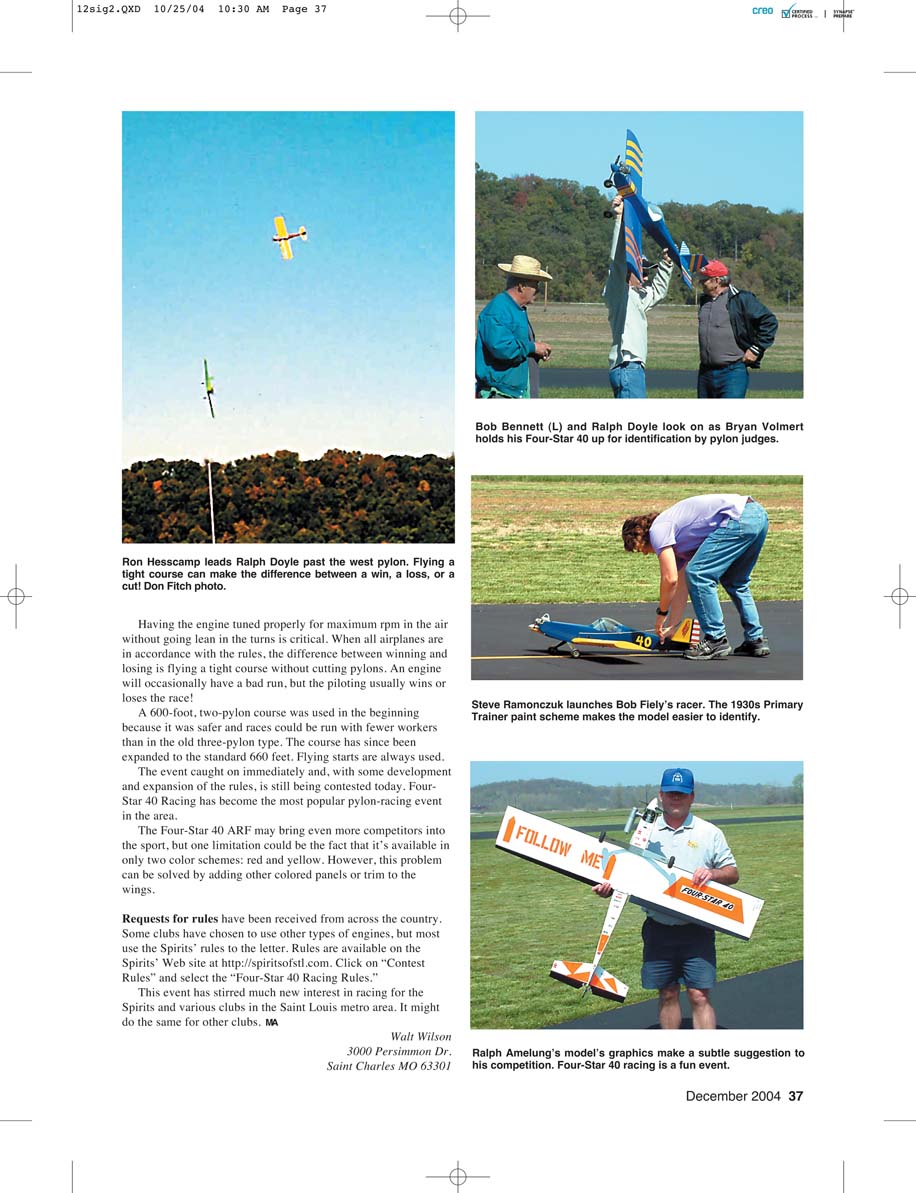
Tuning the engine for maximum rpm in the air without going lean in the turns is critical. When all airplanes conform to the rules, the difference between winning and losing is flying a tight course without cutting pylons. Engines occasionally have bad runs, but piloting usually determines the outcome.
A 600‑foot, two‑pylon course was used originally because it was safer and required fewer workers than a three‑pylon layout. The course was later expanded to the standard 660 feet. Flying starts are always used.
The event caught on immediately and, with further development and expansion of the rules, is still contested today. Four‑Star 40 racing has become the most popular pylon‑racing event in the area.
The Four‑Star 40 ARF may attract even more competitors, but one limitation is that it is available in only two color schemes: red and yellow. This can be remedied by adding other colored panels or trim to the wings.
Requests for the rules have come from across the country. Some clubs have chosen to use different engines, but most adopt the Spirits' rules as written. Rules are available on the Spirits' website: http://spiritsofstl.com — click "Contest Rules" and select "Four‑Star 40 Racing Rules."
This event has generated renewed interest in racing for the Spirits and various clubs in the Saint Louis metro area and might do the same for other clubs.
Walt Wilson 3000 Persimmon Dr. Saint Charles, MO 63301
Transcribed from original scans by AI. Minor OCR errors may remain.

