
Free Flight Duration
Louis Joyner [[email protected]]
The new FAI F1Q electric-powered FF event is explained
Electric-powered free flight has been around for almost 50 years. In the 1959–61 Model Aeronautic Year Book by Frank Zaic, Fred Militky described his electric experiments from 1940 to 1959. After almost 20 years of experimentation he finally achieved a successful flight with his Silentius: a 30-inch-span model that weighed 5 ounces.
If I remember correctly, some variation of that design was later kitted by Graupner, for which Fred was the designer. In the early 1970s Mattel introduced its Super Star foam RTF electric-powered free flight model that featured programmable flight using cams.
Although electric power offered a quiet, easy-starting, no-mess alternative to glow-ignition power, it never seemed to catch on as an event in free flight. Batteries were heavy, and high-revving motors needed gears to be effective.
The two AMA electric free flight events have been lightly supported, with only a few modelers, such as Charles Groth, willing to spend the necessary research time to develop electric power systems (motor, gearing, propeller, and battery) and compatible models.
However, in radio control (RC) electric has become a popular power source for models ranging from park flyers to sailplanes. The strong interest and large market have made a variety of electric motors, batteries, and propellers available at reasonable prices.
Interest in developing an FAI class began growing a few years ago. The idea was to create an event that would offer some of the excitement of F1C without the noise and the grace of F1B without the cost of rubber. The rules were thrashed out informally via e-mail by a group that included Aram Schlosberg, Ross Jahnke, Charles Groth, Dan Tracy, and Tapio Linkosalo. Their proposal was approved in March 2005.
In creating the rules for any free flight event, the most important question is how best to limit performance. The climb phase of the flight can be limited by reducing power (for example, by limiting the displacement of the engine, the weight of the rubber motor, or the length and elasticity of the towline) or, in the case of internal-combustion engines, by limiting the motor run.
The rate of sink in the glide phase can be increased by enlarging the wing loading or total surface loading of the model (as in F1A, F1B, and F1C), by limiting its wingspan (as in P-30), or by requiring a minimum aircraft weight. (Model weight also affects climb; heavier models with the same power don’t fly as high.)
The more restrictive the rules are, the more a premium is placed on model design and construction and the fewer the available optimum design choices. Categories such as F1A Towline, F1B Wakefield Rubber, and F1C Power, which have strictly written rules for total surface area and weight, have each evolved into events in which the aircraft are similar in design and use carbon-fiber composite construction. On the other hand, the F1G Coupe rules specify only rubber motor weight and total model weight. The result is a much wider variety of model sizes, design approaches, and construction methods. Coupe wings can range from as small as 120 square inches to well in excess of 250 square inches. Construction can be conventional balsa and tissue, carbon composite, or almost any combination in between.
In developing the rules for F1Q, the decision was to keep things simple. The battery weight is limited to a maximum of 125 grams for Ni-Cd and NiMH and a maximum of 90 grams for Li-Ion/Poly batteries. The maximum motor run is 25 seconds. There are no model area or weight restrictions. As in F1A, F1B, and F1C, F1Q is flown in seven rounds with 180-second maxes. You can find complete rules for the F1Q event on the National Free Flight Society Web site (http://freeflight.org) or the FAI Web site (www.fai.org/aeromodelling/documents/sc4.asp).
The two AMA electric events also have simple rules; the only limitation is on the batteries. A maximum of 1.5 volts per cell is allowed. Class A models use six cells or less and Class B models use more than six cells.
With an event such as F1Q in which there are no restrictions on airplane size or weight, the big question is where to start.
"I'm starting from the electric motor and designing a model around it," says Aram Schlosberg. "But what motor?"
I asked Charles Groth, who is perhaps the most experienced free-flight electric modeler in the country, for his suggestions. (His Nats-winning electric-powered Big Red was voted a Model of the Year and featured in the 2004 NFFS Symposium.) He said:
"The best combination for the serious beginner at this time is probably different from my [geared] system because of the advent of a type of motor we call the outrunner, which appears to make gears unnecessary. Both static tests on a dynamometer and flight tests show great promise."
The power package Charles suggests for a starting point is a Hacker A20 34S motor, Graupner 8 x 4.5 folding blades, a Castle Creations Phoenix-10 brushless motor controller, and six SR Batteries 190 Series Ni-Cd cells. He uses an electronic timer of his own design for motor run and thermalarizing. He also machined the hub for the folding propeller from Delrin.
The total weight of the power package is just under 4 ounces. The battery weight is approximately 60 grams, which is well below the allowable 125 grams.
The cost breakdown is: motor $60; battery $33; controller $60; and blades roughly $9. Charles makes and sells the electronic timer and propeller hubs. For information e-mail him at [email protected].
What about the model? A good rule of thumb is that the airframe weight should be equal to the power-package weight. That would result in a model that would weigh approximately the same as an F1B Wakefield or a 1/2 A gas model with a wing area of 250–350 square inches.
However, there are a variety of options. Aram Schlosberg said:
"The airframe is an interesting issue. Vic Nippert modified a gas kit, while Dick Ivers has bought an RC electric-powered model and flies it as a Free Flight. Others — Dick and some Finns — have started from a Wakefield.
"However, a Wakefield might be under-area given the battery/controller/motor weight. My approach was to build something like a Power model from the 1960s."
Aram suggests Ernö Frigyes' Taltos F1C design, which won the 1963 World Championship. The 61-inch-span model uses a modified Benedek B-3533b airfoil. There are three-view drawings in the 1964–65 Model Aeronautic Year Book.
Frank Zaic did a detailed analysis of the model's climb characteristics in his Circular Airflow and Model Aircraft. (The Taltos was one of the first winning designs to use auto stabilizer and auto rudder to control the flight path under power.) The Zaic Year Books are available from the AMA.
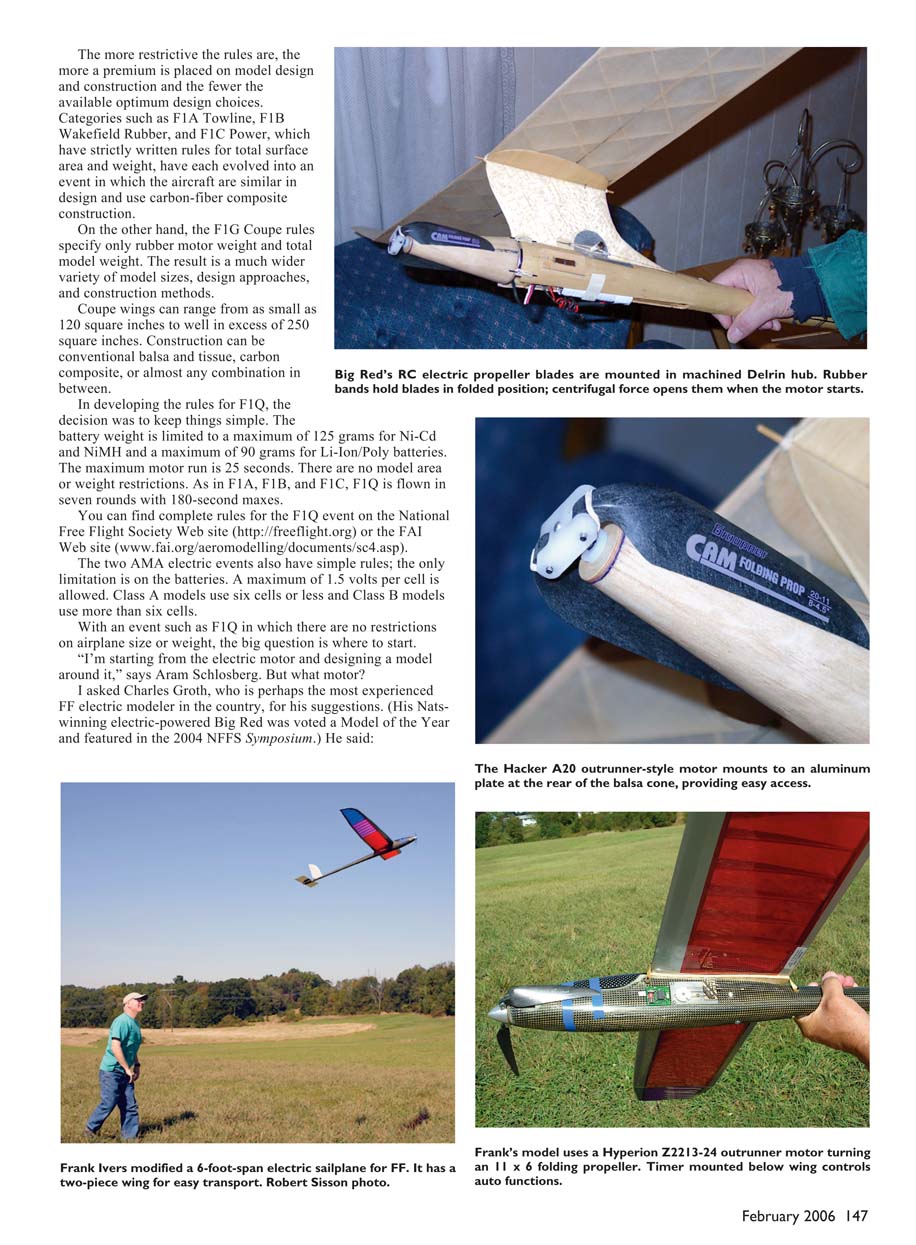
Using a larger motor and the maximum allowable battery weight is basically what Charles Groth has done with his Nats-winning Big Red. In its six-cell Class A configuration it meets the 125-gram maximum battery weight and has an all-up weight of 18.5 ounces. The wing area is 615 square inches.
The model uses a geared motor to swing a 16-inch-diameter propeller. A nose extension prevents a folded blade from hitting the wing. (Using the higher-torque outrunner type of motor would eliminate the need for gears and allow a smaller propeller and slightly shorter nose. But the geared motor may have a slight edge in efficiency.)
Dick Ivers' model is an Omega 1.8E Poly RC electric-powered sailplane from Northeast Sailplane Products. It spans 72 inches, has a wing area of 455 square inches, and uses an SD 7036 airfoil. The wing construction uses a carbon-fiber D-box.
Power is a Hyperion Z2213-24 brushless outrunner turning an Aeronaut 11 x 6 propeller with folding blades. The battery is a Thunder Power ProLite Li-Poly weighing 88.7 grams with connectors. All-up weight is roughly 19 ounces. To control the power pattern Dick uses timer-activated auto stabilizer and auto rudder. He said:
"The stabilizer and rudder move a few seconds after motor shutdown. The model is moving too fast to move the auto surfaces during the motor run.
"These airplanes are closer to F1C or F1J than to F1B. Of course you could start with a lighter battery, with less power, and scale down the model size. I tried the approach of a Wakefield conversion with only modest success. The airfoil is wrong for the speed involved."
(Wakefield rubber models typically have higher-camber wing airfoils than power models.)
With the wide variety of design options, the availability of motors, and the challenge of breaking new ground, F1Q should be an exciting event. The reduced noise should allow models to be flown on some close-in fields that would not allow gas-powered models. Get building. MA
Sources
- Hacker motors: www.hackerbrushless.com
- SR Batteries: www.srbatteries.com
- Castle Creations Phoenix-10 controller: www.castlecreations.com
- Omega 1.8E Poly sailplane: www.nesail.com
Transcribed from original scans by AI. Minor OCR errors may remain.

