
An update on Jedelsky wing construction
Louis Joyner [email protected]
Jedelsky updated
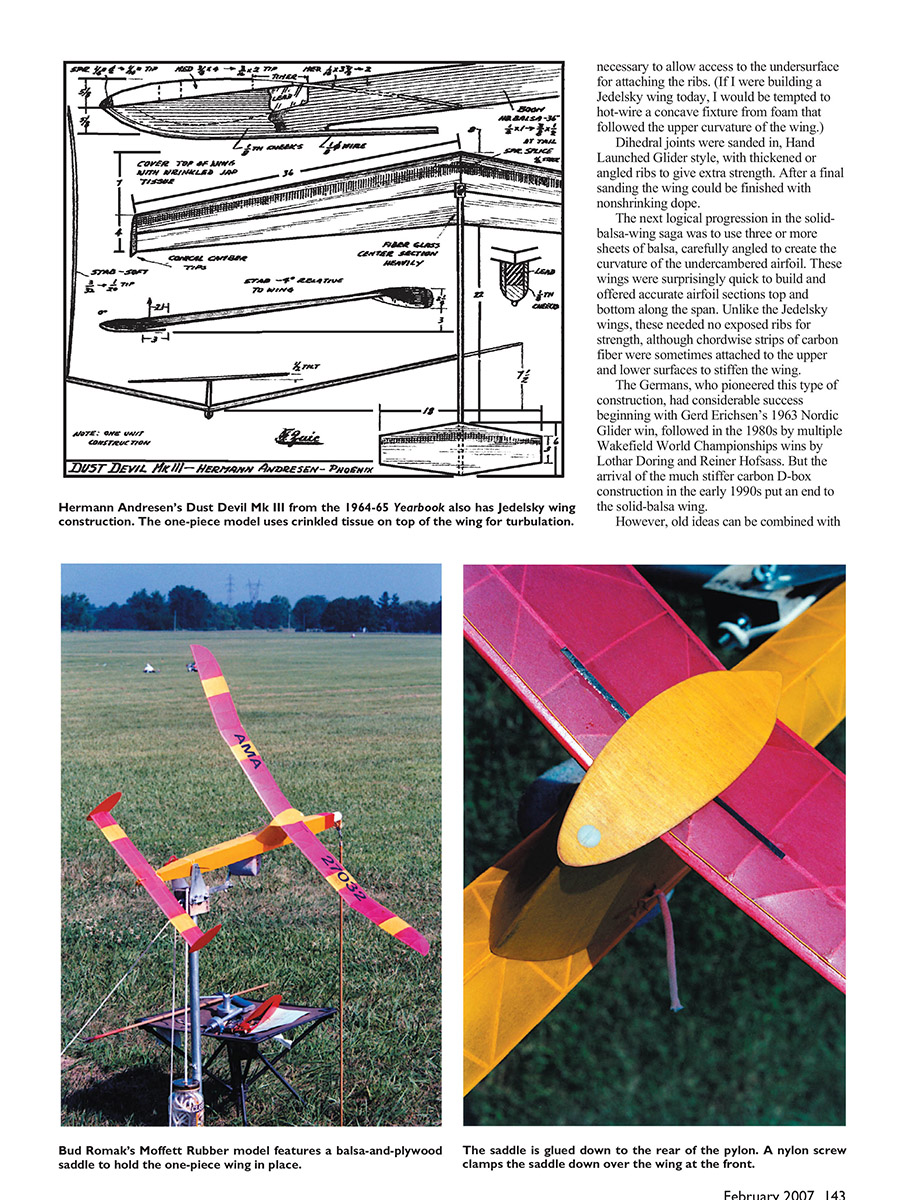
In the 1950s and 1960s Jedelsky wing construction provided an alternative to the usual stick-and-tissue methods. Developed by Eric Jedelsky of Austria, the all-balsa wing was quick to build and produced an accurate upper surface without the sags inherent in most tissue-covered structures.
The wing essentially consisted of two balsa pieces joined along the wing's high point. The front piece was shaped like a hand-launched glider wing, with a flat bottom and a curved upper surface. The rear piece was thin sheet, bent into a slight curve. Widely spaced ribs on the underside of the wing helped maintain the curve of the rear section and keep it at the proper angle relative to the front piece. The ribs were strictly stiffeners and were exposed to the breeze rather than enclosed with tissue covering.
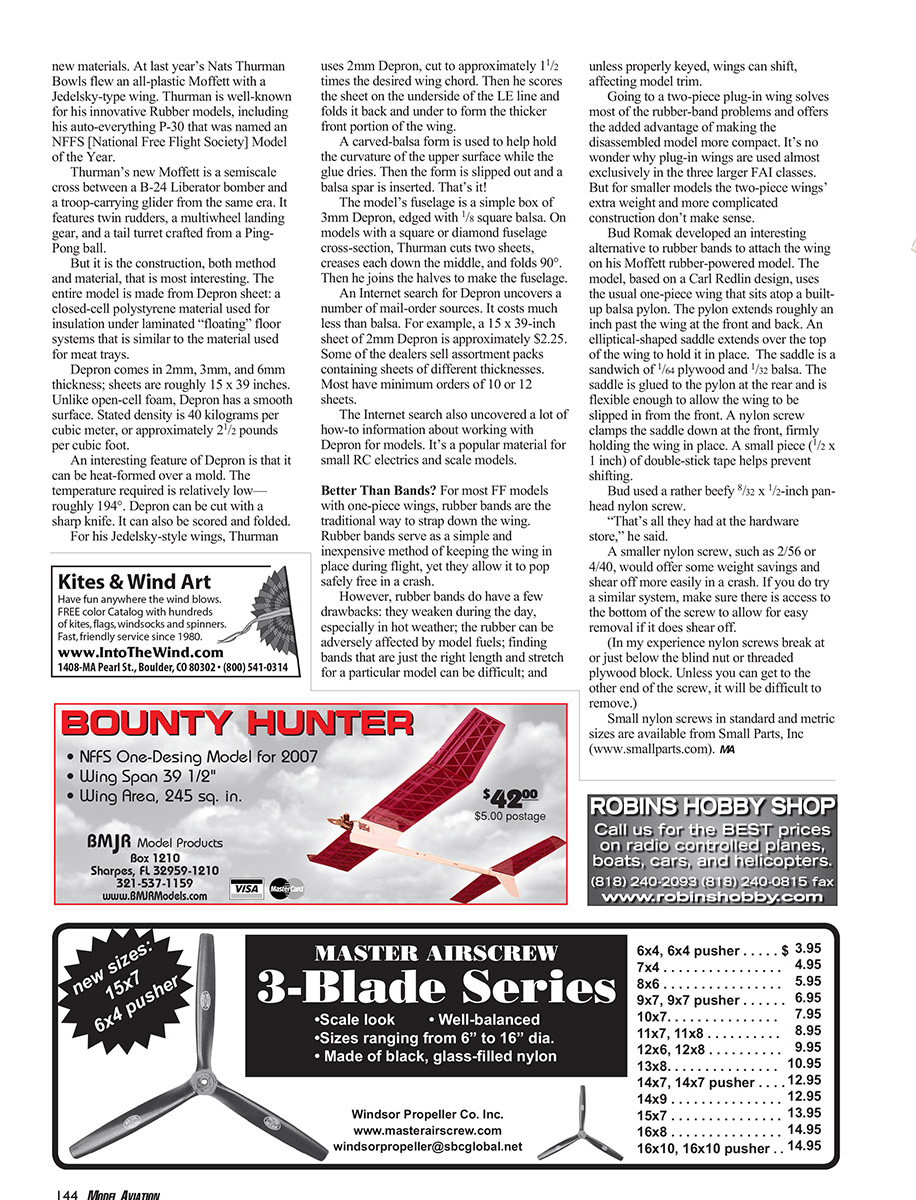
Jedelsky wings were fast to build, making them popular for beginners' models and for experimentation. A look through some Frank Zaic yearbooks from that period shows a wide range of models using Jedelsky wing construction.
Examples from the Model Aeronautic Yearbook:
- Lawrence Wellman's Idiot's Delight A-1 (1964–65) used a 3/16 x 1-1/2-inch balsa front section and a 1/16 x 3-inch rear section to produce a wing with a chord of 4-1/2 inches.
- Ed Turner's A-2 from the same yearbook used 3/8-inch balsa sheet for the front portion of the wing and 1/16-inch sheet for the rear. A strip of spruce afforded the leading edge some protection from inevitable dings.
Construction
Construction was simple. The front section of the wing was roughed out with a razor plane and then carefully sanded to give a flat surface along the top rear. That piece was pinned to the building board upside down with the leading edge elevated above the board.
The thinner rear section was glued to the front section. Ribs were then glued in place to provide the curve to the rear portion of the wing. Building the wing upside down was necessary to allow access to the underside for attaching the ribs. (If building a Jedelsky wing today, one might hot-wire a concave foam fixture that follows the upper curvature of the wing.) Dihedral joints were sanded in, hand-launched-glider style, with thickened or angled ribs to give extra strength. After final sanding the wing could be finished with nonshrinking dope.
Evolution: multi-sheet balsa and later developments
The next logical progression was to use three or more sheets of balsa, carefully angled to create the curvature of an undercambered airfoil. These wings were surprisingly quick to build and offered accurate airfoil sections top and bottom along the span. Unlike the Jedelsky wings, these needed no exposed ribs for strength, although chordwise strips of carbon fiber were sometimes attached to the upper and lower surfaces to stiffen the wing.
The Germans, who pioneered this type of construction, had considerable success beginning with Gerd Erichsen's 1963 Nordic Glider win, followed in the 1980s by multiple Wakefield World Championship wins by Lothar Döring and Reiner Hofsass. The arrival of much stiffer carbon D-box construction in the early 1990s largely ended the era of solid-balsa wings.
However, old ideas can be combined with new materials.
Depron and Thurman's Moffett
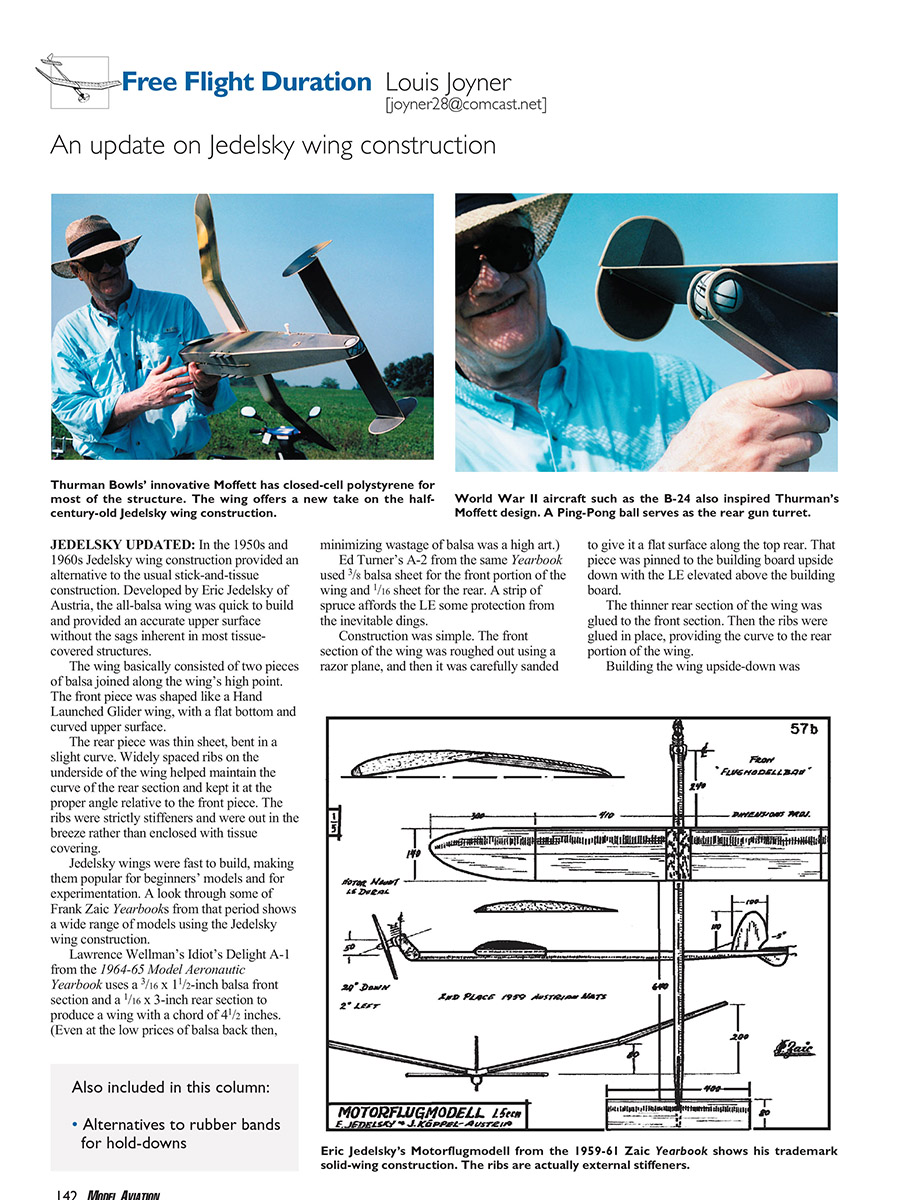
At last year's Nats, Thurman Bowls flew an all-Depron Moffett with a Jedelsky-type wing. Thurman is well known for his innovative rubber models, including an auto-everything P-30 that was named a National Free Flight Society Model of the Year.
Thurman's new Moffett is a semi-scale cross between a B-24 Liberator bomber and a troop-carrying glider from the same era. It features twin rudders, multiwheel landing gear, and a tail turret crafted from a ping-pong ball.
But the construction—both method and material—is most interesting. The entire model is made from Depron sheet: a closed-cell polystyrene material used for insulation under laminated "floating" floor systems that is similar to the material used for meat trays.
Depron characteristics:
- Common thicknesses: 2 mm, 3 mm, and 6 mm.
- Typical sheet size: roughly 15 x 39 inches.
- Smooth surface (unlike open-cell foam).
- Stated density: about 40 kilograms per cubic meter (approximately 2-1/2 pounds per cubic foot).
- Can be heat-formed over a mold; required temperature is relatively low—roughly 194°F.
- Can be cut with a sharp knife, or scored and folded.
For his Jedelsky-style wings Thurman uses 2 mm Depron, cut to approximately 1-1/2 times the desired wing chord. He scores the sheet on the underside along the leading-edge line and folds it back and under to form the thicker front portion of the wing. A carved-balsa form helps hold the curvature of the upper surface while the glue dries; the form is then slipped out and a balsa spar is inserted.
The fuselage is a simple box of 3 mm Depron, edged with 1/8-inch square balsa. On models with a square or diamond fuselage cross-section, Thurman cuts two sheets, creases each down the middle, folds them 90°, then joins the halves to make the fuselage.
An Internet search for Depron uncovers a number of mail-order sources. It costs much less than balsa—for example, a 15 x 39-inch sheet of 2 mm Depron is approximately $2.25. Some dealers sell assortment packs of different thicknesses; most have minimum orders of 10 or 12 sheets. The Internet also uncovers lots of how-to information about working with Depron for models—it's a popular material for small RC electrics and scale models.
Better Than Bands?
For most free-flight models with one-piece wings, rubber bands are the traditional way to strap down the wing. Rubber bands are simple and inexpensive and allow the wing to pop free in a crash. However, rubber bands have drawbacks:
- They weaken during the day, especially in hot weather.
- Rubber can be adversely affected by model fuels.
- Finding bands with the right length and stretch for a particular model can be difficult.
- Unless properly keyed, wings can shift and affect model trim.
Two-piece plug-in wings solve most rubber-band problems and make the disassembled model more compact. That's why plug-in wings are used almost exclusively in the three larger FAI classes. But for smaller models the extra weight and more complicated construction of two-piece wings often don't make sense.
Bud Romak developed an interesting alternative to rubber bands for his Moffett rubber-powered model (based on a Carl Redlin design). The model uses a one-piece wing that sits atop a built-up pylon. The pylon extends roughly an inch past the wing at the front and back. An elliptical-shaped saddle extends over the top of the wing to hold it in place. The saddle is a sandwich of 1/16-inch plywood and 1/32-inch balsa. It is glued to the pylon at the rear and is flexible enough to allow the wing to be slipped in from the front. A nylon screw clamps the saddle down at the front, firmly holding the wing in place. A small piece (1/2 x 1 inch) of double-stick tape helps prevent shifting.
Bud used a rather beefy 5/32 x 1/2-inch panhead nylon screw—"that's all they had at the hardware store," he said. A smaller nylon screw, such as 2-56 or 4-40, would save weight and shear off more easily in a crash. If trying a similar system, make sure there is access to the bottom of the screw to allow easy removal if it does shear off. In my experience, nylon screws break at or just below the blind nut or threaded plywood block; unless you can get to the other end of the screw, removal will be difficult.
Small nylon screws in standard and metric sizes are available from Small Parts, Inc. (www.smallparts.com).
Transcribed from original scans by AI. Minor OCR errors may remain.

