
Free Flight Duration
Louis Joyner [[email protected]]
Reigning in model performance
As FF models improve, the number of flying sites that can accommodate them lessens. Many of those flying sites are, of necessity, located far away from population centers. (The California site is not called "Lost Hills" for nothing.) No wonder that so few people, including most AMA members, have ever seen a contest FF Duration model in action.
To allow FF models to be flown on small fields and to attract new people to FF, model performance must be limited.
For the existing Duration events the rules-makers have, through the years, limited performance by reducing altitude in the climb and by increasing the rate of sink in the glide. But modelers are a competitive and ingenious lot. Every rule to decrease model performance has been answered by improvements in model design, construction, and flying tactics. Most rules changes lead to an increase in a model’s cost and complexity. Changes in aircraft specifications can have a major cost impact. A competitive FAI flier usually has $1,000–$2,000 tied up in each model and typically has at least four. A rules change that would make those models no longer legal might turn that modeler from FF to stamp collecting or fly-fishing.
We need to look at the ways we fly the models we have now. The problem is usually not performance per se, but with models flying off the field. For more than a half century we have had a simple and reliable way to limit model performance: the DT. Controlled by an onboard timer or fuse, the DT pops the tail up, putting the aircraft into a deep stall so it descends rapidly and safely to the ground. For lightly loaded models, more radical DT arrangements such as pop-off or folding wings may be necessary to get the model down from a strong thermal.
The distance a model travels downwind is a function of several factors, only some of which are controlled by model specifications:
- Altitude at the end of climb (influenced by model design).
- Dead-air glide rate of sink (influenced by model design).
- Thermal activity (weather dependent).
- Wind speed (weather dependent).
Many of us have had the enjoyable experience of a contest day with virtually no wind and gentle thermals. Chases are measured in feet — not miles. Even on a more typical day, wind speed and thermal activity are lower in the morning, build to a peak at midafternoon, and then drop back toward evening. However, the way many contests are run pushes the flying into the time of day that is most likely to carry models off the field.
A better approach would be to start early, say 30 minutes after sunup; suspend flying during the middle of the day, when wind and thermal activity peak; and then resume flying in the late afternoon. Maximums could — and should — be adjusted to suit atmospheric conditions and keep models on the field. Such an approach is easy when flying by rounds from designated pole positions, as with the FAI events.
A good example was F1B at the 2006 Nats. Event Director Chuck Markos had read the weather forecasts, which called for increasing wind during the day. He set a higher-than-normal first-round max, knowing that it would most likely be the longest max of the day. As the wind increased, Chuck decreased the max to suit the conditions. The result was that only two or three flights went off the field.
Another approach that works for FAI events with a small number of contestants is to vary round length to suit weather and retrieval conditions. Rounds are set at the usual one hour, but they can be shortened by unanimous consent of the fliers involved.
Compressing the rounds allows more flights to be fit in before thermal and wind activity pick up, yet it allows a competitor the full hour if he or she needs it for a long chase, model repair, or simply to rest.
With the current AMA rules, modelers can fly when they want and often from where they want. This makes it impossible for the CD to change the max after the start of the contest day. Perhaps we need to investigate ways to allow adjustments in the max during the course of the contest. The simplest way would be to fly all AMA events in rounds, with max times adjusted up or down for each round to suit conditions.
Another method would be to require a certain number of flights be completed during a set time period. At the end of that period, the CD would evaluate weather conditions and adjust max length for another group of flights.
For instance:
- Flights 1, 2, and 3 must be flown between 8 a.m. and 11 a.m.
- Flights 4 and 5 must be flown between 11 a.m. and 1 p.m.
- Take a midday break and pick back up at 3 p.m. or 4 p.m.
The max times would not necessarily have to follow the standard length and order established for that event and category. The goal should be to adjust the flying schedule to take maximum advantage of weather conditions and to minimize the number of flights going off-site. (For record purposes the standard max times and flight order would need to apply.)
E-36 Update:
The provisional E-36 electric-power event seems to be attracting increased interest and will be flown at this year's Nats. Several suppliers have stepped up to make getting started easier.
BMJR Model Products is kitting Rex Hinson's Sparks design, which was detailed in the November 2006 FF Duration column. The February 2007 National Free Flight Society (NFFS) Digest featured a construction article for the kit. The laser-cut kit sells for $38.75 plus shipping and handling. Visit the company's Web site at www.bmjrmodels.com for more information.
Two suppliers are offering timers designed for the E-36 event. Hank Nystrom of Texas Timers has developed the Micro E mechanical timer. The faceplate measures 2 1/8" x 15/16" and weighs 7.2 grams, including the snubber capacitor and wires. Run time can be set for up to 30 seconds. (Motor run for the E-36 event is 25 seconds.) Based on the popular Micro I pinch-off timer for Gas models, the Micro E will be familiar to many Power fliers. Check the Web site at www.texastimers.com for the price.
Dick Ivers' E-36 electronic timer offers motor run and DT monitors. The motor run features a soft start and electrodynamic braking at the end of the run. The timer can trip the DT via servo or by using a hot wire to burn through a rubber band. The timer measures just less than 1 inch square and weighs 2.5 grams without wires or cables. The price is $35 plus $4 shipping and handling. A start switch, hotwire board, and cables are extra. E-mail Dick at [email protected] for additional information.
US Team for 2007 FF World Championships
Weather conditions were anything but easy at the US Team Selection Finals held in October at Lost Hills, California. The 71 contestants vying for the nine team slots encountered rain, dust, and winds up to 40 mph.
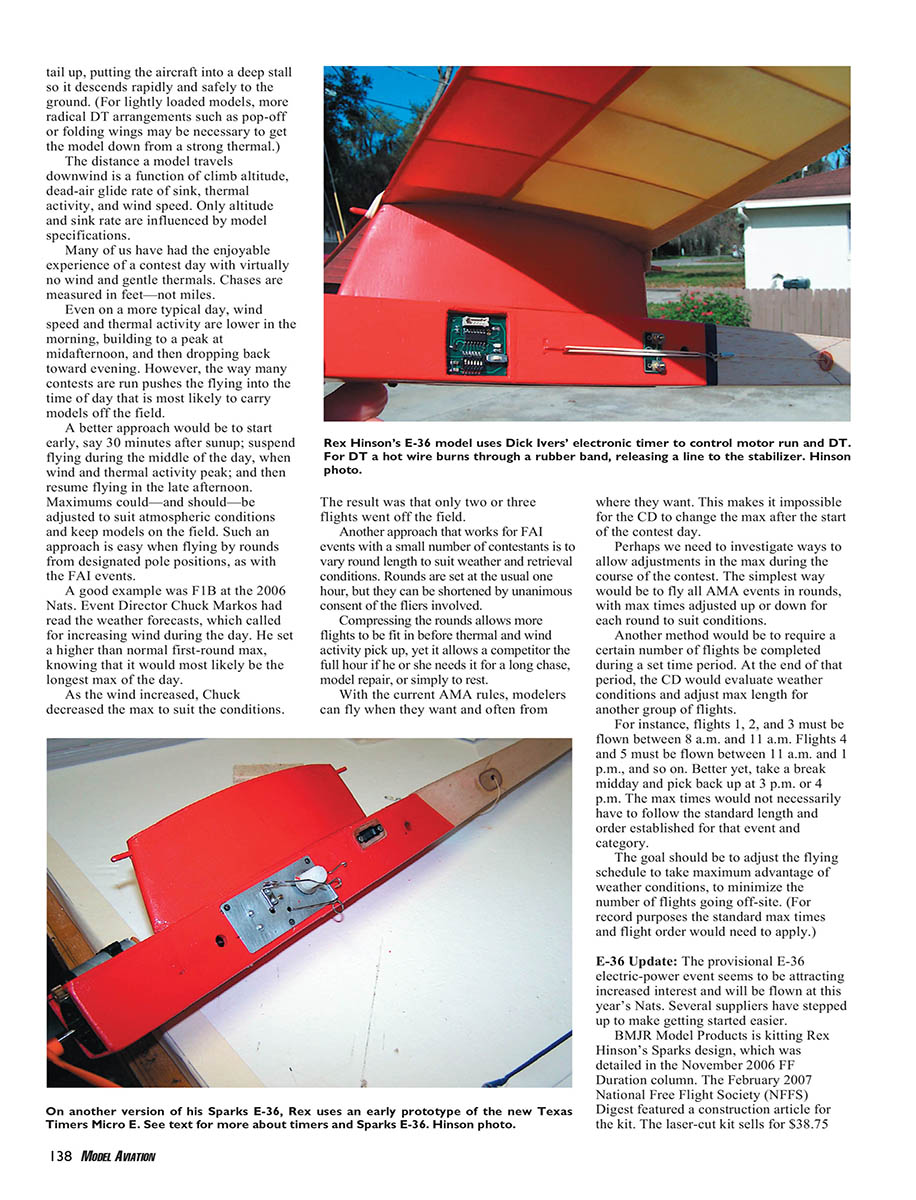
"The weather was really screwy," said F1B Event Director Walt Rozelle. "We saw a little bit of hail at one point." Other event directors were Martin Cowley for F1A and Doug Galbreath for F1C.
The normal Team Selection Finals format is for two of the three events to be flown each day, with the contestants in the third event timing. During the three-day period that should mean each contestant flies seven rounds on each of two days, plus flyoffs.
For this contest F1B and F1C contestants were only able to get in two rounds each before weather conditions forced Finals CD and reigning F1A World Champion Mike McKeever to cancel flying for the rest of the first day.
Weather conditions were better the second day, allowing F1A and F1B contestants to get in the scheduled seven rounds. That left only three people maxed out in F1B, so the US Team of Walt Ghio, Roger Morrell, and Bob Piserchio was set without the need for a flyoff. Bob made the team for the first time. Bjo Biedron dropped two seconds in the last round to finish fourth.
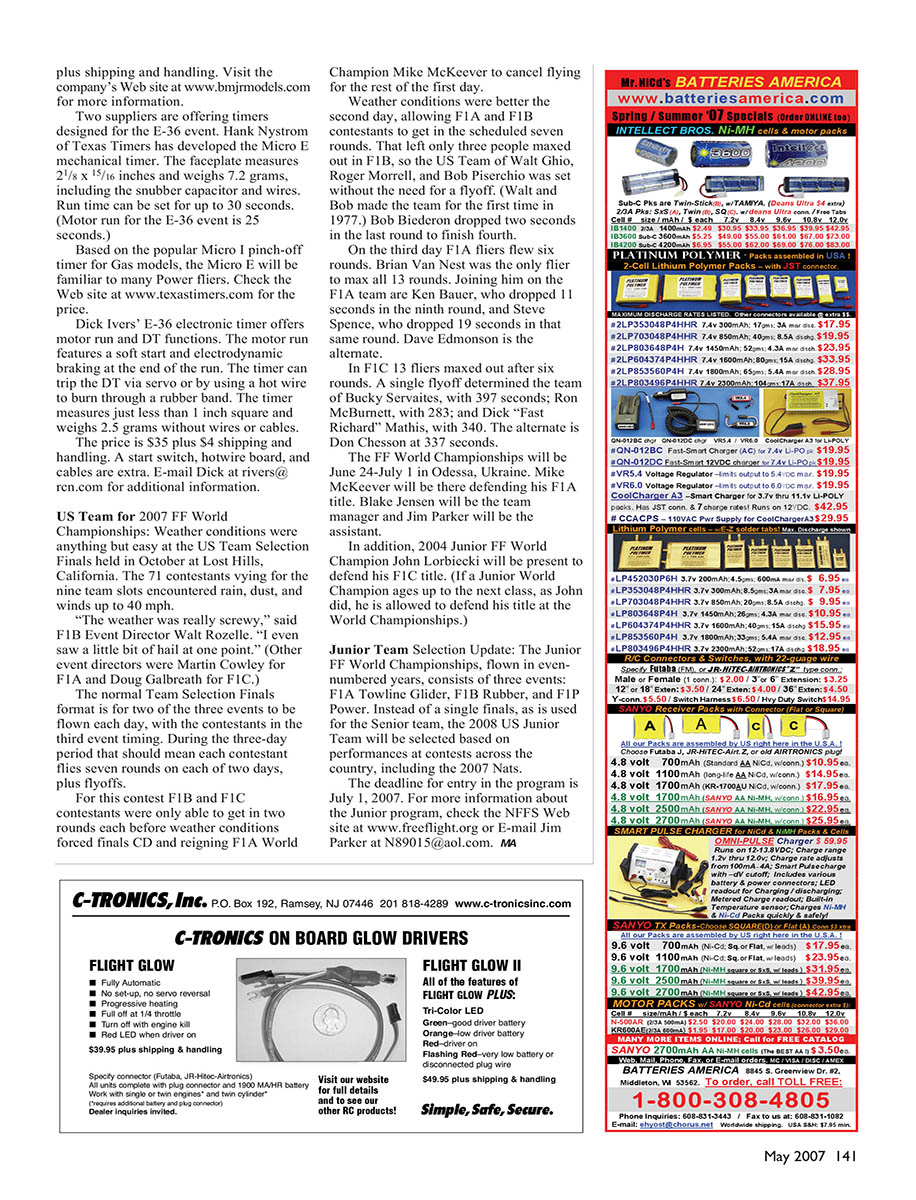
On the two-day F1A contest, fliers flew six rounds. Brian Van Nest was the only flier to max all rounds; joining him on the F1A team are Ken Bauer, who dropped 11 seconds in the ninth round, and Steve Spence, who dropped 19 seconds in that same round. Dave Edmonson is the alternate.
In F1C, 13 fliers maxed out after six rounds. A single flyoff determined the team of Bucky Servaites (397 seconds), Ron McBurnett (283), and Dick "Fast Richard" Mathis (340). The alternate is Don Chesson at 337 seconds.
The FF World Championships will be June 24–July 1 in Odessa, Ukraine. Mike McKeever will be there defending his F1A title. Blake Jensen will be the team manager and Jim Parker will be the assistant. In addition, 2004 Junior FF World Champion John Lorbiecki will be present to defend his F1C title. (If a Junior World Champion ages up to the next class, as John did, he is allowed to defend his title at the World Championships.)
Junior Team Selection Update
The Junior FF World Championships, flown in even-numbered years, consist of three events: F1A Towline Glider, F1B Rubber, and F1P Power. Instead of a single finals, as is used for the Senior team, the 2008 US Junior Team will be selected based on performances at contests across the country, including the 2007 Nats.
The deadline for entry in the program is July 1, 2007. For more information about the Junior program, check the NFFS Web site at www.freeflight.org or e-mail Jim Parker at [email protected].
Transcribed from original scans by AI. Minor OCR errors may remain.

