
Free Flight: Duration
Bob Meuser
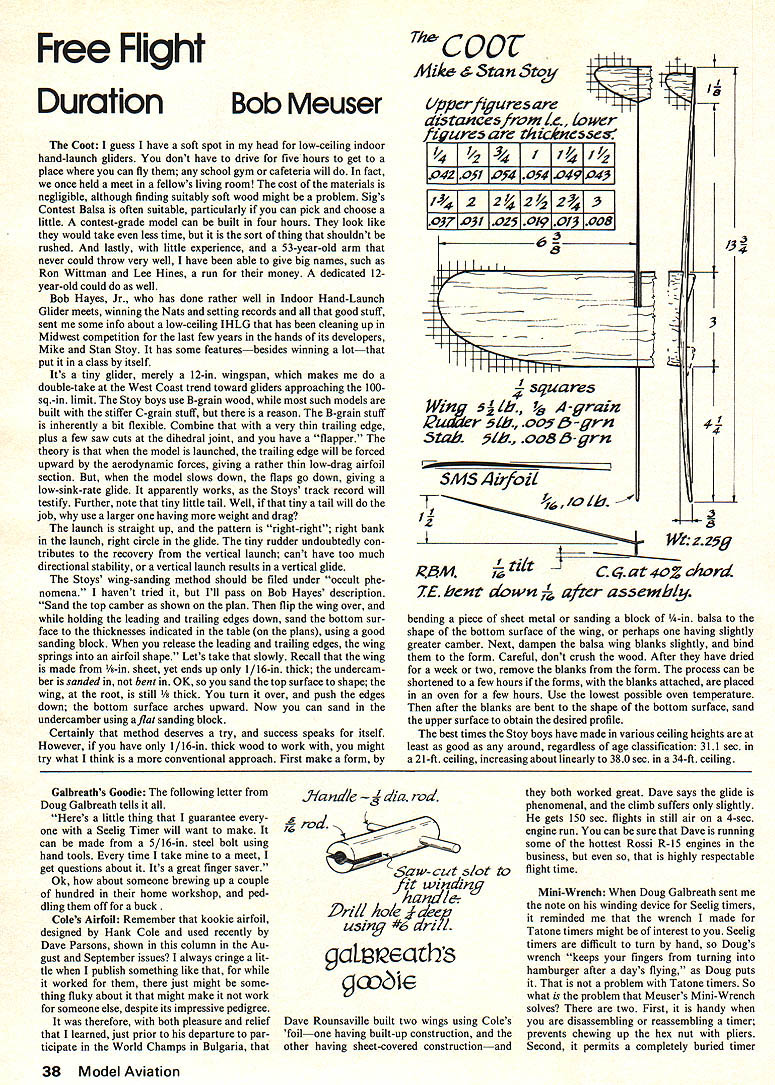
The Coot
I guess I have a soft spot in my head for low-ceiling indoor hand-launch gliders. You don't have to drive for five hours to get to a place where you can fly them; any school gym or cafeteria will do. In fact, we once held a meet in a fellow's living room! The cost of the materials is negligible, although finding suitably soft wood might be a problem. Sig's Contest Albatros is often suitable, particularly if you can pick and choose a little. A contest-grade model can be built in four hours. They look like they would take even less time, but it is the sort of thing that shouldn't be rushed. And lastly, with little experience, and a 53-year-old arm that never could throw very well, I have been able to give big names, such as Ron Wittman and Lee Hines, a run for their money. A dedicated 12-year-old could do as well.
Bob Hayes, Jr., who has done rather well in Indoor Hand-Launch Glider meets, winning the Nats and setting records and all that good stuff, sent me some info about a low-ceiling IHLG that has been cleaning up in Midwest competition for the last few years in the hands of its developers, Mike and Stan Stoy. It has some features—besides winning a lot—that put it in a class by itself.
It's a tiny glider, merely a 12-in. wingspan, which makes me do a double-take at the West Coast trend toward gliders approaching the 100-sq.-in. limit. The Stoy boys use B-grain wood, while most such models are built with the stiffer C-grain stuff, but there is a reason. The B-grain stuff is inherently a bit flexible. Combine that with a very thin trailing edge, plus a few saw cuts at the dihedral joint, and you have a "flapper." The theory is that when the model is launched, the trailing edge will be forced upward by the aerodynamic forces, giving a rather thin low-drag airfoil section. But, when the model slows down, the flaps go down, giving a low-sink-rate glide. It apparently works, as the Stoys' track record will testify. Further, note that tiny little tail. Well, if that tiny a tail will do the job, why use a larger one having more weight and drag?
The launch is straight up, and the pattern is "right-right"; right bank in the launch, right circle in the glide. The tiny rudder undoubtedly contributes to the recovery from the vertical launch; can't have too much directional stability, or a vertical launch results in a vertical glide.
Wing-Sanding and Construction Techniques
The Stoys' wing-sanding method should be filed under "occult phenomena." I haven't tried it, but I'll pass on Bob Hayes' description. "Sand the top camber as shown on the plan. Then flip the wing over, and while holding the leading and trailing edges down, sand the bottom surface to the thicknesses indicated in the table on the plans, using a good sanding block. When you release the leading and trailing edges, the wing springs into an airfoil shape." Let's take that slowly. Recall that the wing is made from 1/16-in. sheet, yet ends up only 1/16-in. thick; the undercamber is sanded in, not bent in. OK, so you sand the top surface to shape; the wing, at the root, is still 1/16 thick. You turn it over, and push the ends down; the bottom surface arches upward. Now you can sand in the undercamber using a flat sanding block.
Certainly that method deserves a try, and success speaks for itself. However, if you have only 1/16-in. thick wood to work with, you might try what I think is a more conventional approach:
- First make a form by bending a piece of sheet metal or sanding a block of 1/4-in. balsa to the shape of the bottom surface of the wing, or perhaps one having slightly greater camber.
- Clamp the balsa wing blanks slightly, and bend them to the form. Careful, don't crush the wood.
- After they have dried for a week or two, remove the blanks from the form.
- The process can be shortened to a few hours if the forms, with the blanks attached, are placed in an oven for a few hours. Use the lowest possible oven temperature.
- After the blanks are bent to the shape of the bottom surface, sand the upper surface to obtain the desired profile.
Performance
The best times the Stoy boys have made in various ceiling heights are at least as good as any around, regardless of age classification: 31.1 sec. in a 21-ft. ceiling, increasing about linearly to 38.0 sec. in a 34-ft. ceiling.
Timer Installation
The timer is set deep into the fuselage, and covered by a thin celluloid window, glued or taped in place. The window has a hole large enough to accept the business end of the mini-wrench, and a slot wide enough to clear the release arm when the timer cuts it loose. The advantage over a conventional surface mount? There are two.
- First, there is less drag; totally unimportant on a D-Gas job, but perhaps important on a Nordic glider, Wakefield rubber-powered model, or small gas model.
- Second, the window presents an additional obstacle to be overcome by dirt particles intent on finding their way into the vital organs of the timer.
Tissue Tantrums
We've been hearing for some time that colored Japanese tissue will no longer be produced. Then out of the blue we received a flier from Sig regarding its new Plyspan: "super-tough laminated Japanese tissue manufactured specifically for covering model airplanes," and available in colors! In response to my "What the heck?" letter, Glen Sigalose explained that Plyspan is currently available in colors, but is no longer produced in colors; when present stocks are gone, that is. Plyspan comes in three weight grades: Lite-Flite, Medium-Flite (white only), and Super-Flite.
- Lite-Flite would pass for good old-fashioned Japanese tissue. Its weight is about the same, and if anything it is more uniform and closer grained than some; might take less dope to seal the pores.
- Super-Flite is about twice the weight of regular tissue, seems a little more porous than the Lite-Flite but less porous than some other heavy paper covering materials. It might well serve as a substitute for expensive and time-consuming double-tissue coverings used on larger gas models.
- Medium-Flite lies in between but comes in white only.
Here are some other sources of tissue:
- Peck-Polymers (now combined with W.C. Hannegan Graphics plans) carries Super-Lite Japanese tissue in five colors plus white, at 20¢ per 20 x 18 in. sheet. They also sell their older P-P Tissue in colors at 15¢ per sheet. Address: P.O. Box 2498, La Mesa, Calif. 92041.
- Old-Timer Models (Jim Noonan): ten different paper coverings, some in colors. P.O. Box 18002, Milwaukee, Wisc. 53218.
- Micro-X Products: Japanese tissue in several colors. P.O. Box 1063, Lorain, Ohio 44055.
- Marlow Engineering sells Featherlite Tissue in 14 colors, including aluminum and olive drab; 20¢ each for 20 x 30 in. sheets. Write: 6850 Vineland, North Hollywood, Calif. 91605. It is about 50% heavier than the average Japanese tissue.
- Bill Wilson will send a sample book of 19 colors for a dime and a stamped envelope. Bill Wilson, P.O. Drawer Y, Kountze, Texas 77625.
- Blue Ridge Models has an ample supply of the same fine tissue it puts in its Coupe kits. Colors: yellow, orange, and white. Minimum order 20 sheets at 20¢ per 18 x 20 in. sheet plus $1 postage and handling.
If you are either an individual free-flighter or a cottage-industry kit manufacturer, you might check it out. Colors are yellow, orange, and white. Minimum order 20 sheets, at 20¢ per 18 x 20 sheet plus $1 postage and handling.
Industry Notes and Kits
FF Duration/Meuser — continued from page 39
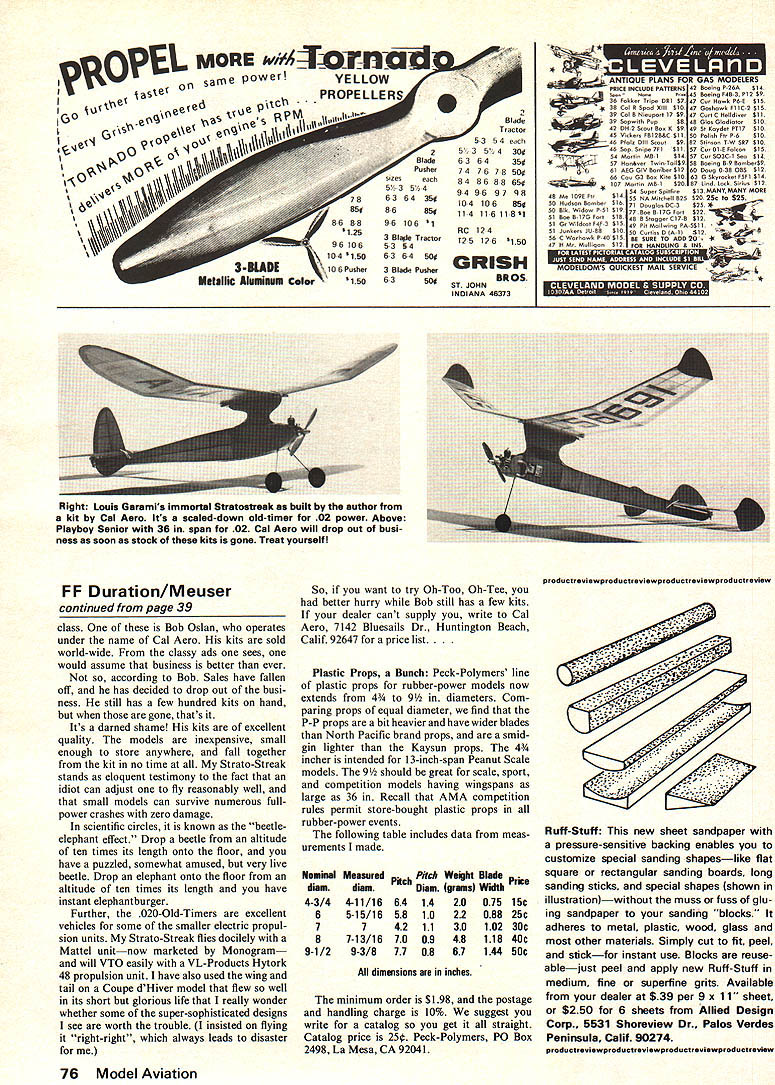
One of the small-kit makers is Bob Oslan, who operates under the name of Cal Aero. His kits are sold world-wide. From the class ads one sees, one would assume that business is better than ever.
Not so, according to Bob. Sales have fallen off, and he has decided to drop out of the business. He still has a few hundred kits on hand, but when those are gone, that's it. It's a darned shame! His kits are of excellent quality. The models are inexpensive, small enough to store anywhere, and fall together from the kit in no time at all. My Strato-Streak stands as eloquent testimony to the fact that an idiot can adjust one to fly reasonably well, and that small models can survive numerous full-scale crashes with zero damage. In scientific circles, it is known as the "beetle-elephant effect." Drop a beetle from an altitude of ten times its length onto the floor, and you have a puzzled, somewhat amused, but very live beetle. Drop an elephant onto the floor from an altitude of ten times its length and you have instant elephantburger.
Further, the .020-OlD-Timers are excellent vehicles for some of the smaller electric propulsion units. My Strato-Streak flies nicely with a Mattel unit—now marketed by Monogram—and will VTO easily with a VL-Products Hytor 48 propulsion unit. I have also used the wing and tail on a Coupe d'Hiver model that flew so well in its short but glorious life that I really wonder whether some of the super-sophisticated designs are worth the trouble. (I insisted on flying it "right-right", which always leads to disaster for me.)
So, if you want to try Oh-Too, Oh-Tee, you had better hurry while Bob still has a few kits. If your dealer can't supply you, write to Cal Aero, 7142 Blasuis Dr., Huntington Beach, Calif. 92647 for a price list.
Plastic Props
Peck-Polymers' line of plastic props for rubber-power models now extends from 4¾ to 9½ in. diameters. Comparing props of equal diameter, we find that the P-P props are a bit heavier and have wider blades than North Pacific brand props, and are a snugger fit in the Kaysun props. The 4¾ inch is intended for 13-inch-span Peanut Scale models. The 9½ should be great for scale, sport, and competition models having wingspans as large as 36 in. Recall that AMA competition rules permit store-bought plastic props in all rubber-power events.
All dimensions are in inches.
The minimum order is $1.98, and the postage and handling charge is 10%. We suggest you write for a catalog so you get it all straight. Catalog price is 25¢. Peck-Polymers, P.O. Box 2498, La Mesa, CA 92041.
Transcribed from original scans by AI. Minor OCR errors may remain.

