

Free Flight Indoor
John Kagan [email protected]
Big doings at the Kibbie Dome Annual
Also included in this column:
- Battle Near Seattle IHLG competition
- US F1D team selection
- The Van Nuys, California, "Local Scene"
Kibbie Dome 2005
Every "game" has its big events that cultivate lots of local activity; college football has the bowl games and dogs have the Westminster Kennel Club show. For indoor free flight on the west half of the country, it's the Kibbie Dome Annual in Moscow, Idaho.
For five days in July this fantastic site hosts one of the US's biggest competitions, with a large number of local, nationwide, and international competitors in attendance. I had the opportunity to go this year, so for those who haven't had the pleasure of flying there I'll give you some of my impressions on the venue and location.
Getting there was a breeze. Moscow is an easy 1.5-hour drive south from the Spokane, Washington, airport—a ride made even more enjoyable by the spectacular rolling hills and farmland scenery. I had previously been under the impression that this event was remote and difficult to reach, but nothing could have been further from the truth.
Spokane is a major airline hub, so finding a flight was simple. At the same time, the city is small enough that things such as car rentals were affordable. This was easy traveling.
The town of Moscow is college oriented, with the University of Idaho situated prominently in the center. The downtown area has a young feel to it, with several coffee houses, pawn shops with some pretty cool stuff, and even a hobby store. There were places to go, but not many people to go there; this was summer break, and with all the kids gone the streets were deserted.
We were supposed to begin our session during the day Saturday, but a women's volleyball camp was finishing up in the dome. Some modelers considered this a problem; go figure! The rest of us took the opportunity to relax after all the traveling and watched the final games from the stands. Later that evening, after the local work crew disassembled the nets and flooring, we carted in our stuff and got to flying.
The Kibbie Dome is a great building. One striking feature is the white ceiling tiles suspended a few feet below the actual roof. They make the place feel bright, but it's also much more difficult to see a model at high altitude. That, along with the intense lights lining the sides, makes steering quite a challenge.
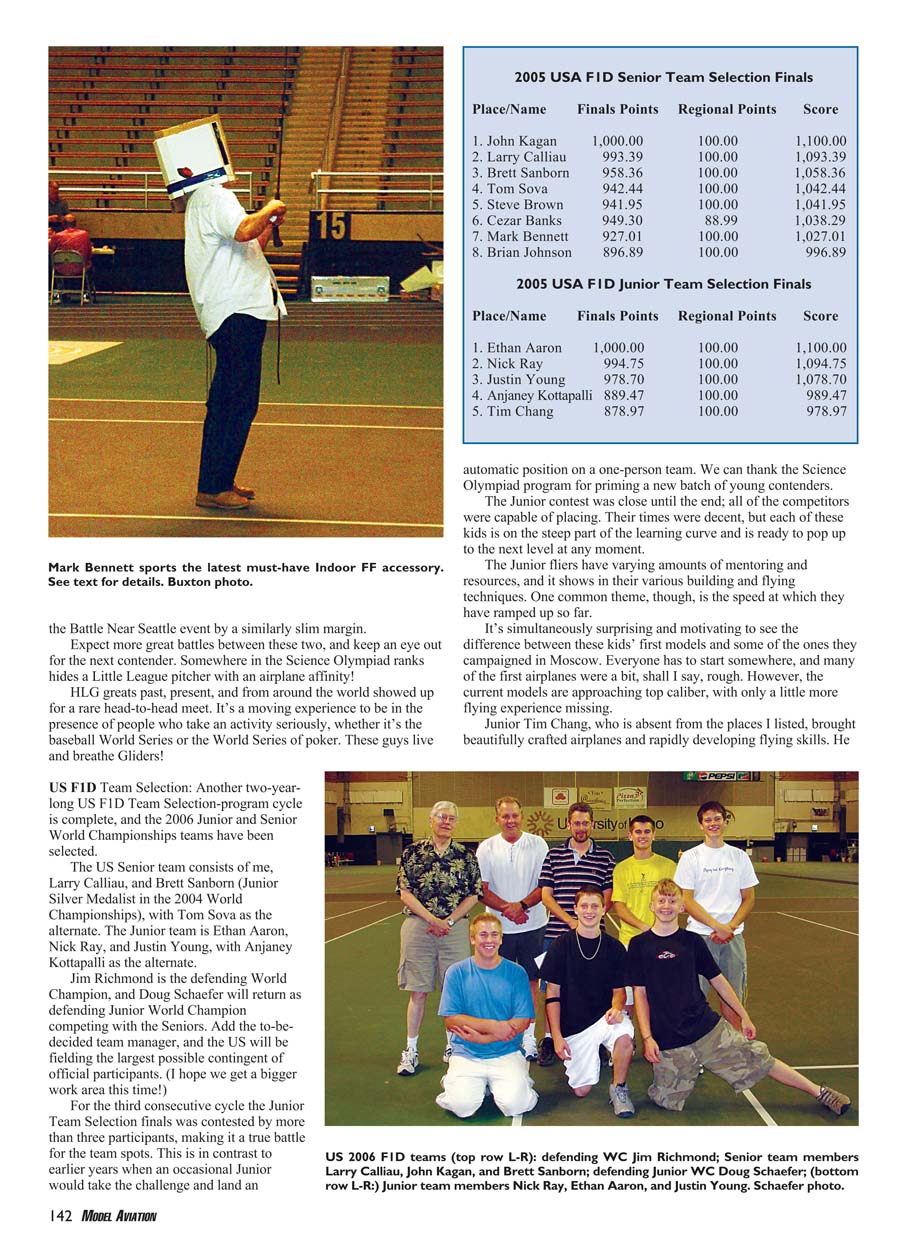
Mark Bennett came up with a unique solution. He chopped a FedEx box into a set of personal blinders, complete with ear holes. I don't know how well it worked, but it does teach one useful lesson: don't worry about anyone making fun of you!
The ceiling tiles are also capable of trapping airplanes that are unfortunate enough to fly between the gaps. Several MiniSticks, F1Ls, and an errant balloon made it on top of the suspended platforms. One Catapult Glider even knife-edged right between the tiles, disappearing in an instant!
On the plus side, the dome staff was often willing to go up into the space above the ceiling and poke airplanes off the tiles with a long pole. Many models were retrieved this way, much to the delight of their reunited owners.
Andy Tagliarico and company did a superb job of arranging and running the events. During the awards he happily reported that this year's turnout had been the largest ever.
The week's activities included two special events in addition to the regular Kibbie Dome Annual: the international Battle Near Seattle Indoor Hand Launched Glider (IHLG) extravaganza and the 2005 US F1D Team Selection Finals.
Battle Near Seattle (IHLG)
Jim Buxton is going to provide an in-depth report on the Battle Near Seattle IHLG competition in an upcoming National Free Flight Society Digest. Look for it and get the details about some significant happenings in the glider world.
Mark Bennett proved the feasibility of discus-launched free flight indoor models in a major way by shattering the F1N record. (That was shortly before he proved a case for a wing strength/stiffness requirement by shattering his glider.)
This could be a positive development for HLG, allowing more people to be competitive at the highest levels. I think HLG participation would benefit from having separate discus- and javelin-launch categories, but some feel it could splinter an already small group.
Jim Lewis (who had recently swept the Outdoor HLG and Old-Time HLG Nationals) is neck-and-neck with Jim Buxton as the dominant force in the IHLG world. Jim Buxton narrowly won the Kibbie Dome Annual HLG contest, and Jim Lewis took the Battle Near Seattle event by a similarly slim margin. Expect more great battles between these two, and keep an eye out for the next contender. Somewhere in the Science Olympiad ranks hides a Little League pitcher with an airplane affinity!
HLG greats past, present, and from around the world showed up for a rare head-to-head meet. It’s a moving experience to be in the presence of people who take an activity seriously, whether it’s the baseball World Series or the World Series of poker. These guys live and breathe gliders!
US F1D Team Selection
Another two-year US F1D Team Selection-program cycle is complete, and the 2006 Junior and Senior World Championships teams have been selected.
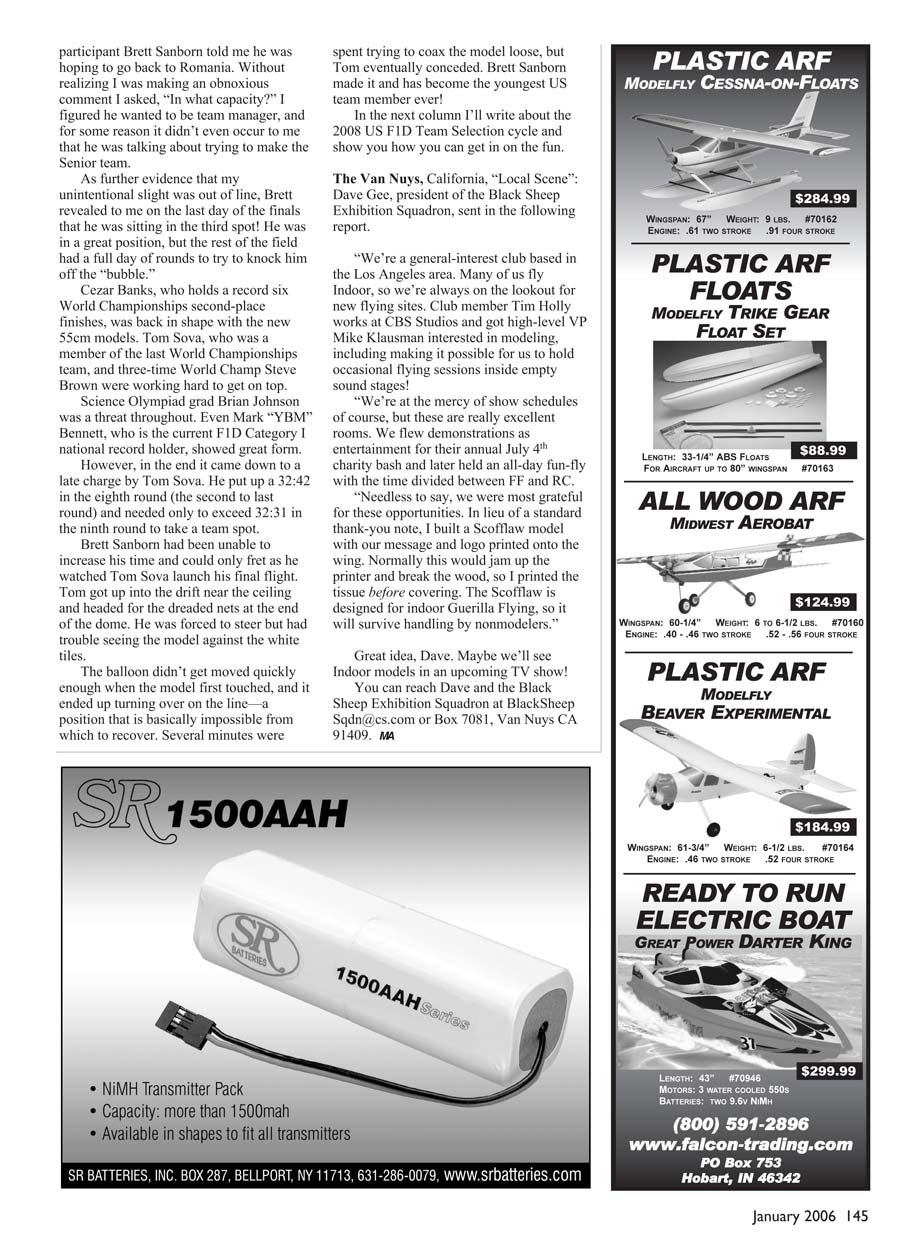
The US Senior team consists of me, Larry Calliau, and Brett Sanborn (Junior Silver Medalist in the 2004 World Championships), with Tom Sova as the alternate. The Junior team is Ethan Aaron, Nick Ray, and Justin Young, with Anjaney Kottapalli as the alternate.
Jim Richmond is the defending World Champion, and Doug Schaefer will return as defending Junior World Champion competing with the Seniors. Add the to-be-decided team manager, and the US will be fielding the largest possible contingent of official participants. (I hope we get a bigger work area this time!)
For the third consecutive cycle the Junior Team Selection finals was contested by more than three participants, making it a true battle for the team spots. This is in contrast to earlier years when an occasional junior would take the challenge and land an automatic position on a one-person team. We can thank the Science Olympiad program for priming a new batch of young contenders.
The Junior contest was close until the end; all of the competitors were capable of placing. Their times were decent, but each of these kids is on the steep part of the learning curve and is ready to pop up to the next level at any moment. The junior fliers have varying amounts of mentoring and resources, and it shows in their various building and flying techniques. One common theme, though, is the speed at which they have ramped up so far.
It’s simultaneously surprising and motivating to see the difference between these kids’ first models and some of the ones they campaigned in Moscow. Everyone has to start somewhere, and many of the first airplanes were a bit, shall I say, rough. However, the current models are approaching top caliber, with only a little more flying experience missing.
Junior Tim Chang brought beautifully crafted airplanes and rapidly developing flying skills. He missed a spot on the team but, fortunately for the US, he is only 15 and has another cycle as an FAI Junior. Expect to see more of his name in the future.
The Senior competition was tight as well; almost the entire field earned more than 1,000 points out of 1,100. As fliers become more familiar with the not-so-new-anymore 55 cm models, the gap between times is shrinking to be much smaller than with the previous models.
My experience in the finals started tough. I struggled to find the right setup on the first day, putting up a continuous stream of partial-motor flights. Jim Lewis commented that I was a "testing fool," but hey — if the partial-motor test doesn't do the time, what's the point of flying an official?
Just when I thought I had it right, my last full-motor flight of the day landed on one of the curtain rods that sit approximately 15 feet from the top. I learned that the Kibbie Dome has a strong jet stream near the tiles and decided that the extra time gained above the curtain rod wasn't worth the drift risk. I had one flight move roughly 100 feet down the building in five minutes, flying through the two sets of cables suspending the rods!
My models were returned to fly just below the curtain rods, and on the second day I managed a 34:14 fourth-round flight. Before I even got a chance to rest on my laurels, Larry Calliau topped it with a 34:25.
In the sixth round he and I put up flights at the same time. Our models slowly circled each other to the top and then, just when they were out of danger from getting into the roof, they mid‑aired and came down in a clump. We disentangled the two airplanes and headed back to our tables to try again.
On the relaunch Larry's model got approximately 4 feet away before something failed and the model imploded—instant confetti. Having a reasonably comfortable lock on one of the top three slots, he decided not to risk any more models. My flight bumped me into first, and I decided to sit back and watch the field too.
Participant Brett Sanborn told me he was hoping to go back to Romania. Without realizing I was making an obnoxious comment I asked, "In what capacity?" I figured he wanted to be team manager, and for some reason it didn't even occur to me that he was talking about trying to make the Senior team. As further evidence that my unintentional slight was out of line, Brett revealed to me on the last day of the finals that he was sitting in the third spot! He was in a great position, but the rest of the field had a full day of rounds to try to knock him off the "bubble."
Cezar Banks, who holds a record six World Championships second-place finishes, was back in shape with the new 55 cm models. Tom Sova, who was a member of the last World Championships team, and three-time World Champ Steve Brown were working hard to get on top.
Science Olympiad grad Brian Johnson was a threat throughout. Even Mark "YBM" Bennett, who is the current F1D Category I national record holder, showed great form.
However, in the end it came down to a late charge by Tom Sova. He put up a 32:42 in the eighth round (the second to last round) and needed only to exceed 32:31 in the ninth round to take a team spot.
Brett Sanborn had been unable to increase his time and could only fret as he watched Tom Sova launch his final flight. Tom got up into the drift near the ceiling and headed for the dreaded nets at the end of the dome. He was forced to steer but had trouble seeing the model against the white tiles.
The balloon didn't get moved quickly enough when the model first touched, and it ended up turning over on the line—a position that is basically impossible from which to recover. Several minutes were spent trying to coax the model loose, but Tom eventually conceded. Brett Sanborn made it and has become the youngest US team member ever!
In the next column I'll write about the 2008 US F1D Team Selection cycle and show you how you can get in on the fun.
2005 USA F1D Senior Team Selection Finals
- John Kagan — Finals Points 1,000.00, Regional Points 100.00, Score 1,100.00
- Larry Calliau — Finals Points 993.39, Regional Points 100.00, Score 1,093.39
- Brett Sanborn — Finals Points 958.36, Regional Points 100.00, Score 1,058.36
- Tom Sova — Finals Points 942.44, Regional Points 100.00, Score 1,042.44
- Steve Brown — Finals Points 941.95, Regional Points 100.00, Score 1,041.95
- Cezar Banks — Finals Points 949.30, Regional Points 88.99, Score 1,038.29
- Mark Bennett — Finals Points 927.01, Regional Points 100.00, Score 1,027.01
- Brian Johnson — Finals Points 896.89, Regional Points 100.00, Score 996.89
2005 USA F1D Junior Team Selection Finals
- Ethan Aaron — Finals Points 1,000.00, Regional Points 100.00, Score 1,100.00
- Nick Ray — Finals Points 994.75, Regional Points 100.00, Score 1,094.75
- Justin Young — Finals Points 978.70, Regional Points 100.00, Score 1,078.70
- Anjaney Kottapalli — Finals Points 889.47, Regional Points 100.00, Score 989.47
- Tim Chang — Finals Points 878.97, Regional Points 100.00, Score 978.97
Tim Chang missed a spot on the team, but, fortunately for the US, he is only 15 and has another cycle as an FAI Junior. Expect to see more of his name in the future.
The Senior competition was tight as well; almost the entire field earned more than respectable scores and any number of flights could have changed the outcome.
The Van Nuys, California, "Local Scene"
Dave Gee, president of the Black Sheep Exhibition Squadron, sent in the following report.
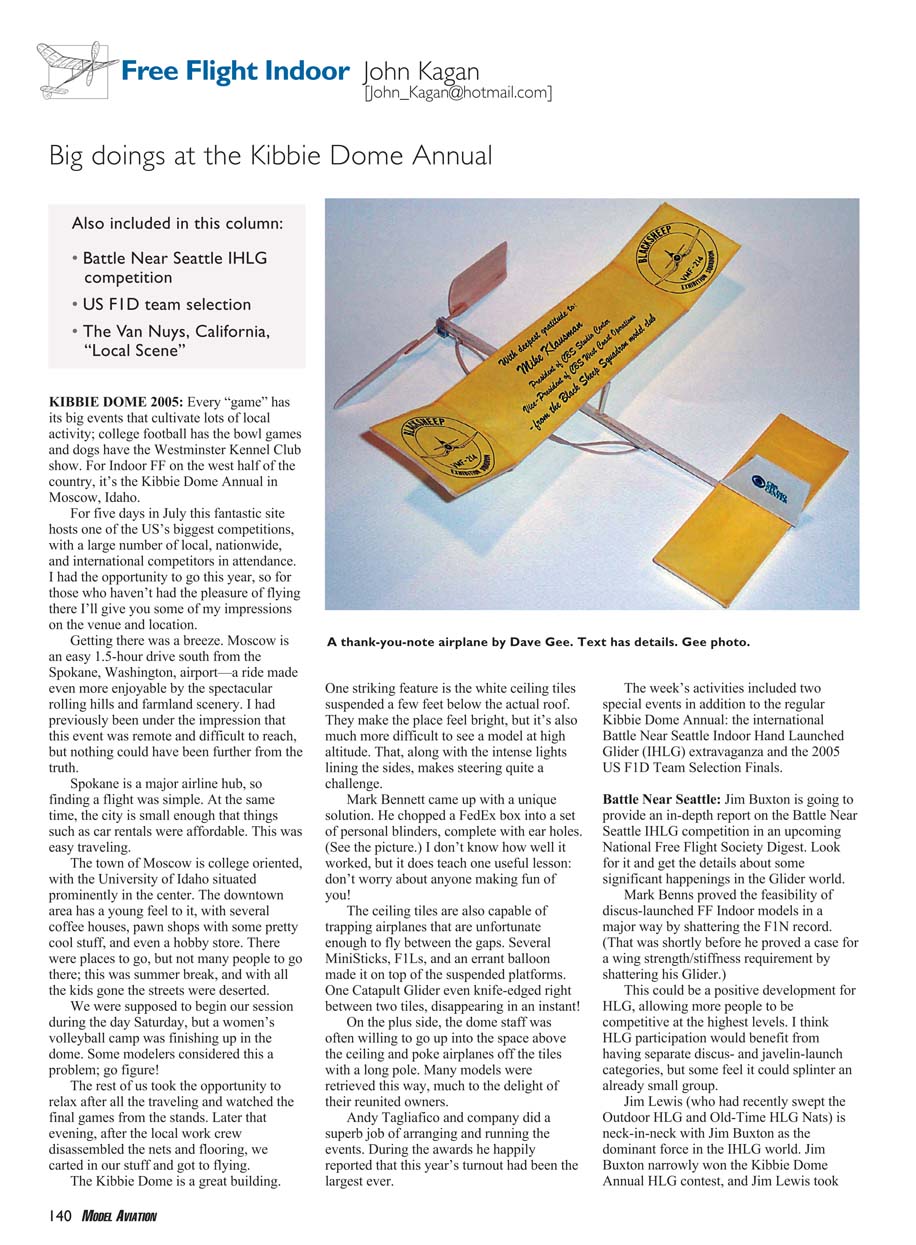
"We're a general-interest club based in the Los Angeles area. Many of us fly indoor, so we're always on the lookout for new flying sites. Club member Tim Holly works at CBS Studios and got high-level VP Mike Klausman interested in modeling, including making it possible for us to hold occasional flying sessions inside empty sound stages!
"We're at the mercy of show schedules, of course, but these are really excellent rooms. We flew demonstrations as entertainment for their annual July 4th hat mat and later held an all-day fun-fly with the time divided between FF and RC.
"Needless to say, we were most grateful for these opportunities. In lieu of a standard thank-you note, I built a Scofflaw model with our message and logo printed onto the wing. Normally this would jam up the printer and break the wood, so I printed the tissue before covering. The Scofflaw is designed for indoor guerrilla flying, so it will survive handling by nonmodelers."
Great idea, Dave. Maybe we'll see indoor models in an upcoming TV show! You can reach Dave and the Black Sheep Exhibition Squadron at [email protected] or Box 7081, Van Nuys CA 91409. MA
Transcribed from original scans by AI. Minor OCR errors may remain.

