
Tom Sova and Rob Romash win inaugural National Cups
John Kagan [[email protected]]
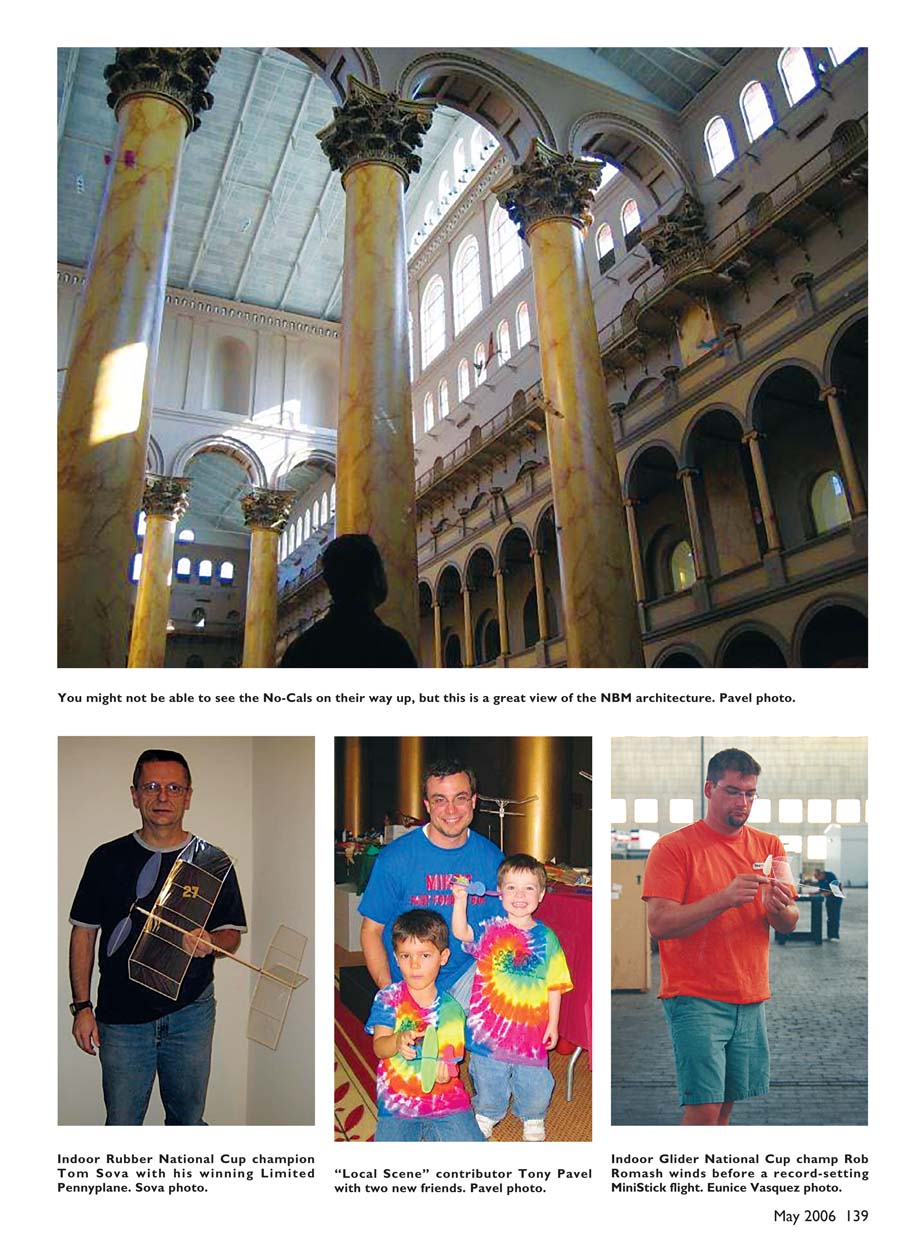
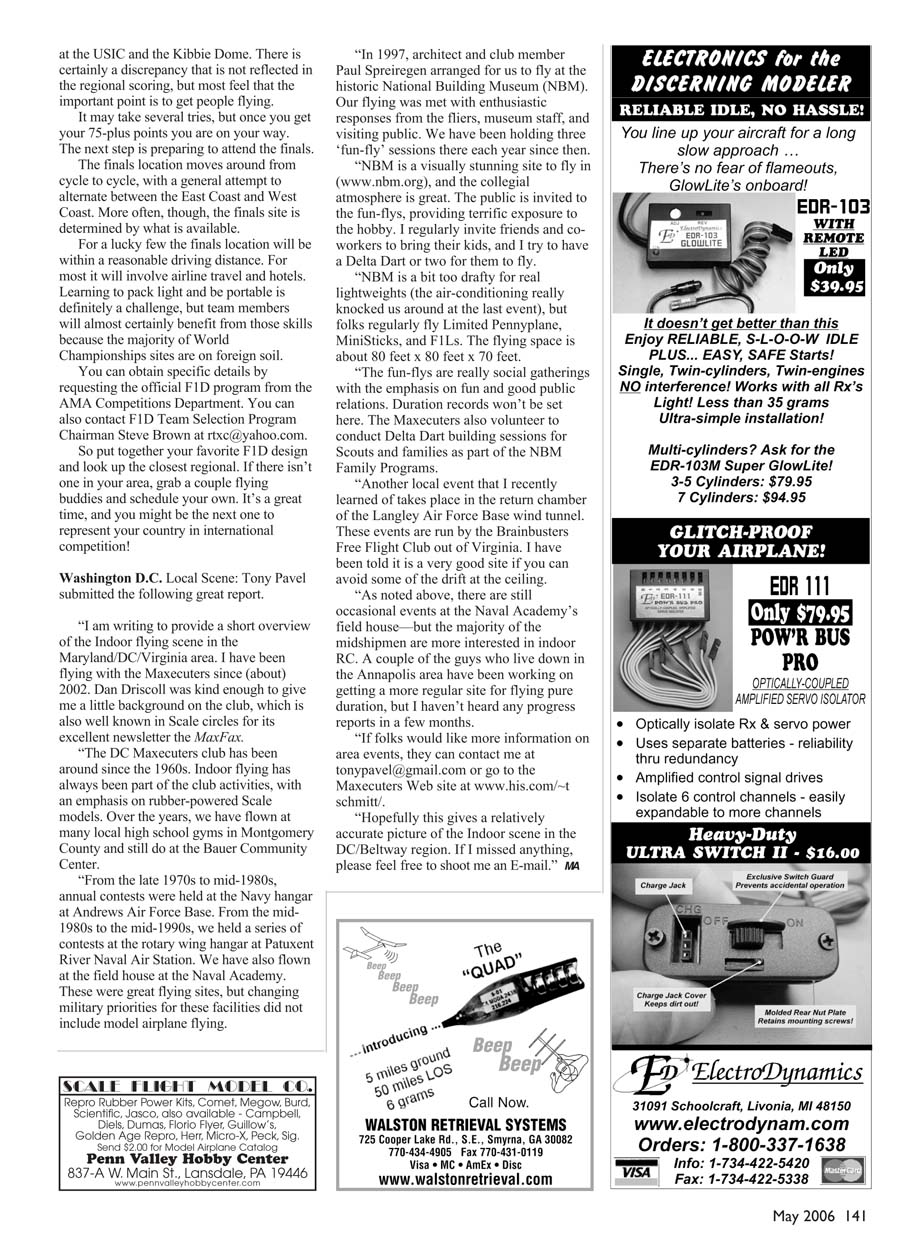
CONGRATULATIONS TO Tom Sova and Rob Romash: winners of the first Indoor National Rubber Cup and Glider Cup! Their names now grace the lead positions on the perpetual trophies. The awards take into account a yearlong points series of select Rubber and Glider events in sanctioned meets.
Sponsored by the National Free Flight Society (NFFS), the official FF SIG, this program mirrors the popular Outdoor FF cups, rewarding consistent performance and promoting participation at contests of all shapes and sizes throughout the country. The emphasis is on attendance and results, and the format seems to work; the names atop the list belong to faces that are familiar to many.
This year's competition ended in a rather dramatic fashion that attests to its recognized importance. Tom held a reasonably comfortable lead in the Rubber Cup (F1L, Limited Pennyplane, and MiniStick) as the season approached its close, but there remained one contest on the schedule: the regional meet in Colorado Springs, Colorado. Rob, who was second in the standings, had to win the three Rubber categories to nip Tom at the line. Tom contacted recent Colorado Springs transplant Bill Leppard (who finished third in the Rubber Cup) and arranged a quick vacation to attend the contest and seal the deal. Tom ended up winning the cup by a convincing 80 points. Rob and Bill finished second and third respectively, with only a five-point gap between them.
The Glider Cup featured similar adventures. Kurt Krempetz held a narrow lead near the end, and Rob had a clear opportunity to take over. Kurt didn't have plans to attend the Colorado event, but there was the possibility that organizers of a final contest near him would have their event added to the Cup schedule. That didn't end up happening, and Rob nabbed the cup by 59 points. Kurt finished second, and Indoor National Cup founder Jim Buxton finished third.
For rules and a calendar of National Cup contests, go to the "Indoor National Cup" page under the "Competitions" section on the NFFS website (www.freeflight.org). If you are a contest organizer, please visit the page to get information about adding your contest to the National Cup schedule. It's a great way to support the program and increase exposure for your event!
USIC, Kibbie, and Other Great Contests
Spring should be springing up by the time you read this column (it is still cold and snowy as I write it!). That means it's time to start preparing for the big summer contests. If you live east of the Mississippi River, the major contest is at the East Tennessee State University MiniDome in Johnson City. Almost every Indoor FF event will be battled out in the combined AMA Nats/NFFS US Indoor Championships (USIC). From Wednesday, May 31–Sunday, June 4 we have exclusive access to the 116-foot dome for flying that will last from dawn until well past dusk.
I've heard several people say, "I'd love to go but I'm not ready yet." Hogwash! There's plenty of room, lots of support, super air, and a fantastic building to hold it all. This is a great contest to attend to fly, watch, and learn. And if you are one of the hotshots, you already know that this is one of the must-attend events.
For more AMA Indoor Nats/USIC information (entry forms, event schedules, etc.), visit the Nats page in the Competitions section of the AMA website: www.modelaircraft.org.
Fliers in the western half of the country will descend on the Kibbie Dome in Moscow, Idaho, Friday, July 7–Tuesday, July 11. This contest offers great competition and a newcomer-friendly experience, as well as a 145-foot building laid out so that heavy and light models can fly concurrently, which provides an unbeatable opportunity for racking up airtime on your favorite airplanes.
For more information about the 2006 Kibbie Dome Annual, contact Andrew Tagliafico at [email protected].
These are two of the big annual events, but they are just the tip of the iceberg for contests. For information about bimonthly records trials at Lakehurst, New Jersey; the Midwest States Indoor Championships in Champaign, Illinois; and many other great contests, visit the Indoor Contest Calendar on the NFFS website.
Ornithopter Postal Contest
Nathan Chronister, flapper fan, sent in the following announcement.
"An ornithopter is a model that flies by flapping its wings. If you've never built one of these intriguing models, this new contest will give you a good reason to try one!
There are two categories:
- Standard — based on AMA rules.
- Simplified — limits the complexity of models, making it easier for a first-timer to compete.
The contest is open to everyone and there is no entry fee. Fly your ornithopter locally and send in your best flight times by mail. The contest runs now through June 2006. For details and an entry form, visit the Ornithopter Zone website, www.ornithopter.org, or send a self-addressed, stamped envelope to The Ornithopter Zone, 582 Laurelton Rd., Rochester NY 14609.
The Ornithopter Zone website also has some free plans and other resources for building your first ornithopter!"
Getting Started in the F1D Team Selection Program
During my report on the F1D Finals I promised a description of how to get started in the Team Selection Program — a rewarding experience for those who enjoy the focused challenge in their flying. Since the program cycle begins in even-numbered years, culminating with the Finals during odd years, now is a great time to start.
First you must qualify at one of the regionals. There are two per district in even years and one during odd years, in addition to the large regionals held during the USIC and the Kibbie Dome annual. A small regional fee is charged to adults, which helps fund the team, but juniors fly for free.
To qualify for the finals you must finish a regional with a two-flight combined total that is 75% or more of the winner's score. This percentage is converted to regional points that comprise as much as 10% of your finals score. You may participate in as many regionals as you want, taking the points from your best result.
According to Ray Harlan, who has a long history with the program, regionals were added in the early stages to help keep the finals from being a luck-of-the-draw, winner-take-all, fly-whatever-you-bring scramble for a team spot. The result was a dramatic improvement in the team's performance that has continued to this day.
Major benefits of the regionals:
- Encourages participation throughout the cycle rather than just in the months before the finals.
- Gives people a compelling reason to build and prepare airplanes.
- Because a regional must have three or more contestants to count, at least two other people will often be brought in for each enthusiastic participant.
Many of the smaller regionals are cobbled together by a few local fliers. These are often much easier to qualify in than the big regionals.
Washington D.C. Local Scene
Tony Pavel submitted the following great report.
"I am writing to provide a short overview of the Indoor flying scene in the Maryland/DC/Virginia area. I have been flying with the Maxecuters since (about) 2002. Dan Driscoll was kind enough to give me a little background on the club, which is also well known in Scale circles for its excellent newsletter the MaxFax.
The DC Maxecuters club has been around since the 1960s. Indoor flying has always been part of the club activities, with an emphasis on rubber-powered Scale models. Over the years, we have flown at many local high school gyms in Montgomery County and still do at the Bauer Community Center.
From the late 1970s to mid-1980s, annual contests were held at the Navy hangar at Andrews Air Force Base. From the mid-1980s to the mid-1990s, we held a series of contests at the rotary wing hangar at Patuxent River Naval Air Station. We have also flown at the field house at the Naval Academy. These were great flying sites, but changing military priorities for these facilities did not include model airplane flying.
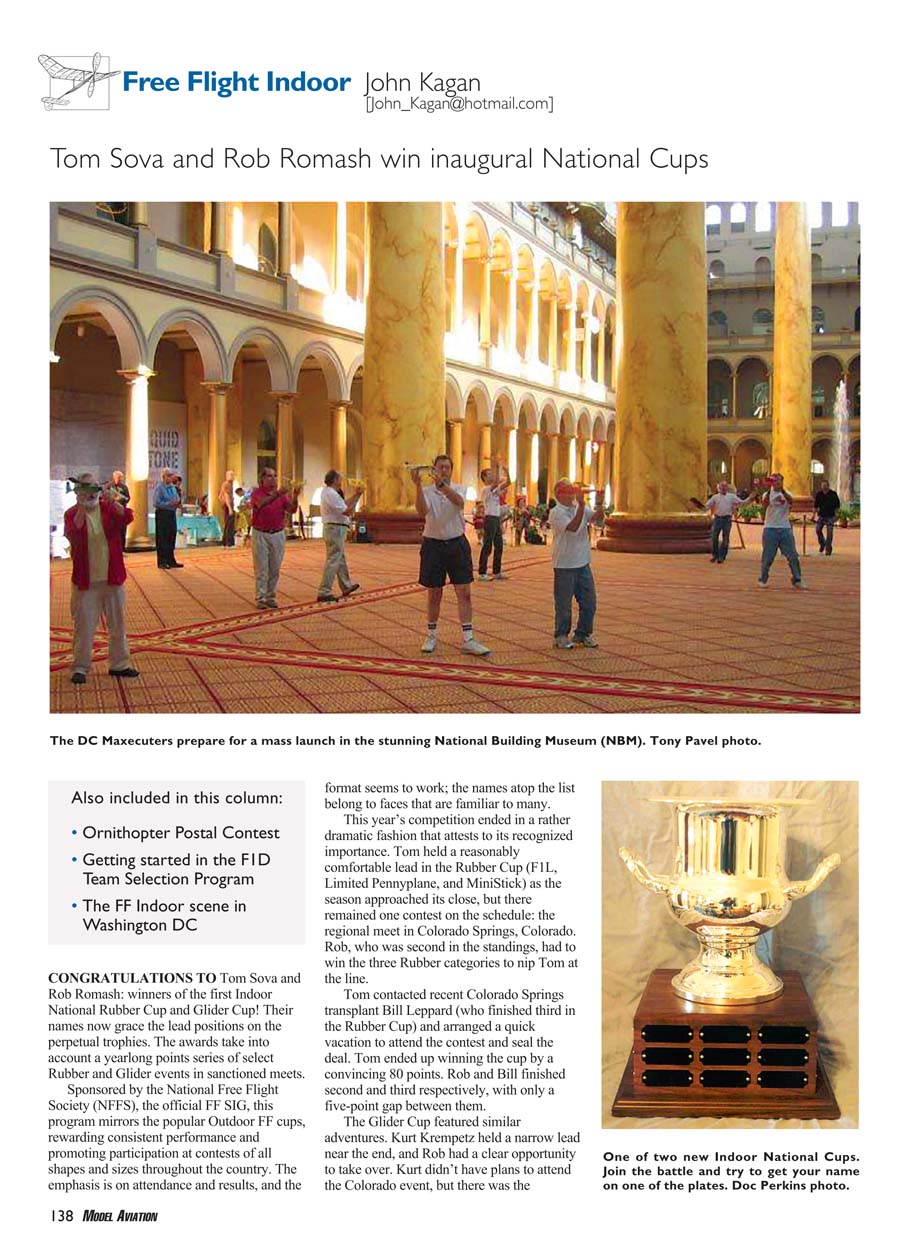
In 1997, architect and club member Paul Spreiregen arranged for us to fly at the historic National Building Museum (NBM). Our flying was met with enthusiastic responses from the fliers, museum staff, and visiting public. We have been holding three 'fun-fly' seasons there each year since then.
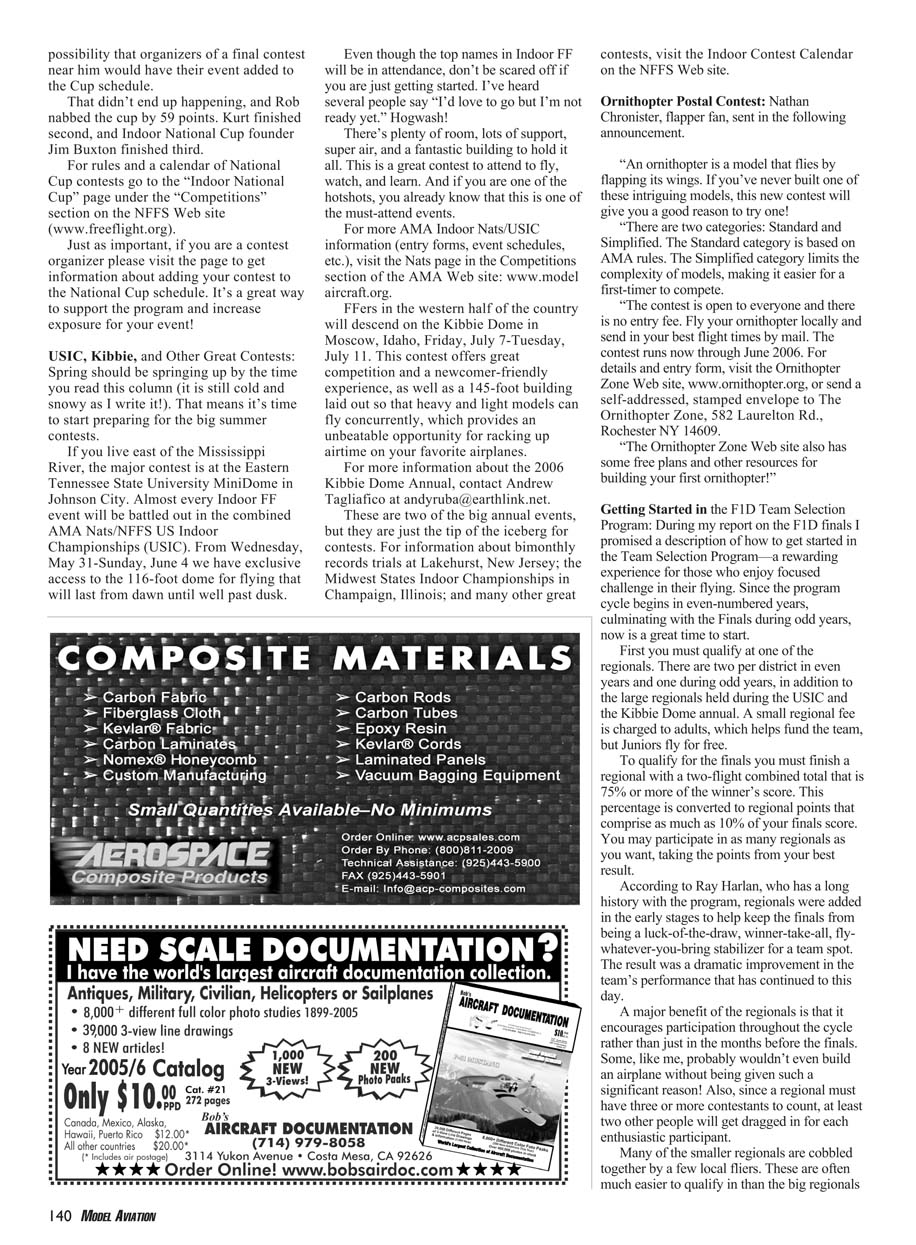
NBM is a visually stunning site to fly in (www.nbm.org), and the collegial atmosphere is great. The public is invited to the fun-flys, providing terrific exposure to the hobby. I regularly invite friends and co-workers to bring their kids, and I try to have a Delta Dart or two for them to fly.
NBM is a bit too drafty for real lightweights (the air-conditioning really knocked us around at the last event), but folks regularly fly Limited Pennyplane, MiniSticks, and F1Ls. The flying space is about 80 feet x 80 feet x 70 feet.
The fun-flys are really social gatherings with the emphasis on fun and good public relations. Duration records won't be set here. The Maxecuters also volunteer to do Delta Dart building sessions for Scouts and families as part of the NBM family programs.
Another local event that I recently learned of takes place in the return chamber at the Langley Air Force Base wind tunnel. These events are run by the Brainbusters Free Flight Club out of Virginia. I have been told it is a very good site if you can avoid some of the drift at the ceiling.
As noted above, there are still occasional events at the Naval Academy's field house — but the majority of the midshipmen are more interested in indoor RC. A couple of the guys who live down in the Annapolis area have been working on getting a more regular site for flying pure duration, but I haven't heard any progress reports in a few months.
If folks would like more information on area events, they can contact me at [email protected] or go to the Maxecuters website at www.his.com/~tschmitt/.
"Hopefully this gives a relatively accurate picture of the Indoor scene in the DC/Beltway region. If I missed anything, please feel free to shoot me an e-mail."
Transcribed from original scans by AI. Minor OCR errors may remain.

