
Free Flight Indoor - 2006/07
John Kagan [[email protected]]
Variable-pitch propellers explained
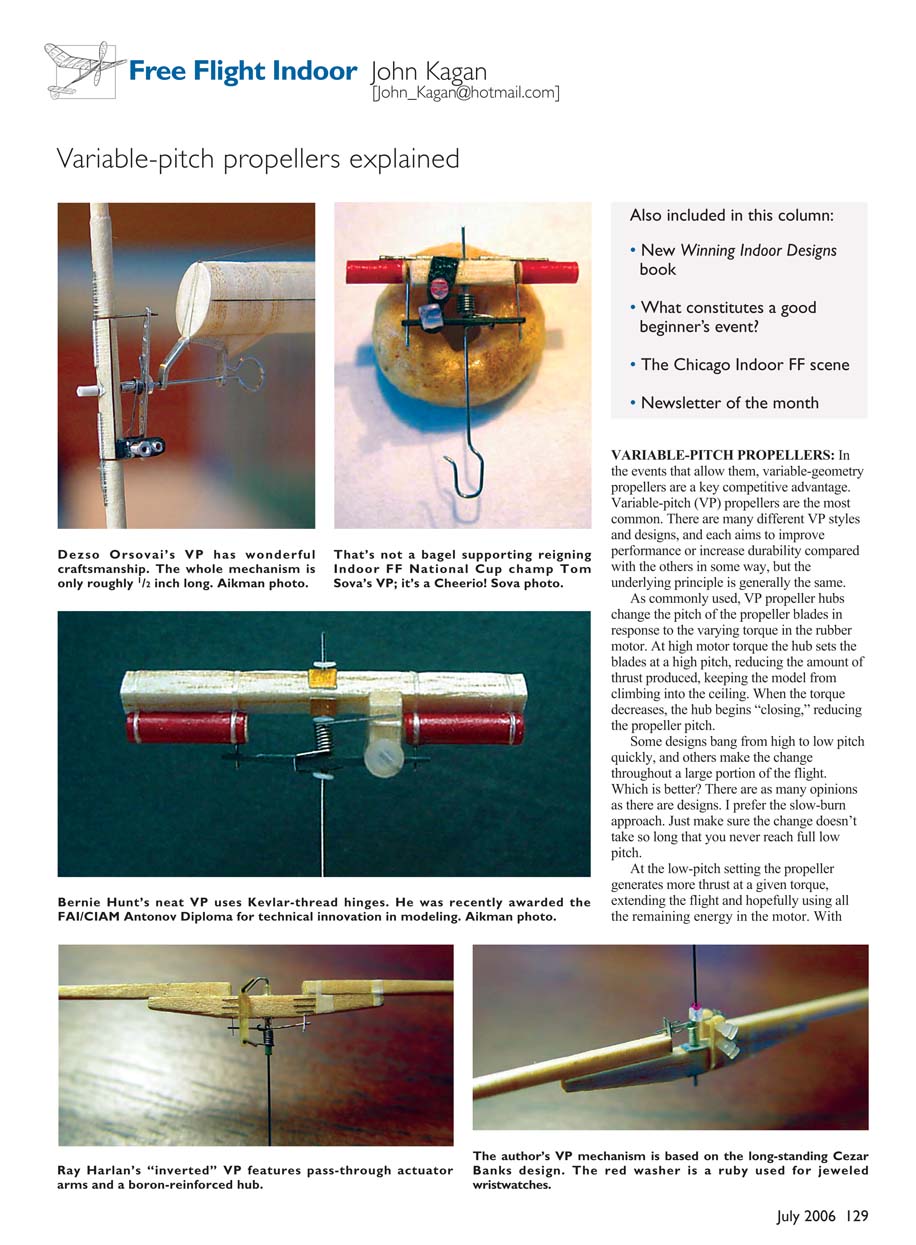
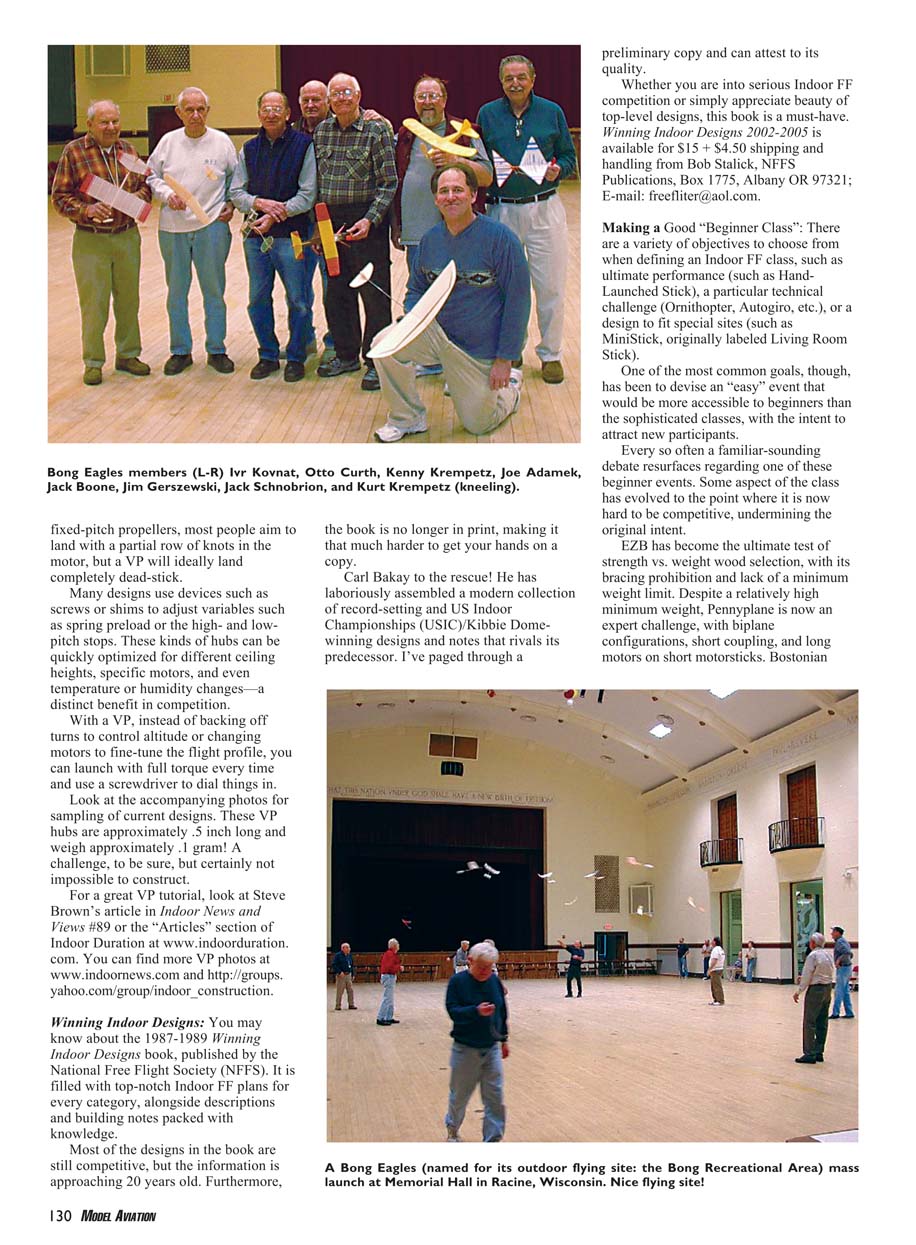
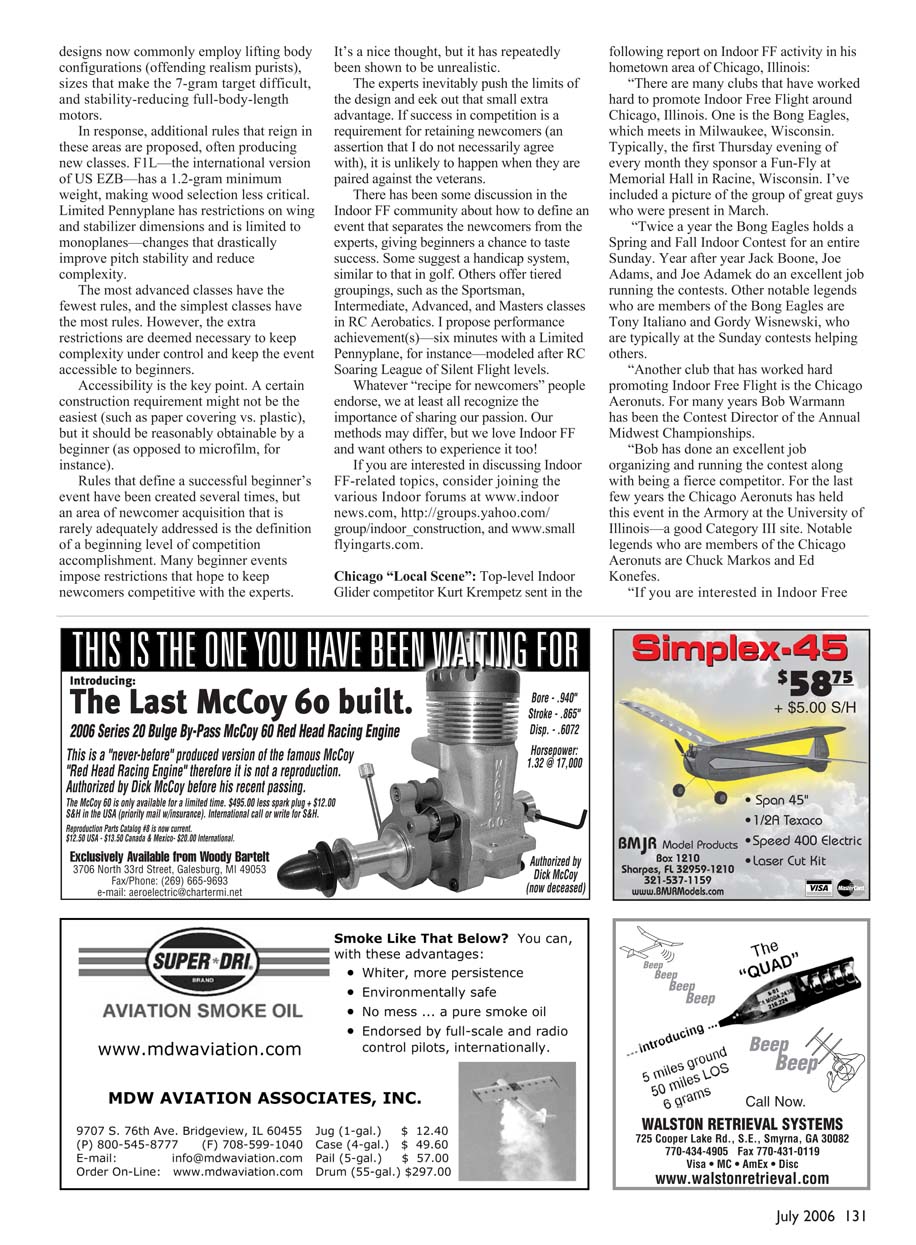
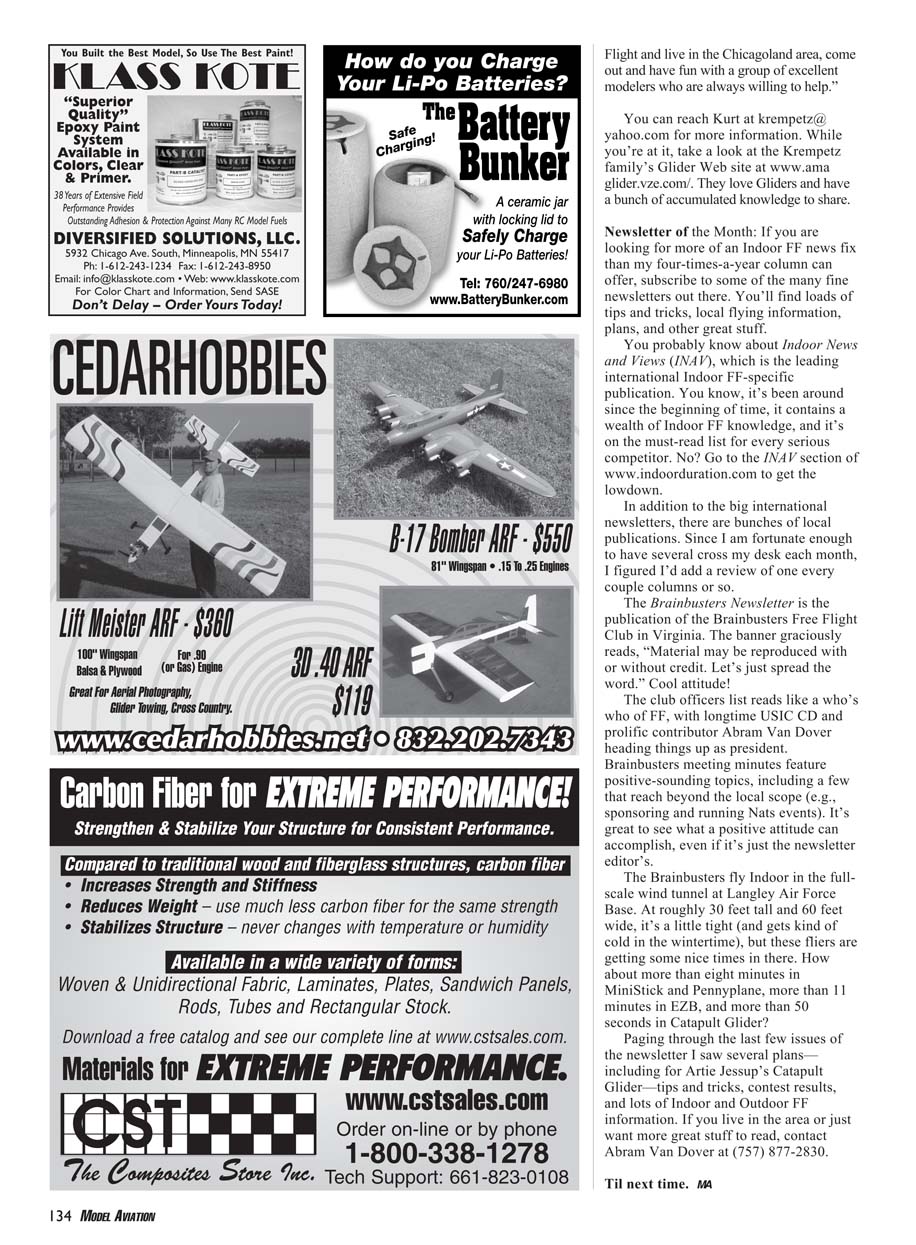
VARIABLE-PITCH PROPELLERS: In the events that allow them, variable-geometry propellers are a key competitive advantage. Variable-pitch (VP) propellers are the most common. There are many different VP styles and designs, and each aims to improve performance or increase durability compared with the others in some way, but the underlying principle is generally the same.
As commonly used, VP propeller hubs change the pitch of the propeller blades in response to the varying torque in the rubber motor. At high motor torque the hub sets the blades at a high pitch, reducing the amount of thrust produced and keeping the model from climbing into the ceiling. When the torque decreases, the hub begins "closing," reducing the propeller pitch.
Some designs bang from high to low pitch quickly, and others make the change throughout a large portion of the flight. Which is better? There are as many opinions as there are designs. I prefer the slow-burn approach. Just make sure the change doesn't take so long that you never reach full low pitch.
At the low-pitch setting the propeller generates more thrust at a given torque, extending the flight and hopefully using all the remaining energy in the motor. With fixed-pitch propellers, most people aim to land with a partial row of knots in the motor, but a VP will ideally land completely dead-stick. Many designs use devices such as screws or shims to adjust variables such as spring preload or the high- and low-pitch stops. These kinds of hubs can be quickly optimized for different ceiling heights, specific motors, and even temperature or humidity changes—a distinct benefit in competition. With a VP, instead of backing off turns to control altitude or changing motors to fine-tune the flight profile, you can launch with full torque every time and use a screwdriver to dial things in.
Look at the accompanying photos for a sampling of current designs. These VP hubs are approximately 0.5 inch long and weigh approximately 0.1 gram! A challenge, to be sure, but certainly not impossible to construct. For a great VP tutorial, see Steve Brown's article in Indoor News and Views #89 or the "Articles" section of Indoor Duration at www.indoorduration.com. You can find more VP photos at www.indoornews.com and http://groups.yahoo.com/group/indoor_construction.
Winning Indoor Designs
You may know about the 1987–1989 Winning Indoor Designs book, published by the National Free Flight Society (NFFS). It is filled with top-notch Indoor FF plans for every category, alongside descriptions and building notes packed with knowledge. Most of the designs in the book are still competitive, but the information is approaching 20 years old. Furthermore, the book is no longer in print, making it that much harder to get your hands on a copy.
Carl Bakay to the rescue! He has laboriously assembled a modern collection of record-setting and US Indoor Championships (USIC)/Kibbie Dome–winning designs and notes that rivals its predecessor. I've paged through a preliminary copy and can attest to its quality.
Whether you are into serious Indoor FF competition or simply appreciate the beauty of top-level designs, this book is a must-have. Winning Indoor Designs 2002–2005 is available for $15 + $4.50 shipping and handling from Bob Stalick, NFFS Publications, Box 1775, Albany OR 97321; E-mail: [email protected].
Making a Good "Beginner Class"
There are a variety of objectives to choose from when defining an Indoor FF class, such as ultimate performance (Hand-Launched Stick), a particular technical challenge (Ornithopter, Autogiro, etc.), or a design to fit special sites (such as MiniStick, originally labeled Living Room Stick).
One of the most common goals, though, has been to devise an "easy" event that would be more accessible to beginners than the sophisticated classes, with the intent to attract new participants.
Every so often a familiar-sounding debate resurfaces regarding one of these beginner events. Some aspect of the class has evolved to the point where it is now hard to be competitive, undermining the original intent.
EZB has become the ultimate test of strength-versus-weight wood selection, with its bracing prohibition and lack of a minimum weight limit. Despite a relatively high minimum weight, Pennyplane is now an expert challenge, with biplane configurations, short coupling, and long motors on short motor sticks. Bostonian designs now commonly employ lifting-body configurations (offending realism purists), sizes that make the 7-gram target difficult, and stability-reducing full-body-length motors.
In response, additional rules that reign in these areas are proposed, often producing new classes. FIL—the international version of US EZB—has a 1.2-gram minimum weight, making wood selection less critical. Limited Pennyplane has restrictions on wing and stabilizer dimensions and is limited to monoplanes—changes that drastically improve pitch stability and reduce complexity.
The most advanced classes have the fewest rules, and the simplest classes have the most rules. However, the extra restrictions are deemed necessary to keep complexity under control and keep the event accessible to beginners.
Accessibility is the key point. A certain construction requirement might not be the easiest (such as paper covering vs. plastic), but it should be reasonably obtainable by a beginner (as opposed to microfilm, for instance).
Rules that define a successful beginner’s event have been created several times, but an area of newcomer acquisition that is rarely adequately addressed is the definition of a beginning level of competition accomplishment. Many beginner events impose restrictions that hope to keep newcomers competitive with the experts.
It’s a nice thought, but it has repeatedly been shown to be unrealistic. The experts inevitably push the limits of the design and eke out that small extra advantage. If success in competition is a requirement for retaining newcomers (an assertion that I do not necessarily agree with), it is unlikely to happen when they are paired against the veterans.
There has been some discussion in the Indoor FF community about how to define an event that separates the newcomers from the experts, giving beginners a chance to taste success. Some suggest a handicap system, similar to that in golf. Others offer tiered groupings, such as the Sportsman, Intermediate, Advanced, and Masters classes in RC Aerobatics. I propose performance achievements—six minutes with a Limited Pennyplane, for instance—modeled after RC Soaring League of Silent Flight levels.
Whatever “recipes for newcomers” people endorse, we at least all recognize the importance of sharing our passion. Our methods may differ, but we love Indoor FF and want others to experience it too!
If you are interested in discussing Indoor FF-related topics, consider joining the various Indoor forums at www.indoornews.com, http://groups.yahoo.com/group/indoor_construction, and www.smallflyingarts.com.
Chicago "Local Scene"
Top-level Indoor Glider competitor Kurt Krempetz sent in the following report on Indoor FF activity in his hometown area of Chicago, Illinois:
"There are many clubs that have worked hard to promote Indoor Free Flight around Chicago, Illinois. One is the Bong Eagles, which meets in Milwaukee, Wisconsin. Typically, the first Thursday evening of every month they sponsor a Fun-Fly at Memorial Hall in Racine, Wisconsin. I've included a picture of the group of great guys who were present in March.
"Twice a year the Bong Eagles hold a Spring and Fall Indoor Contest for an entire Sunday. Year after year Jack Boone, Joe Adams, and Joe Adamek do an excellent job running the contests. Other notable legends who are members of the Bong Eagles are Tony Italiano and Gordy Wisniewski, who are typically at the Sunday contests helping others.
"Another club that has worked hard promoting Indoor Free Flight is the Chicago Aeronuts. For many years Bob Warmann has been the Contest Director of the Annual Midwest Championships.
"Bob has done an excellent job organizing and running the contest along with being a fierce competitor. For the last few years the Chicago Aeronuts have held this event in the Armory at the University of Illinois—a good Category III site. Notable legends who are members of the Chicago Aeronuts are Chuck Markos and Ed Konfes.
"If you are interested in Indoor Free Flight and live in the Chicagoland area, come out and have fun with a group of excellent modelers who are always willing to help."
You can reach Kurt at [email protected] for more information. While you're at it, take a look at the Krempetz family's Glider Web site at www.amaglider.vze.com/. They love gliders and have a bunch of accumulated knowledge to share.
Newsletter of the Month
If you are looking for more of an Indoor FF news fix than my four-times-a-year column can offer, subscribe to some of the many fine newsletters out there. You'll find loads of tips and tricks, local flying information, plans, and other great stuff.
You probably know about Indoor News and Views (INAV), which is the leading international Indoor FF–specific publication. It's been around since the beginning of time, it contains a wealth of Indoor FF knowledge, and it's on the must-read list for every serious competitor. No? Go to the INAV section of www.indoorduration.com to get the lowdown.
In addition to the big international newsletters, there are bunches of local publications. Since I am fortunate enough to have several cross my desk each month, I figured I'd add a review of one every couple of columns or so.
The Brainbusters Newsletter is the publication of the Brainbusters Free Flight Club in Virginia. The banner graciously reads, "Material may be reproduced with or without credit. Let's just spread the word." Cool attitude!
The club officers list reads like a who's who of FF, with longtime USIC CD and prolific contributor Abram Van Dover heading things up as president. Brainbusters meeting minutes feature positive-sounding topics, including a few that reach beyond the local scope (e.g., sponsoring and running Nats events). It's great to see what a positive attitude can accomplish, even if it's just the newsletter editor's.
The Brainbusters fly Indoor in the full-scale wind tunnel at Langley Air Force Base. At roughly 30 feet tall and 60 feet wide, it's a little tight (and gets kind of cold in the wintertime), but these fliers are getting some nice times in there. How about more than eight minutes in MiniStick and Pennyplane, more than 11 minutes in EZB, and more than 50 seconds in Catapult Glider?
Paging through the last few issues of the newsletter I saw several plans—including for Artie Jessup's Catapult Glider—tips and tricks, contest results, and lots of Indoor and Outdoor FF information. If you live in the area or just want more great stuff to read, contact Abram Van Dover at (757) 877-2830.
Til next time. MA
Transcribed from original scans by AI. Minor OCR errors may remain.

