
Free Flight Indoor
John Kagan [[email protected]]
An overview of the great 2006 FF Indoor event season
Some of the biggest Indoor FF events of the 2006 season are now in the history books. If you enjoy any part of this hobby, hopefully you had a chance to attend some of them.
There is nothing quite like flying in these great, and often historic, sites surrounded by other enthusiasts. Whether you are into competition, personal bests, or just flying for fun, these large meets are a fantastic way to spend a few days—not to mention all the fun getting prepared.
USIC:
The 2006 US Indoor Championships (USIC), combined with the AMA Indoor FF Nats, was another resounding success. More than 90 people traveled to Johnson City, Tennessee, May 31–June 4 to enjoy the 116-foot site, renowned for great flying conditions that are impervious to the weather outside.
The floor layout was rearranged this year to further minimize the impact of the new scoreboard, providing a large amount of airspace under one of the main beams. A variety of models were flown, ranging from opening-day Gliders to the morning Scale events to the late-evening superlightweight duration classes. There were also quite a few Science Olympiad kids who got to wring out their aircraft in the expansive dome. Various Flying Aces Club (FAC) activities rounded out the experience.
Running five days from 7:30 a.m. until the last flights come down at roughly 11 p.m., the USIC provides a fix big enough to satisfy the cravings of any model-airplane junkie. Add in a few great meals with flying buddies you only see once a year (make sure you hit the Firehouse restaurant), and you’ve got some great vacation material. It doesn’t get much better than this.
For a complete rundown of each day’s happenings, complete with results and great photos, check out NatsNews on the AMA website at www.modelaircraft.org/events/natsnews.asp. If you are even remotely interested in Indoor FF and live anywhere within range, consider coming to the 2007 USIC. It will be in the same place at approximately the same time.
Lakehurst:
Next on the agenda was the July 4 contest at legendary Lakehurst, New Jersey. For those who aren’t used to it, the Lakehurst experience is quite a bit different from the other big once-a-year contests. There are so many days of access to this site (essentially every weekend of the year) that Indoor FF attendance tends to be spread out. A regular indoor RC crowd meets every Saturday morning (the incompatibilities that exist in smaller sites are nonexistent in the cavernous hangar), but getting more than 20 FFers in on any given day is a big deal. The July 4 and Labor Day contests are your best bets for finding a decent-sized group.
The smaller daily numbers and frequent flying dates require more organizational involvement from participants. Many members are also AMA CDs so that the management duties can be shared. Indoor FF master Larry Coslick took on contest management duties this time. (Thanks, Larry!) Small details—such as keeping a full tank of helium—are pretty much hands-on. If the tank is empty, someone on-site has to load it into his or her car and take it to the local party-supply store to have it swapped out on the East Coast Indoor Modelers (ECIM) account.
Lakehurst is an active military base, so there are a number of complexities involved with access. Membership in the ECIM is required since that is the official organization in contact with the Navy previously and now the Air Force. The good news is that membership requires little more than an e-mail to the club president (Rob Romash at [email protected]), along with a membership form and club dues. Access is currently limited to US citizens—unfortunately excluding some participants.
The hangar floor space is often crowded with an ever-changing array of paraphernalia: assembled tents, a huge tent drying rack, and even a 1/3-scale carrier deck. Getting your model back to a clear space requires steering most of the time (this is where I learned the art), although on the best days flights land mere feet from where they were launched.
And this place is dirty! A street sweeper is sent through every few years, but most of the dust surely dates back to the days of the Hindenburg. This airdock isn't a cozy sports dome.
However, even with all these hurdles, Lakehurst is still most assuredly worth the effort. Hangar 1 is an amazing place, and there are many who treasure it enough to travel enormous distances to take part. The ECIM roster is a veritable who's who of the Indoor world, with many top names making sure they have access when they need it.
A model up near the center catwalk in calm summer-evening air is pure magic. You owe it to yourself to experience that at least once. I guarantee you'll be hooked!
Kibbie Dome:
July brought the annual Kibbie Dome contest in Moscow, Idaho—another truly great summer event, offering five days in a huge site with stable air.
The dome's location may seem remote, but it's beautiful and an easy ride from the airport in Spokane (if you don't actually live within driving distance to the site). Add that the dome's layout supports flying heavy and light models concurrently—thus allowing competitors to fly whatever they want, for as long as they want—and you can see why this contest is an absolute favorite of those who attend.
Steve Brown graciously provided a few contest insights since I was unable to attend this year (I'm going to make airline reservations further in advance next time!), and Mark Bennett posted a list of results that I've used for reference. (Thanks, guys!) There were several noteworthy highlights.
- Andy Tagliafico, mastermind behind this meet, found time to win EZB and the grown-up Science Olympiad event.
- Rebekah Altig won the regular Science Olympiad with a time that was only approximately a minute off of Andy's.
- Wally Miller, founder of the EZB, handily won the 1.2-gram EZB event and AROG.
- Mark Bennett shined with wins in MiniStick, Open Pennyplane, F1D, and the F1D regional.
Tim Chang missed making the Junior F1D team in the last cycle, but he took the setback in good form and returned this year with a new fleet of immaculate models and a bunch more flying experience. Still a Junior, Tim posted excellent times of 32:09 and 31:17 to take third place in the F1D regionals behind Mark Bennett and F1D great Cezar Banks.
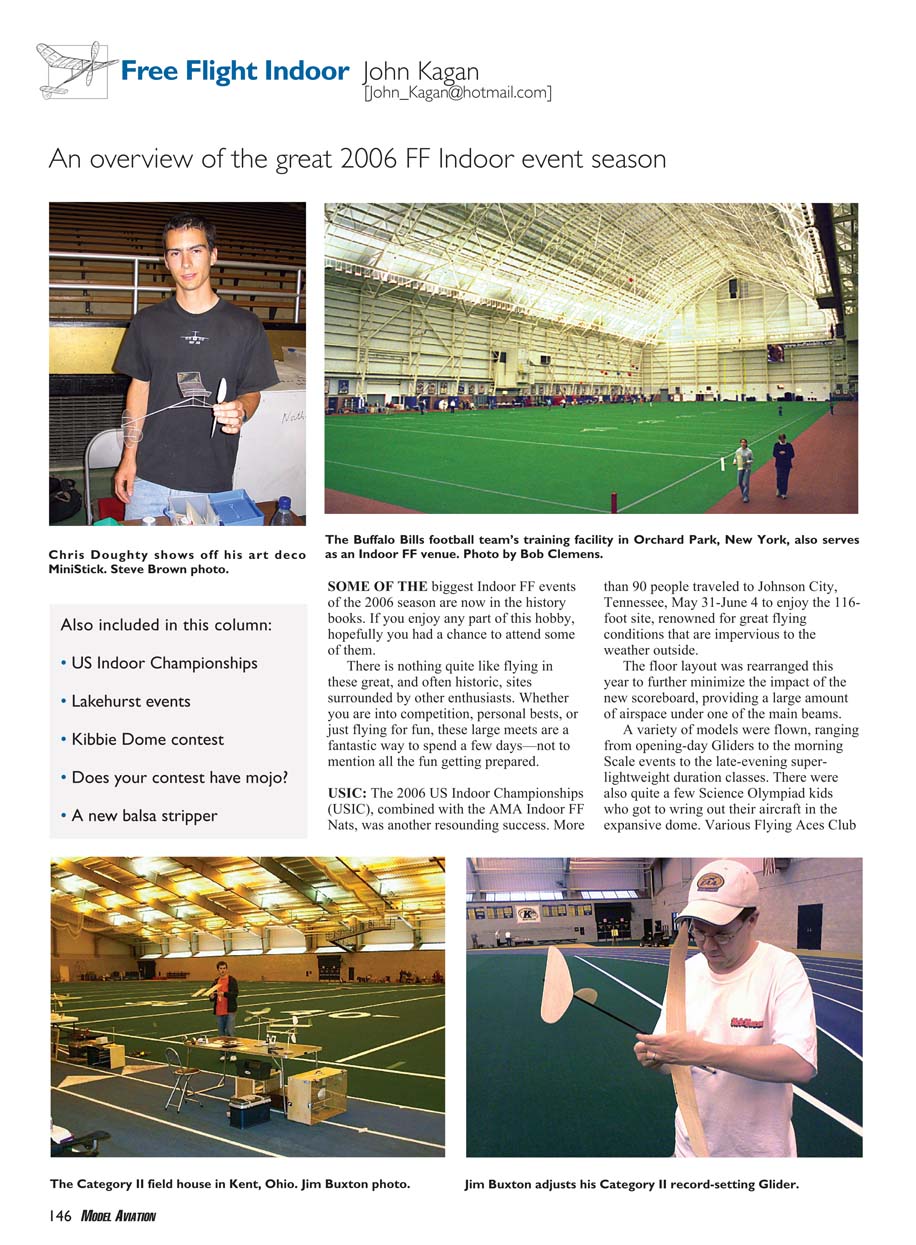
Another new face that stood out was Chris Doughty. Hailing from Vancouver, British Columbia, Chris developed his Indoor FF skills in relative isolation and has a decidedly unique style to show for it.
"I prefer designing my own models to building from plans, and try to make them look good as well as perform," he said.
He's not kidding! Chris showed off a strange but true built-up-fuselage MiniStick and a pair of unbelievably tiny Ornithopters. To top it off, he brought all his models and equipment eight hours by motorcycle!
You can find more detailed reports online at http://groups.yahoo.com/group/indoor_construction or in Indoor News and Views at www.fld.biz.
Make plans now to join these fliers at next year's meet. Andy Tagliafico has already set the dates of July 6–10, 2007.
Contest Mojo:
I took a business trip to Florida last spring and looked forward to going to my favorite restaurant/night club on South Beach. I made reservations in advance and everything. When I got there I was highly disappointed to find that the place had completely lost its mojo. Gone was the energy it used to carry and, along with it, all the people who used to go.
That got me thinking about how some Indoor FF contests have a "vibe" (that nebulous combination of good air, nice organization, publicity, and who knows what else that makes people feel like they just have to go) and some don't. Further, how does one go about making a contest popular? It ought to be as simple as getting a site and letting people know about it, but, as any restaurateur knows, that isn't enough.
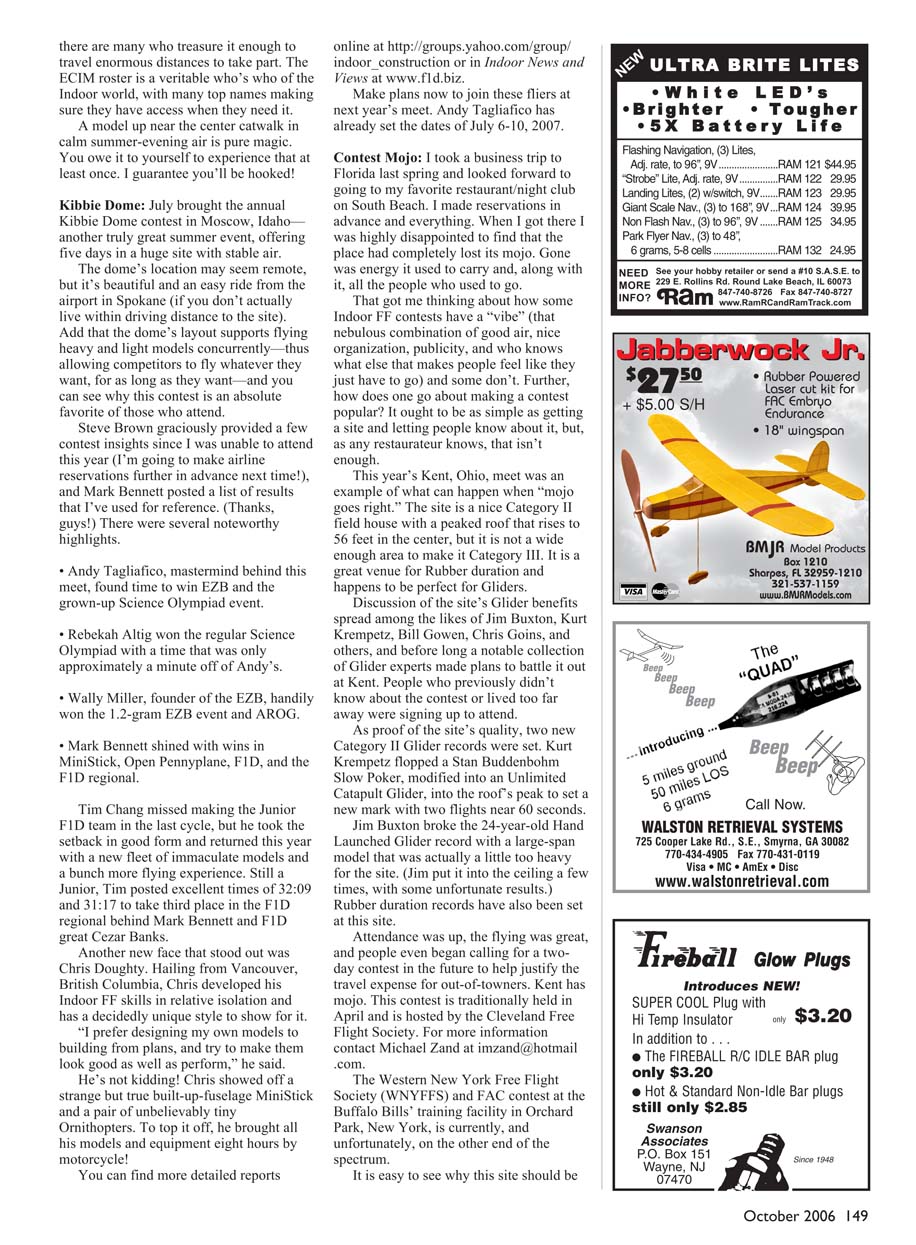
This year's Kent, Ohio, meet was an example of what can happen when "mojo" goes right. The site is a nice Category II field house with a peaked roof that rises to 56 feet in the center, but it is not a wide enough area to make it Category III. It is a great venue for Rubber duration and happens to be perfect for Gliders.
Discussion of the site's Glider benefits spread among the likes of Jim Buxton, Kurt Krempetz, Bill Gowen, Chris Goins, and others, and before long a notable collection of Glider experts made plans to battle it out at Kent. People who previously didn't know about the contest or lived too far away were signing up to attend.
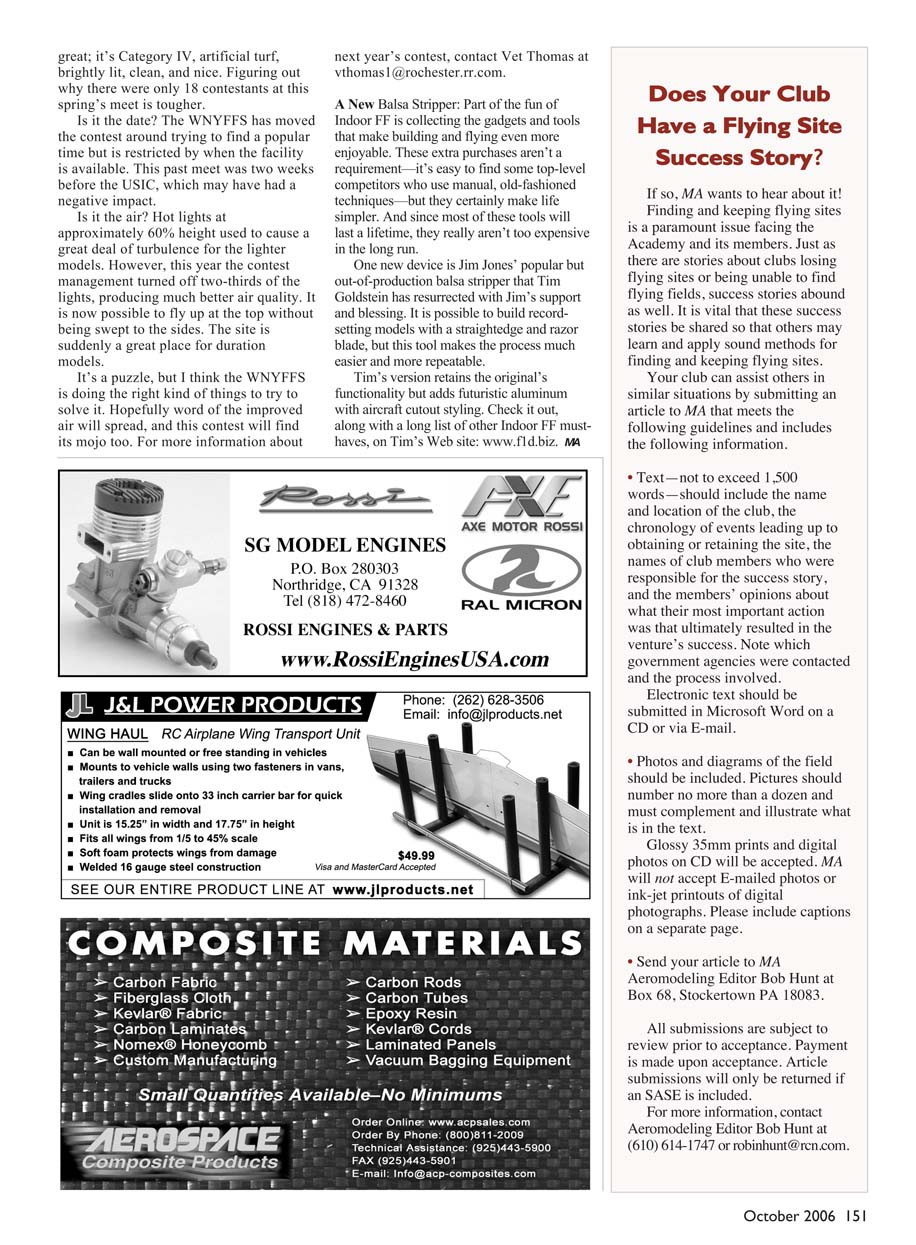
As proof of the site's quality, two new Category II Glider records were set. Kurt Krempetz flipped a Stan Buddenbohm Slow Poker, modified into an Unlimited Catapult Glider, into the roof's peak to set a new mark with two flights near 60 seconds.
Jim Buxton broke the 24-year-old Hand Launched Glider record with a large-span model that was actually a little too heavy for the site. (Jim put it into the ceiling a few times, with some unfortunate results.)
Rubber duration records have also been set at this site.
Attendance was up, the flying was great, and people even began calling for a two-day contest in the future to help justify the travel expense for out-of-towners. Kent has mojo. This contest is traditionally held in April and is hosted by the Cleveland Free Flight Society. For more information contact Michael Zand at [email protected].
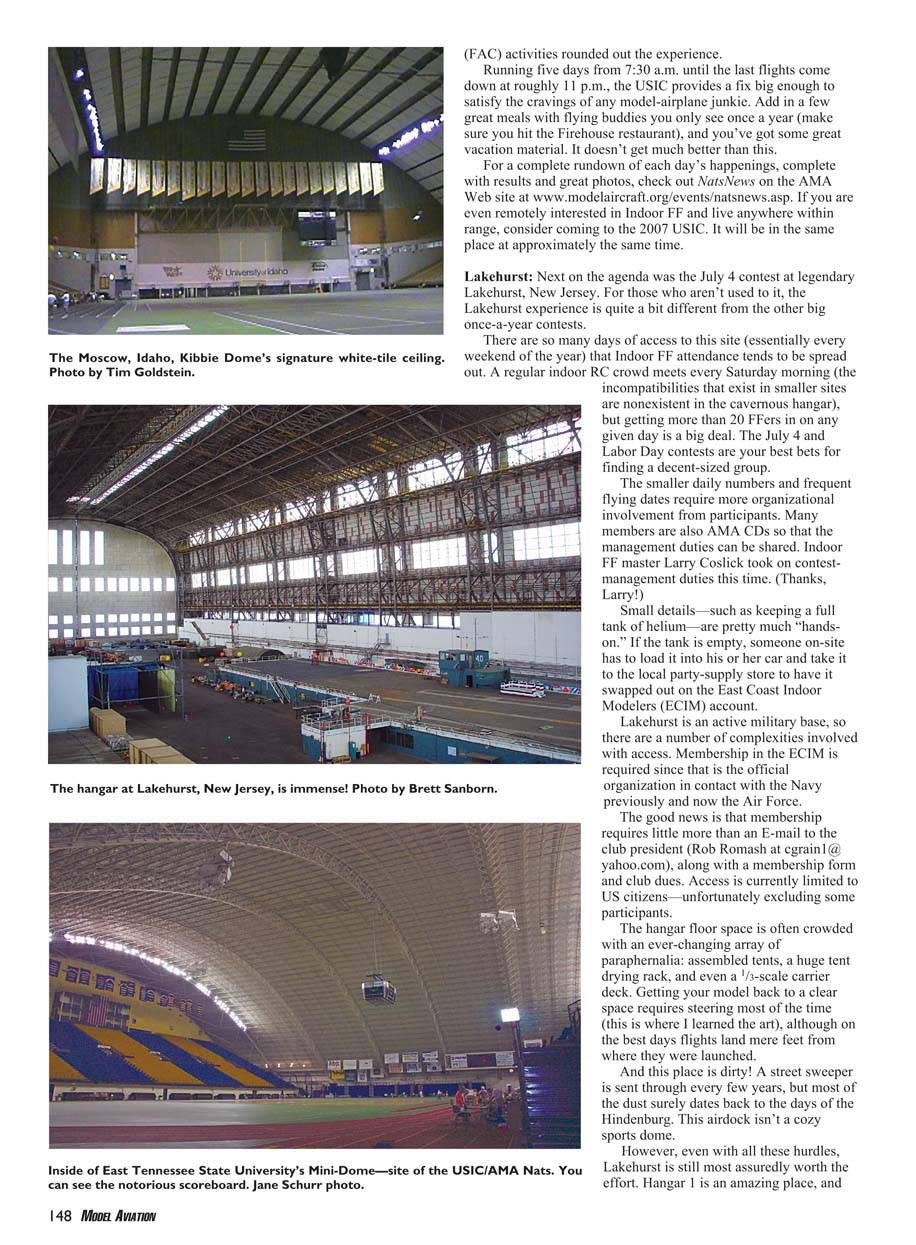
The Western New York Free Flight Society (WNYFFS) and FAC contest at the Buffalo Bills' training facility in Orchard Park, New York, is currently, and unfortunately, on the other end of the spectrum.
It is easy to see why this site should be attractive for contests: it's comfortable, close to Buffalo Harbor and several hotels, and it's a Category II site (56 feet to center). However, attendance has dwindled, and the meet lacks momentum and organization. A few local fliers continue to meet there, but it's not the vibrant event it could be. If you're interested in seeing this contest flourish again, contact the Western New York Free Flight Society.
Is it the date? The WNYFFS has moved the contest around trying to find a popular time but is restricted by when the facility is available. This past meet was two weeks before the USIC, which may have had a negative impact.
Is it the air? Hot lights at approximately 60' height used to cause a great deal of turbulence for the lighter models. However, this year the contest management turned off two-thirds of the lights, producing much better air quality. It is now possible to fly up at the top without being swept to the sides. The site is suddenly a great place for duration models.
It's a puzzle, but I think the WNYFFS is doing the right kind of things to try to solve it. Hopefully word of the improved air will spread, and this contest will find its mojo too. For more information about next year's contest, contact Vet Thomas at [email protected].
A New Balsa Stripper
Part of the fun of Indoor FF is collecting the gadgets and tools that make building and flying even more enjoyable. These extra purchases aren't a requirement—it's easy to find some top-level competitors who use manual, old-fashioned techniques—but they certainly make life simpler. And since most of these tools will last a lifetime, they really aren't too expensive in the long run.
One new device is Jim Jones' popular but out-of-production balsa stripper that Tim Goldstein has resurrected with Jim's support and blessing. It is possible to build record-setting models with a straightedge and razor blade, but this tool makes the process much easier and more repeatable.
Tim's version retains the original's functionality but adds futuristic aluminum aircraft cutout styling. Check it out, along with a long list of other Indoor FF must-haves, on Tim's website: www.fld.biz.
Transcribed from original scans by AI. Minor OCR errors may remain.

