
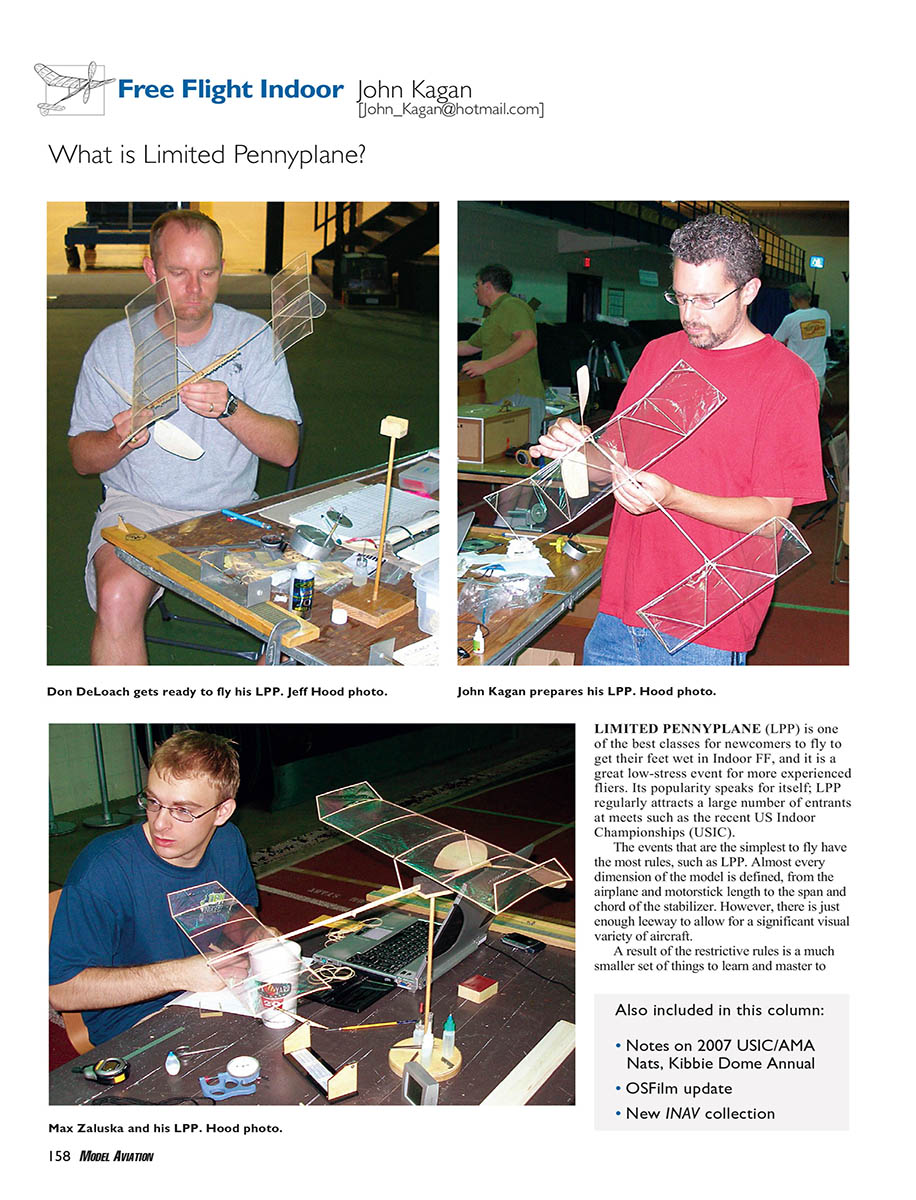
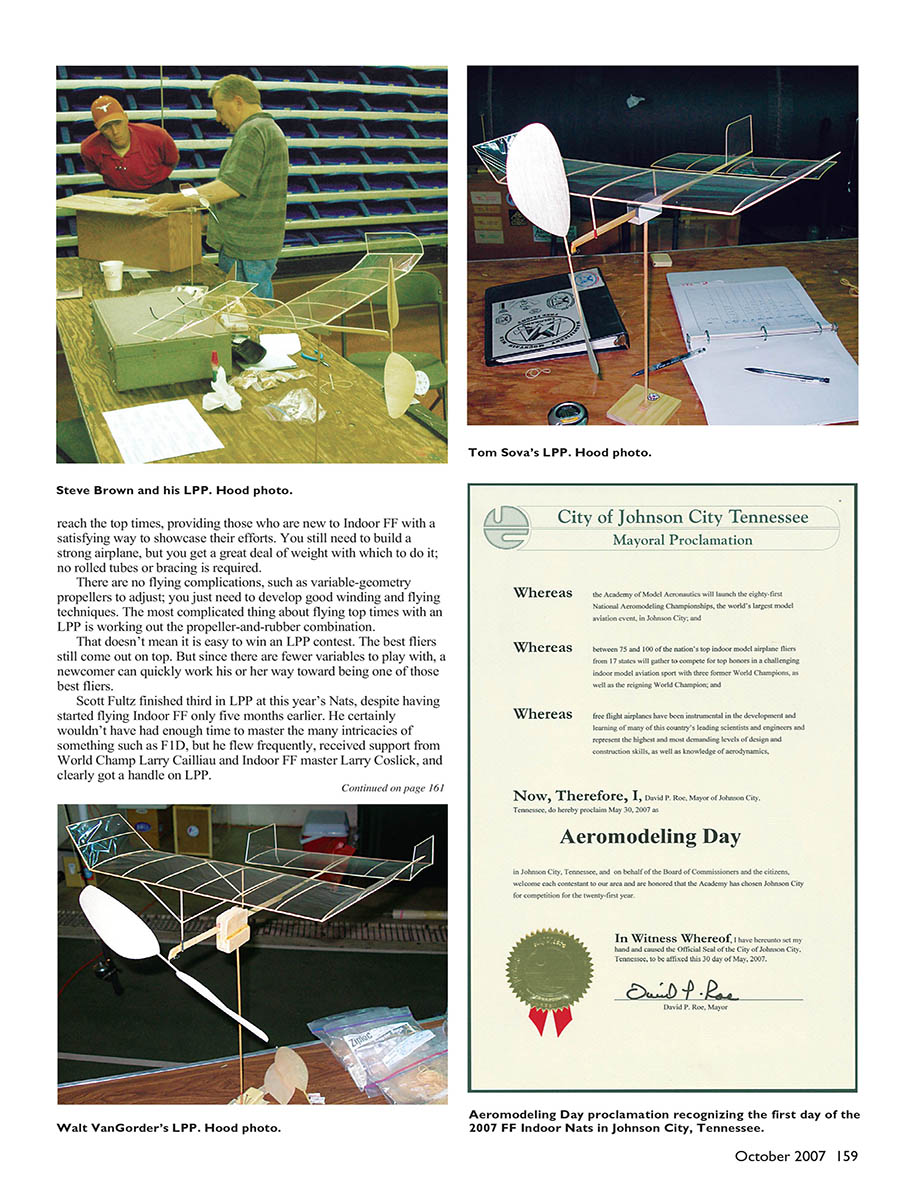
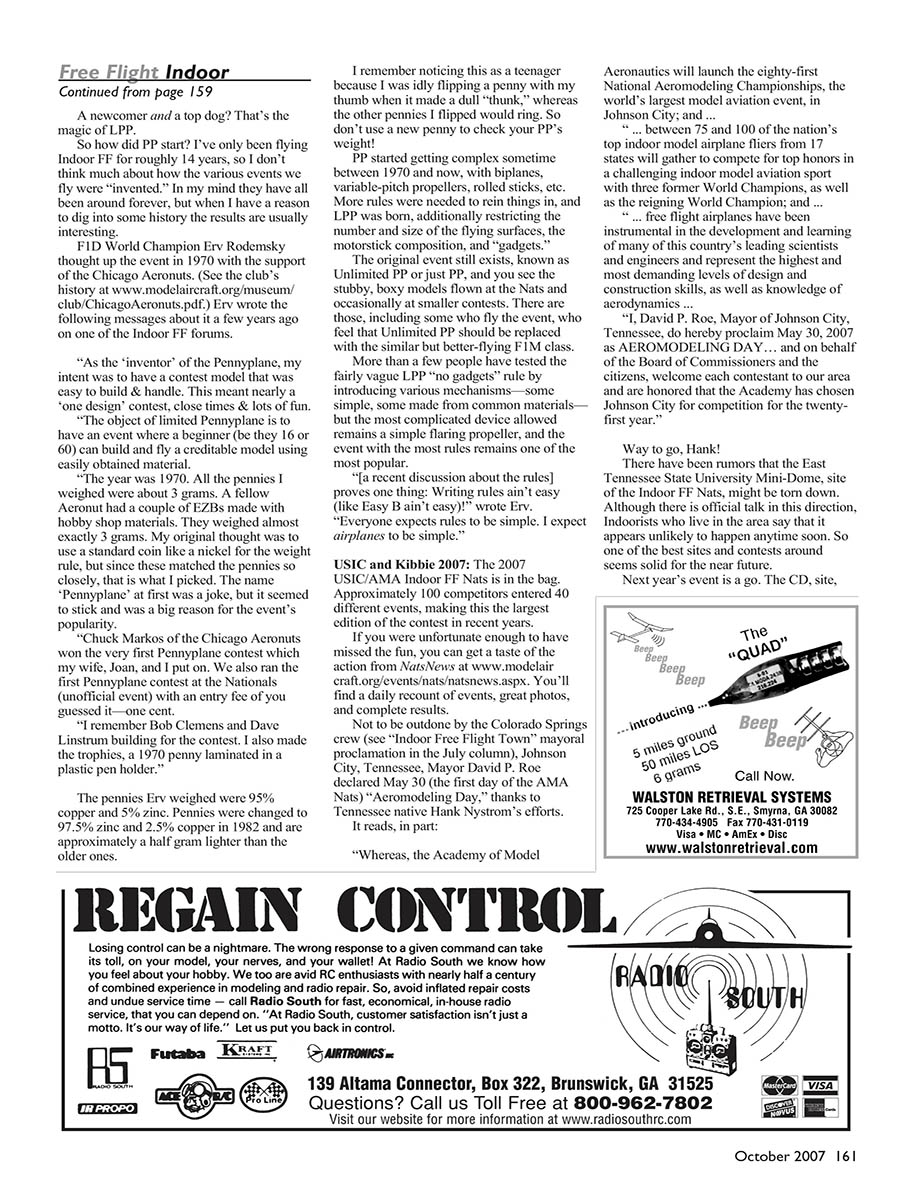
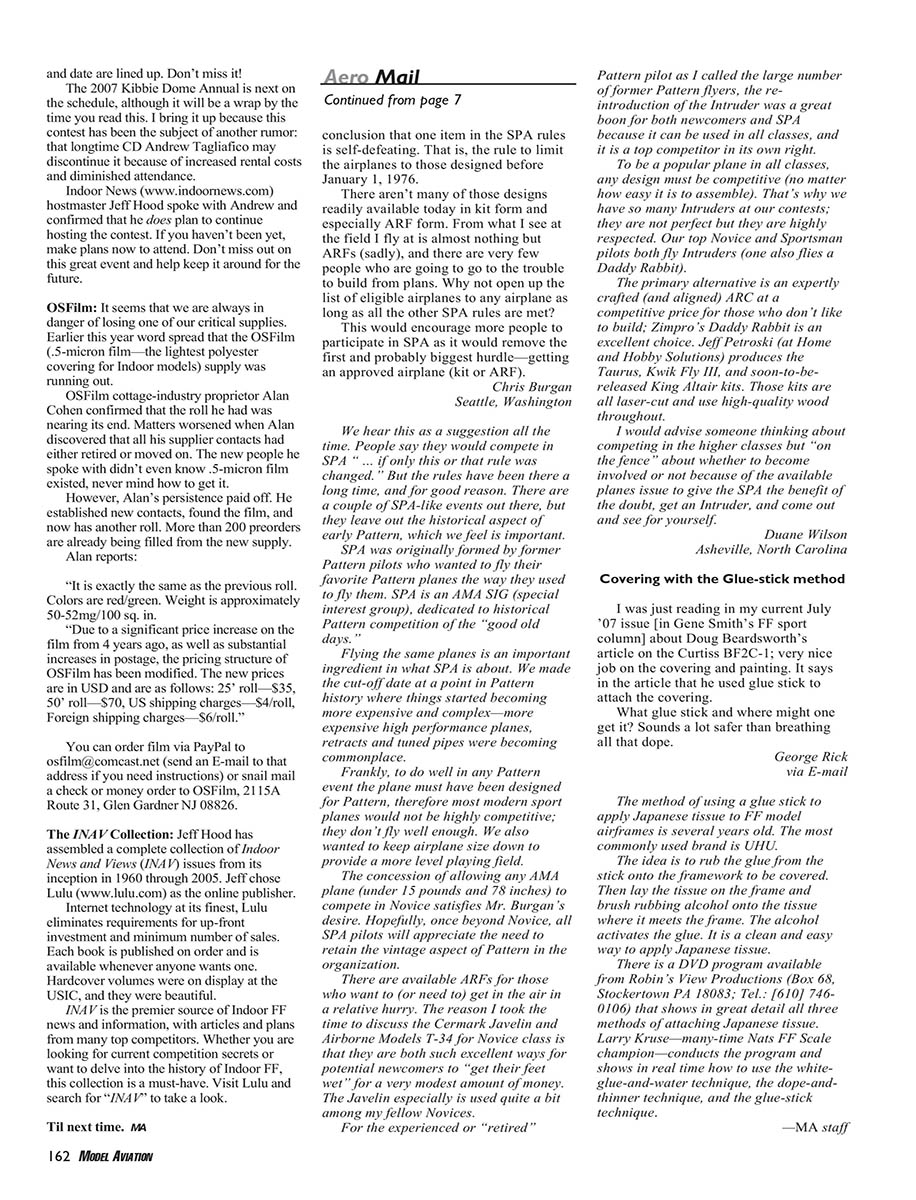
What is Limited Pennyplane?
John Kagan [[email protected]]
LIMITED PENNYPLANE (LPP) is one of the best classes for newcomers to get their feet wet in Indoor Free Flight (FF), and it is a great low-stress event for more experienced fliers. Its popularity speaks for itself; LPP regularly attracts large entry lists at meets such as the US Indoor Championships (USIC).
LPP is a highly rule-defined event: almost every dimension of the model is specified, from airplane and motorstick length to stabilizer span and chord. That restriction, however, still allows enough leeway for significant visual variety. The result is a smaller set of things to learn and master to reach top times, which gives newcomers a satisfying way to showcase their efforts. You still need to build a strong airplane, but you get a good deal of useful weight—no rolled tubes or bracing is required. There are no flying complications such as variable-geometry propellers to adjust; what matters is good winding and flying technique.
The most complicated part of achieving top times in LPP is working out the propeller-and-rubber combination. That doesn’t mean winning is easy—the best fliers still come out on top—but because there are fewer variables, a newcomer can move quickly toward being competitive. Scott Fultz, for example, finished third in LPP at this year’s Nats despite having started Indoor FF only five months earlier. He flew frequently, received help from World Champion Larry Cailliau and Indoor FF master Larry Coslick, and clearly got a handle on LPP. A newcomer and a top dog? That’s the magic of LPP.
Origins
Pennyplane was conceived in 1970 by F1D World Champion Erv Rodemsky with support from the Chicago Aeronuts. Erv’s intent was to create a contest model that was easy to build and handle—nearly a one-design contest with close times and lots of fun. He wrote about the event:
"As the 'inventor' of the Pennyplane, my intent was to have a contest model that was easy to build & handle. This meant nearly a 'one design' contest, close times & lots of fun.
"The object of limited Pennyplane is to have an event where a beginner (be they 16 or 60) can build and fly a creditable model using easily obtained material.
"The year was 1970. All the pennies I weighed were about 3 grams. A fellow Aeronut had a couple of EZBs made with hobby shop materials. They weighed almost exactly 3 grams. My original thought was to use a standard coin like a nickel for the weight rule, but since these matched the pennies so closely, that is what I picked. The name 'Pennyplane' at first was a joke, but it seemed to stick and was a big reason for the event's popularity.
"Chuck Markos of the Chicago Aeronuts won the very first Pennyplane contest which my wife, Joan, and I put on. We also ran the first Pennyplane contest at the Nationals (unofficial event) with an entry fee of, you guessed it—one cent.
"I remember Bob Clemens and Dave Linstrom building for the contest. I also made the trophies, a 1970 penny laminated in a plastic pen holder."
The pennies Erv weighed were 95% copper and 5% zinc. In 1982 pennies changed to 97.5% zinc and 2.5% copper and are roughly a half gram lighter than the older ones. Erv recalled noticing the difference as a teenager when a newer penny made a dull "thunk" while older pennies rang—so don't use a new penny to check your Pennyplane's weight.
Over time Pennyplane grew more complex—biplanes, variable-pitch props, rolled sticks, etc.—and more rules were needed. Limited Pennyplane (LPP) was introduced to rein in complexity by additionally restricting the number and size of flying surfaces, motorstick composition, and "gadgets." The original, less-restricted event continues as Unlimited Pennyplane (PP), where stubby, boxy models still appear at the Nats and smaller contests. Some feel Unlimited PP should be replaced by a more modern class such as F1M, but opinions vary.
More than a few people have tested LPP’s fairly vague "no gadgets" rule by introducing various mechanisms—some simple, some using common materials—but the most complicated device generally allowed remains a simple flaring propeller. As Erv observed: "A recent discussion about the rules proves one thing: Writing rules ain't easy (like Easy B ain't easy)! Everyone expects rules to be simple. I expect airplanes to be simple."
USIC and Kibbie 2007
The 2007 USIC / AMA Indoor FF Nationals is in the books. Approximately 100 competitors entered 40 different events, making this one of the largest recent editions of the contest. For a daily recount, photos, and complete results see NatsNews at www.modelaircraft.org/events/nats/natsnews.aspx.
Johnson City, Tennessee, where the Nats were held, proclaimed May 30, 2007 "Aeromodelling Day" thanks to Tennessee native Hank Nystrom's efforts. Mayor David P. Roe's proclamation welcomed contestants and noted the event's role in developing many of the country's leading scientists and engineers.
There were rumors that the East Tennessee State University Mini-Dome—the Nats site—might be torn down. Although there has been official talk, local Indoorists say demolition appears unlikely in the near future. So one of the best sites and contests around seems solid for the near term. Next year's event is a go.
Transcribed from original scans by AI. Minor OCR errors may remain.

