
Free Flight Indoor
John Kagan [[email protected]]
Remembering Vernon Hacker
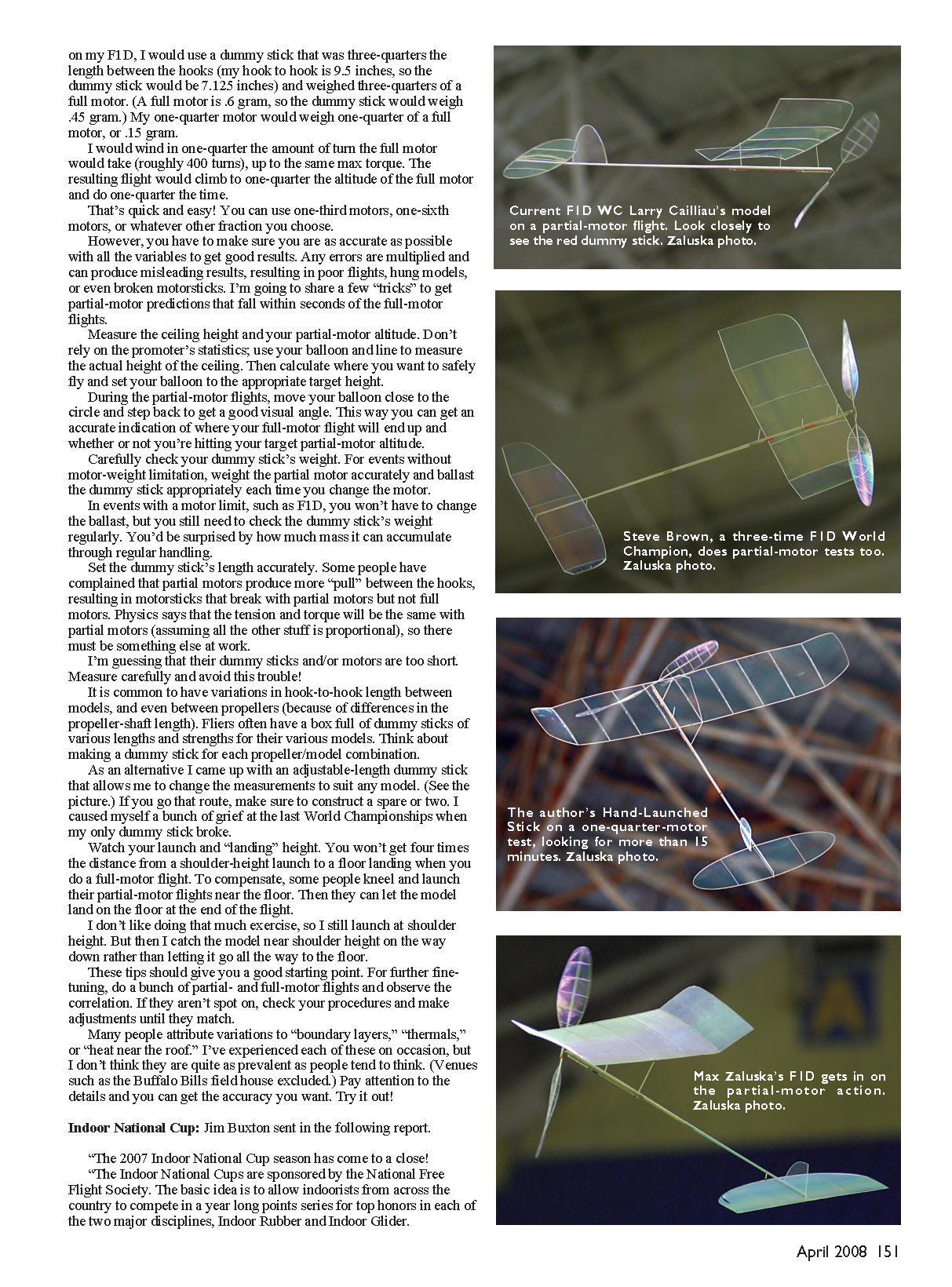
The indoor community lost a well-respected member, tireless supporter, and good friend when Vernon Hacker passed away this winter. Known affectionately as "Doc" or "Hack" (he was both a surgeon and a golfer), he loved model airplanes and flew them his whole life. He enjoyed competing but was even more known for the support, guidance, and encouragement he gave to many in the hobby.
Doc took me under his wing when I moved to Cleveland, Ohio, in 1998. We poured microfilm in his basement, realizing the strength of the fumes only after we returned upstairs from a trip. (I wonder how many brain cells I lost on that project!) When the models covered with the film we made together won the next F1D World Championships, he was not so much thrilled as he was quietly satisfied—like a proud parent.
Doc touched many modelers' lives, with a particular emphasis on beginners and Juniors. He mentored countless fliers (many who are top-level competitors today), traveled to several World Championships as a supporter, raised funds for the Junior team, and when his mobility was restricted by medical equipment, he was the first to try to hook up new modelers with mentors wherever they lived.
At Doc's memorial service I learned that his beneficence extended well beyond the model-airplane world: chief of surgery, community pillar, and even barbershop quartets! He was opinionated, sharp-witted, and quick to speak his mind, but he had a great heart, and those of us who had the honor of knowing him will miss him dearly.
Partial Motors
Last time I wrote about partial-motor testing and some of the problems we experienced at the F1D Team Selection. But what exactly are partial motors and why do some people get more accurate results with them than others?
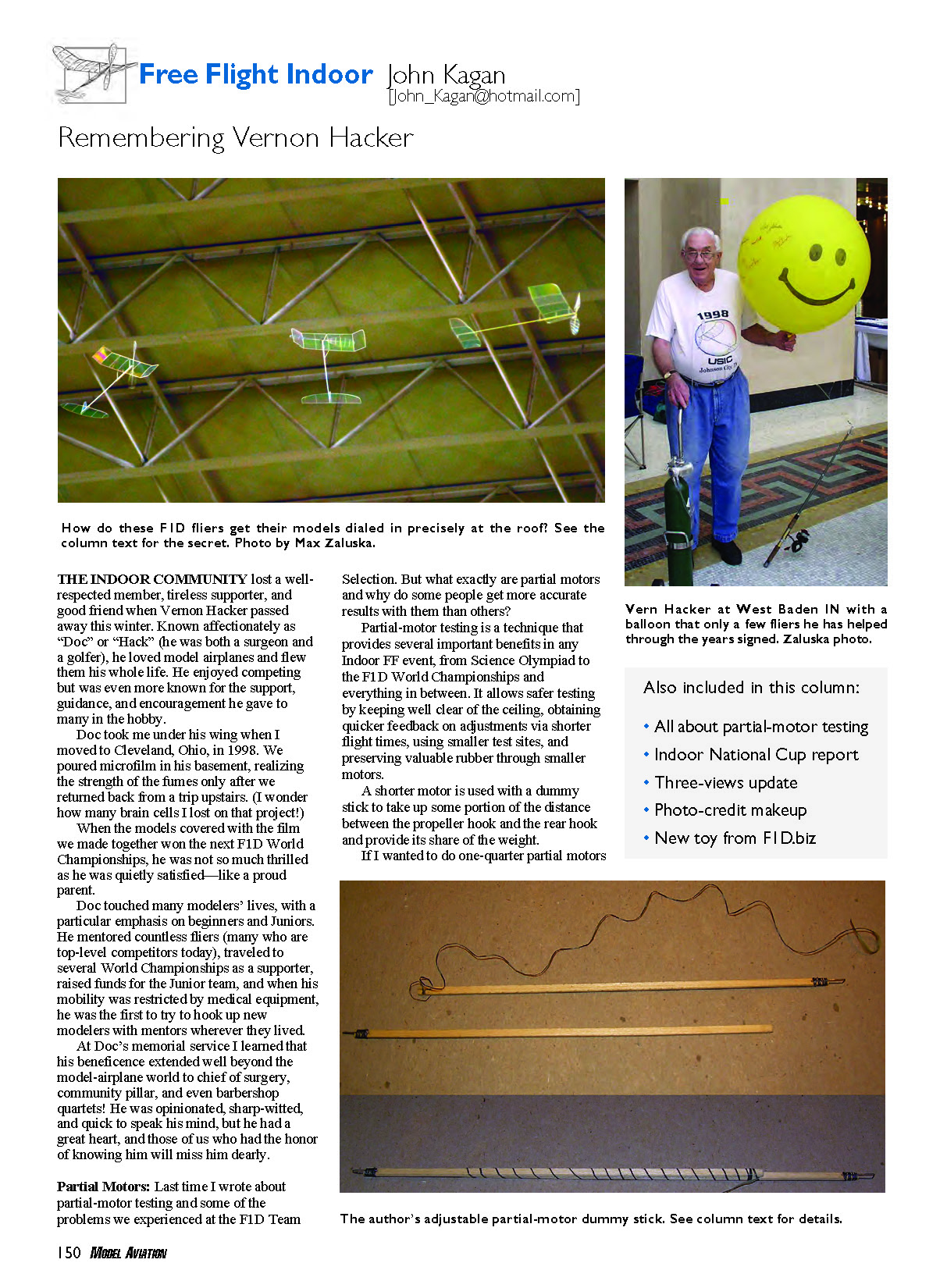
Partial-motor testing is a technique that provides several important benefits in any indoor free-flight event, from Science Olympiad to the F1D World Championships and everything in between. It allows safer testing by keeping well clear of the ceiling, obtaining quicker feedback on adjustments via shorter flight times, using smaller test sites, and preserving valuable rubber through smaller motors.
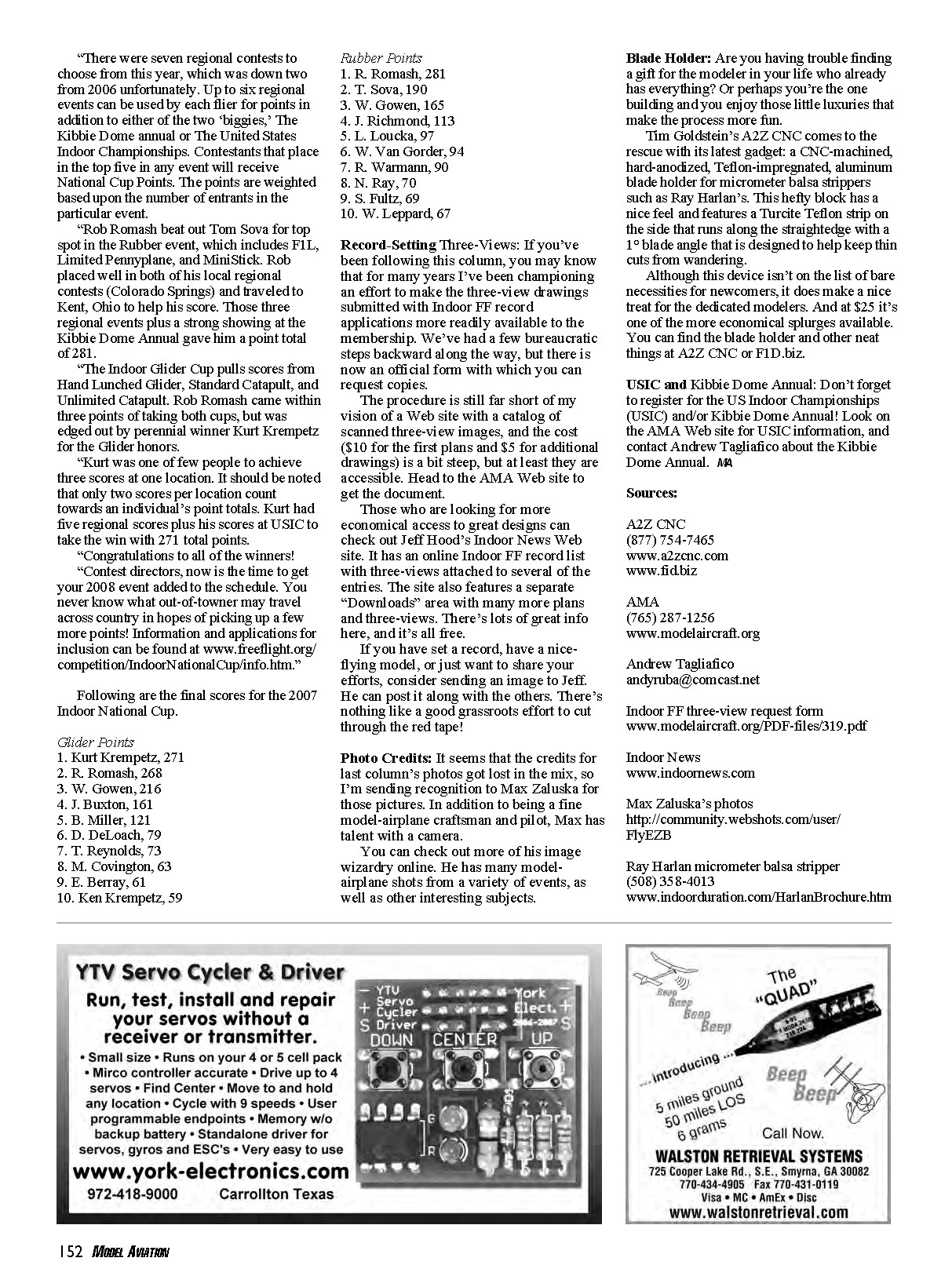
A shorter motor is used with a dummy stick to take up some portion of the distance between the propeller hook and the rear hook and to provide its share of the weight.
If I wanted to do one-quarter partial motors on my F1D, I would use a dummy stick that was three-quarters the length between the hooks (my hook-to-hook is 9.5 inches, so the dummy stick would be 7.125 inches) and weighed three-quarters of a full motor. A full motor is 0.6 gram, so the dummy stick would weigh 0.45 gram. My one-quarter motor would weigh one-quarter of a full motor, or 0.15 gram. I would wind in one-quarter the amount of turn the full motor would take (roughly 400 turns), up to the same max torque. The resulting flight would climb to one-quarter the altitude of the full motor and do one-quarter the time. That's quick and easy!
You can use one-third motors, one-sixth motors, or whatever fraction you choose. However, you have to make sure you are as accurate as possible with all the variables to get good results. Any errors are multiplied and can produce misleading results, resulting in poor flights, hung models, or even broken motorsticks. Below are a few tricks to get partial-motor predictions that fall within seconds of the full-motor flights.
- Measure the ceiling height and your partial-motor altitude. Don't rely on the promoter's statistics; use your balloon and line to measure the actual height of the ceiling. Then calculate where you want to safely fly and set your balloon to the appropriate target height.
- During the partial-motor flights, move your balloon close to the circle and step back to get a good visual angle. This way you can get an accurate indication of where your full-motor flight will end up and whether or not you're hitting your target partial-motor altitude.
- Carefully check your dummy stick's weight. For events without motor-weight limitation, weigh the partial motor accurately and ballast the dummy stick appropriately each time you change the motor.
- In events with a motor limit, such as F1D, you won't have to change the ballast, but you still need to check the dummy stick's weight regularly. You'd be surprised by how much mass it can accumulate through regular handling.
- Set the dummy stick's length accurately. Some people have complained that partial motors produce more "pull" between the hooks, resulting in motorsticks that break with partial motors but not full motors. Physics says that the tension and torque will be the same with partial motors (assuming all the other variables are proportional), so there must be something else at work. I'm guessing that their dummy sticks and/or motors are too short. Measure carefully and avoid this trouble!
It is common to have variations in hook-to-hook length between models, and even between propellers (because of differences in the propeller-shaft length). Fliers often have a box full of dummy sticks of various lengths and strengths for their various models. Think about making a dummy stick for each propeller/model combination.
As an alternative I came up with an adjustable-length dummy stick that allows me to change the measurements to suit any model. If you go that route, make sure to construct a spare or two. I caused myself a bunch of grief at the last World Championships when my only dummy stick broke.
- Watch your launch and "landing" height. You won't get four times the distance from a shoulder-height launch to a floor landing when you do a full-motor flight. To compensate, some people kneel and launch their partial-motor flights near the floor so they can let the model land on the floor at the end of the flight.
I don't like doing that much exercise, so I still launch at shoulder height. But then I catch the model near shoulder height on the way down rather than letting it go all the way to the floor.
These tips should give you a good starting point. For further fine-tuning, do a bunch of partial- and full-motor flights and observe the correlation. If they aren't spot on, check your procedures and make adjustments until they match.
Many people attribute variations to "boundary layers," "thermals," or "heat near the roof." I've experienced each of these on occasion, but I don't think they are quite as prevalent as people tend to think (venues such as the Buffalo Bills field house excluded). Pay attention to the details and you can get the accuracy you want. Try it out!
Indoor National Cup
Jim Buxton sent in the following report.
"The 2007 Indoor National Cup season has come to a close!
"The Indoor National Cups are sponsored by the National Free Flight Society. The basic idea is to allow indoorists from across the country to compete in a year-long points series for top honors in each of the two major disciplines, Indoor Rubber and Indoor Glider.
"There were seven regional contests to choose from this year, which was down two from 2006 unfortunately. Up to six regional events can be used by each flier for points in addition to either of the two 'biggies,' the Kibbie Dome annual or the United States Indoor Championships. Contestants that place in the top five in any event will receive National Cup points. The points are weighted based upon the number of entrants in the particular event.
"Rob Romash beat out Tom Sova for top spot in the Rubber event, which includes F1L, Limited Pennyplane, and MiniStick. Rob placed well in both of his local regional contests (Colorado Springs) and traveled to Kent, Ohio to help his score. Those three regional events plus a strong showing at the Kibbie Dome Annual gave him a point total of 281.
"The Indoor Glider Cup pulls scores from Hand Launched Glider, Standard Catapult, and Unlimited Catapult. Rob Romash came within three points of taking both cups, but was edged out by perennial winner Kurt Krempetz for the Glider honors.
"Kurt was one of few people to achieve three scores at one location. It should be noted that only two scores per location count towards an individual's point totals. Kurt had five regional scores plus his scores at USIC to take the win with 271 total points.
"Congratulations to all of the winners!
"Contest directors, now is the time to get your 2008 event added to the schedule. You never know what out-of-towner may travel across country in hopes of picking up a few more points! Information and applications for inclusion can be found at www.freeflight.org/competition/IndoorNationalCup/info.htm."
Following are the final scores for the 2007 Indoor National Cup.
Glider Points
- Kurt Krempetz, 271
- R. Romash, 268
- W. Gowen, 216
- J. Buxton, 161
- B. Miller, 121
- D. DeLoach, 79
- T. Reynolds, 73
- M. Covington, 63
- E. Beray, 61
- Ken Krempetz, 59
Rubber Points
- R. Romash, 281
- T. Sova, 190
- W. Gowen, 165
- J. Richmond, 113
- L. Loucka, 97
- W. Van Gorder, 94
- R. Warmann, 90
- N. Ray, 70
- S. Fultz, 69
- W. Leppard, 67
Record-Setting Three-Views
If you've been following this column, you may know that for many years I've been championing an effort to make the three-view drawings submitted with Indoor FF record applications more readily available to the membership. We've had a few bureaucratic steps backward along the way, but there is now an official form with which you can request copies.
The procedure is still far short of my vision of a website with a catalog of scanned three-view images, and the cost ($10 for the first plans and $5 for additional drawings) is a bit steep, but at least they are accessible. Head to the AMA website to get the document.
Those who are looking for more economical access to great designs can check out Jeff Hood's Indoor News website. It has an online Indoor FF record list with three-views attached to several of the entries. The site also features a separate "Downloads" area with many more plans and three-views. There's lots of great info here, and it's all free.
If you have set a record, have a nice-flying model, or just want to share your efforts, consider sending an image to Jeff. He can post it along with the others. There's nothing like a good grassroots effort to cut through the red tape!
Photo Credits
It seems that the credits for last column's photos got lost in the mix, so I'm sending recognition to Max Zaluska for those pictures. In addition to being a fine model-airplane craftsman and pilot, Max has talent with a camera.
You can check out more of his image wizardry online. He has many model-airplane shots from a variety of events, as well as other interesting subjects.
Blade Holder
Are you having trouble finding a gift for the modeler in your life who already has everything? Or perhaps you're the one building and you enjoy those little luxuries that make the process more fun.
Tim Goldstein's A2Z CNC comes to the rescue with its latest gadget: a CNC-machined, hard-anodized, Teflon-impregnated, aluminum blade holder for micrometer balsa strippers such as Ray Harlan's. This hefty block has a nice feel and features a Turcite Teflon strip on the side that runs along the straightedge with a 1° blade angle that is designed to help keep thin cuts from wandering.
Although this device isn't on the list of bare necessities for newcomers, it does make a nice treat for the dedicated modelers. And at $25 it's one of the more economical splurges available. You can find the blade holder and other neat things at A2Z CNC or F1D.biz.
USIC and Kibbie Dome Annual
Don't forget to register for the US Indoor Championships (USIC) and/or Kibbie Dome Annual! Look on the AMA website for USIC information, and contact Andrew Tagliafico about the Kibbie Dome Annual.
— MA
Sources
- A2Z CNC
(877) 754-7465 www.a2zcnc.com www.f1d.biz
- AMA
(765) 287-1256 www.modelaircraft.org
- Andrew Tagliafico
- Indoor FF three-view request form
www.modelaircraft.org/PDF-files/319.pdf
- Indoor News
- Max Zaluska's photos
http://community.webshots.com/user/FlyEZB
- Ray Harlan micrometer balsa stripper
(508) 358-4013 www.indooruration.com/HarlanBrochure.htm
Transcribed from original scans by AI. Minor OCR errors may remain.

