
Free Flight Indoor
John Kagan [[email protected]]
The science and application of high-performance rubber
Friends frequently ask me if we use special rubber bands for our airplanes. The answer is, “Of course!” You don’t think we’d have devoted all these hours to our toy airplanes without fully exploring the nuances of extensible motors, do you?
And there is plenty to explore. What might seem as simple a power source actually has many variables; a large amount of knowledge falls into the categories of opinion and black art. However, let’s start with a few facts.
The rubber we use is a special recipe that has significantly more energy storage capacity than your basic office rubber bands. The best batches return more than 4,000 foot-pounds of energy per pound of rubber with a stretch ratio of roughly 10:1.
We measure batches of rubber by winding or stretching, recording force vs. distance (or winds), and calculating the area under the resulting curve. But even this scientific process has a bit of voodoo to it, because you have to measure the energy the rubber gives back (hysteresis steals part of what goes in) and put in close to as much as it will take without breaking to find its max capacity. Understanding where that limit is is an acquired feel and can have a dramatic impact on the results.
Rubber batches are identified by the date of production—similar to fine wine. Indoorists talk about 5/99 Tan II the way wine connoisseurs do a 1945 Mouton. It’s a great day when you get your hands on a batch of 3/02, 2/99, 10/97, 8/95, or one of the other high-energy runs.
But the wine analogy doesn’t end there. Preserving your prize rubber involves special packaging (such as glassine envelopes or oven bags, which don’t outgas acids) and climate control (airtight darkness to reduce degradation and freezer or refrigerator space to slow vulcanizing chemical reactions).
The best batches came from a line that FAI Model Supply called Tan II. Unfortunately it has been out of production since 7/02, when the supplier made a permanent recipe modification prompted by ingredient availability and demand changes. FAI Model Supply calls the resulting new products Tan Sport and Tan Super Sport.
On the plus side, the new line is reportedly more consistent between batches and compares favorably with some decent Tan II runs, especially in outdoor events, in which choosing air plays a major role in competition success. But for indoor events, in which differences in energy capacity correlate much more directly with flight times, Tan II is still highly desired.
However, all is not lost for the newcomer:
- There is plenty to learn using the currently available rubber. It may not compare to the best Tan II if everything else in your program is optimized, but that's a big "if." Sport and Super Sport are perfectly suitable for tuning your models and developing your flying technique. Many top fliers use subpar batches for testing and training, saving the good stuff for competition days.
- Good Tan II can still be obtained sometimes, even though it is no longer produced. For example, outdoor fliers go through rubber by the truckload, and occasionally some of their stash goes on the market. Even the indoor fliers have been known to share their coveted collections with someone they see as having promise. Tan II is not always easy to come by, but once someone puts in the time required to get to a level of competence, he or she almost invariably acquires at least a small supply.
- This isn't the first time we've lost the best rubber. As it reads on my investment statements, "past performance is not an indication of future performance." But history indicates that sooner or later we'll have something that outperforms Tan II.
Having one of the "good" batches doesn't necessarily simplify things, thus bringing us to some of the subtleties.
Different batches have different characteristics, but it isn't as simple as saying one is better than another. A batch may have a lot of energy-storage potential, but if much of it is at high torque (the peak), it may not be as useful for fixed-pitch events as a batch that has a flatter torque curve.
However, many of the batches with a flat curve are also very fragile. They won't take a great deal of peak torque and have to be wound more carefully. A great instance of this is 7/97. It had plenty of useful energy but was so fragile that it frequently broke in flight. I witnessed a handful at the 1997 F1D Team Selection, most with catastrophic results. We somewhat affectionately labeled 7/97 the "Fourth of July" batch for the fireworks it generated.
Different sections of the same batch can have different characteristics. My 3/02 might not be as good as your 3/02 if they came from different parts of the run. Even samples from the same box can vary, especially if they cross a splice in the strip.
When you fly a great deal, you start to develop a feel for what the rubber should be doing, such as how many turns and how much torque it should take. The differences aren't as large as those between "good" and "training" batches, but they can be important at contest time.
Rubber takes a "set" when it is stretched near its max and does not return to its original size right away. The second and third winds are similar to flying on a longer motor with a thinner cross-section. Subsequent winds don't change much more, but nicks and abrasions limit the number of times it can be wound.
As a result, some fliers let their motors recover between uses, waiting up to an hour for it to return to its original characteristics. I prefer to size the motors so that the size is almost right from the second wind on. People win contests both ways.
So there you have it. Keep your eyes out for Tan II, but don't let a lack of it keep you from flying and competing. Learn some of the energy-testing methods so you can measure what you have. Develop your airplanes and flying technique with whatever rubber is available; you will pick up the nuances with experience. And fly, fly, fly! Everything should be this much fun.
Till next time. — MA
Notes From the Glider Fliers (or "How to Motivate Your Friends")
Hand-launched glider expert Jim Buxton sent an interesting account of events leading up to contest day:
"If you have ever seen Ferris Bueller's Day Off you may recall the scene where Ferris repetitively calls Cameron to convince him to get out of bed and drive over to the school to take Ferris out for the ultimate skip day. Cameron, sick at home, would rather not but finally gives in knowing that Ferris will continue to call and harass him until he does.
"For the past two spring seasons I have reluctantly taken on the role as Cameron, with Rob Romash playing the part of Ferris. It starts in March. The phone rings ...
"Romash: 'Buxton, what you building for Kent?'
"Me: 'Nothing, we just had a baby boy two weeks ago, I am not even sleeping. Build models? Good one.'
"Romash: 'Quit being lazy, build something new, don't show up with the same old stuff and baby poop on your shoulder.'
"Me: 'Ben just spit up, I gotta go ...'
"And so it continues, weekly, sometimes daily calls, followed by messages. I get to the point of ignoring the 719 area code altogether. Then he goes in for the kill. See the photos for what appeared on my phone with the text, 'I used THE SHEET.'
"Every glider guy has a sheet of wood too sacred to use. Mine is a beautiful sheet of 3.67-pound, 1/4-inch C-grain. I have had it for almost 20 years. Sometimes I just take it out and look at it, then store it back away.
"It seems all glider fanatics do this. I know Romash and Jim Lewis both talk about having 'THE SHEET' as well. It gives us all comfort to know we still have our best sheet in the rack. One must not take the use of THE SHEET lightly. See the pictures for mine.
"Even mice knew it was a good sheet. Luckily they only got the corner which will not limit the use of 'THE SHEET.' My balsa storage is now rodent proof.
"With Kent looming a week away and a picture of an impressive looking new glider on my phone courtesy of Rob, what to do, what to do? Sleep is a crutch. I dug out 'THE SHEET' and pulled a couple weekend all-nighters. I cannot let Rob do all the trash talking without a shiny new glimmer of hope to call my own.
"Besides, there is something exciting about going to a contest with a brand new stick. It gives you something to think about, even dream about the whole way there. A shiny new glider that has yet to disappoint. Could it be the one? Will it break the 60-second mark in a Cat II building?
"There is just something about a glider that has just emerged from a stack of balsa just days before. Until the first flight, the glider is perfect. After the first flight ... well, all faults are known.
"The glider, well it is bigger, lighter and sexier. That is exactly what Rob said he did, so I did the same. See the pictures.
"So Rob can be considered a master manipulator—of both balsa and people. However, I still have 'THE SHEET.' At the last second I chickened out and chose a slightly less pretty, but already 4-inch-wide sheet of 4.0-pound wood, no joining needed, and time was an issue.
"You always want to have one arrow left in the quiver ..."
Check out Jim's contest report on the Small Flying Arts website to see how things turned out.
Local Scene
Terryl Asla sent in the following report on the Oklahoma City, Oklahoma, scene.
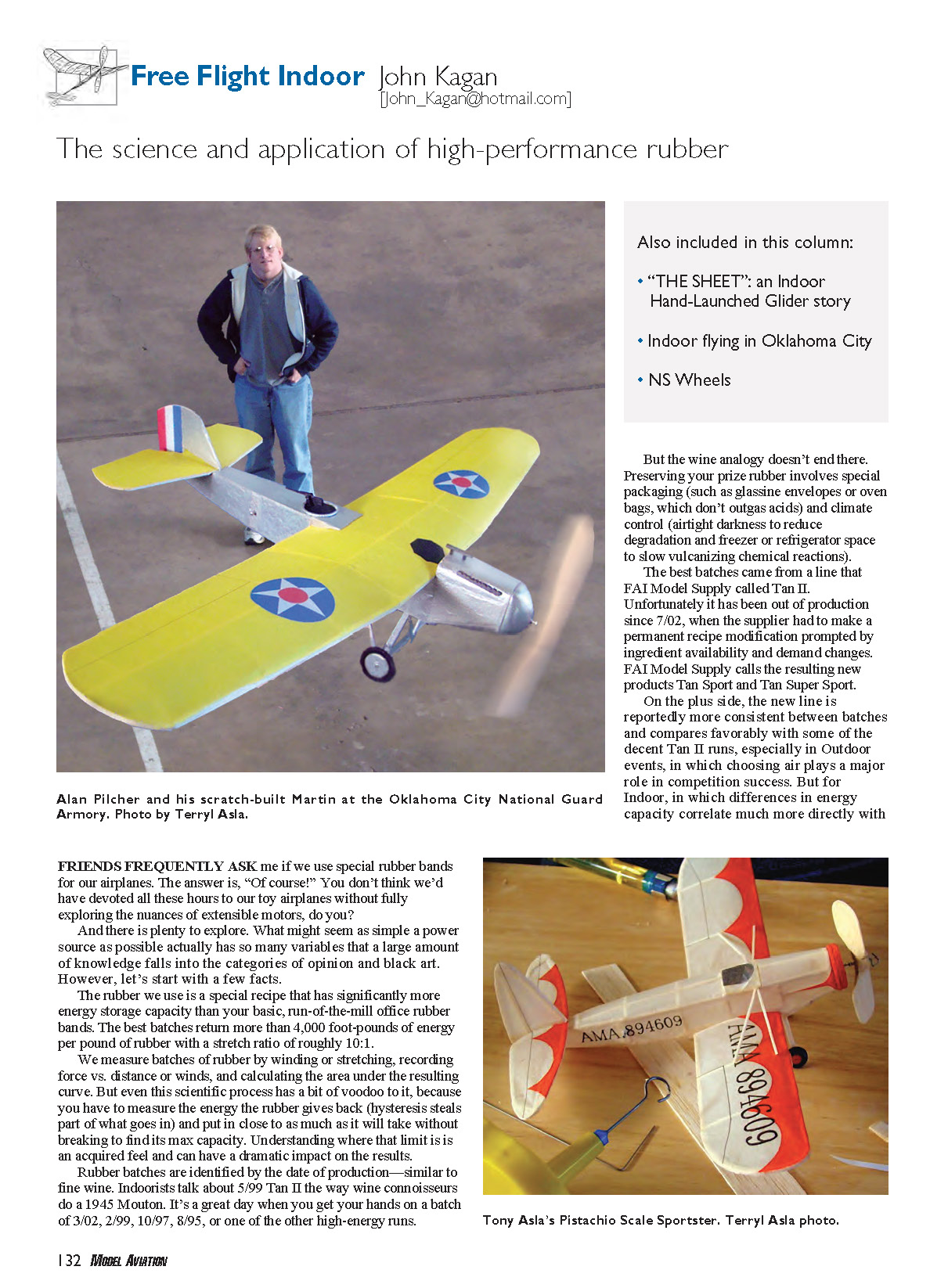
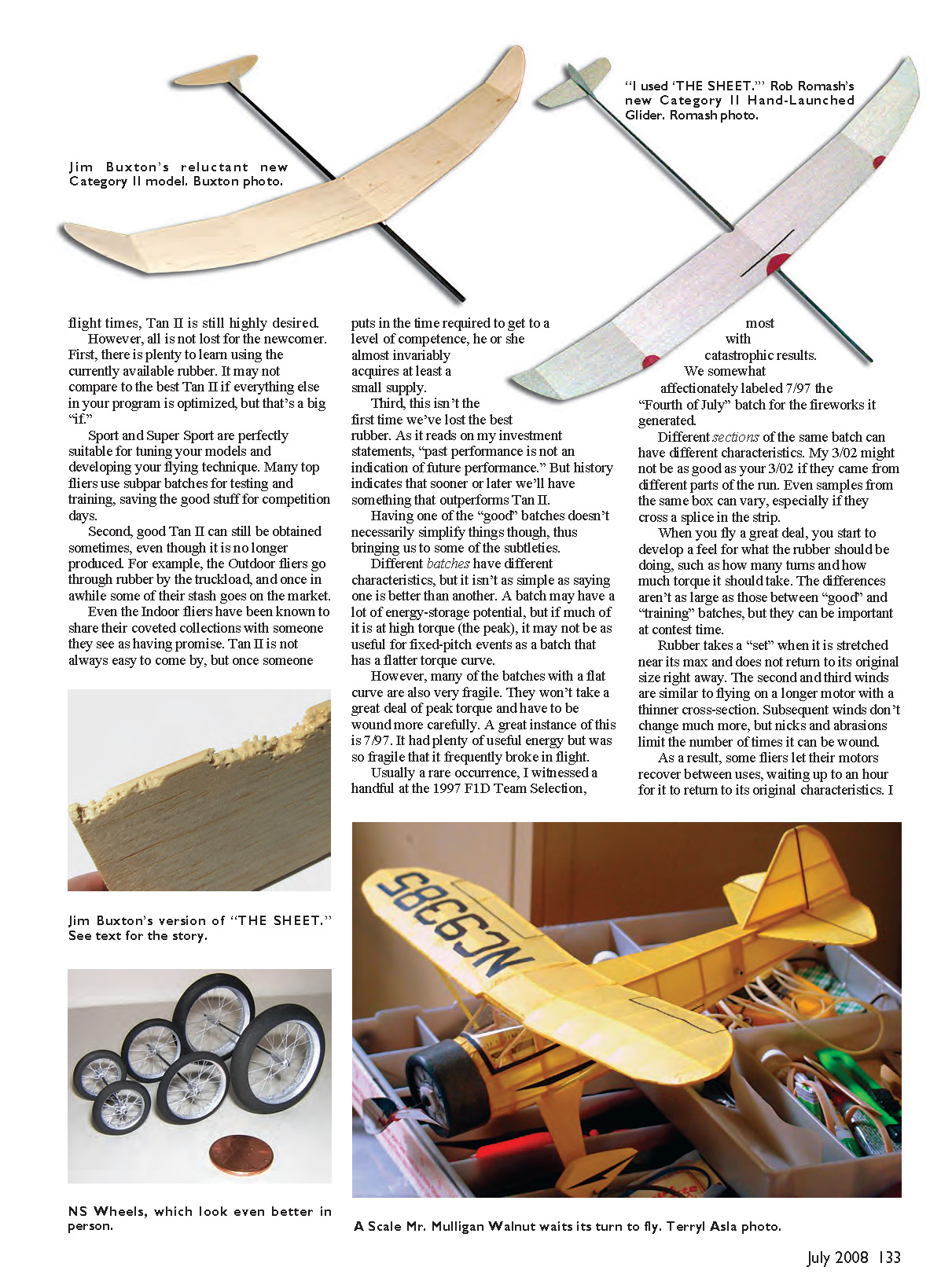
"Since they lost access to their fly-in gymnasium about 18 months ago, the most dedicated members of the Wichita, KS stick and rubber free flight group—David Aaronstein, Alan Pilcher, and Anthony Asla—have been making the monthly 3-hour trek south down Interstate 35 to the National Guard Armory in Oklahoma City, where the OK flyers gather.
"Aaronstein, an aeronautical engineer, is no stranger to anyone familiar with stick and tissue model building. Not surprisingly, he continues to dominate the no-cal WWII mass launches and to amaze with his new designs. Pilcher, a graphic designer, creates and prints his own tissue paper for covering his models.
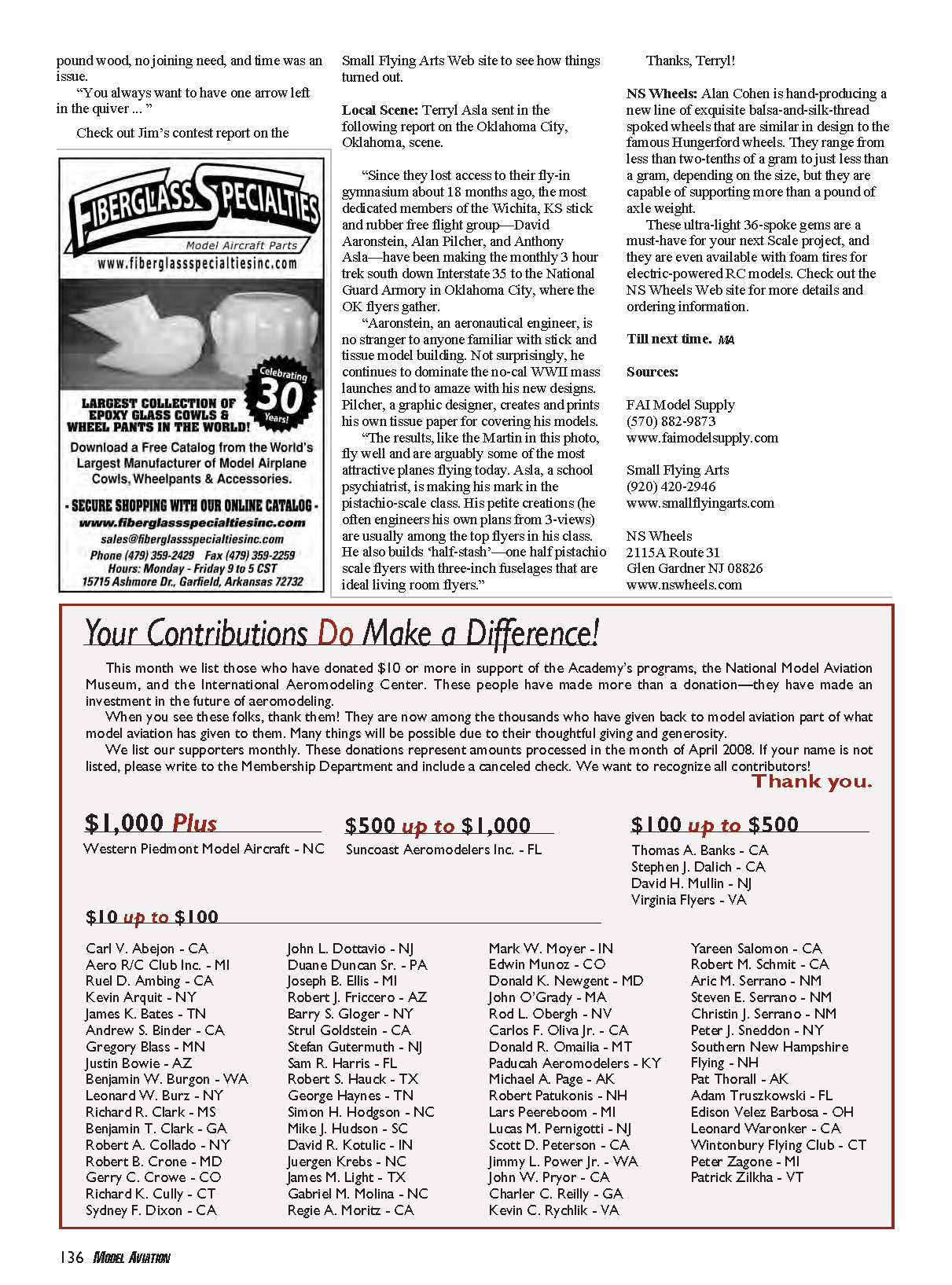
"The results, like the Martin in this photo, fly well and are arguably some of the most attractive planes flying today. Asla, a school psychiatrist, is making his mark in the pistachio-scale class. His petite creations (he often engineers his own plans from 3-views) are usually among the top flyers in his class. He also builds 'half-stash'—one-half pistachio-scale flyers with three-inch fuselages that are ideal living room flyers."
Thanks, Terryl!
NS Wheels
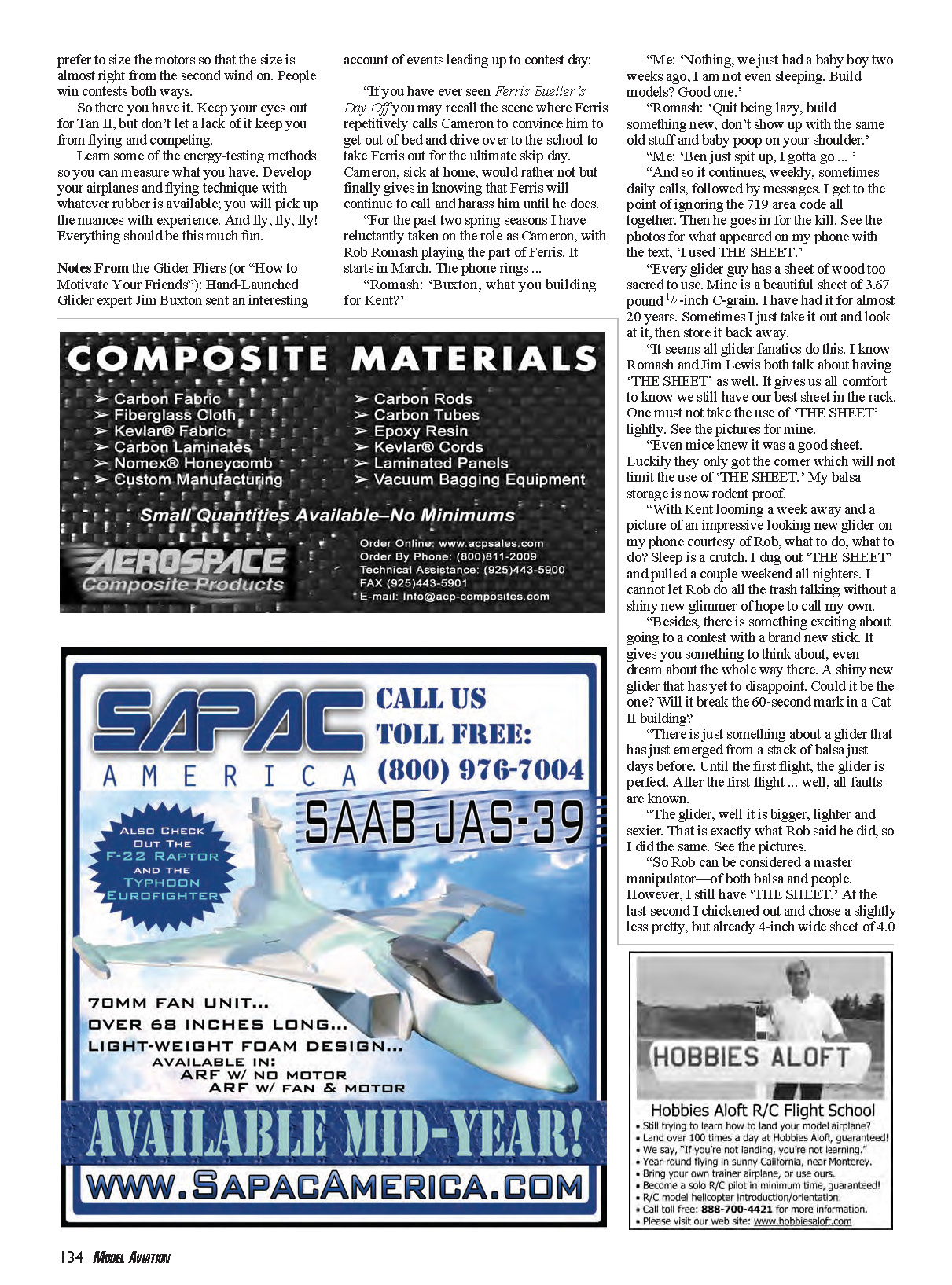
Alan Cohen is hand-producing a new line of exquisite balsa-and-silk-thread spoked wheels that are similar in design to the famous Hungerford wheels. They range from less than two-tenths of a gram to just less than a gram, depending on the size, but they are capable of supporting more than a pound of axle weight.
These ultra-light 36-spoke gems are a must-have for your next scale project, and they are even available with foam tires for electric-powered R/C models. Check out the NS Wheels website for more details and ordering information.
Till next time. — MA
Sources
- FAI Model Supply
(570) 882-9873 www.faimodelsupply.com
- Small Flying Arts
(920) 420-2946 www.smallflyingarts.com
- NS Wheels
2115 A Route 31 Glen Gardner, NJ 08826 www.nswheels.com
Transcribed from original scans by AI. Minor OCR errors may remain.

