
Free Flight Indoor
John Kagan <[email protected]>
F1D World Championships report
NEWS FLASH: US F1D fliers win team Gold, individual Bronze, and Junior individual Gold and Silver at the 2008 World Championships (WC)!
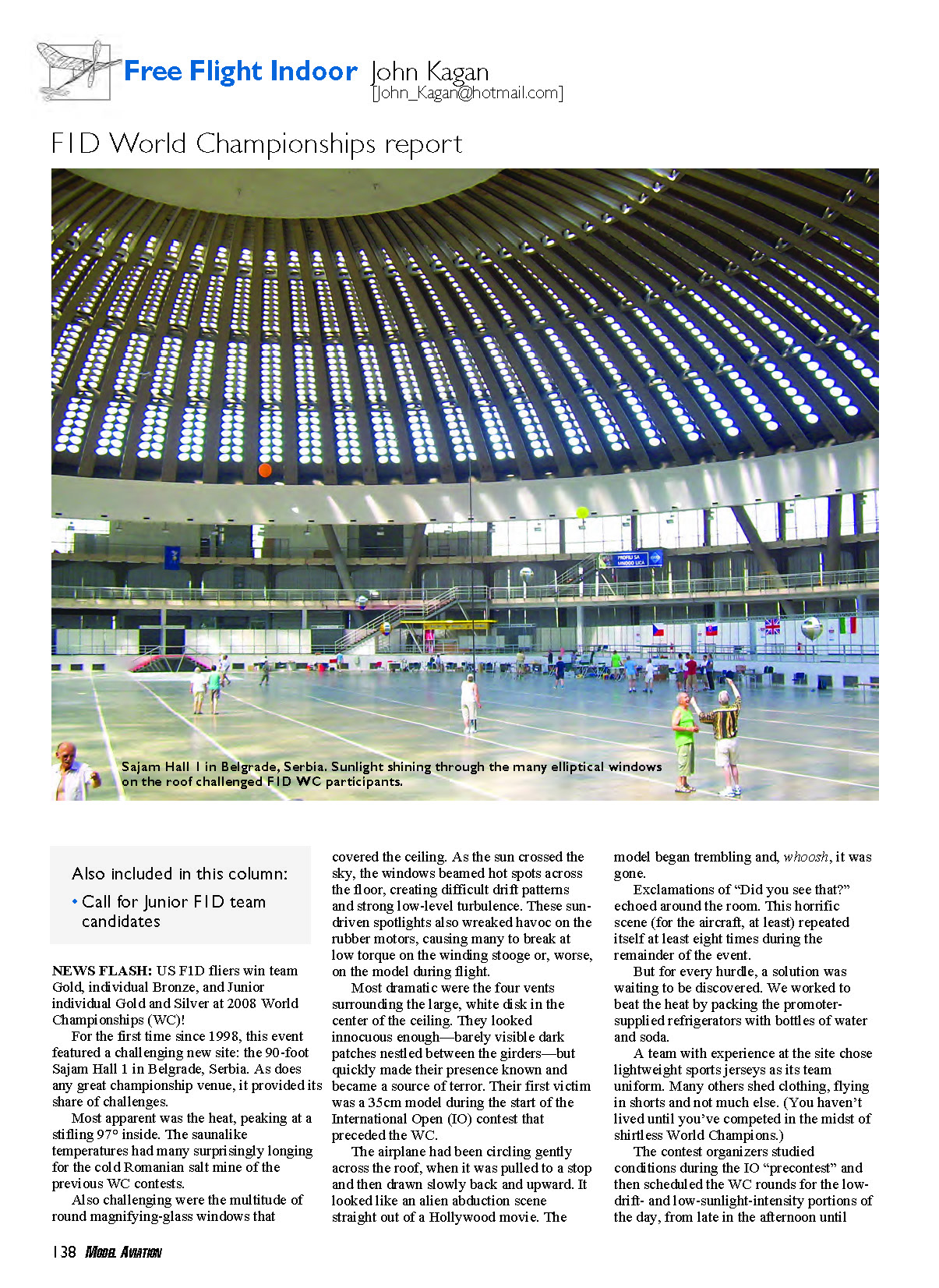
For the first time since 1998, this event featured a challenging new site: the 90-foot Sajam Hall 1 in Belgrade, Serbia. As does any great championship venue, it provided its share of challenges.
Most apparent was the heat, peaking at a stifling 97°F inside. The sauna-like temperatures had many surprisingly longing for the cold Romanian salt mine of previous WC contests. The heat also eked out a touch more energy from the motors; no less than four competitors ended up topping the Category II world record set a year ago in neighboring Hall 3.
Also challenging were the multitude of round magnifying-glass windows that covered the ceiling. As the sun crossed the sky, the windows beamed hot spots across the floor, creating difficult drift patterns and strong low-level turbulence. These sun-driven spotlights also wreaked havoc on the rubber motors, causing many to break at low torque on the winding stooge or, worse, on the model during flight.
Most dramatic were the four vents surrounding the large white disk in the center of the ceiling. They looked innocuous enough—barely visible dark patches nestled between the girders—but quickly made their presence known and became a source of terror. Their first victim was a 35 cm model during the start of the International Open (IO) contest that preceded the WC.
The airplane had been circling gently across the roof when it was pulled to a stop and then drawn slowly back and upward. It looked like an alien abduction scene straight out of a Hollywood movie. The model began trembling and, whoosh, it was gone. Exclamations of "Did you see that?" echoed around the room. This horrific scene (for the aircraft, at least) repeated itself at least eight times during the remainder of the event.
But for every hurdle, a solution was waiting to be discovered. We worked to beat the heat by packing the promoter-supplied refrigerators with bottles of water and soda. A team with experience at the site chose lightweight sports jerseys as its team uniform. Many others shed clothing, flying in shorts and not much else. (You haven't lived until you've competed in the midst of shirtless World Champions.)
The contest organizers studied conditions during the IO "precontest" and then scheduled the WC rounds for the low-drift and low-sunlight-intensity portions of the day—from late afternoon until midnight. This format made meals and transportation a bit more difficult, but the opportunity to fly in great air was well worth the hassle.
We quickly learned to deal with the vents by plugging them with steering balloons if our models ventured near. Picture tossing a ham sandwich into the nozzle of your vacuum cleaner before it sucks up your prize-winning dust bunny (or something like that). Despite—or possibly because of—these hurdles, Hall 1 proved to be an excellent world-class venue. The challenges kept us on our toes, but the site was eminently flyable in the end. Once we identified the best air times, most of the top flights required only a steer or two.
Most of the US team arrived early. After a day of practice, festivities began with the IO, which served as a warm-up for many of the WC competitors and organizers.
Brett Sanborn, Junior team manager and Senior team alternate, planned to compete seriously in this event before switching to a support role. After some promising partial-motor flights, he looked poised to dominate. However, his best model was the second sacrifice to the vents, ending up jammed in the opening and clearly visible when the light hit it right. That was just the start of his troubles: broken motors, steering mishaps, timer difficulties; it was a tough experience. But, hey, that which does not kill us makes us stronger, right?
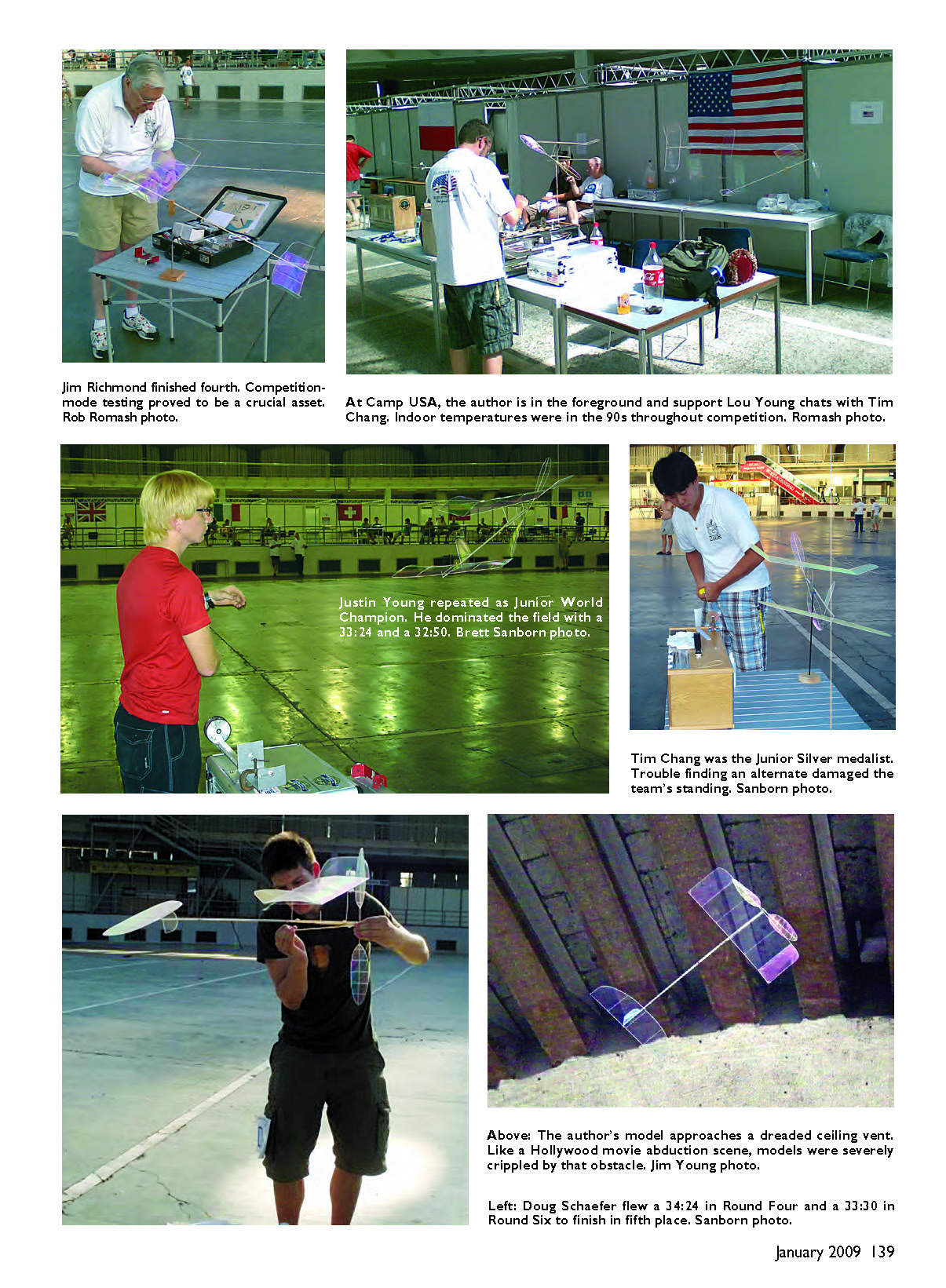
Jim Richmond, defending Champ Larry Cailliau, and I used the contest to do some competition-mode testing. It was a great opportunity to see how we stacked up against the rest of the field, some of whom had flown in this location before. Jim and I ended up in fourth and third place, respectively. That boded well for the WC, even though we knew everyone's times would surely improve.
Senior Doug Schaefer and Junior Justin Young forewent official IO flights in favor of more dedicated testing. Our other Junior, Tim Chang, was scheduled to arrive a few days later. He did, but his luggage didn't. It cost Tim valuable practice time, but everything was eventually delivered and he was good to go.
Doug Schaefer flew first in the opening round but suffered the combined effect of ground turbulence and a borderline launch. The airplane stalled and touched down just after the attempt window, earning him the contest's shortest flight: 1:13. Undaunted, Doug bounced back in the second round with a decent 32:19, showing he was still in the game.
After morning practice the second day, Doug was passing his model over the railing to me when my finger snagged on his motorstick bracing and broke it. He was forced to replace the wire before the next round. Fortunately, the model launched better after the repair. Doug's great pair of team times—34:24 in Round Four and 33:30 in Round Six—earned him fifth place individually.
Jim Richmond started with a nice 34:56, which was the second-best time of the first round and one of six flights that surpassed the world record. Then the troubles began: vision problems with the white ceiling, a Mylar balloon, and sunlight conspired against him, and he lost three flights in a row to botched steers.
With only two rounds remaining to get a good second flight, I asked the FAI Jury members if they would allow Jim to have a proxy steer. A doctor's note describing the requirement for a proxy is normally required, but the Jury concluded that the empirical evidence (Jim had proven steering skill but was clearly unable to see his model properly) was as definitive as any note. I passed the news along and he said, "Heck yeah!" and chose me to proxy. I was happy to oblige, and we set off to fly Round Five.
The US team was in second place, behind Great Britain, and Jim needed only a 23-minute flight to get us into first place. Individually, he needed close to 36 minutes to get onto the podium. In true team spirit, Jim chose to put up a safe flight for the team first and then let it all hang out in the final round.
The Round Five attempt required a couple of steers but stayed a safe distance from the ceiling and the stronger drift zone. My steering broke a couple of ribs near the root of one of the delicate propeller blades, which introduced a slight wobble but didn't seem to affect the flight much. The model landed at 33:10—more than enough to boost the team into a commanding lead.
Jim planned an all-out burn in Round Six, and I prepared to do a bunch of steering at the ceiling. As I feared, the model quickly got to the white disk and began drifting off to the side. I plugged the vent as the model circled by, and then I grabbed it and steered it back to the "upwind" side of the building.
Everything was looking great and the flight had all the earmarks of another famous Richmond last-round comeback. All we had to do was wait for the propeller to fold and then sit back and see if the watch showed enough time at the end.
So we waited—and waited and waited. The propeller started the little hitch that indicated it was ready to fold, but for some reason it didn't flip when Jim planned. Instead, it annoyingly waited until the model had lost the majority of its altitude. It held on for a respectable 32:42, which wasn't enough to move Jim up. He was left in fourth place individually, but he did his work for the team win.
My contest began with a 34:27 and a 34:15. I knew those wouldn't be good enough to win, but they were solid team times and I could spend the next four rounds on more selfish interests.
Brett Sanborn and I stayed late the first day, mapping then-second-place Lutz Schramm's Round Two flight. We took propeller RPM readings every two minutes and then tabulated and analyzed the data to determine his variable-pitch-propeller settings. They correlated closely with the strategy I had chosen and provided valuable corroboration.
During practice on the second day, Brett and I spent even more time with the RPM watches and my airplanes. I was getting minor improvements but finally decided I needed more pitch at the end of the flight. My variable-pitch hubs do not have a low-pitch adjustment, and twisting the spars would change the other parameters (high pitch and preload) that we had worked so hard to tune in. Therefore, I chose the crude tweak of stuffing paper shims in the hinge gap. Voila! Rounds Three and Four bumped up to 35:38 and 35:15, moving me within striking distance—15 seconds out of second place and 30 seconds out of first.
My fifth-round slot coincided with the peak sun intensity of the day, and I learned a valuable lesson: I don't know how the outdoor fliers do it, but I found it impossible to wind motors in direct sunlight. They wouldn't take anything close to their normal energy, and I was left with a pile of broken motors. I finally got one wound and, while I signaled to the timers, it broke on the stooge.
In hindsight, this would have been a great time to choose a different tactic. But in the heat of competition, I forged on and launched a flight. Just as I was about to steer halfway through, the motor broke and disassembled the airplane in several key locations. I lost the round and suffered a significant setback with my best model.
I decided my best chances were with the airplane I had spent so much time on, so I dug in, managed to repair all the damage before lunch, and got one short test flight. I was up last in the final round and, under a bit of time pressure, managed to get the flight off. It had the turns and launch torque I wanted, but too many variables had changed and it landed with only 34:01. I was disappointed I didn't do better, but I was happy to earn an individual podium spot and share the team win.
Defending World Champ Larry Cailliau had his own set of hurdles to overcome. Recent eye surgery had left his vision a little blurry, and the heat seemed to affect him more than most. He also lost a couple of flights to steering problems, once ripping a large hole in his model's wingtip. Brett Sanborn sprang to action and neatly patched the wing so Larry could stick with the airplane he had chosen. He finished seventh with a decent 34:06 and 32:20.
Ivan Treger of Slovakia won (and set a world record) with 36:23 and 35:25. His models were deceptively simple but had a rock-solid launch and flight pattern. Ivan recently won the F1E WC too—amazing!
Germany's Lutz Schramm was second with 36:18 and 35:01. His airplanes were marvels of German engineering, featuring elliptical polyhedral, molded carbon propeller blades, adjustable hollow carbon wing posts, and a bevy of other technical innovations.
In the Junior camp, defending World Champ Justin Young dominated the field with 33:24 and 32:50, taking his second consecutive WC title. Any pair of his top four flights was good enough for the win. He had to look over his shoulder, though, because teammate Tim Chang was a threat.
Tim had some promising partial-motor flights on practice days, but launch problems and the rest of Hall 1's challenges kept him from converting. Still, he managed a pair of 30s to edge in front of Gabriela Kaplanova of the Czech Republic. They finished second and third respectively. Thus Justin and Tim kept the Junior Gold and Silver streak alive at the WC: they made up the fifth straight team to accomplish the feat. It's great to see that kind of talent in the pipeline.
Team manager Rob Romash and Junior team manager Brett Sanborn kept us organized, helped us fly, and made tough decisions when required. Rob even sported an updated version of his "F1D caddy": a belt-mounted holster for essential tools such as ZAP and scissors. He and Brett were Johnny-on-the-spot, saving US team members and anyone else within range more than a few times. Hats off to you guys!
The Serbian organizer, Ljubomir Radosavljevic, and CD Vladimir Zivanovic did an awesome job too. The contest was disciplined and strict but flexible when warranted—truly world class. The city and people of Belgrade were fantastic. There had been some concern about recent political unrest, but we found Serbia to be friendly, safe, and fun. I thoroughly enjoyed myself, and I know my teammates did too. With the next F1D WC already scheduled for Belgrade in 2010, now's the time to start vying for a spot on the team.
Go to page 171 of this issue to see the full results of this year's F1D WC. Additional photos are on page 170.
Call for F1D Juniors
Despite Justin's and Tim's exceptional performances, the streak of Junior team titles ended at this WC. After three other program participants dropped out for various reasons, the team was left with just two members. That was too much of a deficit to overcome.
A last-minute replacement had been snatched from the Science Olympiad ranks and brought up to speed by Junior Team manager Brett Sanborn during an exhausting few weeks. The new flier wasn't going to be an individual contender, but he had potential to provide critical help for the team. It seemed like a no-brainer to take him: he demonstrated aptitude in the Science Olympiad and at a contest in Lakehurst, New Jersey; the funds had been allocated; and all other interested candidates already had the opportunity to step forward.
But apparently there had been heartburn over replacements for other FAI teams, and the AMA's FAI Executive Council denied the request. Many people, here and abroad, wrote letters and made calls expressing their support for a replacement Junior, but the council was adamant. Reasons given included concern about ever-increasing FAI team costs and not having enough time to alert the entire AMA population, thus potentially bypassing some other interested party (although that requirement exceeds what was done for the original team finals).
I believe in being fair and honorable in our team selection, but we shifted too far away from the primary objective of sending the best team to represent the US in international competition. Ours was the only Junior team of the six that did not have a full three members. A pair of 13:35 flights from a third US flier would have vaulted the team from last to first. To put that in context, the last-place finisher in the contest had a 21 and a 22.
But that's in the past. Let's hope it was a one-time thing and that the Junior program never experiences 60% attrition again. It was suggested that the Indoor FF community look inward to figure out what failed. However, with the Junior Program's phenomenal success (five World Champions, five Silver medalists, four team World Champions, and graduates who have become national record holders, National Champions, Senior team members, etc.), using the words "fail" and "Junior F1D team program" in the same sentence is off target.
It would be great to have even more Juniors involved. In the meantime, let's at least keep doing what has worked so well and ramp up a minimum of four or five Junior team candidates every two years.
The 2008–2009 F1D team-selection cycle is already in progress. If you are, or know of, a Junior who:
- will be 18 or younger for the entire year of 2010,
- has an interest in Indoor Free Flight,
- and would enjoy a largely funded trip to represent the US in international competition,
consider trying out for the US Junior F1D team. It looks great on a college application and is a fantastic experience. You can contact me at my e-mail address for details.
Transcribed from original scans by AI. Minor OCR errors may remain.

