
Free Flight Indoor — 2009/04 By John Kagan ([email protected])
A short history of combined AMA Indoor FF Nats and the USIC
Reader G.W. Poythress sent in a letter that reads, in part:
“The Indoor event covered in the October ’08 issue was very good—however! As a CD for many years, I wondered how it could be sanctioned with so many non-AMA events.
“Ask the [author of the article] to describe the non-AMA models. Not all of us are a member of other organizations. The photos were fantastic!”
The answer to the first part demonstrates such a fine example of cooperation between related organizations (as well as the effort involved in finding flying venues and the value of perseverance) that I felt it would make a nice topic for the column. It’s an interesting story.
Flash back to 1981: the active free flight (FF) population had dwindled, partly because of a lack of decent sites, and many people were predicting the demise of our activity. Sound familiar?
The National Free Flight Society (NFFS), AMA’s FF SIG, reported that its membership was down to about 700, with only a handful of indoor fliers. The AMA Indoor FF Nats were held in a variety of sites located near the Outdoor Nats. The Indoor Nats benefited from access to interested spectators but suffered significantly from the quality of sites available, with short ceilings and drifty air.
NFFS president Tony Italiano met with Hardy Brodersen, the NFFS executive director, and they decided that a more permanent, high-ceiling, good-air site was desperately needed. They planned a large new contest, labeled the United States Indoor Championships (USIC), in addition to the AMA Nats. Tony began scouring the country for the next great indoor site. He even took extended road trips with his wife to visit potential locations. Most of them weren’t particularly desirable, but he did locate a few possibilities.
The first site wanted an exorbitant daily fee, plus 12% of the entry fees. When Tony explained the budget available, they suddenly weren’t interested. The second try produced similar results, as did the third. As Tony crossed site 15 off the list, Don Lindley relayed a message: modeler John Schlagetter had spotted a picture of an indoor football game at Eastern Tennessee State University (ETSU) while browsing through an airline magazine. The building looked huge.
Tony called site manager John Knox, and this time the conversation went differently. Both had grown up outside of Chicago and liked to visit Lake Geneva, Illinois. Then the conversation turned to John’s previous military experience; he had been stationed at the Malabang airstrip in Mindanao, Philippines. Tony perked up and asked John if he remembered the C-47 supply craft that would pop the wheels up immediately after takeoff, tear across the water, pull up vertical, and roll out at the top once the speed bled off. John said, “Heck yeah, we always thought that guy was some ex-fighter pilot or something.” Tony grinned and said, “That was me!” They had an instant bond, and the USIC found a permanent home.
The ETSU Mini-Dome’s rent was low, the university staff loved the event and was eager to have us, and the site was great. It was impervious to outside conditions and of a decent height. The first ETSU USIC was held in 1987, and we’ve been there since. All that is a fine example of the effort and perseverance mentioned earlier.
Several years later, in 1990, Tony struck a deal to have the Indoor FF Nats join the USIC at ETSU. The AMA was happy to relinquish event management, and with the exception of Lubbock, Texas, in 1994, and the Kibbie Dome in Moscow, Idaho, in 1996, the USIC and Indoor FF Nats have run as a combined event at the Mini-Dome. Although there is now one major national contest instead of two, both parts enjoy a new, world-class facility.
Referring to world class, two F1D World Championships have been hosted at ETSU: the first in 1988 and again in 1990.
Flash forward to the present: we are still flying the Indoor FF Nats and the USIC together at the fabulous Mini-Dome. Like model airplane pack rats, we love creating new events, but apparently we can’t bear to get rid of the old ones. There are 16 events in the AMA Indoor FF Nats portion of the contest and 18 in the USIC part.
Aside from the cost of a few more trophies (or more stick-on plates), there isn’t much extra expense for the additional events. They share timeslots and airspace with other models, and processing and scoring are done by the same people, so no additional resources are required.
There’s occasional talk about eliminating low-participation events, but there’s little reason to do that. Consolidating similar events and creating a more structured hierarchy is a different story. The AMA events are more formally vetted and have a national set of regulations published in the rule book that is available to all members. The USIC events are slightly more varied and it can be harder to find the rules, although information is included with every USIC registration packet.
Eight of the USIC events are Flying Aces Club (FAC) classes. The FAC is more than just a few sets of events; it’s a society dedicated to traditional stick-and-tissue FF model aviation, with some competition and a lot of camaraderie. Check the web addresses at the end of this column to learn more about some FAC squadrons across the country. The FAC members fly mostly outdoors, but there’s indoor activity too.
The USIC FAC events include:
- Dime Scale
- Golden Age
- High-Wing Monoplane
- Modern Civil Production
- FAC Scale
- FAC Peanut
- No-Cal (profile scale)
- World War I and II mass launches
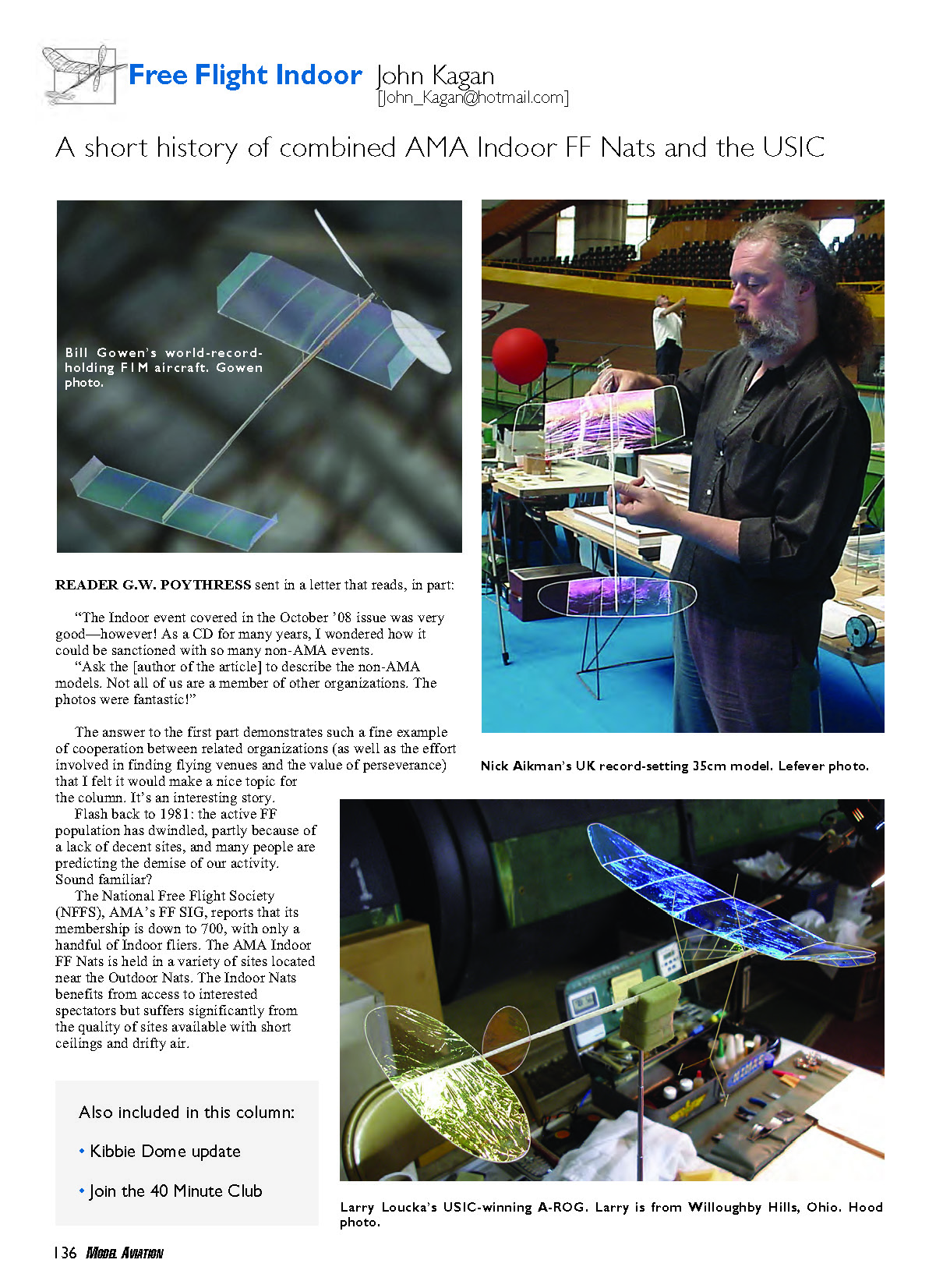
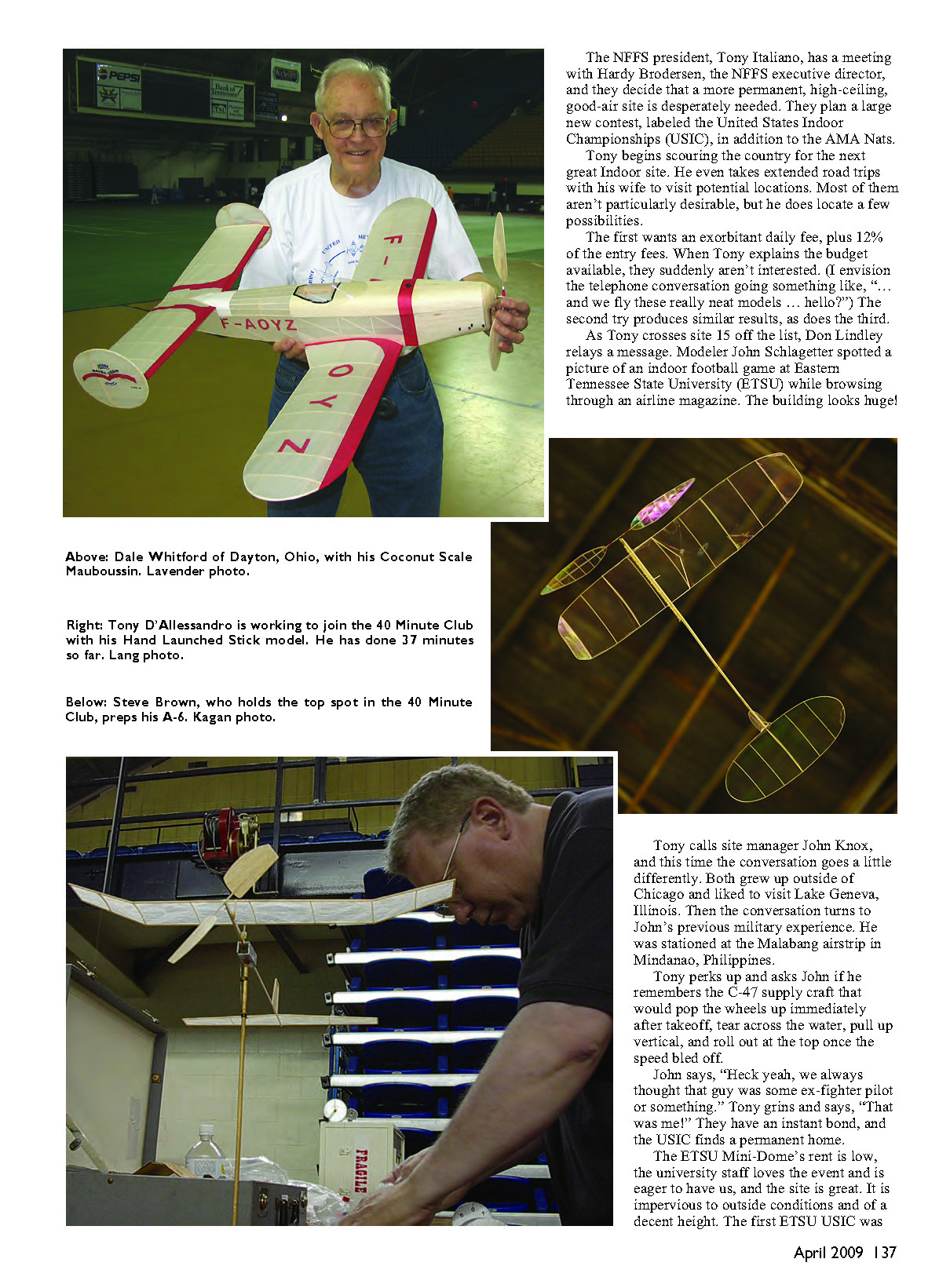
F1M and 35cm are popular international duration events. The 35cm aircraft is a smaller version of F1D, with a 35cm wingspan compared with F1D’s 55cm span, making more flying sites viable. F1M is a “beginner” version of F1D, with a higher minimum weight and smaller wingspan requirements. Both are prime candidates for becoming official AMA events, as F1L (an international 1.2-gram version of EZB) did.
Current top indoor ornithopters, capable of flights approaching 20 minutes, are propelled by flapping wings but have their lift provided by a traditional wing. They are amazingly graceful when everything is working properly, but their intricate mechanisms can go awry with disastrous results.
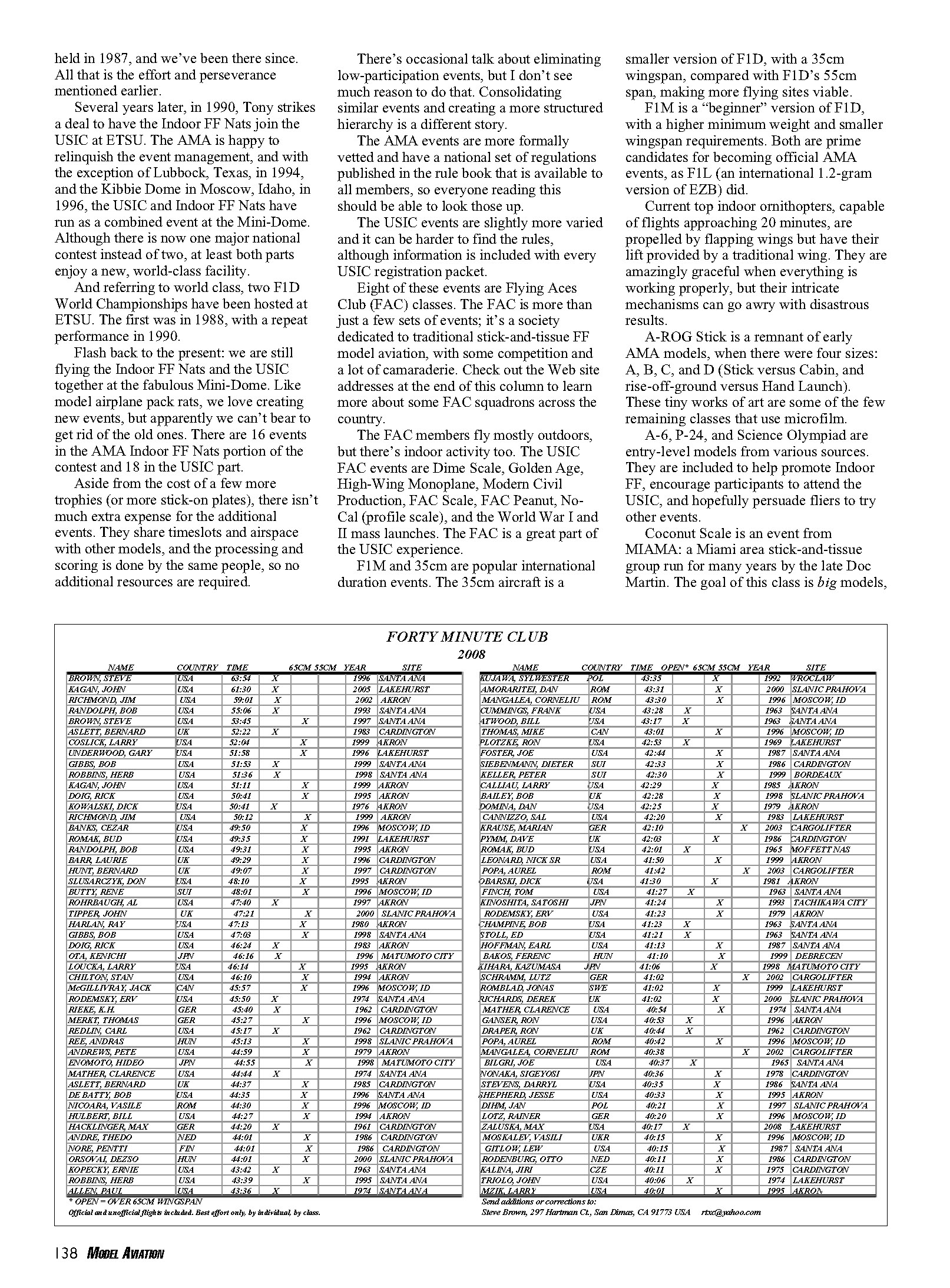
A-ROG Stick is a remnant of early AMA models, when there were four sizes: A, B, C, and D (Stick versus Cabin, and rise-off-ground versus hand launch). These tiny works of art are some of the few remaining classes that use microfilm.
A-6, P-24, and Science Olympiad are entry-level models from various sources. They are included to help promote indoor FF, encourage participants to attend the USIC, and hopefully persuade fliers to try other events.
Coconut Scale is an event from MIAMA (a Miami area stick-and-tissue group) run for many years by the late Doc Martin. The goal of this class is big models, and the mass launch of these behemoths is a USIC highlight.
The final group includes some oddball, just-for-fun events:
- Unlimited Rubber Speed involves three laps around two balloon-string pylons. That's hard enough with an RC model; try coaxing an FF aircraft to stay on course!
- Round the Pole is an FF-CL hybrid in which the model is tethered to a center pole, and three speedy laps are timed.
- Straight Line Speed is a mad dash from a standing start, across a basketball court, into a Visqueen sheet.
- Race to the Roof is a flight straight up. Past winners have flown from a standing start to the 116-foot roof in less than 6 seconds.
There are separate awards for the AMA and USIC events, separate registration forms, and separate historical records, but when we get to the Mini-Dome, it’s all the same people working together like one big happy family (although many vie for the "crazy uncle" title).
Now you can understand how a large number of AMA and NFFS events can run at the same contest and everything is fine. Better yet, come to Johnson City, Tennessee, and see for yourself. There's something for everyone!
The 2009 USIC/AMA FF Indoor Nats events were scheduled for May 27–31. You can get more information on the AMA web site.
Kibbie Dome Update
Andrew Tagliafico reports that the Kibbie Dome is getting some long-promised upgrades. Word is that the plywood ends are going to be reconstructed with something slightly more enduring. He doesn't know if they are going to do other parts of the project now, which include lowering the floor, adding seats, and flattening the ceiling, but they plan to finish the ends before next winter.
Unfortunately the construction means that this year's Kibbie Dome Annual is off, but Andrew is optimistic for 2010.
If you West Coasters are worried about fulfilling your annual big-contests fix, consider making the trek to the USIC this year. There are some format differences, but it's better than nothing. Even a bad day of model airplane flying is better than a good day at work, right?
The 40 Minute Club
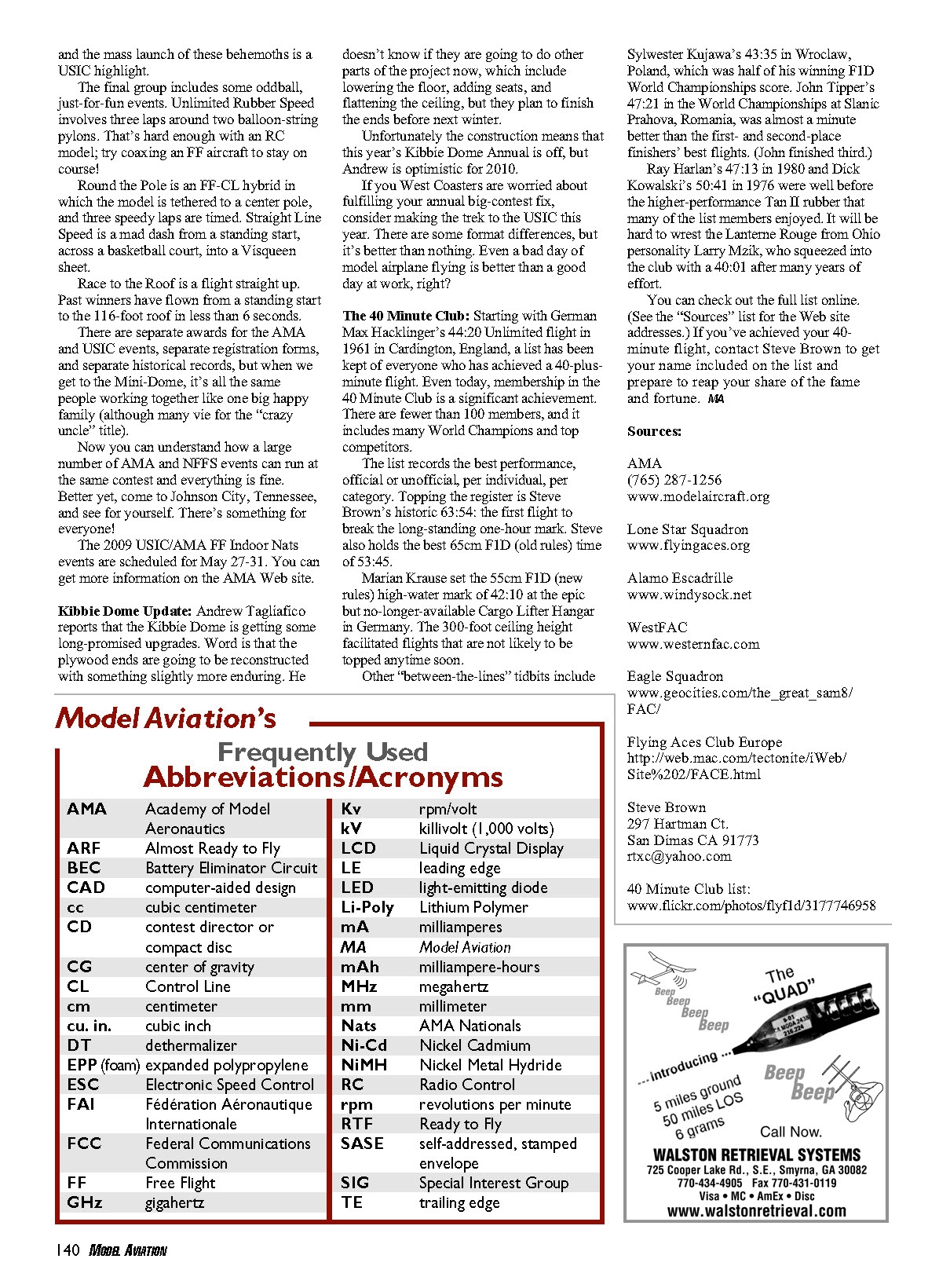
Starting with German Max Hacklinger’s 44:20 unlimited flight in 1961 in Cardington, England, a list has been kept of everyone who has achieved a 40-plus-minute flight. Even today, membership in the 40 Minute Club is a significant achievement. There are fewer than 100 members, and it includes many World Champions and top competitors.
The list records the best performance, official or unofficial, per individual, per category. Topping the register is Steve Brown’s historic 63:54—the first flight to break the long-standing one-hour mark. Steve also holds the best 65cm F1D (old rules) time of 53:45.
Marian Krause set the 55cm F1D (new rules) high-water mark of 42:10 at the epic but no-longer-available CargoLifter hangar in Germany. The 300-foot ceiling height facilitated flights that are not likely to be topped anytime soon.
Other notable entries include Sylwester Kujawa’s 43:35 in Wroclaw, Poland, which was half of his winning F1D World Championships score. John Tipper’s 47:21 in the World Championships at Slanic Prahova, Romania, was almost a minute better than the first- and second-place finishers’ best flights (John finished third).
Ray Harlan’s 47:13 in 1980 and Dick Kowalski’s 50:41 in 1976 were well before the higher-performance Tan II rubber that many of the list members enjoyed. It will be hard to wrest the Lanterne Rouge from Ohio personality Larry Mizik, who squeezed into the club with a 40:01 after many years of effort.
You can check out the full list online (see Sources). If you've achieved your 40-minute flight, contact Steve Brown to get your name included on the list.
Sources
- AMA — (765) 287-1256 — www.modelaircraft.org
- Lone Star Squadron — www.flyingaces.org
- Alamo Escadrille — www.windysock.net
- WestFAC — www.westernfac.com
- Eagle Squadron — www.geocities.com/the_great_sam8/FAC/
- Flying Aces Club Europe — http://web.mac.com/tectonite/iWeb/Site%202/FACE.html
- Steve Brown — 297 Hartman Ct., San Dimas CA 91773 — [email protected]
- 40 Minute Club list — www.flickr.com/photos/flyfld/3177746958
Transcribed from original scans by AI. Minor OCR errors may remain.

