
Steering Indoor FF airplanes
John Kagan [[email protected]]
INDOOR FF is about programming your creation’s flight profile and then letting it do its thing. A few of the parameters within your control are:
- Rate of climb
- Maximum altitude
- Circle diameter
- Stability versus drag
- Reaction to varying torque
- Dynamic propeller geometry changes
- Extensible-motor energy storage
A stopwatch measures your success. This is aviation purity.
But some models can fly for more than a half hour (the Unlimited record surpasses one hour), and that’s plenty of time for even the slightest amount of drift to slide your airplane into a wall or another obstruction, ruining the flight and possibly the aircraft.
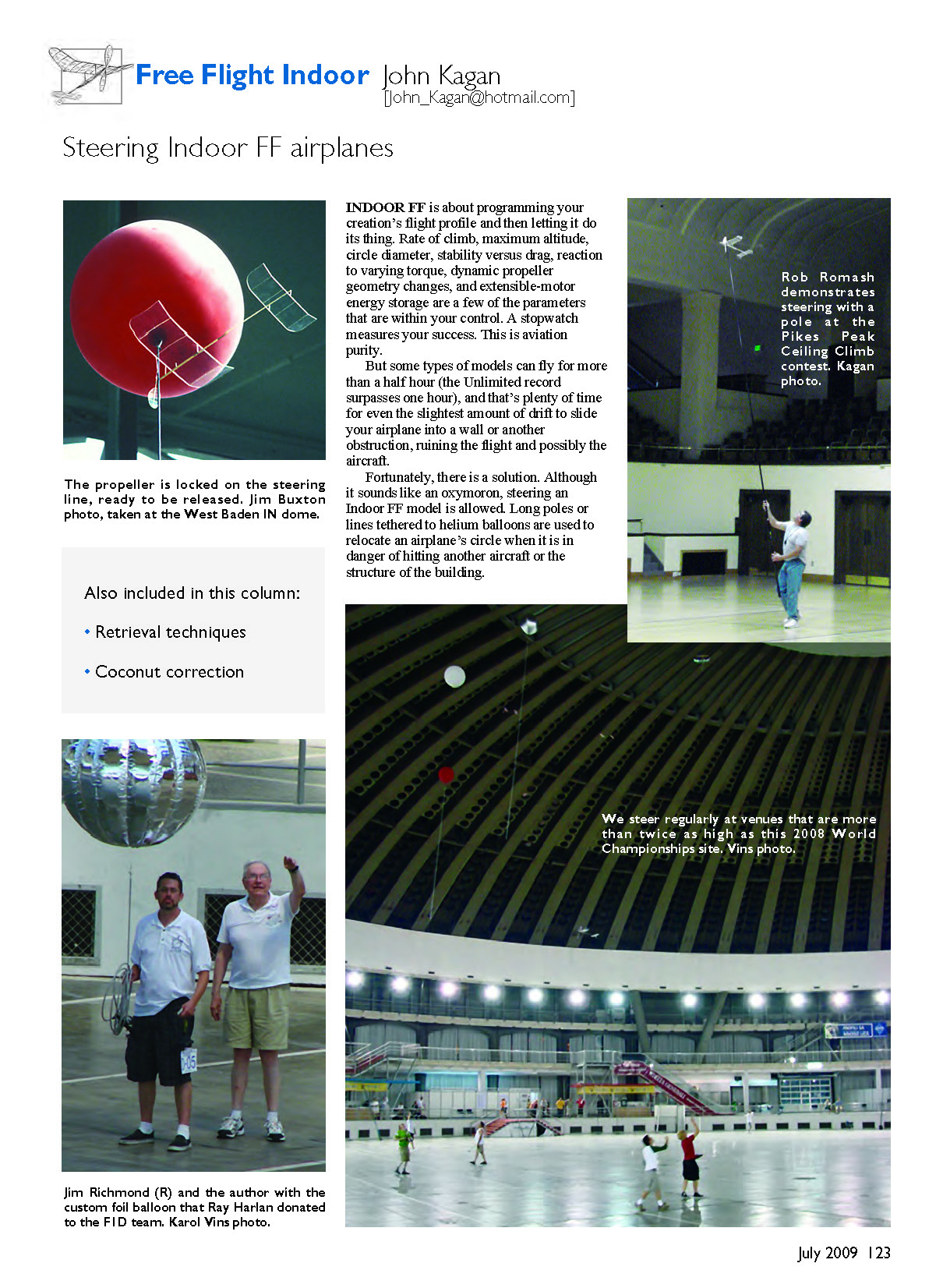
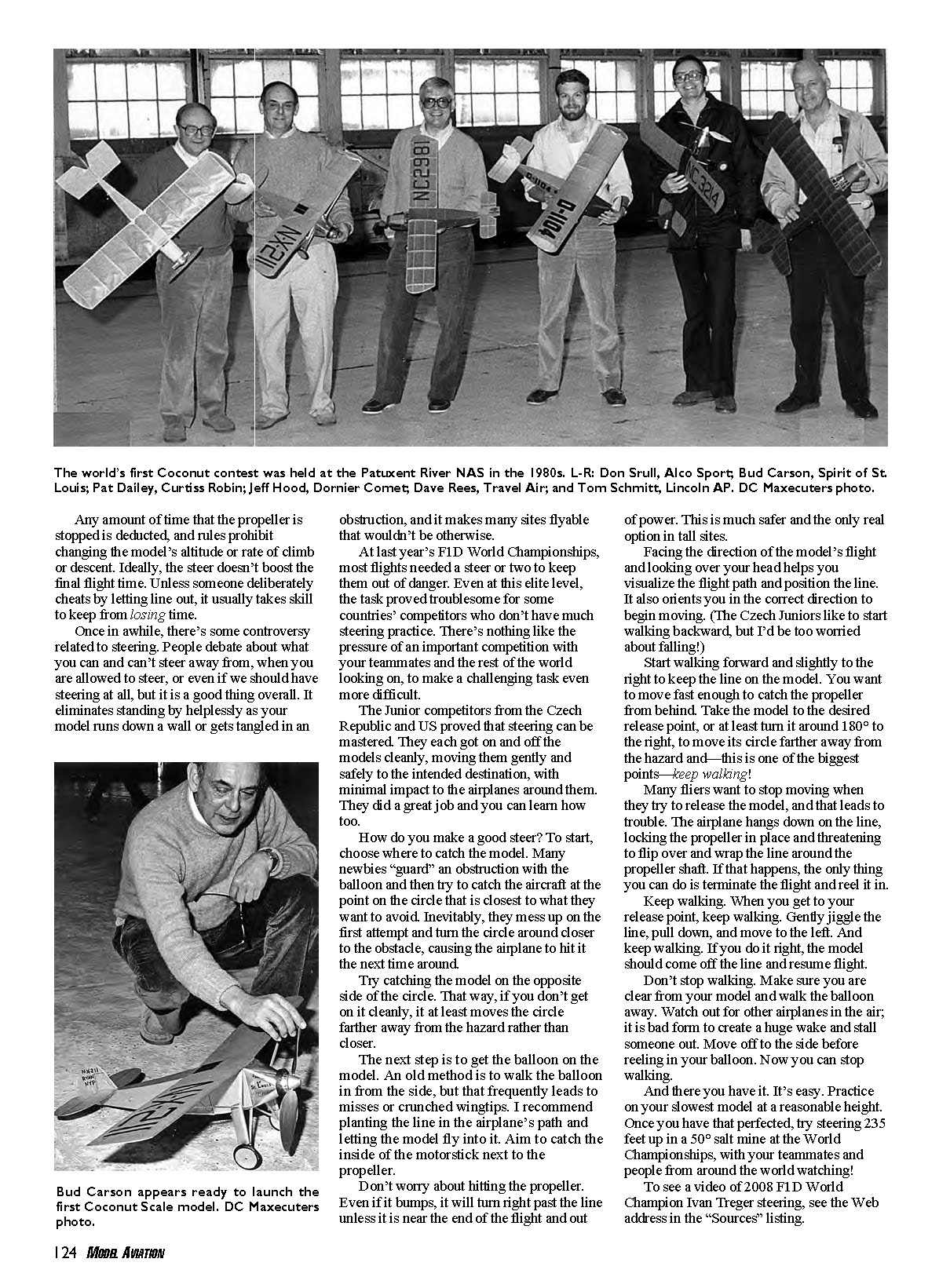
Fortunately, there is a solution. Although it sounds like an oxymoron, steering an Indoor FF model is allowed. Long poles or lines tethered to helium balloons are used to relocate an airplane’s circle when it is in danger of hitting another aircraft or the structure of the building. Any amount of time that the propeller is stopped is deducted, and rules prohibit changing the model’s altitude or rate of climb or descent. Ideally, the steer doesn’t boost the final flight time. Unless someone deliberately cheats by letting line out, it usually takes skill to keep from losing time.
Once in a while there’s controversy related to steering. People debate what you can and can’t steer away from, when you are allowed to steer, or even if we should have steering at all. Overall, steering is a good thing: it eliminates standing by helplessly as your model runs down a wall or gets tangled in an obstruction, and it makes many sites flyable that wouldn’t be otherwise.
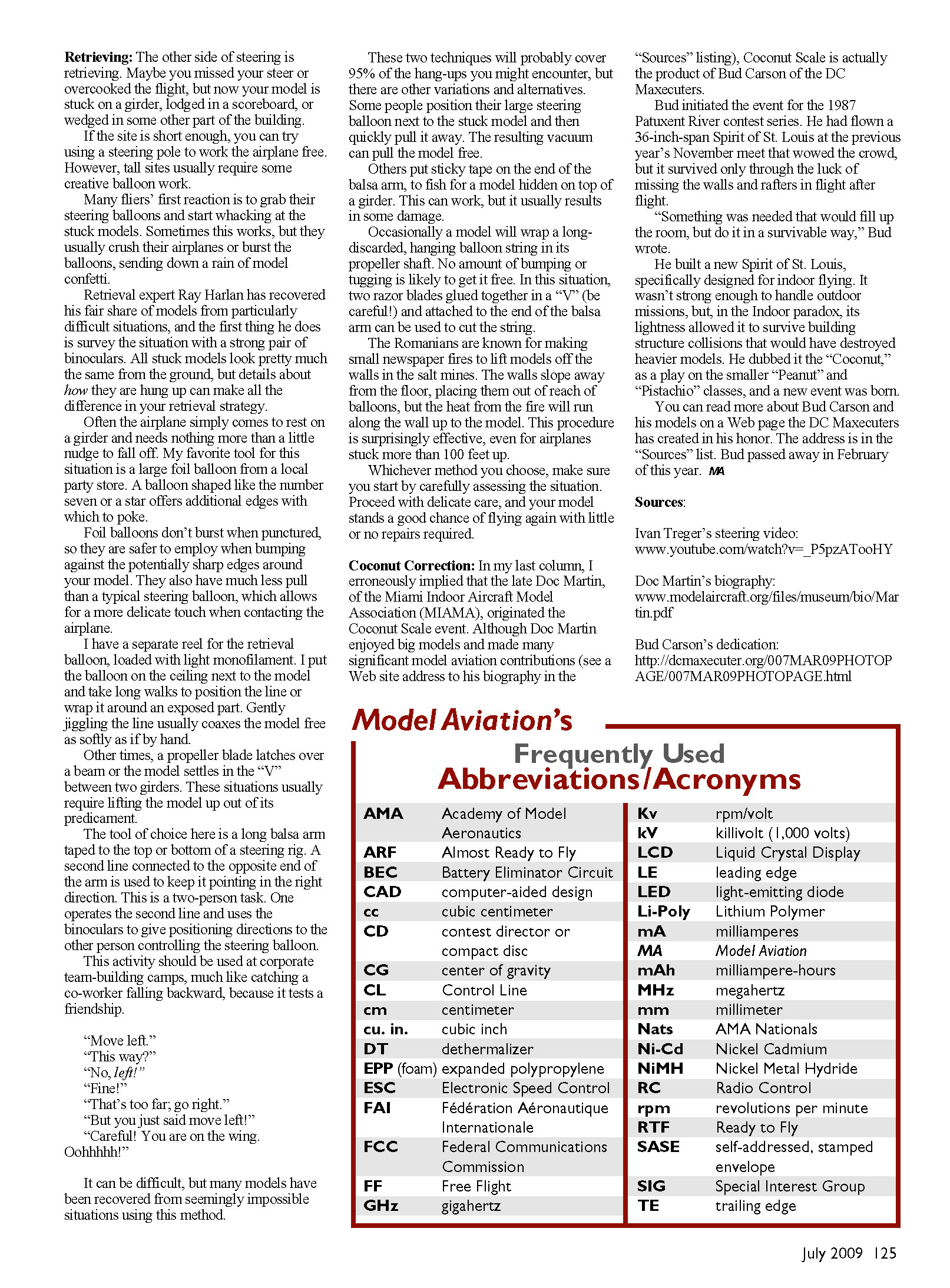
At last year’s F1D World Championships, most flights needed a steer or two to keep them out of danger. Even at this elite level, the task proved troublesome for some countries’ competitors who don’t have much steering practice. There’s nothing like the pressure of an important competition, with your teammates and the rest of the world looking on, to make a challenging task even more difficult. The junior competitors from the Czech Republic and the U.S. proved that steering can be mastered. They each got on and off the models cleanly, moving them gently and safely to the intended destination with minimal impact to the airplanes around them. They did a great job — and you can learn how too.
How to make a good steer
Choose where to catch the model. Many newbies “guard” an obstruction with the balloon and then try to catch the aircraft at the point on the circle that is closest to what they want to avoid. Inevitably, they mess up on the first attempt and turn the circle around closer to the obstacle, causing the airplane to hit it the next time around. Try catching the model on the opposite side of the circle. That way, if you don’t get on it cleanly, it at least moves the circle farther away from the hazard rather than closer.
Get the balloon on the model by planting the line in the airplane’s path and letting the model fly into it. Aim to catch the inside of the motorstick next to the propeller. Don’t worry about hitting the propeller — even if it bumps, it will turn right past the line unless it is near the end of the flight and out of power. This method is much safer and is the only real option in tall sites.
Face the direction of the model’s flight and look over your head to visualize the flight path and position the line. This also orients you in the correct direction to begin moving. Start walking forward and slightly to the right to keep the line on the model. You want to move fast enough to catch the propeller from behind. Take the model to the desired release point, or at least turn it around 180° to the right to move its circle farther away from the hazard and — this is one of the biggest points — keep walking!
Many fliers want to stop moving when they try to release the model, and that leads to trouble. The airplane hangs down on the line, locking the propeller in place and threatening to flip over and wrap the line around the propeller shaft. If that happens, the only thing you can do is terminate the flight and reel it in.
Keep walking. When you get to your release point, keep walking. Gently jiggle the line, pull down, and move to the left. And keep walking. If you do it right, the model should come off the line and resume flight.
Don’t stop walking. Make sure you are clear from your model and walk the balloon away. Watch out for other airplanes in the air; it is bad form to create a huge wake and stall someone out. Move off to the side before reeling in your balloon. Now you can stop walking.
It’s easy. Practice on your slowest model at a reasonable height. Once you have that perfected, try steering 235 feet up in a 50-foot salt mine at the World Championships, with your teammates and people from around the world watching!
To see a video of 2008 F1D World Champion Ivan Treger steering, see the web address in the "Sources" listing.
Retrieving
The other side of steering is retrieving. Maybe you missed your steer or overcooked the flight, and now your model is stuck on a girder, lodged in a scoreboard, or wedged in some other part of the building.
If the site is short enough, you can try using a steering pole to work the airplane free. However, tall sites usually require some creative balloon work.
Many fliers’ first reaction is to grab their steering balloons and start whacking at the stuck models. Sometimes this works, but they usually crush their airplanes or burst the balloons, sending down a rain of model confetti.
Retrieval expert Ray Harlan has recovered his fair share of models from particularly difficult situations, and the first thing he does is survey the situation with a strong pair of binoculars. All stuck models look pretty much the same from the ground, but details about how they are hung up can make all the difference in your retrieval strategy.
Often the airplane simply comes to rest on a girder and needs nothing more than a little nudge to fall off. My favorite tool for this situation is a large foil balloon from a local party store. A balloon shaped like the number seven or a star offers additional edges with which to poke.
Foil balloons don’t burst when punctured, so they are safer to employ when bumping against the potentially sharp edges around your model. They also have much less pull than a typical steering balloon, which allows for a more delicate touch when contacting the airplane.
I have a separate reel for the retrieval balloon, loaded with light monofilament. I put the balloon on the ceiling next to the model and take long walks to position the line or wrap it around an exposed part. Gently jiggling the line usually coaxes the model free as softly as if by hand.
Other times, a propeller blade latches over a beam or the model settles in the “V” between two girders. These situations usually require lifting the model up out of its predicament.
The tool of choice here is a long balsa arm taped to the top or bottom of a steering rig. A second line connected to the opposite end of the arm is used to keep it pointing in the right direction. This is a two-person task. One person operates the second line and uses the binoculars to give positioning directions to the other person controlling the steering balloon.
This activity should be used at corporate team-building camps, much like catching a co-worker falling backward, because it tests a friendship.
- “Move left.”
- “This way?”
- “No, left!”
- “Fine!”
- “That’s too far; go right.”
- “But you just said move left!”
- “Careful! You are on the wing.”
- “Ooohhh!”
It can be difficult, but many models have been recovered from seemingly impossible situations using this method.
These two techniques will probably cover 95% of the hang-ups you might encounter, but there are other variations and alternatives:
- Some people position their large steering balloon next to the stuck model and then quickly pull it away. The resulting vacuum can pull the model free.
- Others put sticky tape on the end of the balsa arm to fish for a model hidden on top of a girder. This can work, but it usually results in some damage.
- Occasionally a model will wrap a long-discarded, hanging balloon string in its propeller shaft. No amount of bumping or tugging is likely to get it free. In this situation, two razor blades glued together in a “V” (be careful!) and attached to the end of the balsa arm can be used to cut the string.
- The Romanians are known for making small newspaper fires to lift models off the walls in the salt mines. The walls slope away from the floor, placing them out of reach of balloons, but the heat from the fire will run along the wall up to the model. This procedure is surprisingly effective, even for airplanes stuck more than 100 feet up.
Whichever method you choose, make sure you start by carefully assessing the situation. Proceed with delicate care, and your model stands a good chance of flying again with little or no repairs required.
Coconut Correction
In my last column, I erroneously implied that the late Doc Martin, of the Miami Indoor Aircraft Model Association (MIAMA), originated the Coconut Scale event. Although Doc Martin enjoyed big models and made many significant model aviation contributions (see a web site address to his biography in the “Sources” listing), Coconut Scale is actually the product of Bud Carson of the DC Maxecuters.
Bud initiated the event for the 1987 Patuxent River contest series. He had flown a 36-inch-span Spirit of St. Louis at the previous year’s November meet that wowed the crowd, but it survived only through the luck of missing the walls and rafters in flight after flight.
“Something was needed that would fill up the room, but do it in a survivable way,” Bud wrote.
He built a new Spirit of St. Louis, specifically designed for indoor flying. It wasn’t strong enough to handle outdoor missions, but, in the indoor paradox, its lightness allowed it to survive building structure collisions that would have destroyed heavier models. He dubbed it the “Coconut,” as a play on the smaller “Peanut” and “Pistachio” classes, and a new event was born.
You can read more about Bud Carson and his models on a web page the DC Maxecuters created in his honor. Bud passed away in February of this year.
Sources
- Ivan Treger’s steering video: www.youtube.com/watch?v=_P5pzATooHY
- Doc Martin’s biography: www.modelaircraft.org/files/museum/bio/Martin.pdf
- Bud Carson’s dedication: http://dcmaxecuter.org/007MAR09PHOTOPAGE/007MAR09PHOTOPAGE.html
Transcribed from original scans by AI. Minor OCR errors may remain.

