
Free Flight Indoor - 2009/10
Announcing the Erv Rodemsky Limited Pennyplane Pro/Am
Theoretical debate is fine, but sooner or later we have to sift something concrete from it. The Jim Buxton/Don DeLoach/John Kagan brain trust has a plan. A Limited Pennyplane Pro/Am will be held during the Saturday Duration session at the 2010 US Indoor Championships / Indoor FF Nats in Johnson City, Tennessee.
An amateur is anyone, high school age and older, who has an interest in Indoor FF but has been too busy or intimidated to give it a try. These participants will sign up in advance and be matched with a pro by random drawing.
Each pro will build a Limited Pennyplane (LPP) to donate to the cause. Amateurs must wind and launch, but the pros can trim, repair, and strategize with their teammates. It’s a team event, so the winning pro and amateur will both get tons of bragging rights—not to mention cool prizes.
And that’s not all. We’ll have a pizza party for dinner on Saturday so everyone can keep flying, as well as a Sportsman Class LPP contest on Sunday for amateurs only. The BOM (Builder of the Model) rule will be suspended so amateurs can fly their new airplanes.
This is a fantastic, once-in-a-lifetime opportunity for amateurs to get some firsthand coaching from Indoor FF experts (you might get paired with a World or National Champion) and fly competition-proven models. You’ll have two great days of flying in one of the world’s best sites.
For the pros, this is a great way to prove your mettle. If you really want to know something, teach it!
If you are interested in participating, as either an amateur or a pro, contact me at my e-mail address at the top of the column. More details will follow as we think of them. The contest is named after Erv Rodemsky, an F1D World Champ, who originated the Pennyplane event.
Indoor FF Nats
The 2009 AMA Indoor FF Nats is a wrap. Fifty-seven competitors signed up to do battle in more than 180 events—similar numbers to last year, although still down from earlier years.
Those in attendance seemed to have a great time in the sealed East Tennessee State University mini-dome air. Thunderstorms raged outside, but the flying inside was perfect. The notorious scoreboard remained a source of grief, affecting the glider fliers more than most. But once the launchers were dialed in, they were able to work around it adequately.
Our second annual raffle was a huge success again. Many thanks to those who contributed products.
Tim Goldstein of A2Z Corp (parent company of Peck-Polymers, Indoor Model Supply, A2Z CNC, F1D.biz, Tru Weight Indoor Balsa, and Sting Aero Products) donated a huge box of scale and indoor kits, tools, and supplies. Check out the extensive collection of cool indoor stuff at the A2Z Corp website.
Ray Harlan contributed a sampling of his affordable, high-tech tools and supplies. You can peruse his line of MIT-smart, scientifically sound products at the Indoor Specialties website.
Jeff Hood tossed in some nice packs of Hood’s Wood, organized by airplane type. Roy White from Y2K Films sent in a generous check. A few of the competitors brought items from their workshops.
The raffle and donations generated approximately $1,100. As they were last year, the proceeds were allocated to support the Indoor FF Nats, in light of the hopefully temporary diminished numbers. If we can boost participation a bit (see the preceding contest announcement), perhaps we can use future proceeds for other Indoor FF purposes.
For a day-by-day breakdown of the action and event winners, check out NatsNews on the AMA website.
Participation Ponderings
The decreasing Nats participation numbers spawned some interesting discussion on the Indoor_Construction Yahoo! forum. It mostly revolved around our activity’s future, how to boost participation, and what—if anything—must be changed about our activity itself.
Almost all of the concerns and doomsday predictions have been brought up before—and not only in the Indoor FF community. Many groups, in any activity, have an internal perception that they are on the brink of extinction, that “outsiders” don’t know enough about them, and that kids these days just want to play video games.
The ideas generated in response are similarly familiar. We need to focus on kids. We need to make our activity more fun. We need to “advertise” more. Some of the ideas are headed in the right direction. Others, maybe not so.
Below is a summary of a few topics that came up, with a healthy dose of opinion added.
- "The ‘old guys’ are passing on, and in a few years Indoor FF will cease to exist."
It is true that participation numbers are on the decline; there isn’t the same aviation fever as when air travel was big news. Younger people tend to assume that model airplanes (and model airplane fliers) have been around forever, but a large population of older fliers was lured in during the aviation heyday. One of my mentors even had a license that was signed by the Wright brothers.
There was a lot of enthusiasm and support for model airplanes during that period, and it is unlikely that we are going to match those numbers anytime soon. This doesn’t mean all is lost.
First, Indoor FF is too much fun to disappear. Even if every current participant went away, someone would still pick up Ron Williams’ Building and Flying Indoor Model Airplanes someday, think “This is pretty cool!”, and build an airplane. We can work on boosting the numbers, but the activity itself is as challenging and fun as it has always been.
Second, we can achieve a stable participation level. It might not be as big as during the days of Lindbergh’s flight across the Atlantic, but there is still a selection of personalities who are intrigued enough by the challenges and rewards of Indoor FF to spend time doing it.
I don’t believe that the life and death of Indoor FF depends on a never-ending infusion of newcomers. But access to the larger flying sites is certainly easier to obtain if we have some numbers behind us, and it's more fun to fly with a bunch of people rather than alone.
Whatever the reason, thinking about promoting participation is time well spent.
- "We need to be more 'newcomer' friendly."
Some lament that a newcomer's first experience with Indoor FF is often being yelled at to "stop running!" by grumpy, introverted old-timers.
It is an unfortunate fact that the stress-filled moments of our slow-motion Indoor FF world are completely invisible to visitors. When we carefully try to squeeze in one last turn on a hypertensioned motor, nervously anticipating the snap of it breaking, the guest sees us twiddling our thumbs—the perfect time to ask a question about our model.
While we watch a potential record-setting flight settle in, anxiously guarding the circle against wanderers who would disturb the air, they see us idly staring off into space.
We could try to eliminate these tense situations so a newcomer would be free to pipe up at any time, but that would defeat the whole purpose of our contests and record trials. A better solution is to be honest with ourselves about what it means to have guests around.
Kids run. Awestruck spectators ask questions. Without some information to guide them, it is unreasonable to expect them to just "know" proper etiquette.
A recurring suggestion is to have readily available handouts that tell visitors how to move around the airplanes and when to hold off asking questions. It can also give them information about the activity, as well as links for further independent research. This is the perfect way to change many fliers' pet peeves into a recruiting opportunity.
- "We need to focus on getting kids involved" or "Kids only want to play video games these days."
Kids are great; I own two of them. And building and flying models with them is great too. It's fun, and it plants a model aviation seed that is probably far more likely to sprout than we expect.
But young kids, if we are again honest with ourselves, are not our primary target audience (with a few rare exceptions). Fathers or grandpas "with kids," sure. Individual elementary school kids, probably not. There is a certain level of mental and physical maturity required to have any degree of success with Indoor FF, and high school age is generally a minimum.
It is common to hear tales of "failed" Delta Dart programs that didn't produce a single new kid and only scattered adult recruits—mostly retired. I think this is a misread of the situation. The gestation period for kids is much longer than that, and the new adults are exactly those we should be aiming for.
Let's face it: the Indoor FF ranks are eccentric. We've got artists and engineers, race car drivers and mechanics, airline pilots, and even secret agents. It takes a unique personality to thrive in this activity. We are never going to be as mainstream as baseball. But for the people who enjoy Indoor FF, that's okay.
We need to start directing some energy toward the kind of people who would tend to have the right disposition, recognizing that we'll get only a small percentage.
Whether you agree with this slant or have an alternate perspective, you can join the discussion at the link listed at the end of this column.
Catapult Glider Breakthrough
Fifty years ago, Ralph Ray won the National Championship title in A Gas at the Dallas Nats, edging out model airplane legend Carl Goldberg. The Veco Model Airplane Company later manufactured Ralph's winning design as a kit.
After the brief distraction of launching a successful company, earning numerous patents and design awards, and amassing a long list of enviable accomplishments, Ralph has notched his second National Championship win; this time he beat eight-time National Champion Kurt Krempetz in Standard Catapult Glider. Kurt flew a personal best time, but Ralph responded with a site record.
Ralph explains how he did it:
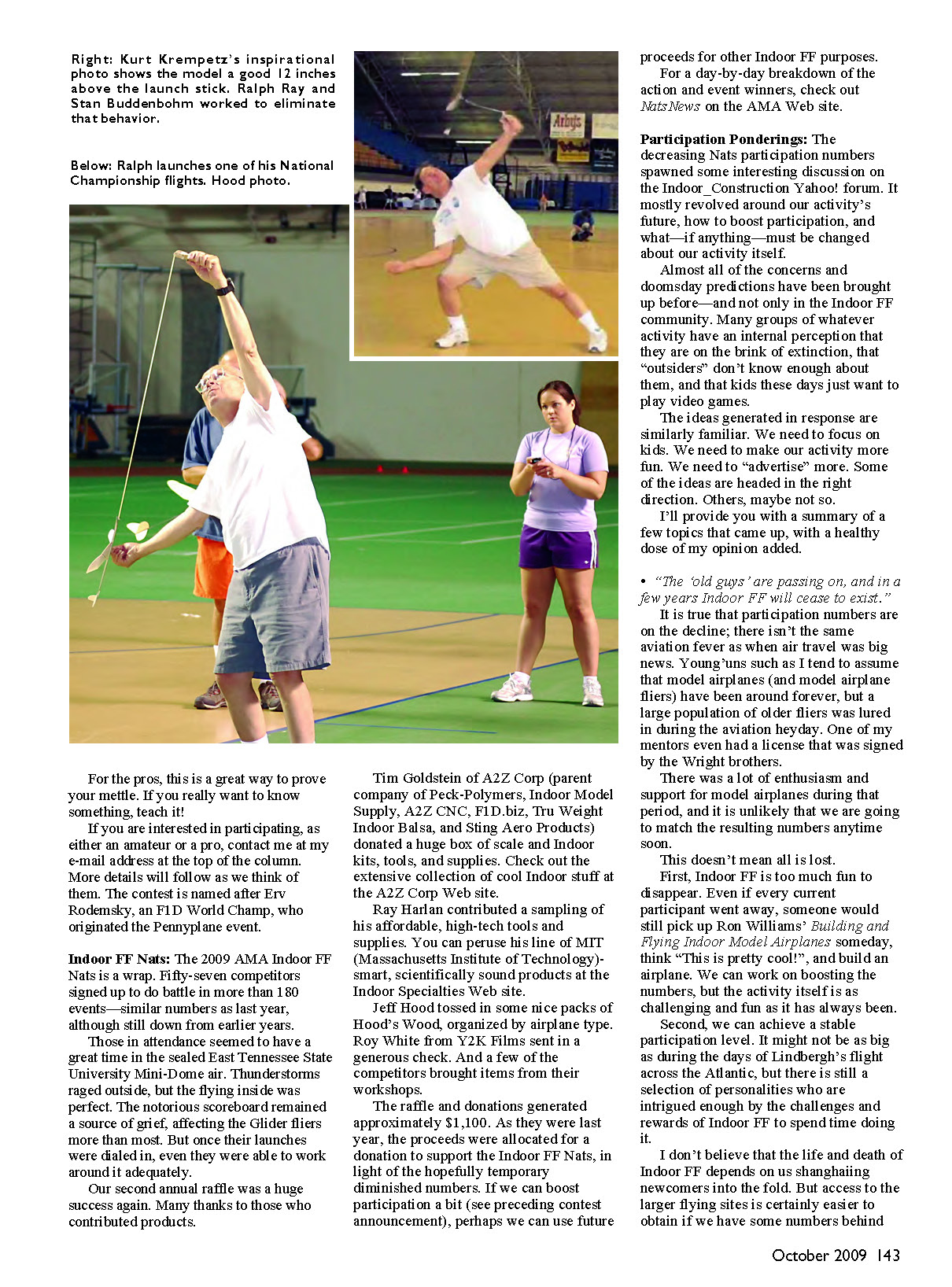
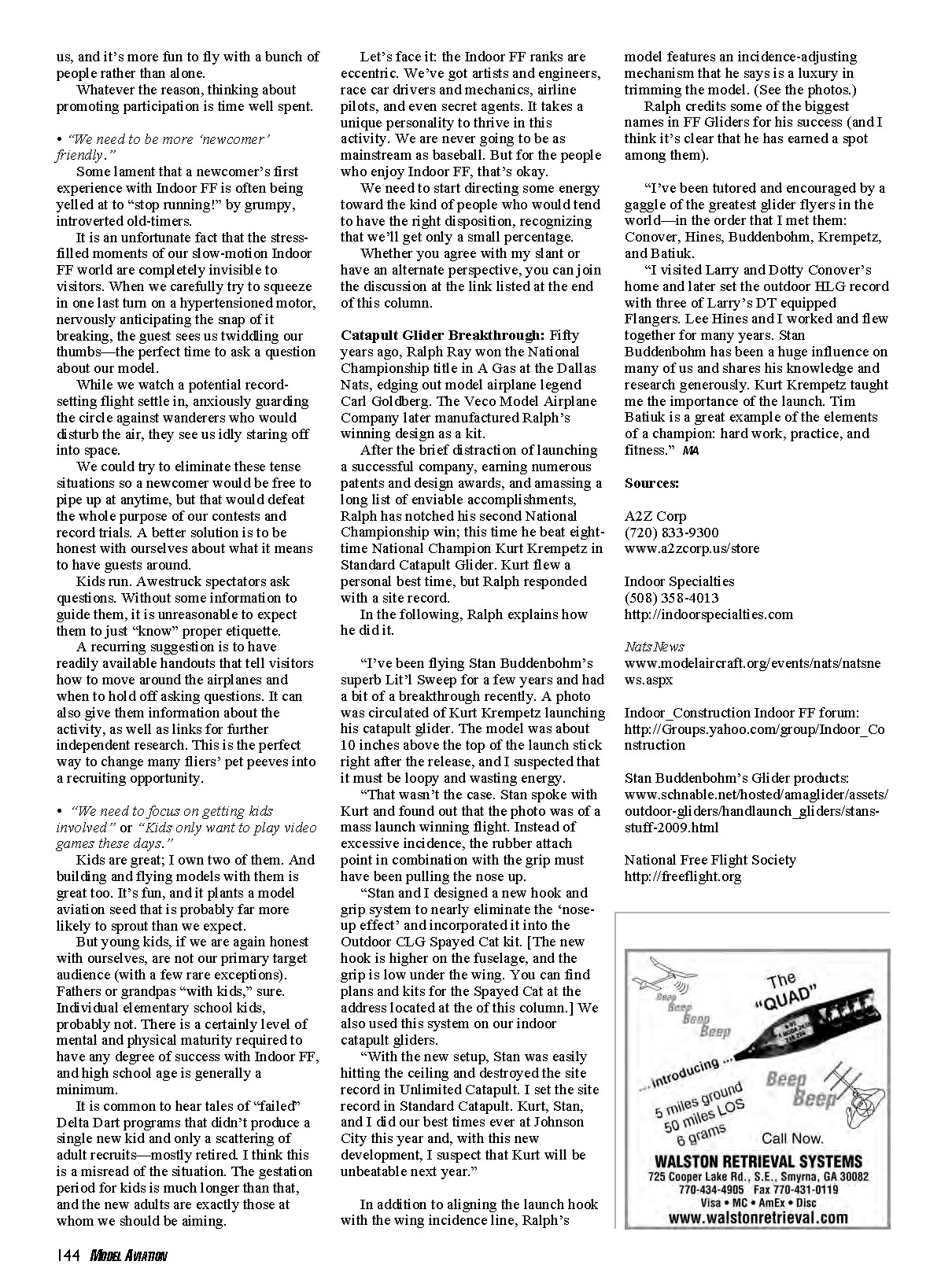
"I've been flying Stan Buddenbohm's superb Lit'l Sweep for a few years and had a bit of a breakthrough recently. A photo was circulated of Kurt Krempetz launching his catapult glider. The model was about 10 inches above the top of the launch stick right after the release, and I suspected that it must be loopy and wasting energy.
"That wasn't the case. Stan spoke with Kurt and found out that the photo was of a mass launch winning flight. Instead of excessive incidence, the rubber attach point in combination with the grip must have been pulling the nose up.
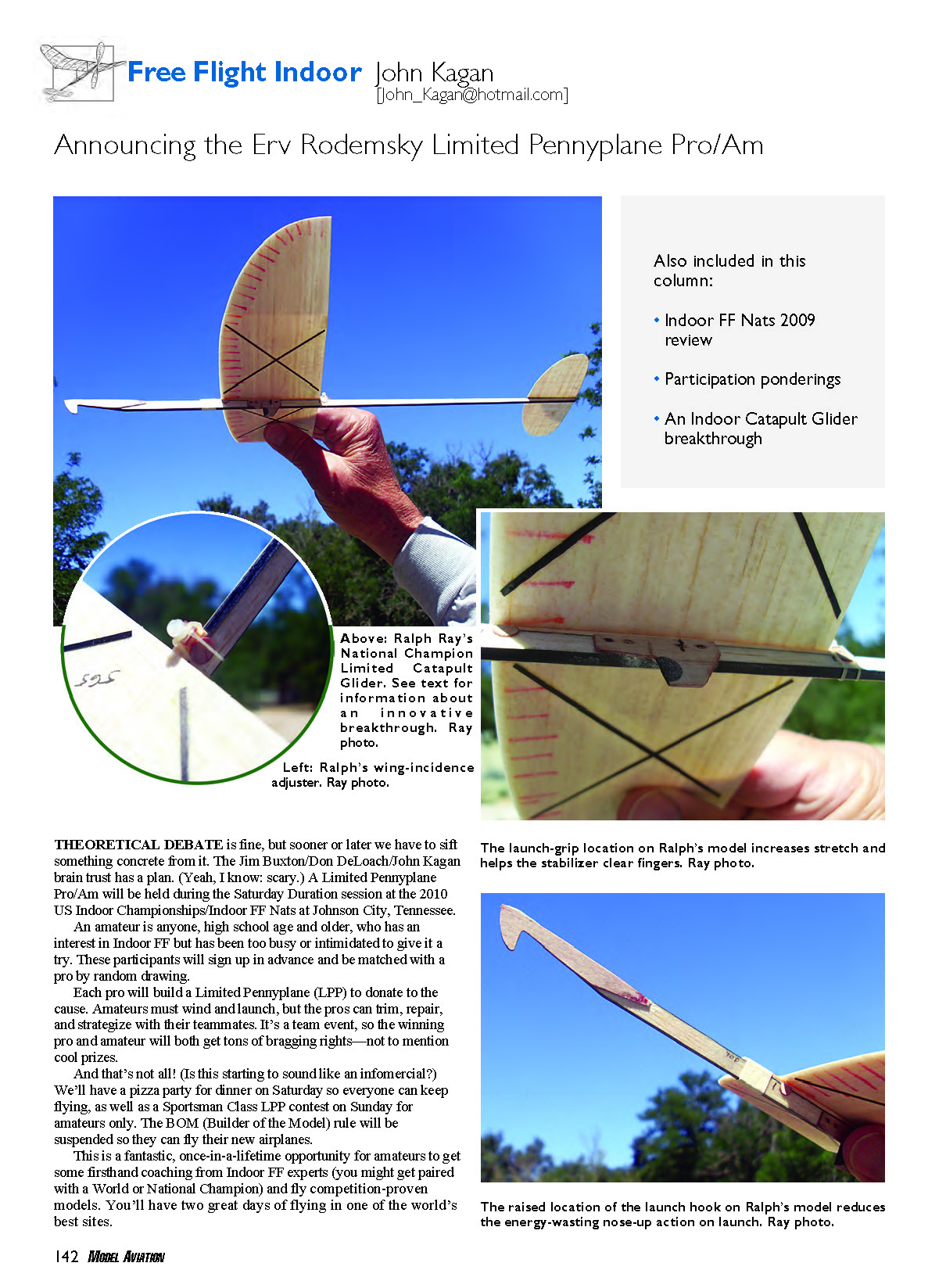
"Stan and I designed a new hook and grip system to nearly eliminate the 'nose-up effect' and incorporated it into the Outdoor CLG Spayed Cat kit. The new hook is higher on the fuselage, and the grip is low under the wing. We also used this system on our indoor catapult gliders.
"With the new setup, Stan was easily hitting the ceiling with his new Spayed Cat and had record times in Unlimited Catapult. I set the site record in Standard Catapult. Kurt, Stan, and I did our best times ever at Johnson City this year and, with this new development, I suspect that Kurt will be unbeatable next year."
In addition to aligning the launch hook with the wing incidence line, Ralph's model features an incidence-adjusting mechanism that he says is a luxury in trimming the model. Ralph credits some of the biggest names in FF gliders for his success (and it is clear that he has earned a spot among them).
"I've been tutored and encouraged by a gaggle of the greatest glider flyers in the world—in the order that I met them: Conover, Hines, Buddenbohm, Krempetz, and Batiuk.
"I visited Larry and Dotty Conover's home and later set the outdoor HLG record with three of Larry's DT-equipped Flangers. Lee Hines and I worked and flew together for many years. Stan Buddenbohm has been a huge influence on many of us and shares his knowledge and research generously. Kurt Krempetz taught me the importance of the launch. Tim Batiuk is a great example of the elements of a champion: hard work, practice, and fitness."
MA
Sources
- A2Z Corp (720) 833-9300 www.a2zcorp.us/store
- Indoor Specialties (508) 358-4013 http://indoorspecialties.com
- Indoor_Construction Indoor FF forum: http://Groups.yahoo.com/group/Indoor_Construction
- Stan Buddenbohm's glider products: www.schnable.net/hosted/maglider/assets/outdoor-gliders/handlaunch_glide...
- National Free Flight Society http://freeflight.org
Transcribed from original scans by AI. Minor OCR errors may remain.

