
FREE FLIGHT SCALE
Dennis O. Norman, 11216 Lake Ave., Cleveland OH 44102
Hi Skysters! We are now in that part of the year known as the "Building Season," and I hope you are well along on your projects for the 2005 "Flying Season."
Apologies and caption corrections
Before writing at length about Dave Diels, I want to apologize to two of our flying buddies for mistakes made in my 2004 Flying Aces Club (FAC) Nats article in the December 2004 MA.
First, to Chris Starleaf for a caption on page 32 that made it appear as though his 41-inch-span Lockheed Electra was built from an ARF kit! The caption should have read that the motors used for the model, along with the propellers and gear trains, came from $15 DJ Aerotech Roadkill RC kits.
Chris is an acknowledged master who carefully researches, designs, and builds his models from scratch. They are magnificent originals that are at the cutting edge of FF Scale.
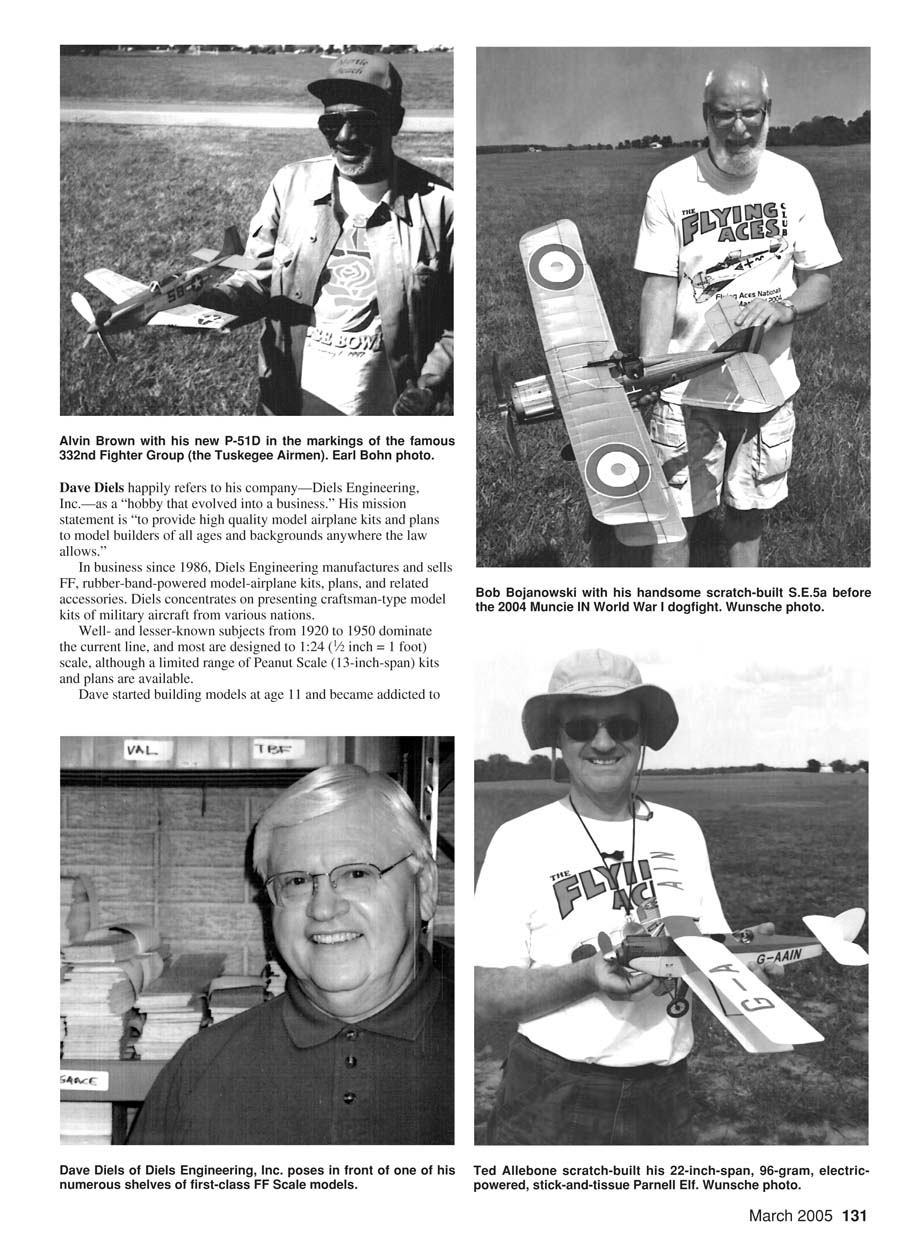
Second, apologies are due Roger Willis for captioning a picture of him with his Jimmie Allen model (page 33) with information that was intended for a picture of George Lewis. Roger's caption should have identified him as the FAC Nats contestant who traveled the farthest in the US (from Carlsbad, California) to attend the event.
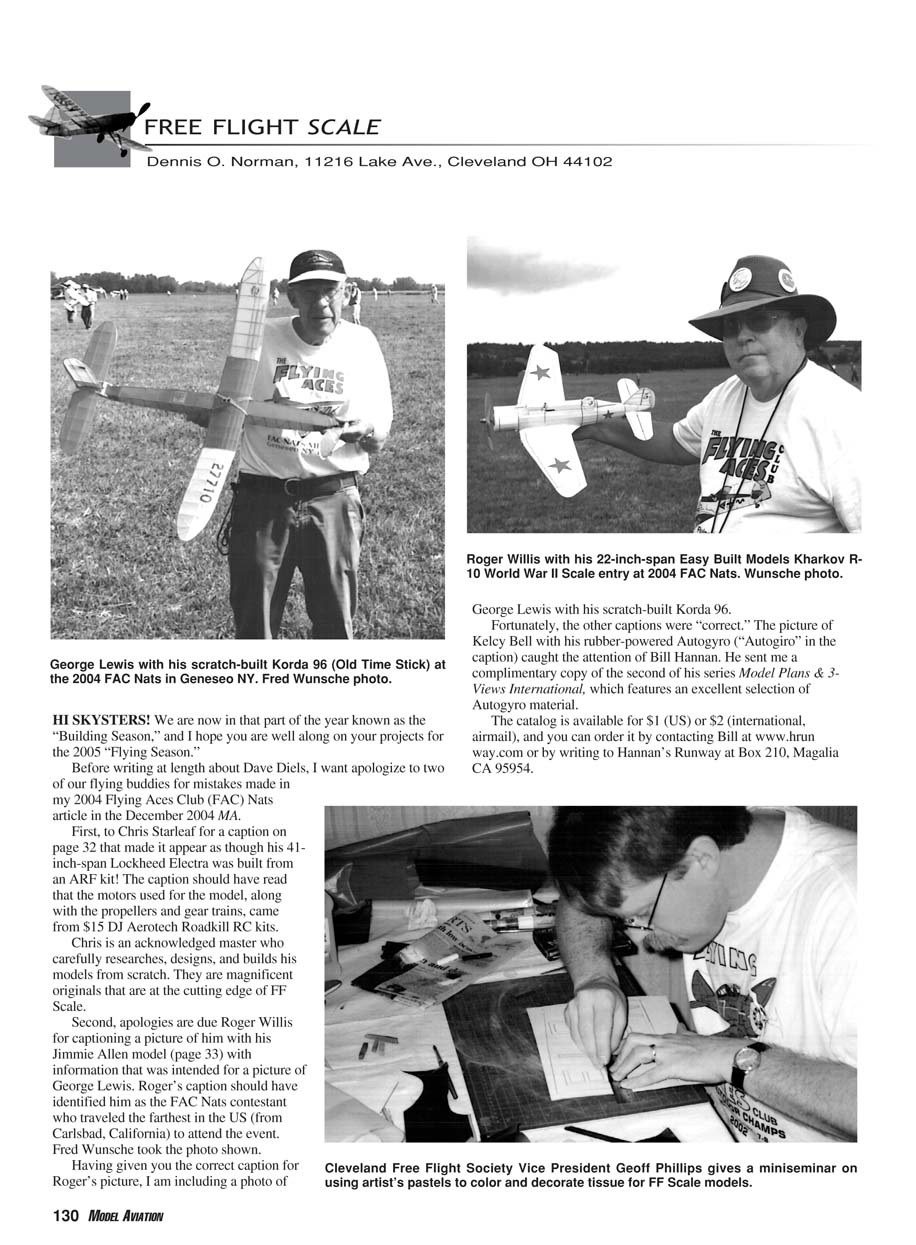
Having given you the correct caption for Roger's picture, I am including a photo of George Lewis with his scratch-built Korda 96 (Old Time Stick) at the 2004 FAC Nats in Geneseo, NY.
Fortunately, the other captions were correct. The picture of Kelcy Bell with his rubber-powered autogyro ("Autogiro" in the caption) caught the attention of Bill Hannan. He sent me a complimentary copy of the second of his series Model Plans & 3-Views International, which features an excellent selection of autogyro material.
The catalog is available for $1 (US) or $2 (international, airmail), and you can order it by contacting Bill at www.hrunway.com or by writing to Hannan's Runway at Box 210, Magalia CA 95954.
Diels Engineering, Inc.
Dave Diels happily refers to his company—Diels Engineering, Inc.—as a "hobby that evolved into a business." His mission statement is "to provide high quality model airplane kits and plans to model builders of all ages and backgrounds anywhere the law allows." In business since 1986, Diels Engineering manufactures and sells FF, rubber-band-powered model-airplane kits, plans, and related accessories.
Diels concentrates on presenting craftsman-type model kits of military aircraft from various nations. Well- and lesser-known subjects from 1920 to 1950 dominate the current line, and most are designed to 1:24 (1/2 inch = 1 foot) scale, although a limited range of Peanut Scale (13-inch-span) kits and plans are available.
Dave started building models at age 11 and became addicted to the products of Comet, Top Flite, Monogram, Goldberg, Guillow's, etc. As did many of us, he built the models to fly but had only limited success. He also tried model railroading, model shipbuilding, and plastic-kit building, but rubber-powered FF military scale has been his favorite to this day.
After marrying his wonderful wife Anita, serving in the US Army, starting his career as a full-time engineer, buying his home, and having two daughters, his interest in model airplanes was reborn in the 1970s.
Inspired by Model Builder Magazine and its magnificent centerfolds by the prolific Walt Mooney and others, Dave began building Peanut Scale models from the limited number of kits available. Soon he was ready to begin drawing his own plans, and he started with a Peanut Scale Boeing XF7B-1 fighter.
At first, Dave used what he now calls "archaic" hand-drafting tools (T-squares, triangles, etc.), but he eventually moved to computers and CAD software. He prefers subjects that are unique and scarce elsewhere. He remains a stickler for parts accuracy, and he carefully builds his prototypes to make certain that the parts fit.
By the mid-1980s, Dave’s line of plans numbered 50 and he was ready to produce his first kit: a Peanut version of the F4B-2. Its success gave Dave the confidence to continue making kits. Thus far, he has produced kits of 47 different subjects.
Design and production process
After gathering reference materials, Dave scans the three-views and converts the scans into .tif, .pcx, or .jpg files and imports them into his CAD software program. Then he sizes the drawings to 1:24 scale and traces the outlines of the various components. After that, he adds construction details such as formers, ribs, spars, keels, etc.
Dave usually places a wing’s main spar approximately one-third of the way back from the leading edge and adds supplemental spars as needed. After the wing is drawn, he concentrates on the wing/fuselage joint area and the fuselage itself, placing formers where needed based on wing and stabilizer locations.
He lays out parts on adhesive-backed paper, which he then adheres to balsa sheet and begins building the prototype. Any errors Dave finds are quickly corrected in the CAD drawing. The whole process takes him roughly 100 hours of part-time design work during a period that may span several weeks or months.
Producing kits is an intricate ritual that requires gathering construction plans, sheet and strip wood, tissue, decals, canopies, propellers, bearings, propeller hooks, wire, rubber, and miscellany. Dave also orders kit boxes, labels, and shipping boxes. When all of the bits arrive, they are carefully organized for formal production.
He uses a large table on which he and Anita lay out 30 kit-box bottoms at a time and then fill them in an orderly production-line style, which ends with taping the box tops and adding labels to identify the finished kits. A run of 120–140 kits typically takes two days to complete.
Lessons learned (advice for kit manufacturers)
- Do not commit to a project until you line up your supplies and have all of your costs in writing.
- Plan on your expenses being at least 25% higher than you expect.
- It will take longer than estimated to get into production.
- Avoid being overly optimistic about sales estimates.
- Beware of underestimating the cost of kit contents.
- Be prepared for a loss of vendors.
- Be aware that parts may not be delivered when promised.
- Watch for printing errors on plans and/or print wood.
- Be aware that costs for second runs of kits may increase dramatically.
- Do not overproduce a kit; it may leave you with costly inventory.
Dave has learned the importance of keeping a list of his customers, and he values their opinions. He typically lets his customers know in advance of proposed new offerings, and he will judge their sales potential by customer reactions. He also treasures the many friendships he has made with modelers, collectors, writers, publishers, and vendors, which have provided him with a source of inspiration and guidance.
You are sure to find something delightful for your "Building Season" in the Diels line. To place orders and for more information about Diels Engineering, Inc., contact Dave on the Internet at http://paperproducer.acinic.net/dielsengr/index.html or write to him at Box 263, Amherst OH 44001.
MA
Transcribed from original scans by AI. Minor OCR errors may remain.

