

These times are a blessing in disguise
Some of us have been around long enough to know that life is cyclical, bumpy, and uncertain in the best of times. The current economic turndown is the latest reminder of this.
Thinking about the last 60 years, it is my observation that hard economic times often are blessings in disguise. They force us to stop and reflect not only upon what is wrong, but also what we can do to make it right again and, hopefully, even better than before.
These times call for a return to the basics. This message is not lost on our interest group.
Events such as Dime Scale and Pseudo-Dime Scale (discussed in my March 2009 column) signify our return to our roots. Even simple stick models, such as the vintage Comet Phantom Flash ROG (rise-off-ground) and the classic Sky Bunny, are again inspiring youngsters and veterans alike to quickly build and fly. They bring us simplicity and joy during these times of complex uncertainty.
On the subject of basics, a simple but delightful event is making a return to FF Scale (FFS): Jet Catapult Scale. It is an official class for Flying Aces Club (FAC) competition that is intended for models of any man-carrying jet or rocket-propelled aircraft.
Jet Catapult Scale (FAC rules and notes)
- FAC rules permit profile fuselages, specify no wingspan limit, and do not require landing gear.
- A bonus of 5 points is given for flying wings or canards.
- One point is awarded for each scale engine, pod, tank, or bomb (all of which may also be in profile) that is not contained within the contours of the airframe.
- Models are launched with a stretched-rubber catapult, with no minimum or maximum times required to be “official.”
- The flight score is determined by adding the three best of six flights; bonus points are tacked on to the total flight points.
- If two or more competitors have identical flight scores, a flyoff is held and bonus and scale points are added to the flyoff score.
Jet Catapult types are especially attractive to younger modelers because their flights are usually short, dramatic, and repeatable to the point of destruction. Supervision is needed, however, because these designs fly quickly and can cause serious injury if flown carelessly. They should always be launched away from, and at a reasonable distance from, spectators.
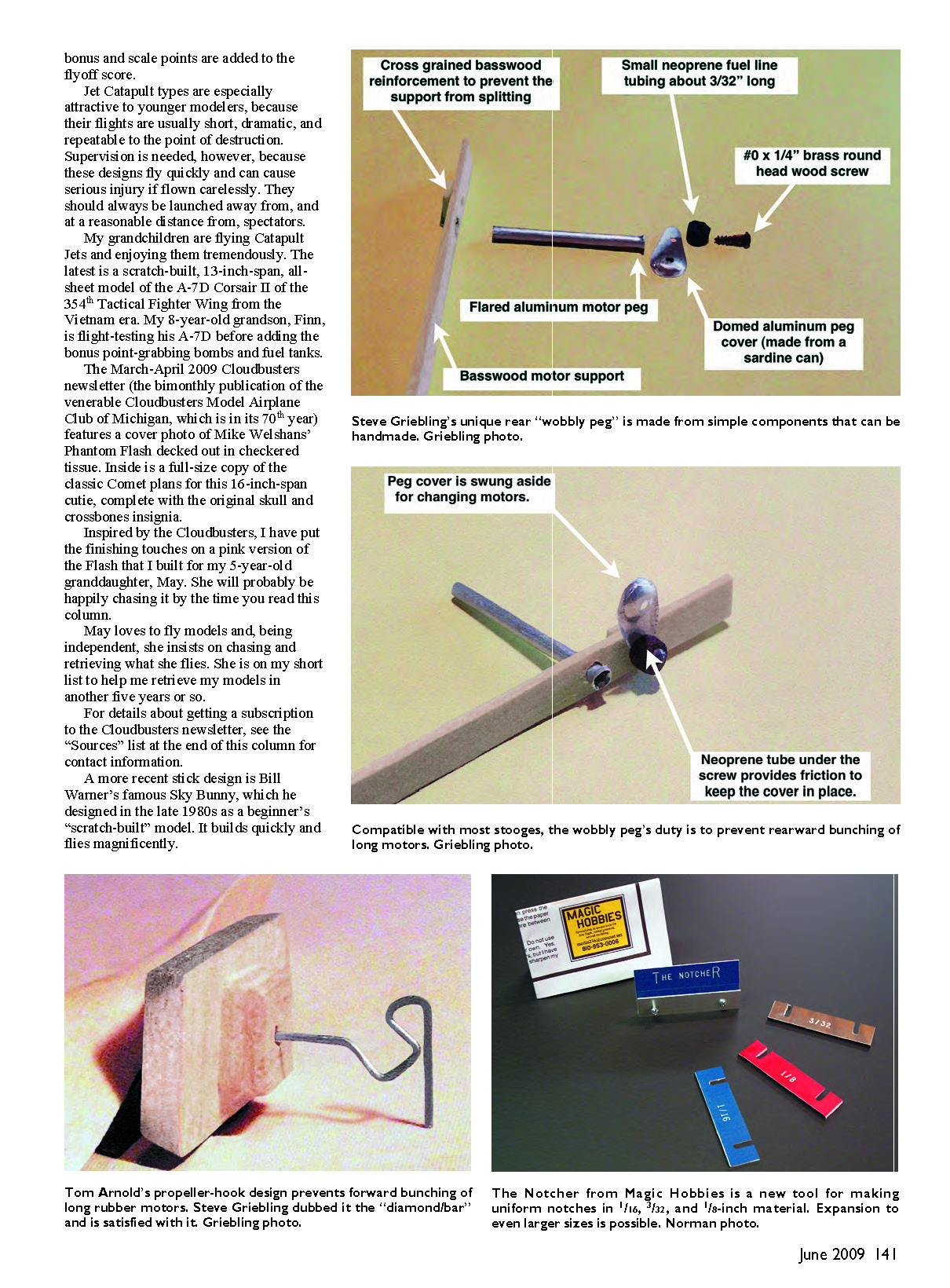
My grandchildren are flying Catapult Jets and enjoying them tremendously. The latest is a scratch-built, 13-inch-span, all-sheet model of the A-7D Corsair II of the 354th Tactical Fighter Wing from the Vietnam era. My 8-year-old grandson, Finn, is flight-testing his A-7D before adding the bonus point-grabbing bombs and fuel tanks.
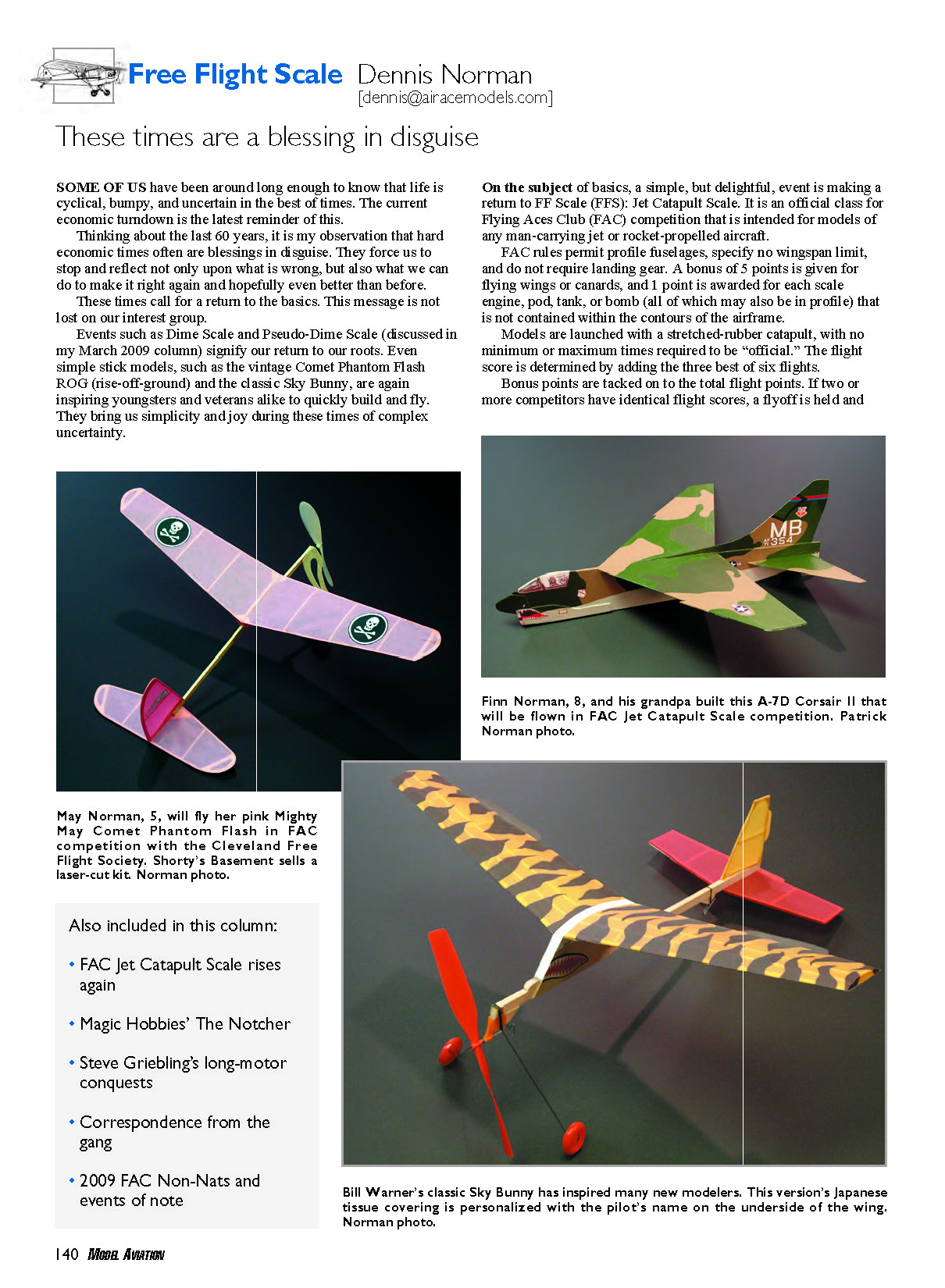
The March–April 2009 Cloudbusters newsletter (the bimonthly publication of the venerable Cloudbusters Model Airplane Club of Michigan, which is in its 70th year) features a cover photo of Mike Welshans' Phantom Flash decked out in checkered tissue. Inside is a full-size copy of the classic Comet plans for this 16-inch-span cutie, complete with the original skull-and-crossbones insignia.
Inspired by the Cloudbusters, I have put the finishing touches on a pink version of the Flash that I built for my 5-year-old granddaughter, May. She will probably be happily chasing it by the time you read this column.
May loves to fly models and, being independent, she insists on chasing and retrieving what she flies. She is on my short list to help me retrieve my models in another five years or so.
For details about getting a subscription to the Cloudbusters newsletter, see the "Sources" list at the end of this column for contact information.
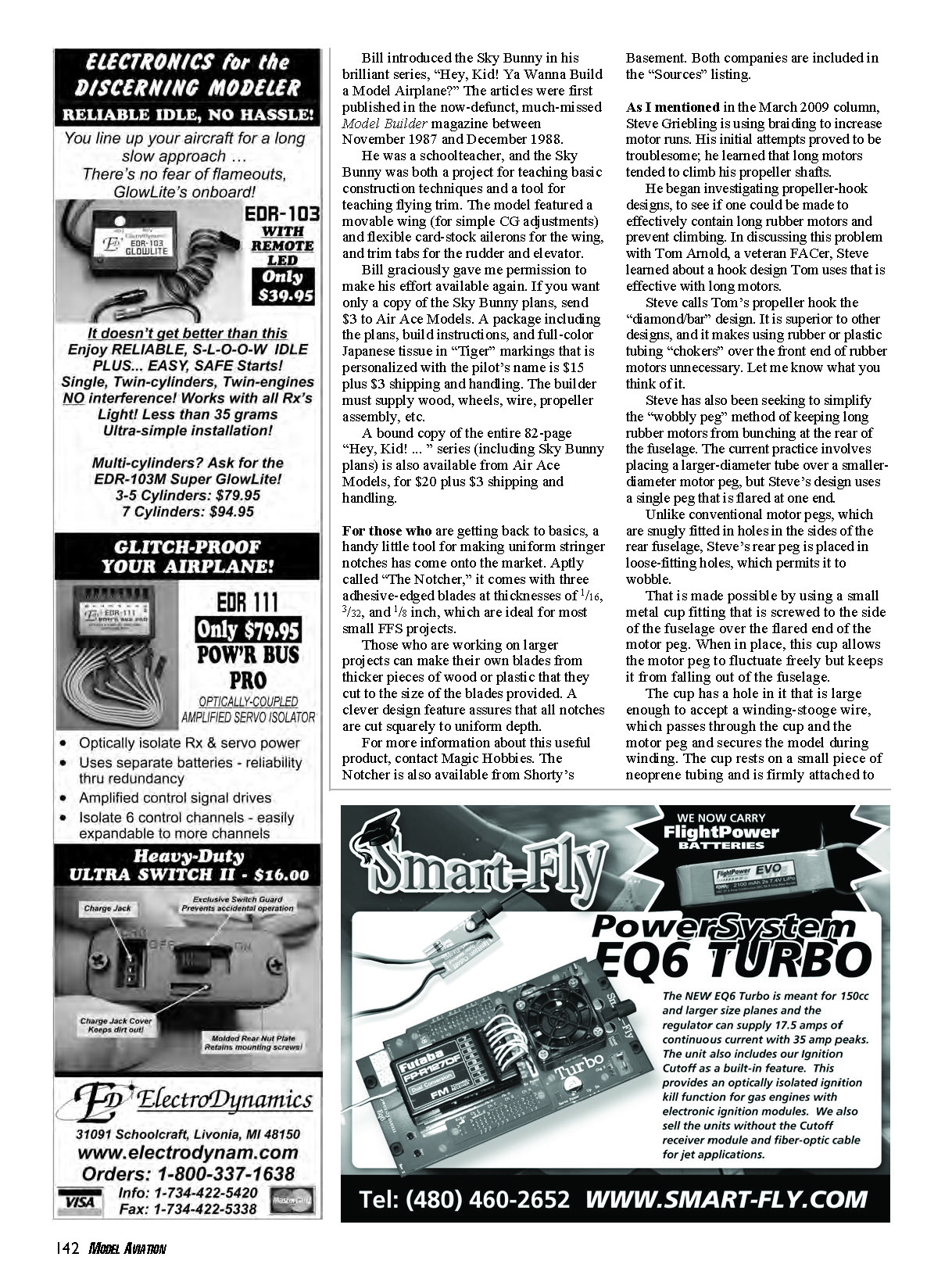
A more recent stick design is Bill Warner’s famous Sky Bunny, which he designed in the late 1980s as a beginner’s "scratch-built" model. It builds quickly and flies magnificently.
Free Flight Scale - 2009/06
Sky Bunny and Air Ace Models
Bill introduced the Sky Bunny in his brilliant series, "Hey, Kid! Ya Wanna Build a Model Airplane?" The articles were first published in the now-defunct, much-missed Model Builder magazine between November 1987 and December 1988.
He was a schoolteacher, and the Sky Bunny was both a project for teaching basic construction techniques and a tool for teaching flying trim. The model featured a movable wing (for simple CG adjustments), flexible card-stock ailerons for the wing, and trim tabs for the rudder and elevator.
Bill graciously gave me permission to make his effort available again. If you want only a copy of the Sky Bunny plans, send $3 to Air Ace Models. A package including the plans, build instructions, and full-color Japanese tissue in "Tiger" markings that is personalized with the pilot’s name is $15 plus $3 shipping and handling. The builder must supply wood, wheels, wire, propeller assembly, etc.
A bound copy of the entire 82-page "Hey, Kid! ..." series (including Sky Bunny plans) is also available from Air Ace Models for $20 plus $3 shipping and handling.
Tools: The Notcher
For those who are getting back to basics, a handy little tool for making uniform stringer notches has come onto the market. Aptly called "The Notcher," it comes with three adhesive-edged blades at thicknesses of 1/16, 3/32, and 1/8 inch, which are ideal for most small FFS projects.
Those who are working on larger projects can make their own blades from thicker pieces of wood or plastic cut to the size of the blades provided. A clever design feature assures that all notches are cut squarely to uniform depth.
For more information about this useful product, contact Magic Hobbies. The Notcher is also available from Shorty’s Basement. Both companies are included in the "Sources" listing.
Motor and propeller improvements (Steve Griebling)
As I mentioned in the March 2009 column, Steve Griebling is using braiding to increase motor runs. His initial attempts proved troublesome; he learned that long motors tended to climb his propeller shafts.
He began investigating propeller-hook designs to see if one could be made to effectively contain long rubber motors and prevent climbing. In discussing this problem with Tom Arnold, a veteran FACer, Steve learned about a hook design Tom uses that is effective with long motors.
Steve calls Tom’s propeller hook the "diamond/bar" design. It is superior to other designs and makes using rubber or plastic tubing "chokers" over the front end of rubber motors unnecessary. Let me know what you think of it.
Steve has also been seeking to simplify the "wobbly peg" method of keeping long rubber motors from bunching at the rear of the fuselage. The current practice involves placing a larger-diameter tube over a smaller-diameter motor peg, but Steve’s design uses a single peg that is flared at one end.
Unlike conventional motor pegs, which are snugly fitted in holes in the sides of the rear fuselage, Steve’s rear peg is placed in loose-fitting holes, which permits it to wobble. That is made possible by using a small metal cup fitting that is screwed to the side of the fuselage over the flared end of the motor peg. When in place, this cup allows the motor peg to fluctuate freely but keeps it from falling out of the fuselage.
The cup has a hole in it that is large enough to accept a winding-stooge wire, which passes through the cup and the motor peg and secures the model during winding. The cup rests on a small piece of neoprene tubing and is firmly attached to the fuselage side with a small screw.
When a motor change is needed, the rubber tubing allows the cup to be moved aside and the motor peg to be removed.
You can find more details about this method in Issue 128 of the Crosswinds newsletter or by e-mailing Steve Griebling. See the "Sources" list for those addresses.
Letters, news, and condolences
- The D.C. Maxecuters informed me that Bill Ceresa, a longtime member, passed away on January 18, 2009. He was a professional artist who spent 30 years as a medical illustrator for the Walter Reed Army Institute of Research. Bill produced many cover drawings for MaxFax, the Maxecuters' outstanding club newsletter. He also masterfully built stick-and-tissue models that reflected his artistic gifts. Known for his willingness to help others, his sense of humor, and his big smile, Bill Ceresa typified the best of FAC members. Condolences to his wife, Rose, and his son, Bill.
- Ronny Gosselin of Montreal, Quebec, Canada, e-mailed to inform me that he and his fellow members of FAC 71 Harfane (Snow Owl) Squadron are well along in their preparations to attend this year's FAC Non-Nats in Geneseo, New York. The event will be held July 16–18. Ronny has completed a Morane-Saulnier MS.406 in Finnish markings. Now he is working on a Corsair from the 1946 Reno Air Races and a Fokker F.20 with working landing and position lights. Both models will be ready for Geneseo. The Harfane group's Bernard Dion has a new Stuka V1. Luc Martin is doing a Kellner-Bechereau racer and has finished a model of the Arsenal VG 39. Ronny plans to arrive early in Geneseo to see the big air show that will be held at the National Warplane Museum the weekend of July 11–12; this site will host the FAC Non-Nats the following weekend.
- Bill Hannan sent a warm note to say that he and his wife, Joan, are enjoying this column. They especially appreciated the "Geneseo" coverage in the January 2009 MA. According to Bill, he and Joan continue to downsize their company, Hannan's Runway. See "Sources" for contact information. They now consider themselves "semiretired," although the hoped-for spare time has yet to emerge. The Hannans remain philosophical and sent the following quips:
- "A scientist is a person who believes that anything that works must be obsolete." — Anonymous
- "Growing old is no more than a bad habit which a busy person has no time to form." — André Maurois
- An e-mail from Jack Page raises the question of why I, and others, have never mentioned the Hi-Flier brand of Dime kits. He points out that they were lighter and, consequently, much better fliers than Comet, et al. Jack built a Hi-Flier Fokker D.VII kit at the age of 10, and it was one of the best fliers of his young life. I agreed that the Hi-Flier kits were outstanding. One of my favorites was the 18-inch-span Bellanca Skyrocket, which I built (and lost) on several occasions.
Current FAC rules limit Dime Scale types to a maximum wingspan of 16 inches. The Hi-Flier models with spans longer than that are ineligible to compete, since FAC rules prohibit reducing existing plans to conform with wingspan limits. Perhaps the issue of shrinking plans to conform with those span restrictions is a topic for FACers to discuss.
FAC Non-Nats, deadlines, and special events
If you have not already made reservations for the FAC Non-Nats in Geneseo, do so without delay. The hotels are probably booked by now, but accommodations can be obtained at the State University of New York at Geneseo, which is within sight of the flying field. You can find details about this in the latest issues of the Flying Aces Club News newsletter.
- All fees for the Non-Nats must be remitted by June 15. Mail a completed entry form and payment by check or international money order to FAC, to Juanita Reichel. Her contact information is in the "Sources" list. GHQ will be unable to refund cancellations after June 20.
The year 2009 marks the 100th anniversary of the first English Channel crossing by Louis Blériot. To mark this historic occasion, the FAC will hold a new event at this year's Non-Nats.
- The S.L.O.W. (Slow, Low, or Wet) Race will be held the evening of Friday, July 17. It will be for "plain Jane" pioneer models of full-scale aircraft built before 1915. The aircraft are to be built to scale, but wild color schemes are invited.
- The contest will be flown using the BLUR racecourse as the English Channel. Airplanes will initially be flown in heats of three; the "winners" will be the lowest and slowest to fly within the confines of the course. The champion will be the slowest and lowest of all.
Events of note for later this year include:
- Magnificent Mountain Men's club FAC World War II Combat contest — Denver, Colorado, Labor Day weekend. Contact Don DeLoach (see "Sources").
- FAC Outdoor Champs — Muncie, Indiana, September 10–11.
- WESTFAC II (hosted by WESTFAC — the Western Region Flying Aces Club) — Gainesville, Texas, September 25–27. Check the club's website for more information.
- The biennial Dawn Patrol gathering — National Museum of the US Air Force, Dayton, Ohio, September 25–27. This is not a model contest; it is one of the greatest opportunities to see World War I aviation up close. It is free and open to the public.
Thermals! MA
Sources
- Cloudbusters newsletter:
Ralph Kuenz, editor Box 402 Shepherd, MI 48883 [email protected]
- Air Ace Models
(216) 631-7774 www.airacemodels.com
- Magic Hobbies
(810) 953-0006 [email protected]
- Shorty's Basement
(740) 223-7471 (740) 225-8671 www.shortysbasement.com
- Crosswinds newsletter:
Russ Brown 4909 N. Sedgewick Lyndhurst, OH 44124
- Steve Griebling
753 Cliffside Dr. Akron, OH 44313 [email protected]
- Hannan's Runway
(530) 873-6421 www.hrunway.com
- Juanita Reichel
3301 Cindy Ln. Erie, PA 16506
- Don DeLoach
- WESTFAC
Transcribed from original scans by AI. Minor OCR errors may remain.

