
Free Flight Sport
Gene Smith [[email protected]]
Expanded 2007 Nats Starduster X event
The Starduster X event at the 2007 FF Nats will include any prior year’s 1/2A One Design of the Year model. Engine requirements remain the same: nostalgia-legal power plants for Nostalgia models and Tee Dees for others, such as the Starduster X, last year’s Mini Pearl, and the Space Rod from 2001.
Don't forget to build your Bounty Hunter for this year’s One Design event.
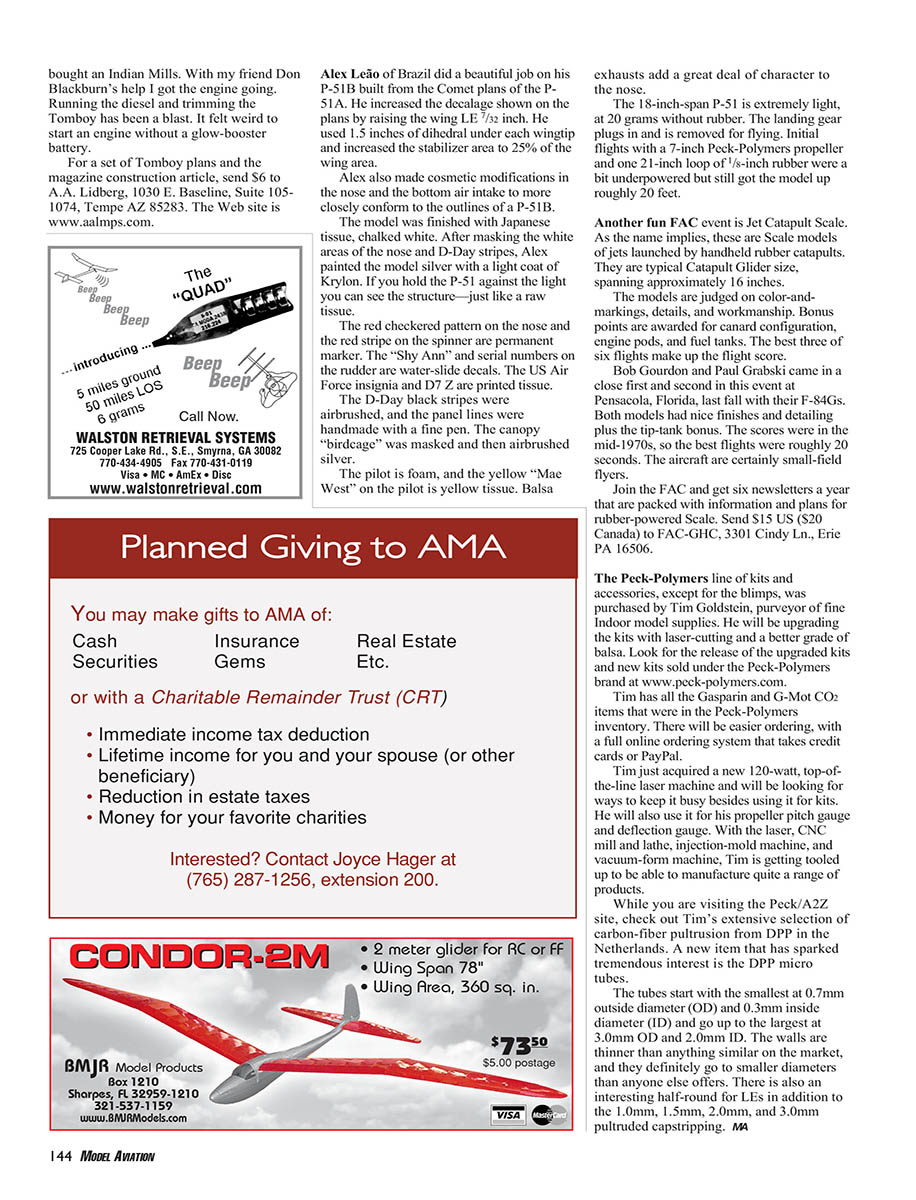
With the decreasing availability of Jetex units and fuel, there was a push to legalize the Rapier rocket engines in the Jetex event. That has been done, and Larry Kruse designed a model for the Rapier. If initial flights are any indication, his new Heat Stroke will be a great performer. It is roughly the size of a hand-launched glider but is extremely light. Look for a construction article and plans in the May 2007 Flying Models magazine.
Rubber-powered Scale twins and related models
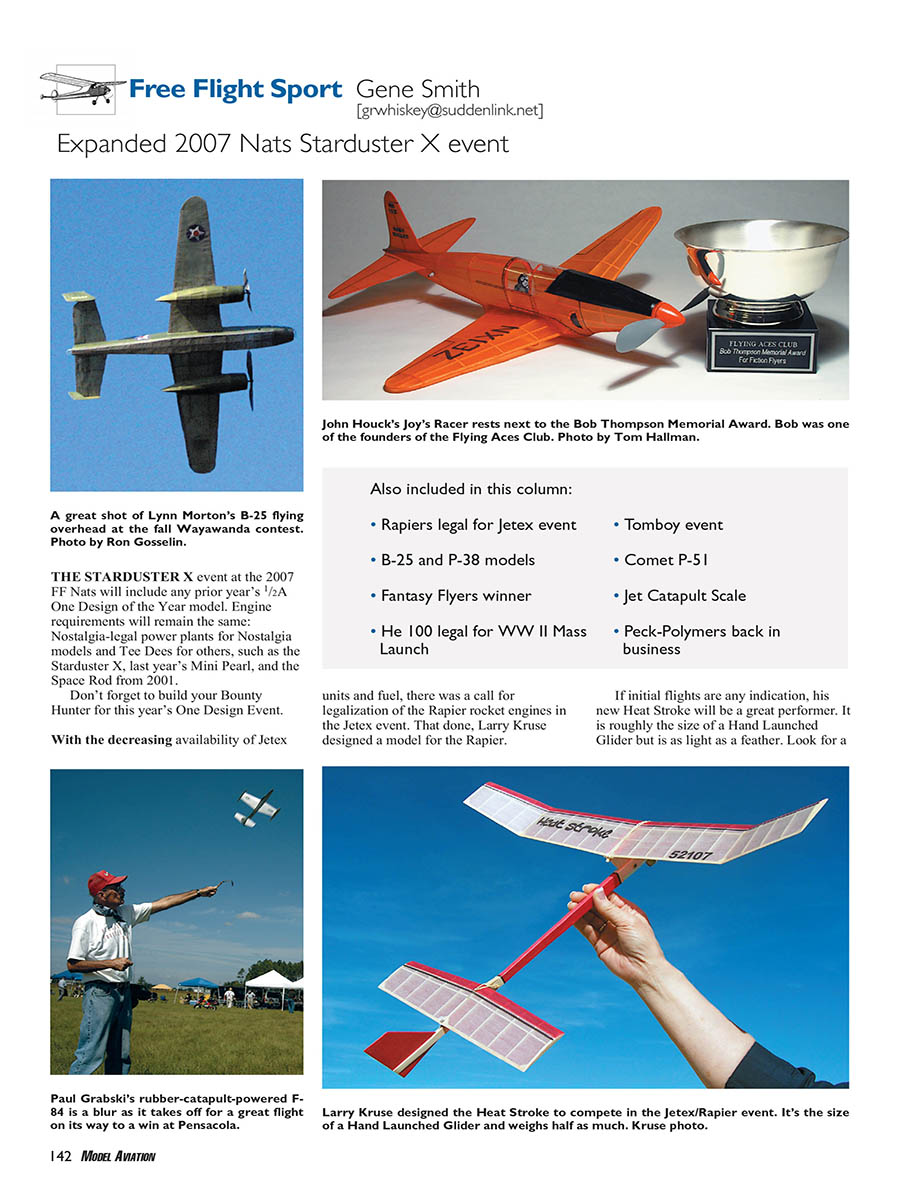
Something about a rubber-powered scale twin such as Lynn Morton’s B-25 turns heads. Lynn built a Comet P-38 in 2005; it flew so well he decided to build the B-25. He constructed his B-25 from downsized Mike Midkiff plans with only minor changes (smaller wood sizes and a few gussets). Details:
- Model: B-25 (Lynn Morton)
- Wingspan: 30 inches
- Power: one loop of 3/16" rubber in each nacelle, turning slightly cut-down 7" propellers rotating counterclockwise
- Covering: Japanese tissue sprayed with Krylon dull olive (item 3522); bottom covered with gray tissue
- Finish: Krylon misted lightly to remain translucent and keep weight down
- Weight (with rubber and props): 80 grams
- Best time at Wayawanda: 46 seconds (Lynn thinks it is slightly underpowered)
Lynn’s P-38 required an extreme amount of downthrust on both sides, even after adding more than the plans called for. The most difficult part was the canopy; he made laminated hoops for the front and rear canopy frames, bent flat acetate for most of the canopy, and plunge-molded only the top center area. He finished the P-38 with Krylon dull aluminum (item 1403). Its wingspan is 4 inches longer than the B-25’s, but it weighs 5 grams less and flies well with one loop of 3/16" rubber in each nacelle.
Duke Horn has also had good luck with his P-38 based on the Comet kit. He lengthened the wing 2 inches (to 36 inches) so it could fly in Jumbo Scale and built other components per the plans. His P-38’s empty weight was 140 grams. At the Texas Scale Champs in 2005 the P-38 placed second, behind Mike Midkiff’s Sea Fury. The P-38 consistently flew more than a minute, with a best flight of 71 seconds. Power and prop details:
- Rubber: two loops of 3/16" Tan 2, approximately 30" long, unbraided
- Propellers: three-blade Superior Props (one left-hand and one right-hand)
- Downthrust: 3° on each propeller
- Flight pattern: large left turns in power and glide with slight washout of the left wingtips
Duke modeled his P-38 after the Reno air racer White Lightning, which crashed a few years ago. Duke’s model also crashed last year due to a Crocket hook climbing up the propeller shaft and locking the starboard motor when the model was pulled over. Duke says he will never build a twin again without a Z-hook shaft. He is currently working on a new P-38.
Joy's Racer — John Houck
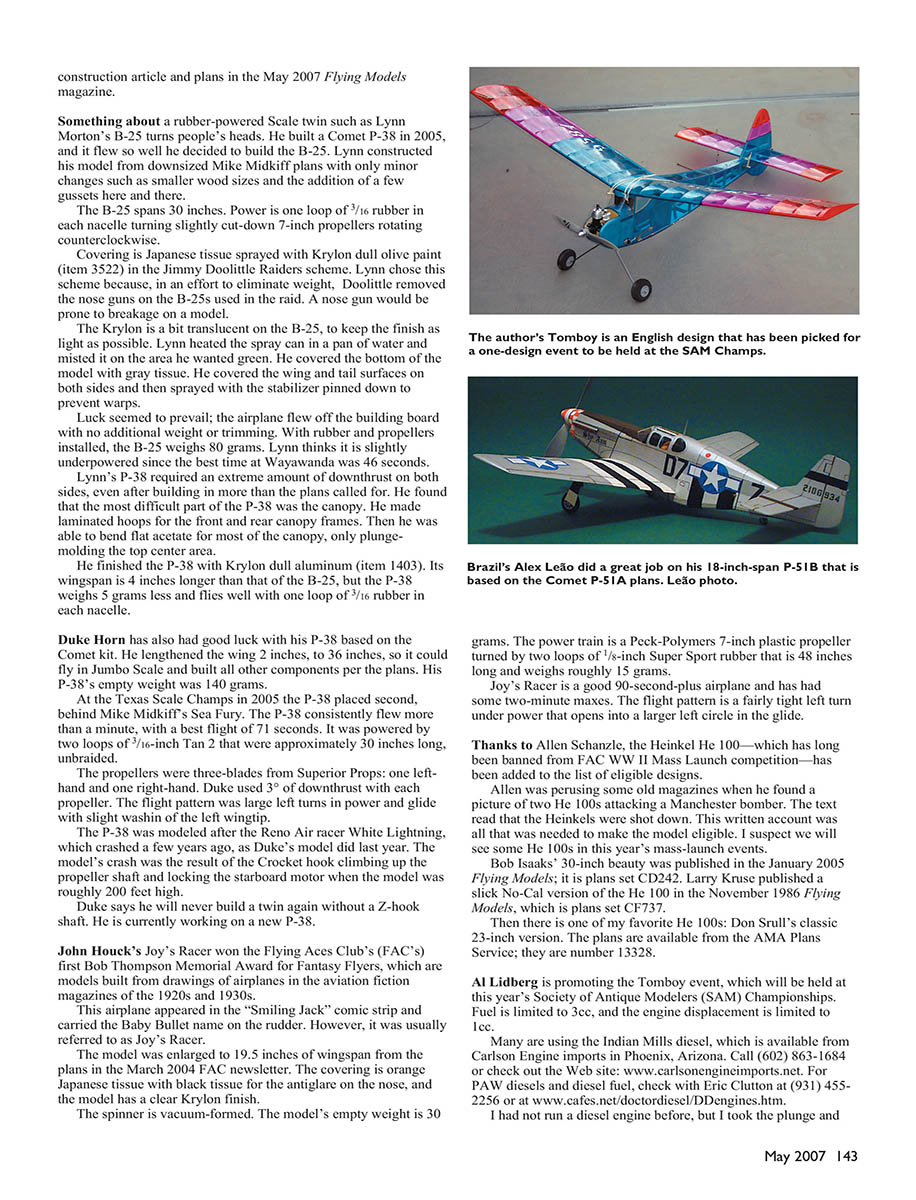
John Houck's Joy's Racer won the Flying Aces Club's (FAC) first Bob Thompson Memorial Award for Fantasy Flyers (models built from drawings of airplanes in the aviation fiction magazines of the 1920s and 1930s). The airplane appeared in the "Smiling Jack" comic strip and carried the Baby Bullet name on the rudder, though it was usually called Joy's Racer.
- Based on: plans enlarged from a March 2004 FAC newsletter
- Wingspan: 19.5 inches
- Covering: orange Japanese tissue with black tissue anti-glare on the nose; clear Krylon finish
- Spinner: vacuum-formed
- Empty weight: 30 grams
- Power: Peck-Polymers 7" plastic propeller turned by two loops of 1/8" Super Sport rubber (48" long, ~15 grams)
- Performance: good 90-second-plus flights, some two-minute maxes
- Flight pattern: fairly tight left turn under power that opens into a larger left circle in the glide
Heinkel He 100 eligibility
Thanks to Allen Schanzle, the Heinkel He 100 — long banned from FAC WWII Mass Launch competition — has been added to the list of eligible designs. Allen found a written account in an old magazine describing He 100s attacking a Manchester bomber and being shot down; that written account was sufficient to make the model eligible. Expect to see some He 100s in this year's mass-launch events.
Plans and references:
- Bob Isaacs' 30" He 100: published January 2005 Flying Models, plans set CD422
- Larry Kruse No-Cal version: November 1986 Flying Models, plans set CF737
- Don Srull classic 23" version: AMA Plans Service number 13328
Tomboy event and diesels
Al Lidberg is promoting the Tomboy event at this year's Society of Antique Modelers (SAM) Championships. Restrictions:
- Fuel limit: 3 cc
- Engine displacement limit: 1 cc
Many are using the Indian Mills diesel, available from Carlson Engine Imports in Phoenix, AZ. Contact:
- Carlson Engine Imports: (602) 863-1684, www.carlsonengineimports.net
- For PAW diesels and diesel fuel: Eric Clifton, (931) 455-2256, www.cafes.net/doctordiesel/Derengines.htm
I had not run a diesel engine before, but I bought an Indian Mills and, with Don Blackburn’s help, got it running. Running the diesel and trimming the Tomboy has been a blast — it felt strange to start an engine without a glow-booster battery.
For a set of Tomboy plans and the magazine construction article, send $6 to: A.A. Lidberg, 1030 E. Baseline, Suite 105-1074, Tempe AZ 85283. Web: www.aalmps.com
Alex Leão’s P-51B (Brazil)
Alex Leão did a beautiful job on his P-51B built from Comet P-51A plans with several modifications:
- Increased decalage by raising the wing LE 7/32"
- Dihedral: 1.5" under each wingtip
- Increased stabilizer area to 25% of wing area
- Cosmetic changes to nose and bottom air intake to match P-51B outline
Finish and details:
- Covering: Japanese tissue, chalked white
- Silver finish: light coat of Krylon after masking white areas and D-Day stripes (so structure shows through like raw tissue)
- Nose checker pattern and spinner stripe: permanent marker
- “Shy Ann” and serial numbers: water-slide decals
- USAF insignia and D7Z: printed tissue
- D-Day black stripes: airbrushed; panel lines drawn by hand with a fine pen
- Canopy birdcage: masked and airbrushed silver
- Pilot: foam with a yellow “Mae West” made from tissue; balsa exhausts add character
Specs and performance:
- Wingspan: 18 inches
- Empty weight: ~20 grams (without rubber)
- Landing gear: plug-in, removed for flying
- Initial flights: 7" Peck-Polymers propeller and one 21" loop of 1/8" rubber were a bit underpowered but got the model up to roughly 20 feet
Jet Catapult Scale
Jet Catapult Scale models are scale jets launched by handheld rubber catapults, typical catapult-glider size (~16" span). Judging is on color-and-markings, details, and workmanship; bonus points given for canard configuration, engine pods, and fuel tanks. The best three of six flights count toward the flight score.
At Pensacola last fall, Bob Gourdon and Paul Grabski placed first and second with F-84Gs. Both models had fine finishes and tip-tank bonuses. Scores were in the mid-1970s, so best flights were roughly 20 seconds. These aircraft are small-field flyers.
Join the FAC
Join the Flying Aces Club (FAC) to receive six newsletters a year packed with information and plans for rubber-powered scale. Send $15 US ($20 Canada) to: FAC-GHC, 3301 Gundy Ln., Erie PA 16506
Peck-Polymers, Tim Goldstein, and DPP micro tubes
The Peck-Polymers line of kits and accessories (except blimps) was purchased by Tim Goldstein, purveyor of indoor model supplies. Tim will upgrade kits with laser-cutting and better-grade balsa and will release upgraded and new Peck-Polymers kits at www.peck-polymers.com.
Tim also carries the Gasparin and G-Mot CO2 items formerly in the Peck-Polymers inventory. He is implementing an improved online ordering system that will accept credit cards and PayPal.
Tim recently acquired a 120-watt laser cutter and will use it alongside a CNC mill and lathe, injection-mold machine, and vacuum-form machine to manufacture a broader range of products. He will also use the laser for tools such as a propeller pitch gauge and deflection gauge.
While visiting the Peck/A2Z site, check out Tim’s selection of carbon-fiber pultrusion from DPP (Netherlands). A notable new item is the DPP micro tubes:
- Sizes: from 0.7 mm OD / 0.3 mm ID up to 3.0 mm OD / 2.0 mm ID
- Features: very thin walls, smaller diameters than most on the market
- Other items: half-rounds for leading edges and pultruded capstripping in 1.0 mm, 1.5 mm, 2.0 mm, and 3.0 mm
MA
Transcribed from original scans by AI. Minor OCR errors may remain.

