
FREE FLIGHT SPORT
Gene Smith 1401 N. Husband St., Stillwater OK 74075 E-mail: [email protected]
DIME SCALE MODELS
It amazes me how the model-airplane designers of the 1930s could produce an airplane from a few bits of balsa that was as easily recognizable as a full-scale airplane. Dime Scale models have a unique niche in the history of scale-model-aircraft design. They have just the right blend of realism and simplicity.
When the Flying Aces Club (FAC) added Dime Scale to its list of events, it created a virtual firestorm of protest from modelers who felt that the rules discriminated against their favorite Dime Scale plans. Now that things have settled down and the controversy is largely over, the event has become quite popular.
An interesting twist is the pseudo-Dime designs. These are "new" Dime Scale models that compete along with the originals. A modeler can draw new plans that follow Dime Scale design techniques. The airplane being modeled must have flown before December 7, 1941, and cannot have been previously published as Dime Scale plans.
Many of the original Dime Scale models are available as kits from Penn Valley Hobby Center, 837 W. Main St., Lansdale PA 19446; Web site: www.pennvalleyhobbycenter.com.
Fantasy Flyers were a feature of the Bill Barnes adventure comic.
Fokker Dr.I Peanut
Aircraft with no dihedral present a special challenge to the free-flight (FF) scale modeler. Joe Smith drew his own plans and built a great Fokker Dr.I Peanut. He reports that it flew well from the get-go.
His approach to the lateral-stability problem was to build 2° of washout into every one of the triplane’s wing panels. He made the ailerons on the upper wing adjustable with wire hinges. Joe reports that the model had a natural left turn. He cured a slight tendency to drop the left wing by reducing the reflex of the left aileron. He set the three wings at the same +2° incidence. Each wingtip has just more than 1/8 inch of washout, including the wire-hinged ailerons on the upper wing.
He determined the CG by measuring the distance between two lines. The front line was the leading edge (LE) of the top wing, and the other line was the trailing edge (TE) of the bottom wing. He placed the CG one-third of that distance from the LE of the top wing.
Joe purchased the tissue for the covering at the craft store, and the finish was one light coat of Pactra spray-can clear dope. For the test flights, he used a 7-inch loop of 3/16-inch Sig contest rubber. Joe will be going for longer flights with longer motors.
A + B = C (Dematerializers / DTs)
The last time I used a fuse-type dematerializer (DT) was more than seven years ago. I don’t like cutting and mounting fuses, nor is it fun lighting a fuse while a 1/2A engine is screaming in my ear. I know that fuses can be reliable, but burning time varies depending on the temperature and humidity. Flying in a drizzle can be problematic.
In 1996, an article in Free Flight showed how to construct a Silly Putty DT using a cocktail-straw cylinder. I have built a number of those through the years, and they have worked great for their intended use: sport FF models. I made modifications to better enable me to set the time and reset the timer more easily. I used the DTs in rubber- and gas-powered FF models as large as a Satellite 600.
However, the time needed to reset the timer, the fragility of the cocktail straw, and the time required to build the timer had me constantly searching for a light timer that was reliable enough to use for contest work with small rubber and gas models. Larger aircraft can carry a mechanical DT timer without having to worry about its weight, but that same weight can significantly hamper a smaller model’s duration.
When the button/badge-type timers were introduced, I thought they were the answer. But they are best suited to small rubber models or hand-launched gliders. Proper tension for holding down a high-performance 1/2A gas model’s stabilizer—or even the wing of a pop-up-wing-type DT on a P-30—was high enough that it would cause the DT to unwind too rapidly. The elastic thread used to rotate the timer arm wasn’t strong enough for my purpose.
My current DT setup for small gas models incorporates two ideas gleaned from other modelers. These allow the use of the button/badge timers on larger models:
- Andy Ringlen (Free Flight, April 2002) used a U-shaped wire loop trapped under the arm of a badge/button-type timer. Using this wire loop allows separate tension for the stabilizer hold-down and the timer driver.
- Jack Dobbins (mentioned in Dick Miller’s electric-flight column, Flying Models, Sept. 1997) suggested using surgical tubing for the timer driver rather than a spring, elastic thread, or rubber band.
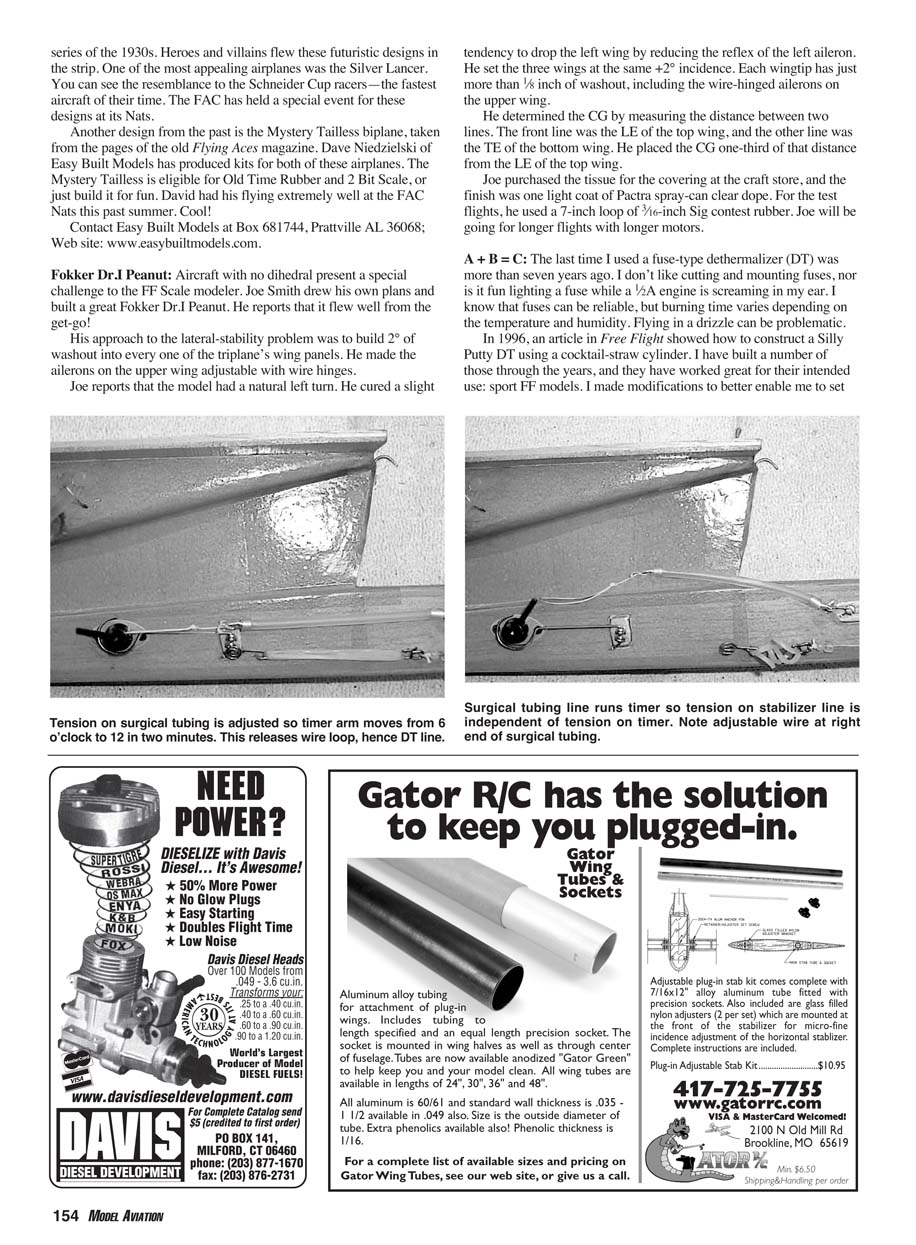
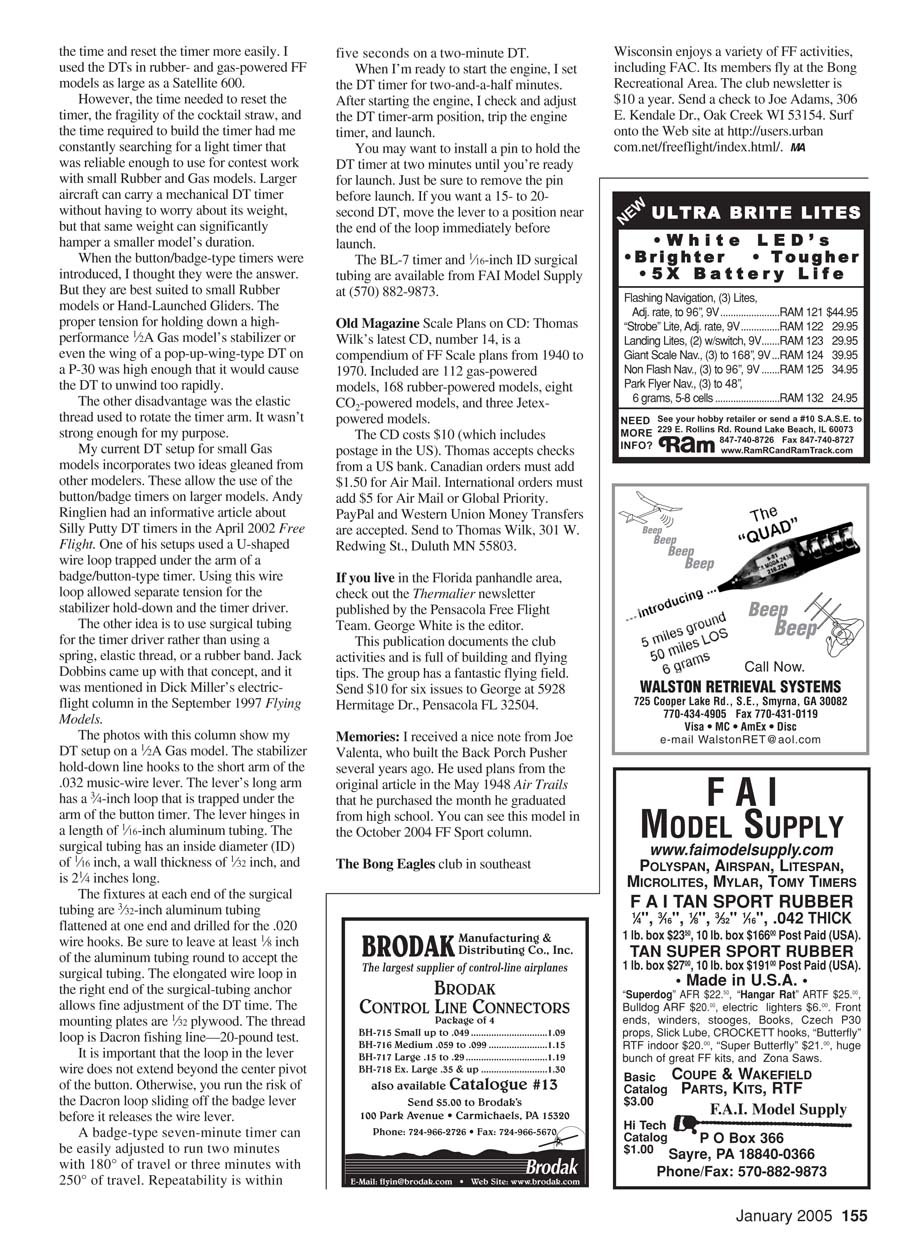
The photos with this column show my DT setup on a 1/2A gas model. Key features:
- Stabilizer hold-down line hooks to the short arm of a .032 music-wire lever.
- The lever’s long arm has a 3/4-inch loop that is trapped under the arm of the button timer.
- The lever hinges in a length of 1/16-inch aluminum tubing.
- Surgical tubing: inside diameter (ID) 1/16 inch, wall thickness 1/32 inch, length 2 1/4 inches.
- End fixtures: 3/32-inch aluminum tubing flattened at one end and drilled for the .020 wire hooks. Leave at least 1/8 inch of the aluminum tubing round to accept the surgical tubing.
- The elongated wire loop in the right end of the surgical-tubing anchor allows fine adjustment of the DT time.
- Mounting plates: 1/32-inch plywood.
- Thread loop: Dacron fishing line—20-pound test.
It is important that the loop in the lever wire does not extend beyond the center pivot of the badge. Otherwise, you run the risk of the Dacron loop sliding off the badge lever before it releases the wire lever.
A badge-type seven-minute timer can be easily adjusted to run two minutes with 180° of travel or three minutes with 250° of travel. Repeatability is within five seconds on a two-minute DT.
When I’m ready to start the engine, I set the DT timer for two-and-a-half minutes. After starting the engine, I check and adjust the DT timer-arm position, trip the engine timer, and launch.
You may want to install a pin to hold the DT timer at two minutes until you’re ready for launch. Just be sure to remove the pin before launch. If you want a 15- to 20-second DT, move the lever to a position near the end of the loop immediately before launch.
The BL-7 timer and 1/16-inch ID surgical tubing are available from FAI Model Supply at (570) 882-9873.
Old Magazine Scale Plans on CD
Thomas Wilk’s latest CD, number 14, is a compendium of FF scale plans from 1940 to 1970. Included are:
- 112 gas-powered models
- 168 rubber-powered models
- 8 CO2-powered models
- 3 Jetex-powered models
The CD costs $10 (includes postage in the U.S.). Thomas accepts checks from a U.S. bank. Canadian orders must add $1.50 for Air Mail. International orders must add $5 for Air Mail or Global Priority. PayPal and Western Union Money Transfers are accepted. Send to:
Thomas Wilk 301 W. Redwing St., Duluth MN 55803
If you live in the Florida Panhandle area, check out the Thermalier newsletter published by the Pensacola Free Flight Team. George White is the editor. This publication documents club activities and is full of building and flying tips. The group has a fantastic flying field. Send $10 for six issues to:
George White 5928 Hermitage Dr., Pensacola FL 32504
Memories
I received a nice note from Joe Valenta, who built the Back Porch Pusher several years ago. He used plans from the original article in the May 1948 Air Trails that he purchased when he graduated from high school. You can see this model in the October 2004 FF Sport column.
The Bong Eagles club in southeast Wisconsin enjoys a variety of FF activities, including FAC. Its members fly at the Bong Recreational Area. The club newsletter is $10 a year. Send a check to:
Joe Adams 306 E. Kendale Dr., Oak Creek WI 53154
Web: http://users.urban.com/net/freeflight/index.html/
MA
Transcribed from original scans by AI. Minor OCR errors may remain.

