
Free Flight Sport - 2006/01
Gene Smith [[email protected]]
Estes Aero Xs and Air Hogs E-Chargers are fun for kids
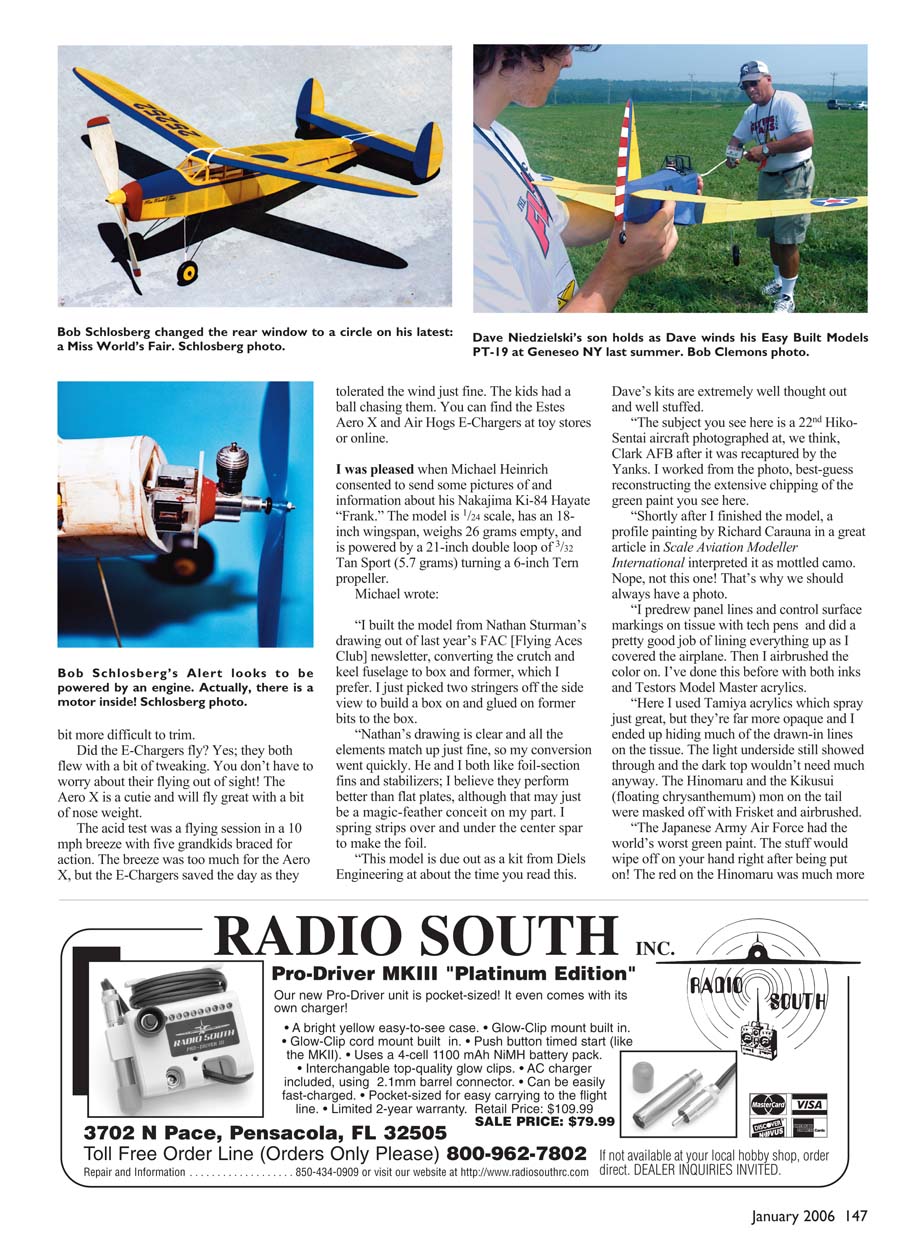
Many of us dads and grandpas are looking for models with which to hook our unsuspecting kids and grandkids on the fun of free flight. Ed Toner recently told me about the Estes Aero X model. He had some success with it after adding a .177-caliber pellet to the nose for balance. Ed has even lost one out of sight! I found an Aero X at the local Hobby Lobby for $12.
If you have ever helped a 4-year-old launch a small model, you know it can go in any direction. It has to be extremely stable to recover from impossible launches. Estes has resolved that with a unique charging-handle launcher: insert the model into the groove on top of the handle, wait five to ten seconds for the charge, and then pull the trigger. It is easy for kids to launch.
My first flights led to a stall and flutter to the ground. I followed the enclosed instructions and bent the elevators down. That produced a flight of sorts, but the model was unstable—typical of a tail-heavy condition. Following Ed’s lead, I used the “magic bullet”: a .177-caliber pellet. I secured it with five-minute epoxy in a pocket made in the model’s nose. The results were impressive. After the next five-second charge, the model flew up and over a small outbuilding in my backyard. (No, not that; we have indoor plumbing.) This little model, properly balanced, is a real flier.
I had also heard about the Air Hogs E-Charger electric-powered free-flight models. I picked up a couple at Wal-Mart. The Air Hogs aircraft were touted as a good source for an electric motor/battery system to cannibalize for other projects. I purchased two designs: one is a conventional tractor model with swept wings and the other a pusher with a centrally located motor and a batlike wing.
Comparative specs and observations:
- Aero X
- Weight: approximately 8 grams
- Motor/battery: very small and light
- Wing loading: 0.38 gram per square inch
- Flight: floater, easy to trim; great for indoors or calm conditions
- Air Hogs E-Chargers
- Weight: 19–21 grams
- Wing loading: 1.16 and 0.90 gram per square inch (depending on model)
- Flight: more like electric missiles — fast and a bit more difficult to trim
Did the E-Chargers fly? Yes; they both flew with a bit of tweaking. You don't have to worry about their flying out of sight! The Aero X is a cutie and will fly great with a bit of nose weight.
The acid test was a flying session in a 10 mph breeze with five grandkids braced for action. The breeze was too much for the Aero X, but the E-Chargers saved the day as they tolerated the wind just fine. The kids had a ball chasing them. You can find the Estes Aero X and Air Hogs E-Chargers at toy stores or online.
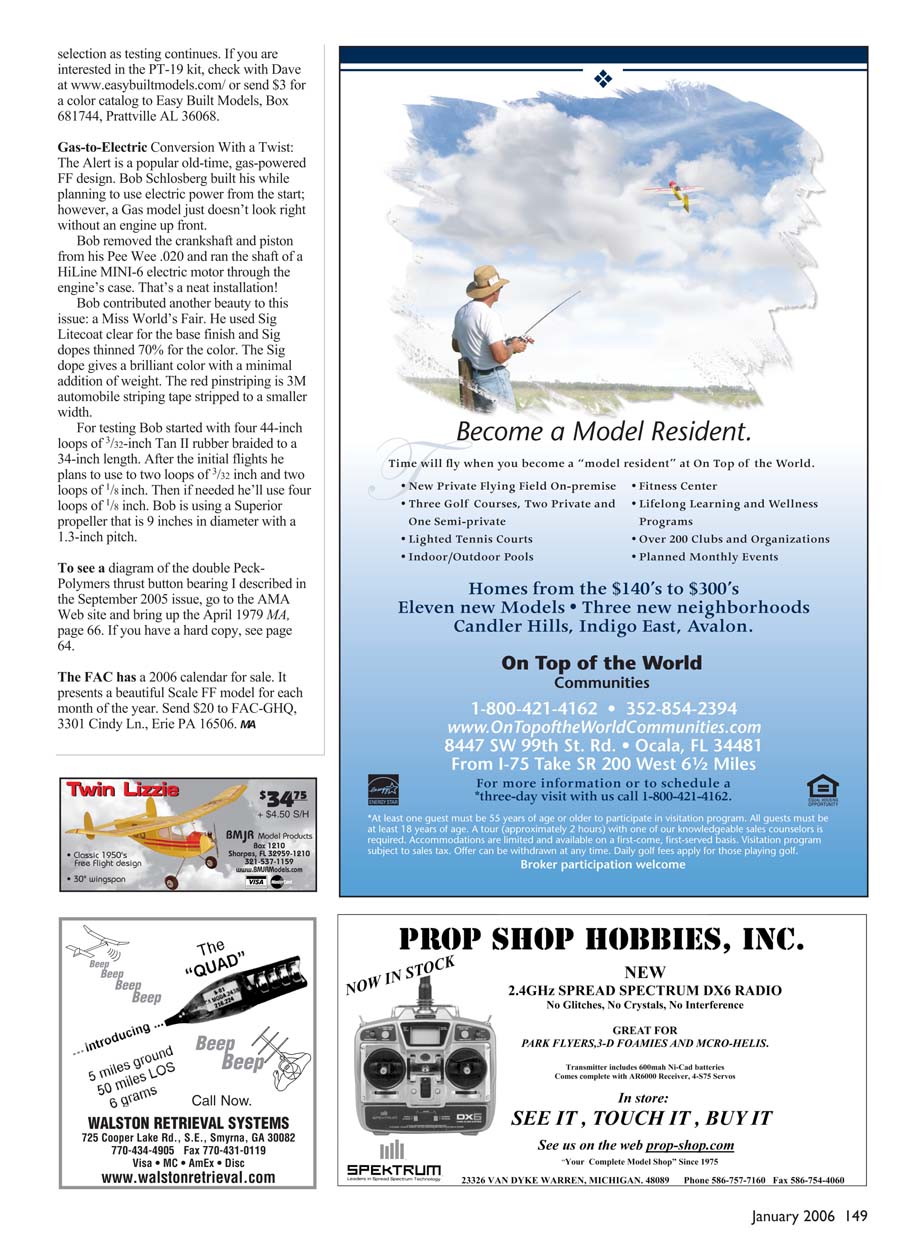
Nakajima Ki-84 Hayate "Frank" — Michael Heinrich
Michael Heinrich kindly sent pictures and information about his Nakajima Ki-84 Hayate "Frank." Key model data:
- Scale: 1/24
- Wingspan: 18 inches
- Empty weight: 26 grams
- Power: 21-inch double loop of 3/32 Tan Sport (5.7 grams) turning a 6-inch Tern propeller
Michael wrote that he built the model from Nathan Sturman's drawing (from last year's FAC newsletter), converting the crutch-and-keel fuselage to box-and-former construction. He used foil-section fins and stabilizers (strip-sanded over and under the center spar to make the foil). The model will be released as a kit from Diels Engineering, with keel-and-former construction and some of Dave Diels’s typical modifications.
About the subject and finish:
- The subject aircraft is a 22nd Hiko-Sentai plane, probably photographed at Clark AFB after recapture.
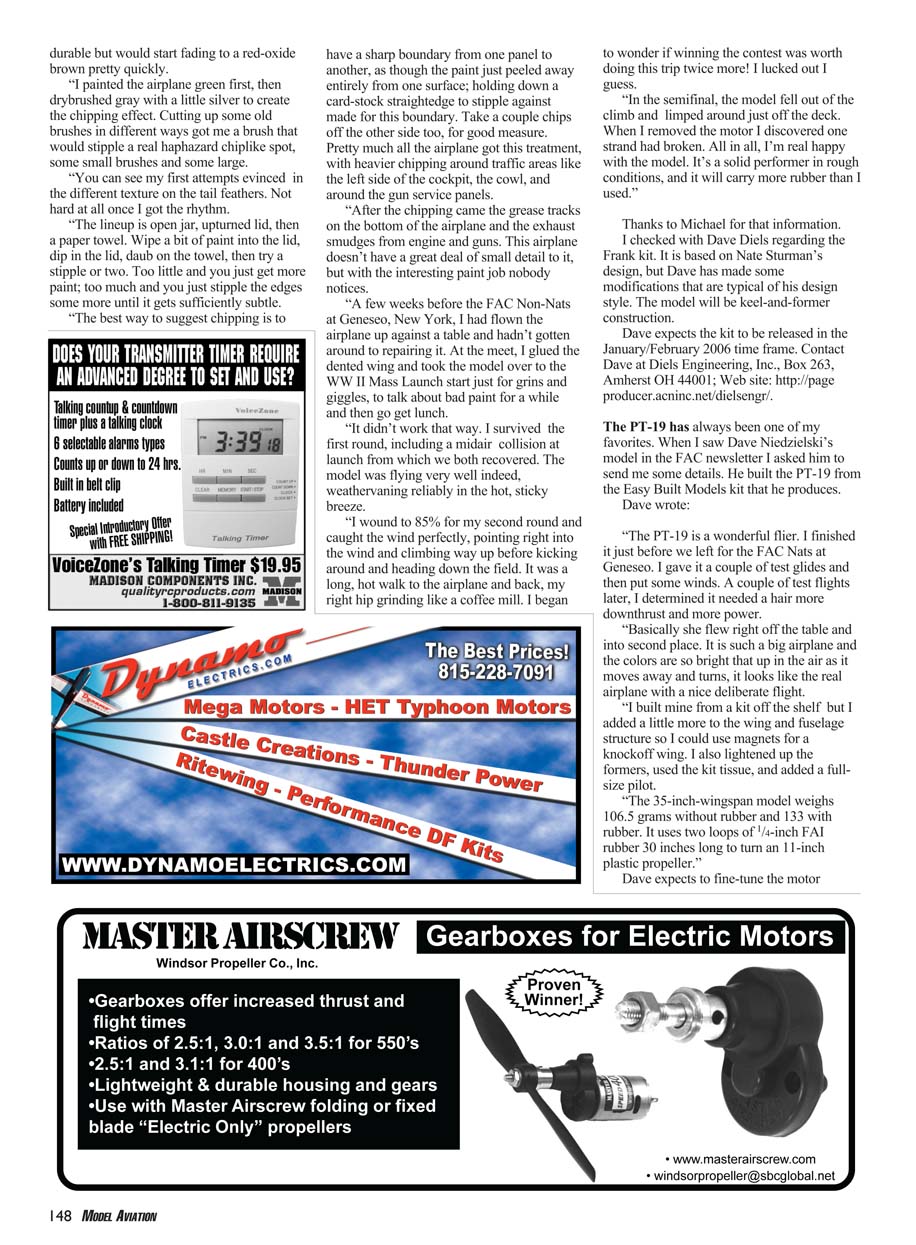
- Michael reconstructed extensive chipping of the green paint from the photo.
- He predrew panel lines and control surface markings on tissue with tech pens, then covered and airbrushed.
- Tamiya acrylics were used (very opaque), and the Hinomaru and Kikusui mon on the tail were masked and airbrushed.
- To simulate chipping he painted green first, then drybrushed gray with a little silver and stippled with modified brushes to get a haphazard chip effect. He used an open jar → upturned lid → paper towel workflow for the stippling.
- He emphasized sharp boundaries between chipped and intact panels (using a cardstock straightedge) and heavier chipping in traffic areas (left side of cockpit, cowl, gun service panels).
- After chipping, he added grease tracks and exhaust smudges.
Operational notes:
- A few weeks before the FAC Non-Nats at Geneseo, New York, he damaged the wing by flying into a table; he repaired it and entered the WW II Mass Launch.
- The model weathervaned reliably in hot, sticky conditions. In one round he wound to 85% and caught the wind well, climbing high before returning down the field.
- In the semifinal one motor strand broke; after removing the motor he discovered the broken strand. Overall, he was pleased — the model is a solid performer in rough conditions and can carry more rubber than he used.
Kit information:
- Dave Diels expects the kit to be released in the January/February 2006 time frame.
- Contact Diels Engineering, Inc., Box 263, Amherst OH 44001; web: http://pageproducer.acninci.net/dielsengr/.
PT-19 (Dave Niedzielski)
The PT-19 has long been a favorite. Dave Niedzielski built his from the Easy Built Models kit that he produces. Dave wrote:
"The PT-19 is a wonderful flier. I finished it just before we left for the FAC Nats at Geneseo. I gave it a couple of test glides and then put some winds. A couple of test flights later, I determined it needed a hair more downthrust and more power.
"Basically she flew right off the table and into second place. It is such a big airplane and the colors are so bright that up in the air it seems to move like a real airplane with a nice deliberate flight.
"I built mine from a kit off the shelf but I added a little more to the wing and fuselage structure so I could use magnets for a knockoff wing. I also lightened up the formers, used the kit tissue, and added a full-size pilot.
"The 35-inch-wingspan model weighs 106.5 grams without rubber and 133 grams with rubber. It uses two loops of 1/4-inch FAI rubber 30 inches long to turn an 11-inch plastic propeller."
Dave expects to fine-tune the motor selection as testing continues. If you are interested in the PT-19 kit, check www.easybuiltmodels.com or send $3 for a color catalog to Easy Built Models, Box 681744, Prattville AL 36068.
Gas-to-Electric Conversion With a Twist
The Alert is a popular old-time, gas-powered free-flight design. Bob Schlosberg built his while planning to use electric power from the start; however, a gas model just doesn't look right without an engine up front.
Bob removed the crankshaft and piston from his Pee Wee .020 and ran the shaft of a HiLine MINI-6 electric motor through the engine's case — a neat installation.
Bob also contributed a Miss World's Fair model. He used Sig Litecoat clear for the base finish and Sig dopes thinned to 70% for color. The Sig dope gives brilliant color with minimal weight. The red pinstriping is 3M automobile striping tape trimmed to a narrower width.
Power and propeller for testing:
- Initial rubber: four 44-inch loops of 3/32-inch Tan II braided to 34 inches
- Planned progression: two loops of 3/32 and two of 1/8; then, if needed, four loops of 1/8
- Propeller: Superior 9-inch diameter, 1.3-inch pitch
Other notes and resources
- To see a diagram of the double Peck-Polymers thrust-button bearing described in the September 2005 issue, go to the AMA website and bring up the April 1979 MA, page 66. If you have a hard copy, see page 64.
- The FAC has a 2006 calendar for sale, presenting a beautiful scale free-flight model for each month. Send $20 to FAC-GHQ, 3301 Cindy Ln., Erie PA 16506.
MA
Transcribed from original scans by AI. Minor OCR errors may remain.

