
Free Flight Sport
Gene Smith [[email protected]]
Also included in this column:
- Mini Pearl for Bill Vanderbeek’s one-design event
- Tom Hallman’s airbrushing tips
- Junior FFer Albert Johnson
- Texas Timers changes
- Pensacola Free Flight Team newsletter
- The Thermal Thumbers of Metro Atlanta
Nickel Scale models are not small change these days
BUDDY, CAN YOU Spare a Nickel? There was a smaller brother to the more popular 16-inch-wingspan Comet Dime Scale series: a series of 10-inch-wingspan Nickel Scale kits. Bill Carney is moderator for a Nickel Scale build on the Small Flying Arts web site at www.smallflyingarts.com/cgi-bin/yabb/YaBB.pl/. You can find the Nickel Scale thread in the Indoor Builds section.
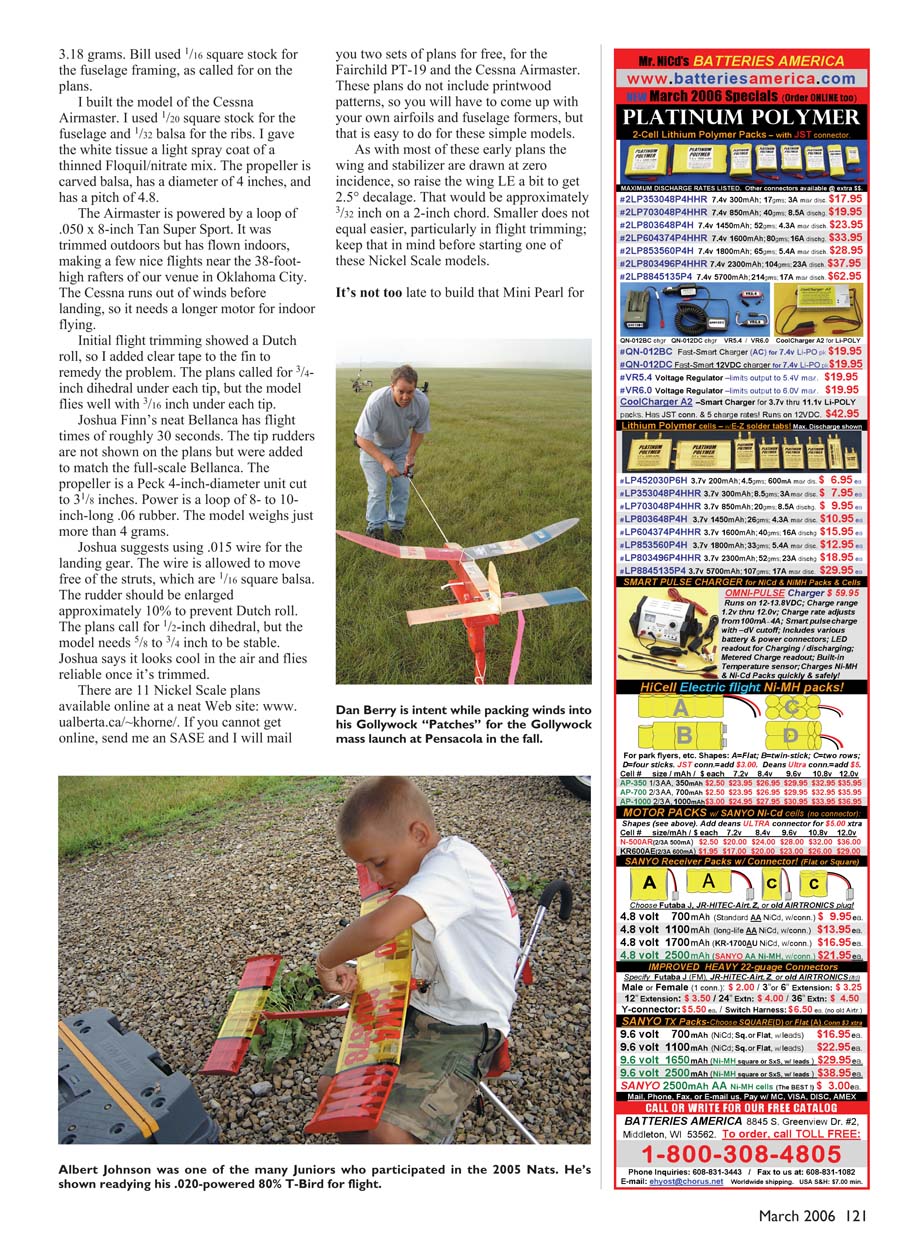
A number of terrific models have been completed and posted on the site, including Bill’s PT-19 (Fairchild). Bill made some great flights with the model at last year’s AMA Indoor Nats. Details on Bill’s PT-19:
- Propeller: 3-inch-diameter, hand-carved
- Empty weight (including nose ballast): 3.18 grams
- Fuselage framing: 1/16" square stock (as on the plans)
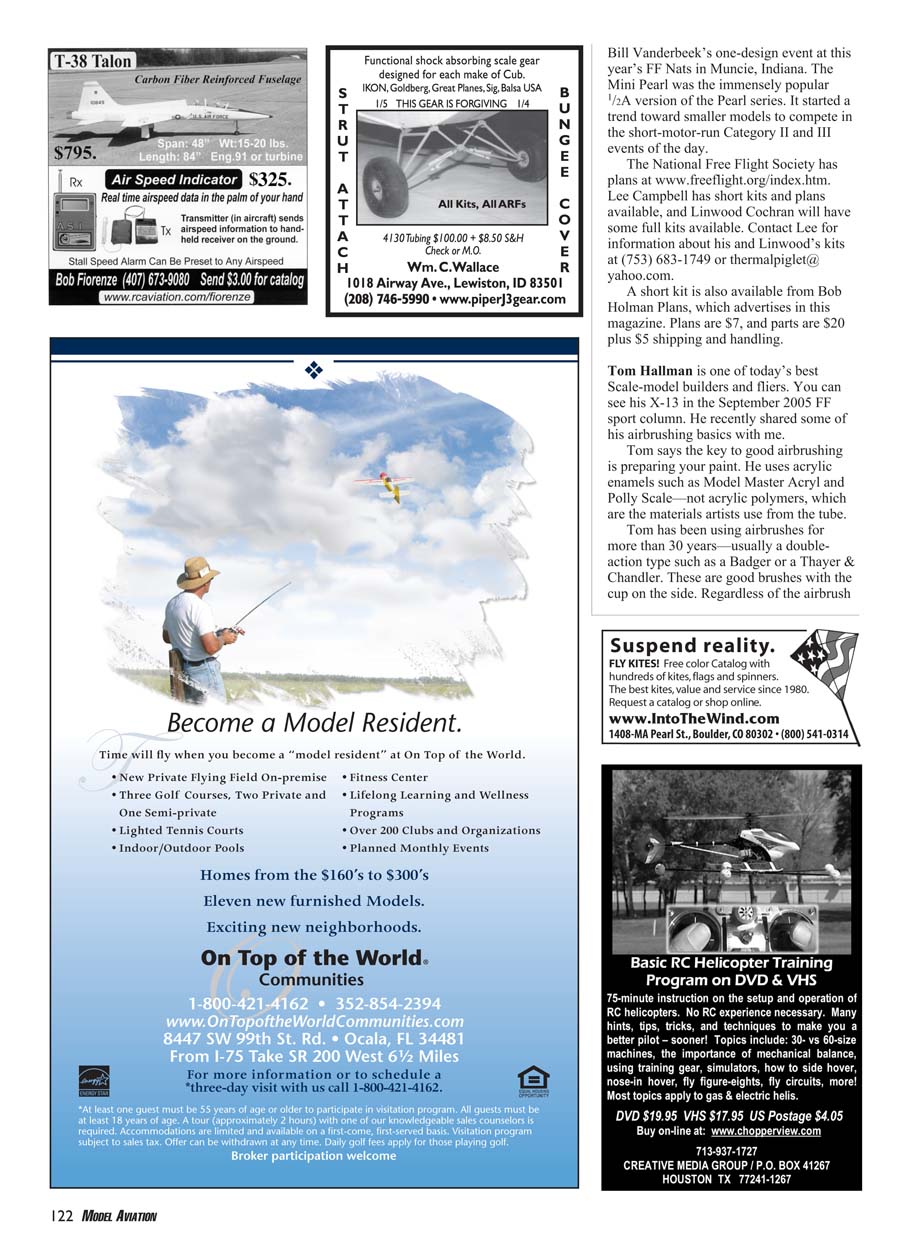
I built a Cessna Airmaster:
- Fuselage: 1/20" square stock
- Ribs: 1/32" balsa
- Covering: white tissue lightly sprayed with a thinned Floquil/nitrate mix
- Propeller: carved balsa, 4" diameter, 4.8" pitch
- Power: loop of .050" x 8" Tan Super Sport rubber
- Flight notes: trimmed outdoors, has flown indoors near 38-foot-high rafters in Oklahoma City. The model tends to run out of wind on landing and needs a longer motor for reliable indoor flights. Initial trimming showed a Dutch roll; adding clear tape to the fin corrected it. Plans called for 3/4" dihedral under each tip, but the model flies well with 3/16" under each tip.
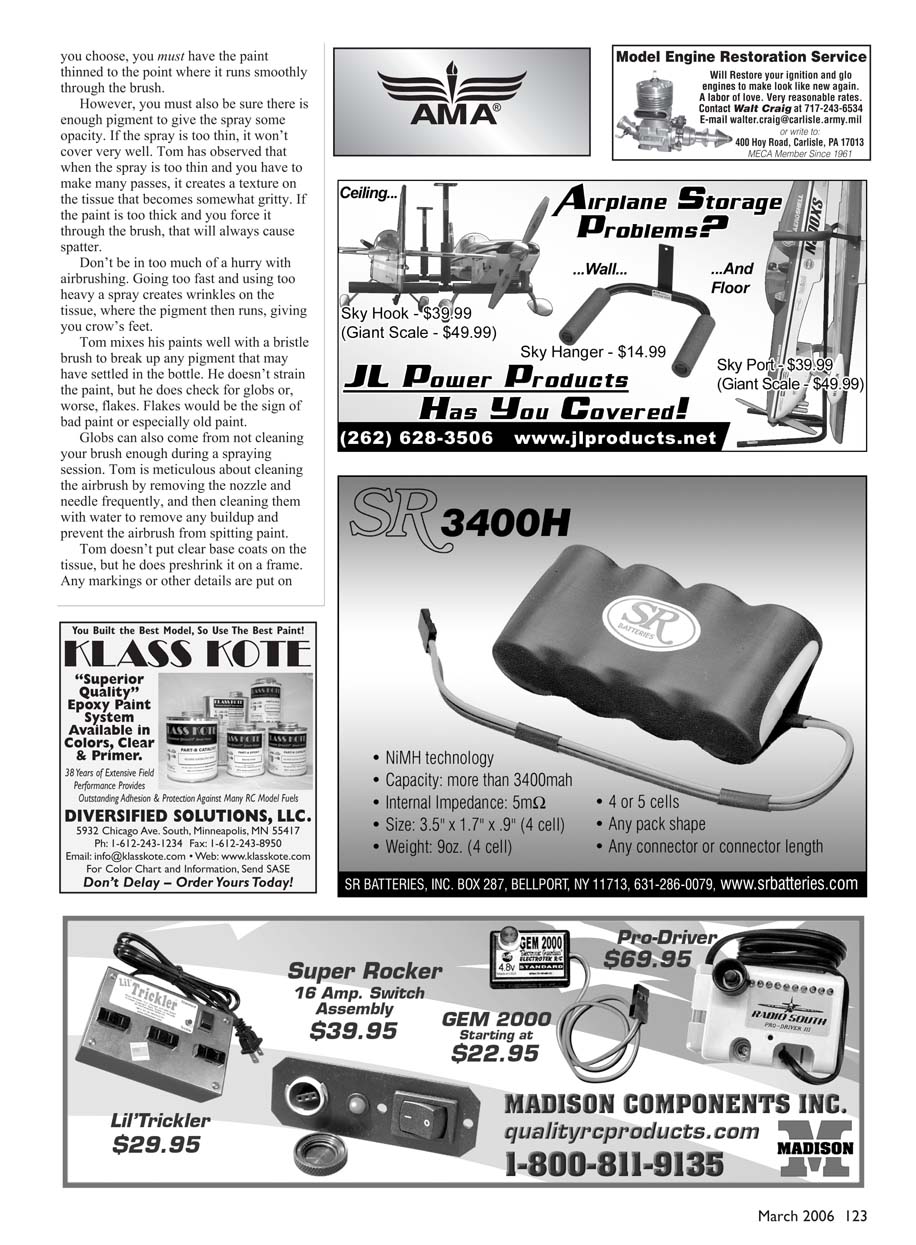
Joshua Finn’s Bellanca:
- Flight times: roughly 30 seconds
- Tip rudders: added (not on plans) to match full-scale Bellanca
- Propeller: Peck 4" cut to 3-1/8"
- Power: loop of 8–10" of .06 rubber
- Weight: just over 4 grams
- Landing gear: use .015" wire; wire should be allowed to move free of the struts (struts are 1/16" square balsa)
- Stability: enlarge rudder ~10% to prevent Dutch roll; plans call for 1/2" dihedral but the model prefers 5/8"–3/4" to be stable
- Flight character: looks good in the air and flies reliably once trimmed
Plans and resources:
- Eleven Nickel Scale plans are available online at www.ualberta.ca/~khorne/.
- If you cannot access the web, send an SASE to the author and he will mail two sets of plans (Fairchild PT-19 and Cessna Airmaster) for free. Note: these plans do not include printwood patterns—you’ll need to create airfoils and fuselage formers yourself.
- As with many early plans, the wing and stabilizer are drawn at zero incidence. Raise the wing leading edge slightly to achieve about 2.5° decalage (approximately 3/32").
Smaller does not equal easier—flight trimming can be more challenging on these Nickel Scale models.
Bill Vanderbeek’s Mini Pearl one-design event
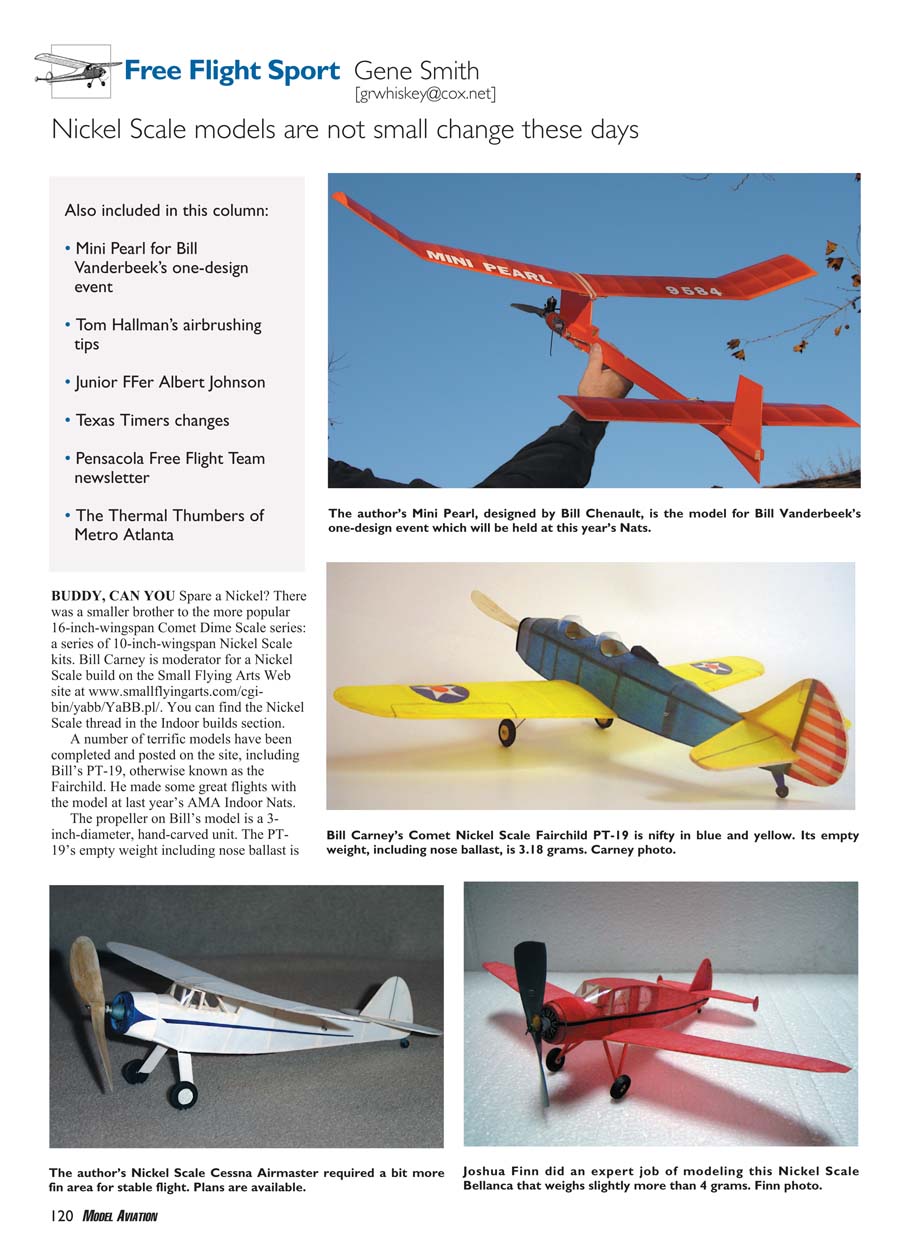
The author’s Mini Pearl, designed by Bill Chenault, is the model for Bill Vanderbeek’s one-design event at this year’s Nats in Muncie, Indiana. The Mini Pearl is the 1/2A version of the Pearl series and started a trend toward smaller models for short-motor-run Category II and III events.
Resources and kits:
- National Free Flight Society plans: www.freeflight.org/index.htm
- Lee Campbell: short kits and plans available; contact (753) 683-1749 or [email protected]
- Linwood Cochran: full kits (contact Lee for information)
- Bob Holman Plans: short kit available (plans $7; parts $20 + $5 shipping & handling)
Tom Hallman’s airbrushing tips
Tom Hallman shared basic airbrushing techniques based on more than 30 years’ experience.
Paint and materials:
- Use acrylic enamels (Model Master Acryl, Polly Scale). Avoid artist acrylic polymers.
- Use a double-action airbrush (Badger or Thayer & Chandler are good choices, with the cup on the side).
Equipment and settings:
- Use a compressor with a water trap and a regulator.
- Typical pressure: 18–20 psi; use lower pressure for fine detail.
Preparation and technique:
- Thin paint according to manufacturer’s directions. Too thin = runs; too thick = clogs.
- Strain paint through nylon stocking or a coffee filter to remove lumps/skin.
- Clean the airbrush frequently with the appropriate thinner.
- Mask with low-tack tape; press down well to prevent seepage. For curves, cut tape into small strips. For very fine lines, use frisket film or liquid mask.
- Practice on scrap balsa to become familiar with brush and paint.
- Apply thin coats and build up color gradually for a smoother finish and fewer runs.
- After covering, Tom sprays two light coats of matte Krylon Clear as a sealer; use gloss sealer only over silver.
Final note: patience and practice are essential—experiment with pressures and thinners to improve results.
Junior FFer: Albert Johnson
Dean McGinnis is proud of his grandson Albert Johnson. Albert, 9 years old, is quick to learn and has shown consistency:
- Built an 80% T-Bird from a Lee Campbell kit, doing all wood-to-wood framing himself (covering was a joint effort).
- Dean installed engine, timers, and DT system.
- Contest record: more than 60 flights under contest conditions with only a couple blown launches.
- Albert placed second in Junior 1/2A Gas.
Texas Timers updates
Hank Nystrom of Texas Timers released an updated Max III timer:
- Improvements: deeper grooves in the scroll and a stronger DT arm wire to prevent the DT arm from jumping out of the scroll during quick DT settings on models with large vibrating engines.
Retrofit option:
- Hank offers retrofit scrolls for older Max III, Max I, Max A, or 3F timers. The retrofit scrolls do not have winding ears and require a special steel screw and winding tool for winding.
Contact Texas Timers:
- Texas Timers, 3317 Pine Timbers Dr., Johnson City TN 37604
- Tel.: (423) 282-6423
- www.texastimers.com
Pensacola Free Flight Team — The Thermalier
The Pensacola Free Flight Team publishes a bimonthly newsletter, the Thermalier, edited by George White. It contains useful tips for sport and scale free flight modelers and lists contests in the Pensacola area.
Subscription:
- Send $10 (check payable to the Pensacola Free Flight Team) to:
George White 5928 Hermitage Dr. Pensacola, FL 32504
The Thermal Thumbers of Metro Atlanta
The Thermal Thumbers are active in several areas of free flight. To connect with them, contact:
- David Mills
- Box 12306
- Atlanta, GA 30355
Transcribed from original scans by AI. Minor OCR errors may remain.

