
Free Flight Sport
Gene Smith [email protected]
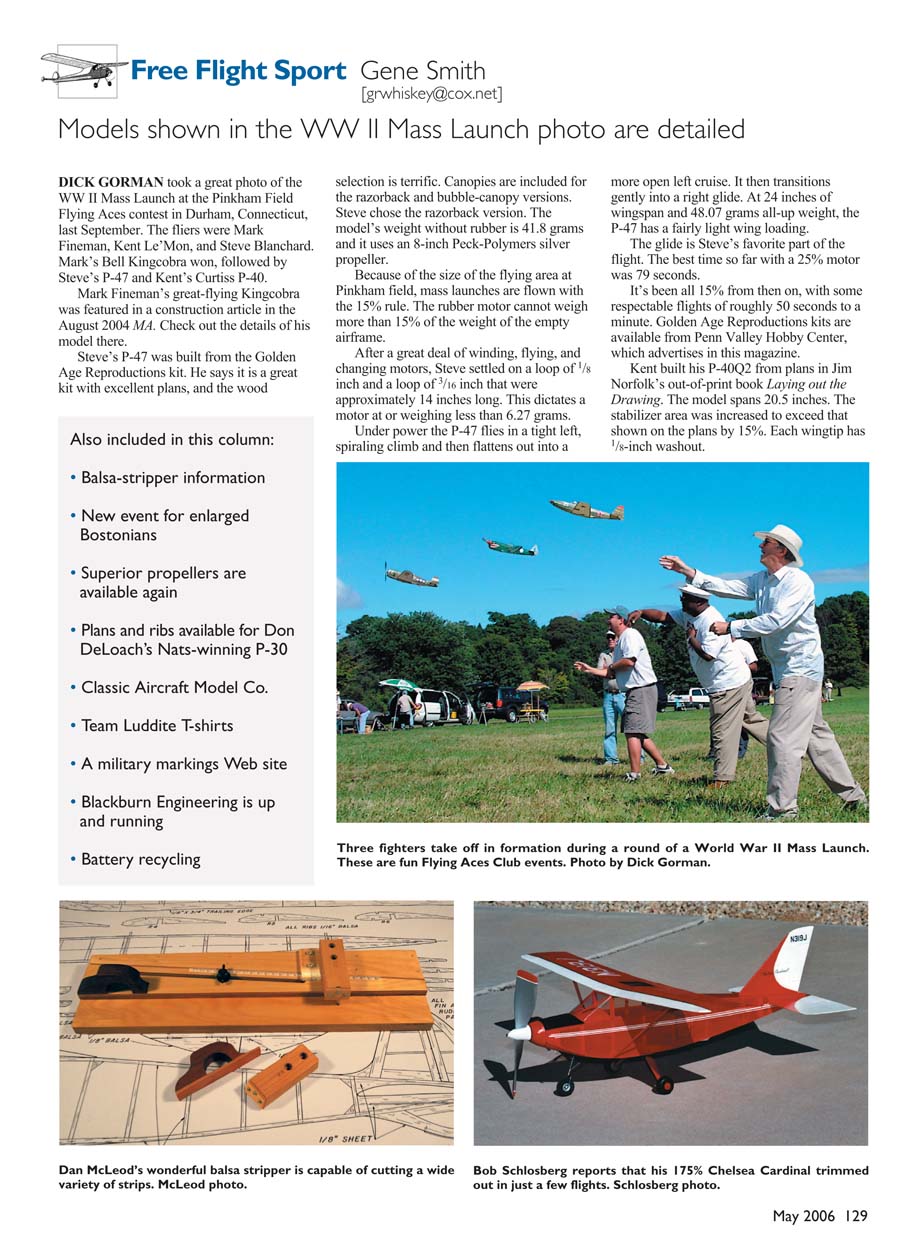
WW II Mass Launch (Pinkham Field)
Dick Gorman took a great photo of the WW II Mass Launch at the Pinkham Field Flying Aces contest in Durham, Connecticut, last September. The fliers were Mark Fineman, Kent Le’Mon, and Steve Blanchard. Mark’s Bell Kingcobra won, followed by Steve’s P-47 and Kent’s Curtiss P-40.
Mark Fineman’s great-flying Kingcobra was featured in a construction article in the August 2004 Model Aviation. Check the details of his model there.
Steve Blanchard’s P-47
Steve’s P-47 was built from the Golden Age Reproductions kit. He says it is a great kit with excellent plans, and the wood selection is terrific. Canopies are included for the razorback and bubble-canopy versions; Steve chose the razorback version. The model’s weight without rubber is 41.8 grams and it uses an 8-inch Peck-type silver propeller.
Because of the size of the flying area at Pinkham Field, mass launches are flown with the 15% rule: the rubber motor cannot weigh more than 15% of the weight of the empty airframe.
After extensive winding, flying, and changing motors, Steve settled on a loop of 1/8-inch and a loop of 3/16-inch rubber, each approximately 14 inches long. This dictates a motor at or weighing less than 6.27 grams.
Under power the P-47 flies in a tight left spiraling climb and then flattens into a more open left cruise before transitioning gently into a right glide. At 24 inches of wingspan and 48.07 grams all-up weight, the P-47 has a fairly light wing loading. The glide is Steve’s favorite part of the flight. The best time so far with a 25% motor was 79 seconds.
Since then it’s been all 15% motors, with some respectable flights of roughly 50 seconds to a minute. Golden Age Reproductions kits are available from Penn Valley Hobby Center, which advertises in this magazine.
Kent Le’Mon’s P-40
Kent built his P-40Q2 from plans in Jim Norfolk’s out-of-print book Laying Out the Drawing. The model spans 20.5 inches. The stabilizer area was increased by 15% over the plans. Each wingtip has 1/8-inch washout. Laminated basswood strips were used to form curved portions of the flying surfaces. The landing-gear fairings were made from blue foam.
The P-40's empty weight is 32.2 grams. Kent uses a 7.5-inch gray propeller shaved to 2.2 grams. Power is provided by a single loop of 3/16-inch Tan II rubber for the 15%-motor-rule events. The model is trimmed to fly left-left using 3° of downthrust and 2° of left thrust. Its best flight to date—78 seconds—used two loops of 3/32 x 24-inch rubber.
Contact paper was used to make the tiger-teeth markings. The finish was sealed with two light coats of Krylon clear.
Kent’s note reminded me that commercial plastic propellers are often on the heavy side, which can lead to a nose-heavy condition in models with long noses. You can lighten a propeller significantly by shaving it with a new single-edge razor blade.
How to shave a propeller:
- Support the propeller blade with folded paper towel so you don't cut yourself.
- Hold the razor blade perpendicular to the front surface of the propeller blade and scrape back and forth.
- You will remove little curls of plastic; have a vacuum handy to clean up.
- Practice will tell you how much plastic to remove—don't overdo it.
- Be sure to balance the blade when finished.
This technique works particularly well on the gray Peck-type propellers.
Strippers Revisited
There are four reasons I like to strip my own balsa spars and longerons:
- I can pick the correct-density wood for its intended use. Wing spars near the center need to be stronger and heavier than those near the wingtip. Longerons for the fuselage of a power model need to be firmer than those of a rubber-powered model.
- I can make odd sizes. I may need a 1/4 x 5/16-inch spar that is not normally stocked.
- Even common sizes can be in short supply at your vendor.
- It’s less expensive. If you do much building, the stripper can easily pay for itself.
There are three primary ways to strip wood thicker than 1/16 inch:
- Use a small table saw (generates lots of balsa dust and you lose material in the kerf).
- Use a Master Airscrew stripper (works, but the blade will tend to wander with the grain and it’s easy to tilt and get an angled cut).
- Use a straightedge and a blade (requires patience, skill, and luck).
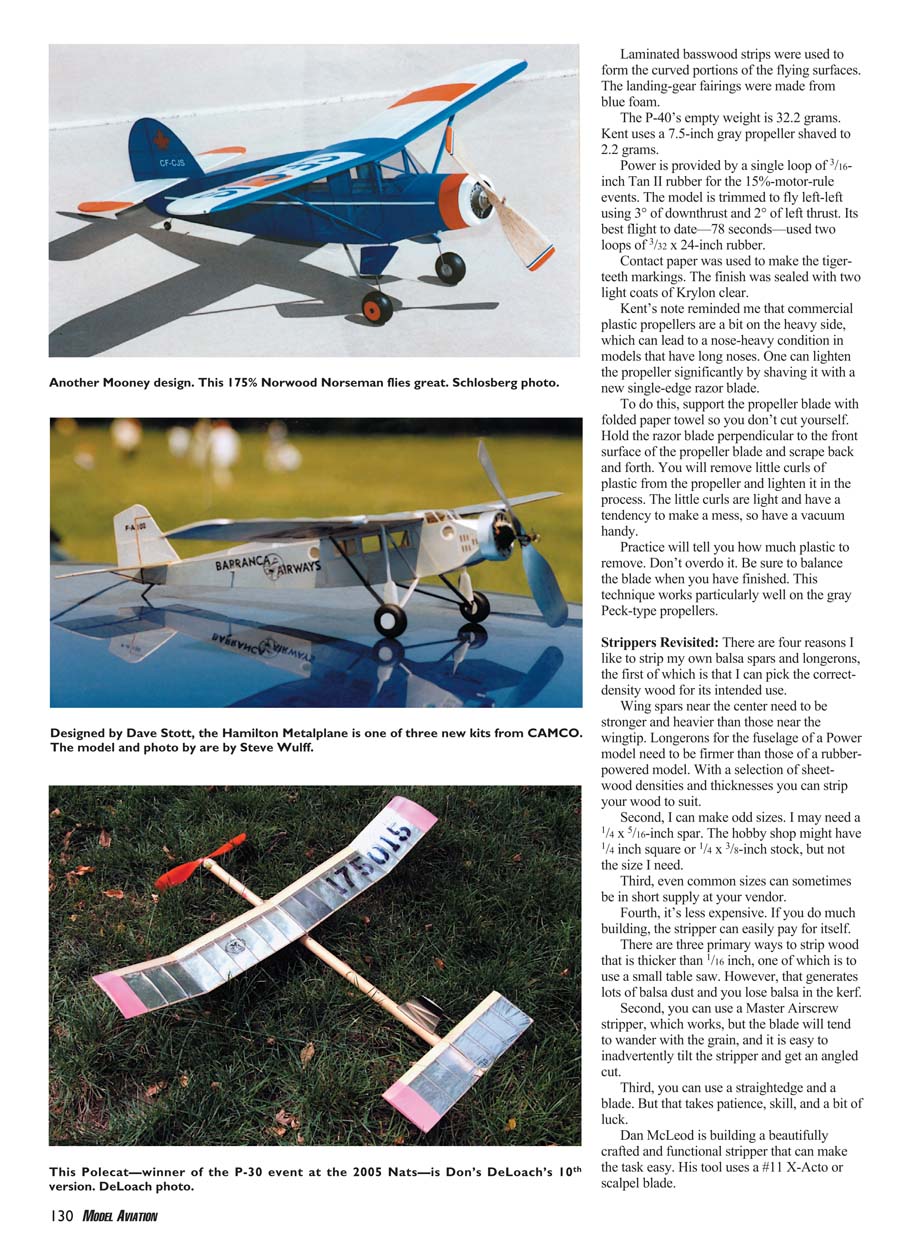
Dan McLeod is building a beautifully crafted and functional stripper that makes the task easy. His tool uses a #11 X-Acto or scalpel blade. The unique feature is that the tip of the blade seats into a brass tube in the base of the stripper, preventing deflection from divergent grain or varying densities and ensuring a square cut. Instead of drawing the blade through the wood, the wood is pushed into the blade.
This stripper’s maximum capacity is 1/2 inch thick and just over 7/8 inch wide. I have easily stripped soft 1/4-inch balsa with mine. Because the stripper’s fence can contact the blade, you can cut strips as thin as you want. A useful feature of Dan’s balsa stripper is its ability to cut the edge of a sheet at a 16° angle for planking, infilling, and sheeting models.
Approximate dimensions: 5 inches wide by 19 inches long.
The McLeod Balsa Stripper is available for $55, postage included in the continental U.S. Outside the U.S. strippers are shipped at actual mailing costs. Shipping weight just exceeds 4 pounds. Contact Dan McLeod at:
- Mail: Box 897, Littlerock, CA 93543
- E-mail: [email protected]
See the May 2005 “Free Flight Sport” column for stripping tips.
Walt Mooney 2x Events (Phoenix Cactus Squadron)
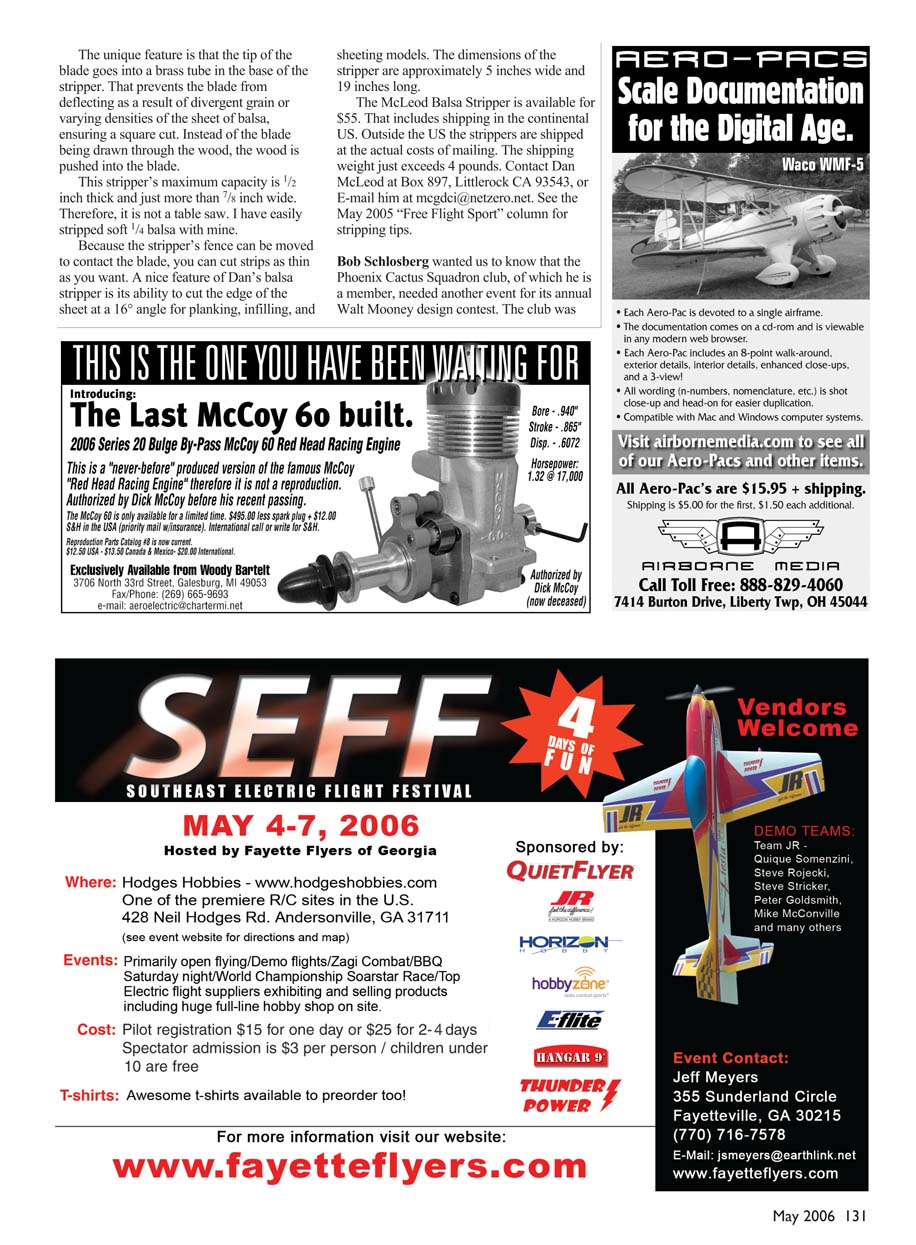
Bob Schlosberg reports that the Phoenix Cactus Squadron added a 2x Bostonian event to its Walt Mooney design contest lineup, which already included Peanut, 2x Peanut, and Bostonian events.
Event rules allow spans of 1.5–2.0 times the original 16 inches; most entrants have selected a span of 28 inches.
Plans:
- Revere Speedster and Back Bay Bellanca — Mooney Plans Bag #4
- Bostonian — Mooney Plans Bag #5
Both plan bags are sold by Peck-Polymers: (619) 448-1818 or www.peck-polymers.com.
Walt Mooney flew at the Cactus Squadron contests and provided additional plans, including the Old Howard, Norwood Norseman, Boston Tea Party, and Medford Milton Mark 2.01. He passed away before some of those designs were published.
Because the 2x models are easy to trim and fly and easier to find in the grass, they have proven popular. According to Bob, his 2x (actually 175%) Bostonians use 10-inch Superior propellers with a 13-inch pitch and fly with four loops of 3/16 rubber (approximately 37 inches long after braiding).
Superior Propellers
Last year’s hurricane damaged B. Gourdon’s shop, but he is making Superior balsa propellers again. Get a catalog by sending a long SASE to:
B. Gourdon 516 Driftwood Ln. Slidell, LA 70458
Or call (504) 726-9673.
Don DeLoach — Polecat P-30 Plans and Ribs
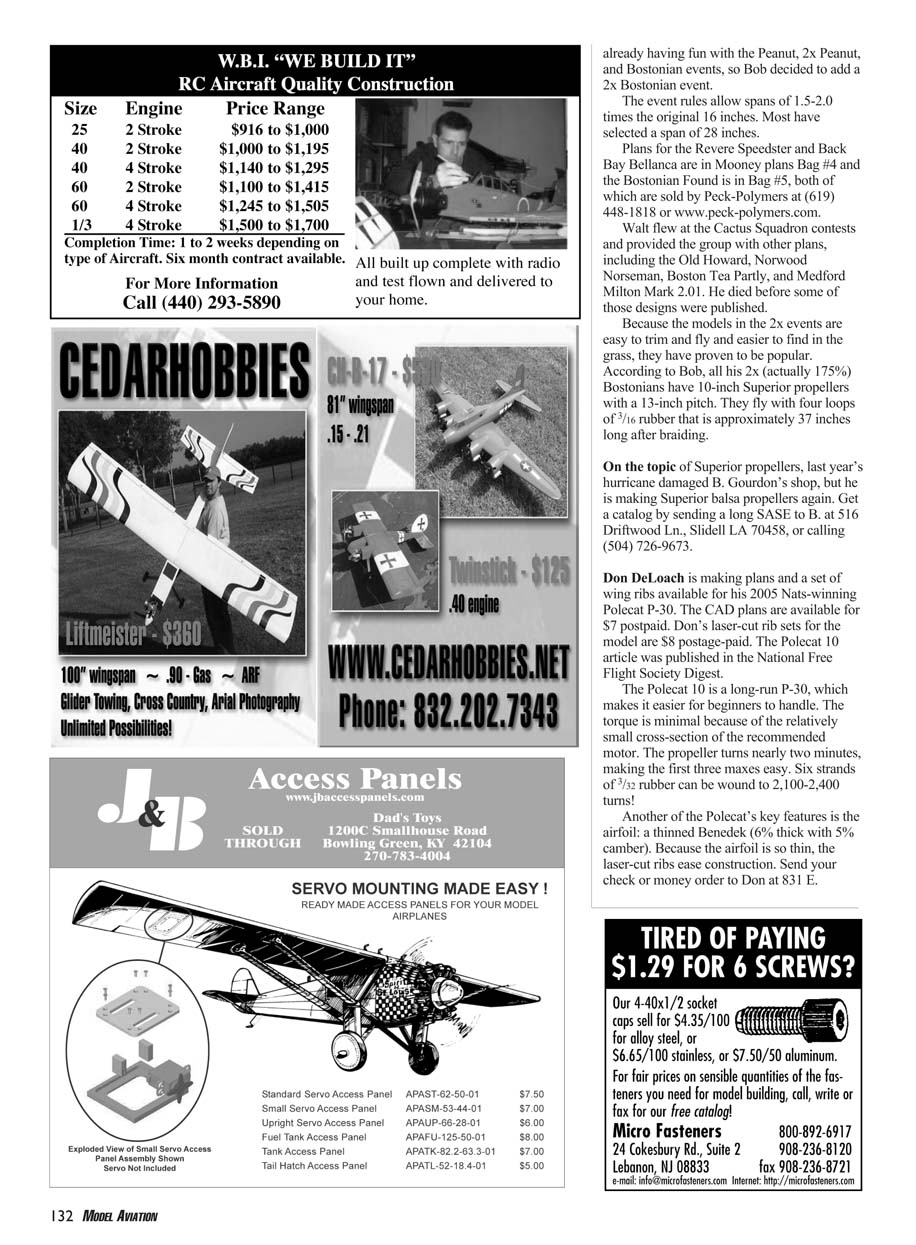
Don DeLoach is making plans and a set of wing ribs available for his 2005 Nats-winning Polecat P-30. The CAD plans are available for $7 postpaid. Don’s laser-cut rib sets are $8 postage-paid. The Polecat 10 article was published in the National Free Flight Society Digest.
The Polecat 10 is a long-run P-30, which makes it easier for beginners to handle. Torque is minimal because of the relatively small recommended motor cross-section. The propeller turns nearly two minutes, making the first three maxes easy. Six strands of 3/32 rubber can be wound to 2,100–2,400 turns.
Another key feature is the airfoil: a thinned Benedek (6% thick with 5% camber). Because the airfoil is so thin, the laser-cut ribs ease construction.
Send checks or money orders to: Don DeLoach 831 E. Willamette Ave. Colorado Springs, CO 80903
Classic Aircraft Model Co. (CAMCO) Kits
Flying Aces Club leader Lin Reichel has started Classic Aircraft Model Co. (CAMCO) and released three kits, two of which are Dave Stott designs:
- 16-inch-span Dime Scale Rearwin Cloudster
- 20-inch-span Hamilton Metalplane (suitable for Golden Age Scale event)
- Jimmie Allen Special (eligible for Jimmie Allen events)
Order from Lin at: 3301 Cindy Ln., Erie, PA 16506
Prices: first two kits $14.56 each, Jimmie Allen kit $15. Shipping $4 for the first kit and $1 for each additional kit. Kits are also available from EZ Built Models at www.easybuiltmodels.com.
Team Luddite T-shirts
A luddite originally described workmen who destroyed labor-saving machinery in early industrial England; now it generally refers to someone “against technology.” With tongue in cheek, Joe Mekina made “Team Luddite” T-shirts for FF modelers resisting the trend toward carbon fiber and other space-age materials. You can check prices and availability at www.teamluddite.com.
Military Markings Resource
There is a great website for builders of World War II vintage military aircraft, loaded with insignia and markings: www.simmerspaintshop.com/colours/markings.html
Don Blackburn — Engine Shop
Don Blackburn has his engine shop working again after a recent move. His specialty is Society of Antique Modelers and nostalgia engine rework.
Contact: Don Blackburn Box 954, Perkins, OK 74059 E-mail: [email protected] Telephone: pending
Battery Recycling
If you would like to recycle used Ni-Cd and Li-Poly batteries but don't know where to take them, check: www.rbrc.org/index.html?sp=true to find the nearest recycling spot anywhere in the U.S.
Transcribed from original scans by AI. Minor OCR errors may remain.

