
Free Flight Sport
Gene Smith [[email protected]]
Build your Bounty Hunter for the one-design Nats event
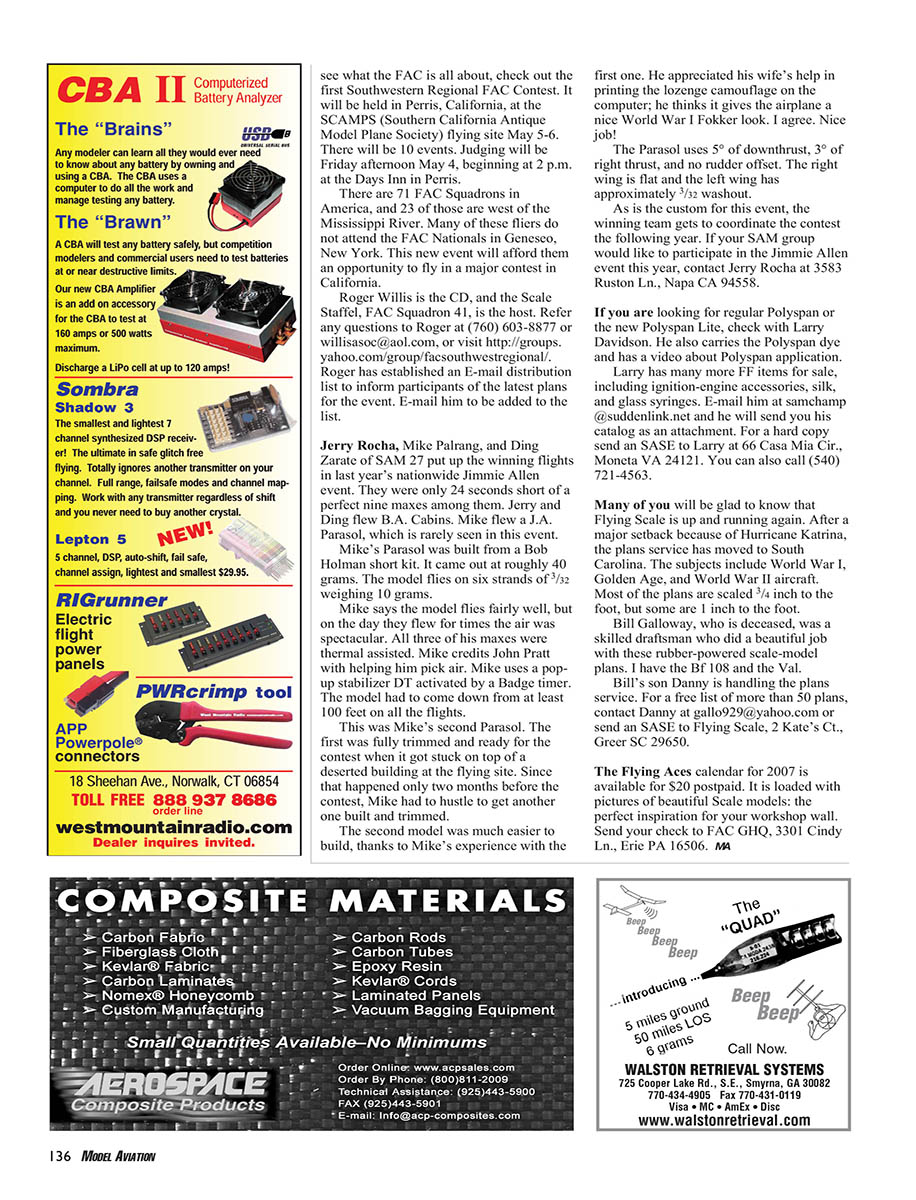
DON'T FORGET to build your Bounty Hunter 245 for the one-design event at this year's Nats. You can use any Nostalgia-eligible 1/2A engine or the Tee Dee .049 or .051. Build your model from scratch using MA plans or use the BMJR Model Products kit. Ballast to the CG shown on the plans. Set it up with no downthrust or side thrust and approximately 1/8-inch wash-in on the left wing. All other surfaces should be flat.
The stabilizer should be tilted for left turn in the glide, with the left side high as seen from the rear. Start with 2.5° decalage. Install a 2-56 screw under the stabilizer trailing edge for fine-tuning the incidence. Sometimes a half turn of the screw makes all the difference.
If the model is climbing too hard to the left or is loopy, lower the rear of the stabilizer. If the model starts up properly but noses down, raise the rear of the stabilizer.
Use small tabs on the fin to control the direction and amount of turn late in the power pattern. When you are happy with the power pattern and the size of the glide circle, add small amounts of weight to the tail until you get a stall. Then remove some weight to reestablish the proper glide.
Fuel-tank pressurization and bladders
The more air your engine can ingest, the more power it can develop. However, as the venturi is enlarged the engine's ability to draw fuel diminishes. The cure for this problem is to pressurize the fuel tank. The two methods commonly used are crankcase pressure or the use of a pressurized bladder.
Years ago I decided to use surgical-tubing bladders. The tubing is latex with a 1/8-inch inside diameter and a 1/32-inch wall thickness. An adapter is needed at one end and a method of closure is needed at the other.
- The adapter I use has a 3/32-inch connector on one end and 1/8 inch on the other.
- The open end of the tube can be closed by folding it on itself. I prefer to use a .177-caliber air-gun pellet. It has a "waist" that makes a good place to wire the end shut. I use 24-gauge copper wire.
Before inflating the tank, stretch it several times. This makes it easier to fill and establishes the area of the tank you want to fill first. I like the tank to fill from the middle—not the ends.
Once the tank has been assembled, inflate it with air and clamp the tubing. Leave the air in the tank for several hours or overnight. This checks for leaks and allows the tank to "break in." Breaking in allows the tank to be inflated with less pressure, making it easier to fill and the engine easier to needle.
Find the proper needle setting before beginning flying for the day. When checking the engine run before the first flight, use the timer to cut off the engine. This confirms that the timer and fuel cutoff are working.
I like to determine the minimum amount of fuel needed for a contest flight. Put only enough fuel in the bladder to start the engine, get the model in launch position, and run for your engine-run allowance and maybe five more seconds. Many of us have seen models with an engine-timer malfunction climb out of sight because they had too much fuel onboard.
Latex is damaged by our fuel. When you are finished with the flying session, inflate the bladder with air and then draw the air and any remaining fuel out. That will make the bladder last longer. If you let any fuel stay in it, the bladder will deteriorate more quickly.
Use a fresh bladder at contests. The latex tubing and nipple fittings are available from Lee Campbell at www.campbellscustomkits.com.
Pen bladders (alternative)
Dean McGinnes has been trying genuine pen bladders in place of the latex tubing. He says they are unaffected by high-nitromethane fuels and require less pressure to inflate than the latex tubing tanks or pacifiers. Dean has learned that one tank can last a whole contest season. He uses #12 for 1/2As and #14 for everything else.
I purchased several of the bladders and found that each is long enough to make two tanks. I am going to try them in the coming season. They are available from Pendemonium, a supply house for fountain pen collectors and restorers, at www.pendemonium.com.
FAC and SAM highlights
Truly in the spirit of the Flying Aces Club (FAC) is the Embryo Spirit of Sicily designed and built by Grant Carson. He mounted the upper and lower wings on pylons so the wing area would not be reduced by the "wing across the fuselage" rule.
When Sal Taibi saw the Spirit of Sicily, he said, "Hey, that's where my folks were from!"
Grant wrote that the model spent a lot of time in the gentle thermals of Mile Square Park.
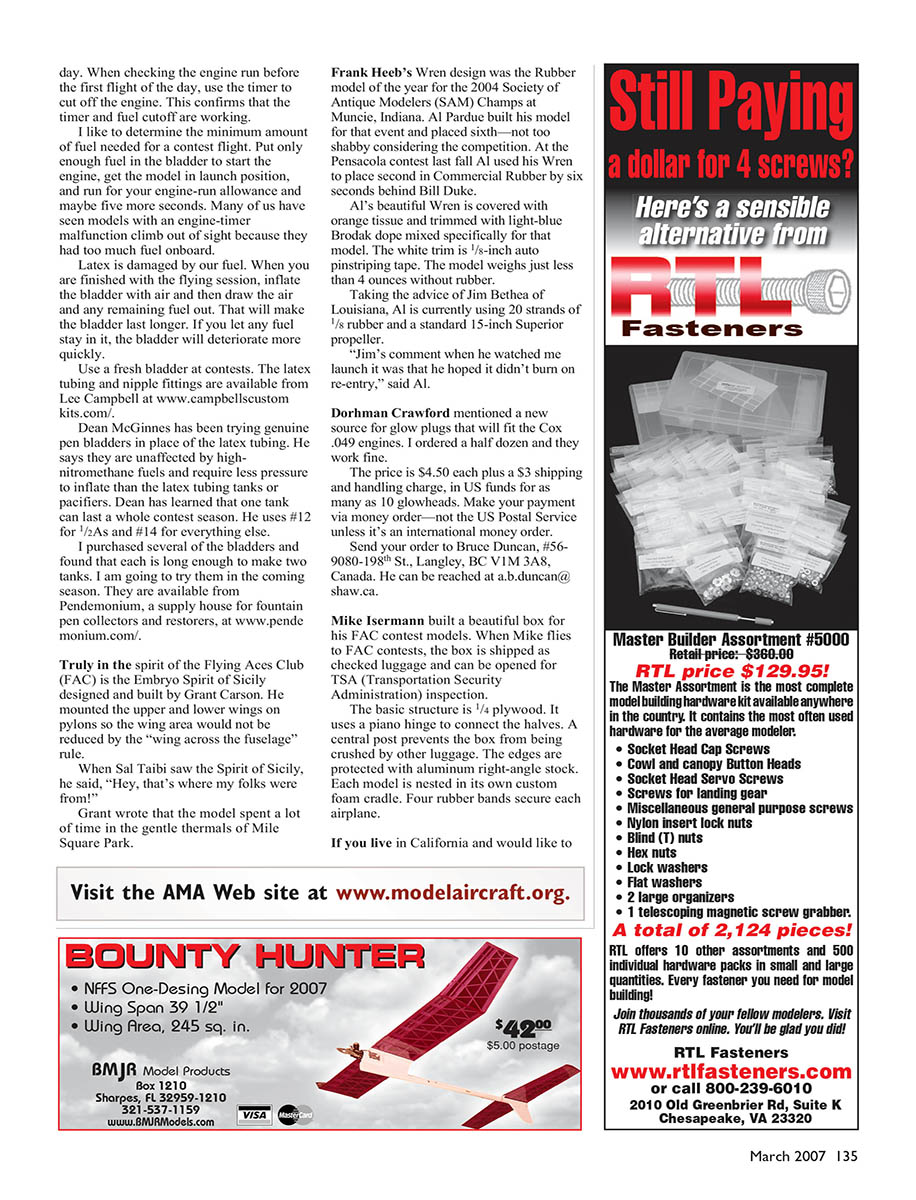
Frank Heeb's Wren design was the Rubber model of the year for the 2004 Society of Antique Modelers (SAM) Champs at Muncie, Indiana. Al Pardue built his model for that event and placed sixth—not too shabby considering the competition. At the Pensacola contest last fall, Al used his Wren to place second in Commercial Rubber by six seconds behind Bill Duke.
Al's beautiful Wren is covered with orange tissue and trimmed with light-blue Brodak dope mixed specifically for that model. The white trim is 1/8-inch auto pinstriping tape. The model weighs just less than 4 ounces without rubber.
Taking the advice of Jim Bethea of Louisiana, Al is currently using 20 strands of 1/8" rubber and a standard 15-inch Superior propeller.
"Jim's comment when he watched me launch it was that he hoped it didn't burn on re-entry," said Al.
Glow plugs source
Dorhman Crawford mentioned a new source for glow plugs that will fit the Cox .049 engines. I ordered a half dozen and they work fine.
- Price: $4.50 each plus a $3 shipping and handling charge, in US funds for as many as 10 glowheads.
- Payment: money order (not the US Postal Service money order unless it is an international money order).
- Mail orders to: Bruce Duncan, #56-9080-198th St., Langley, BC V1M 3A8, Canada.
- Contact: [email protected].
Mike Isermann's FAC box
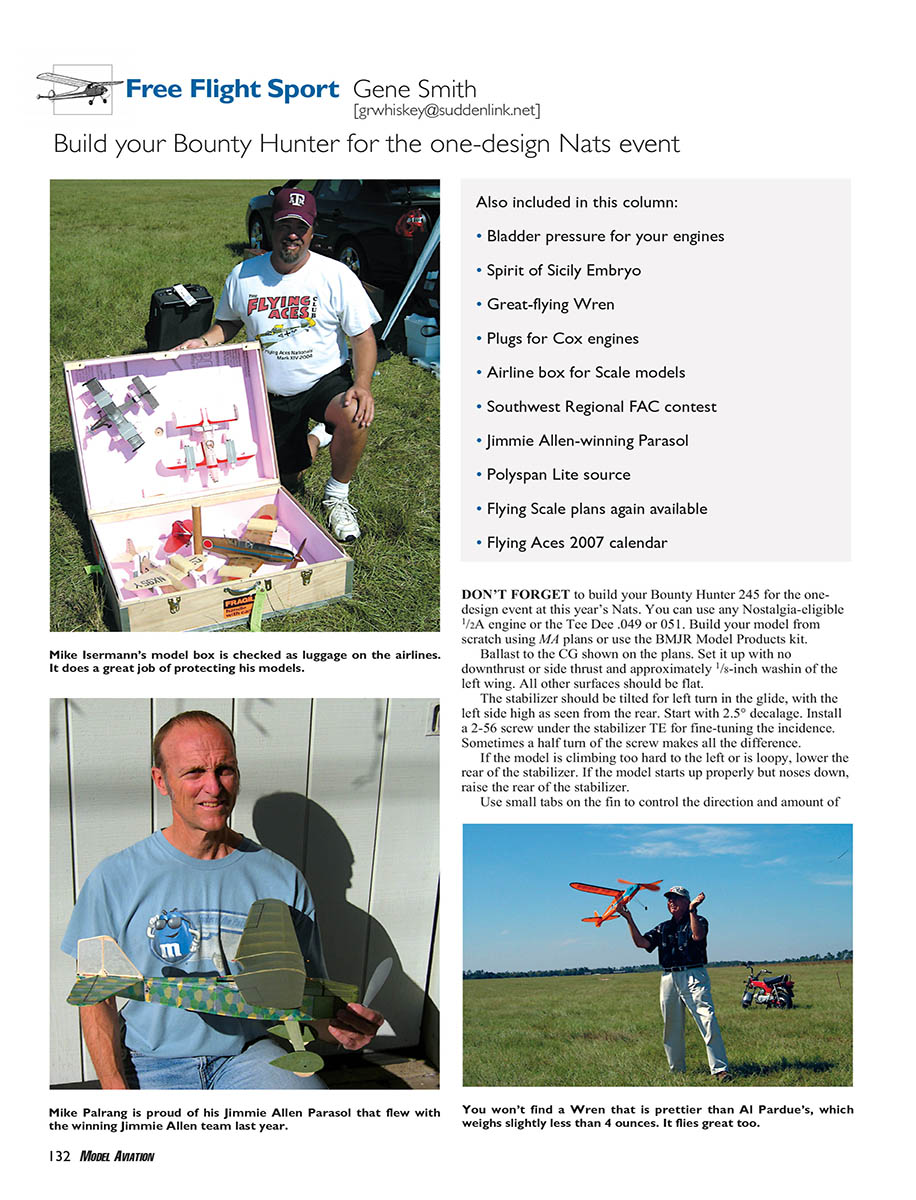
Mike Isermann built a beautiful box for his FAC contest models. When Mike flies to FAC contests, the box is shipped as checked luggage and can be opened for TSA inspection.
- Basic structure: 1/4-inch plywood.
- Uses a piano hinge to connect the halves.
- A central post prevents the box from being crushed by other luggage.
- Edges protected with aluminum right-angle stock.
- Each model is nested in its own custom foam cradle.
- Four rubber bands secure each airplane.
Events and contests
If you live in California and would like to see what the FAC is all about, check out the first Southwestern Regional FAC Contest. It will be held in Perris, California, at the SCAMPS (Southern California Antique Model Plane Society) flying site, May 5–6. There will be 10 events. Judging will be Friday afternoon, May 4, beginning at 2 p.m. at the Days Inn in Perris.
There are 71 FAC Squadrons in America, and 23 of those are west of the Mississippi River. Many of these fliers do not attend the FAC Nationals in Geneseo, New York. This new event will afford them an opportunity to fly in a major contest in California.
- Contest director: Roger Willis
- Host: Scale Staffel, FAC Squadron 41
- Questions/contact: Roger at (760) 603-8877 or [email protected]
- Event group: http://groups.yahoo.com/group/southwestregional/
Roger has established an e-mail distribution list to inform participants of the latest plans for the event. E-mail him to be added to the list.
Jimmie Allen event (SAM)
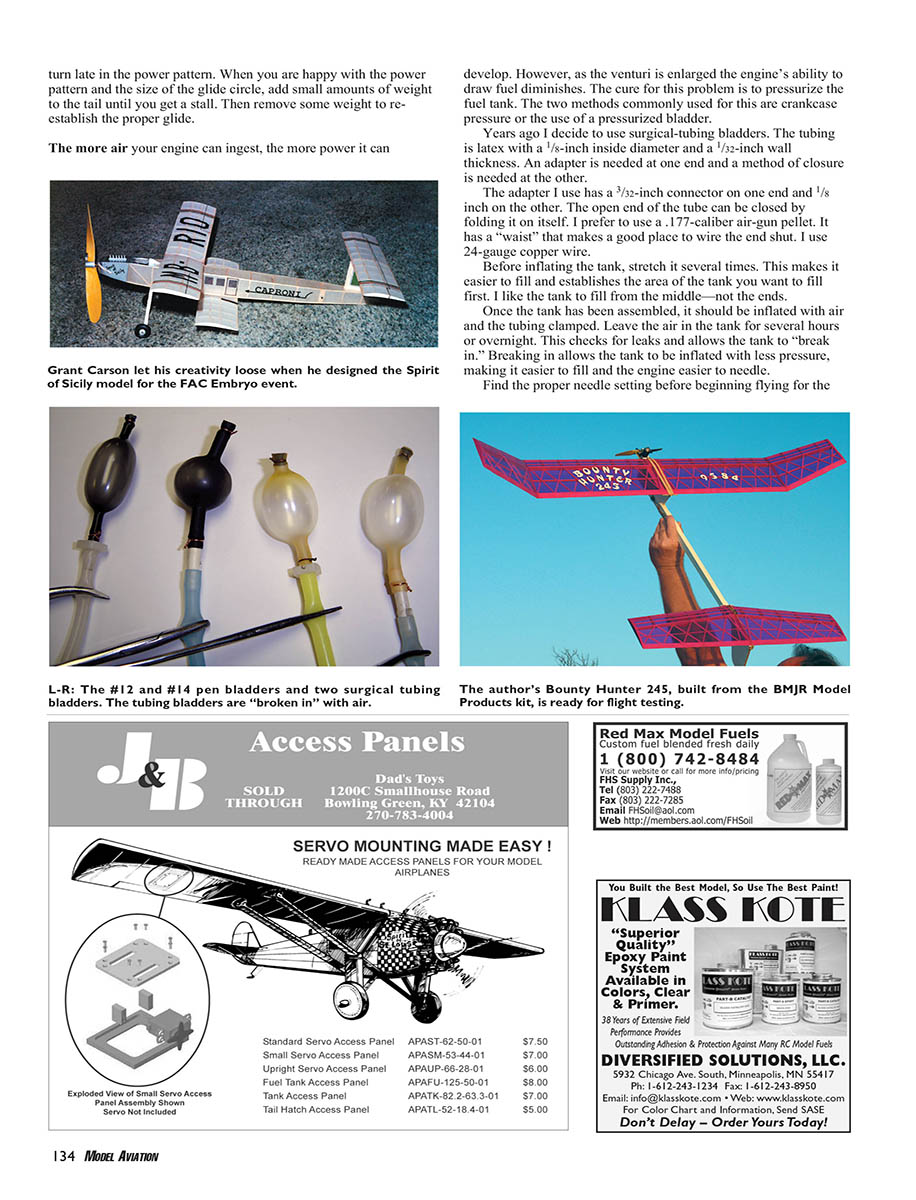
Jerry Rocha, Mike Palrang, and Ding Zarate of SAM 27 put up the winning flights in last year’s nationwide Jimmie Allen event. They were only 24 seconds short of a perfect nine max among them. Jerry and Ding flew B.A. Cabins. Mike flew a J.A. Parasol, which is rarely seen in this event.
Mike’s Parasol was built from a Bob Holman short kit. It came out at roughly 40 grams. The model flies on six strands of 3/32" rubber and 10 grams.
Mike says the model flies fairly well, but on the day they flew for times the air was spectacular. All three of his maxes were thermally assisted. Mike credits John Pratt with helping him pick air. Mike uses a pop-up stabilizer DT activated by a Badge timer. The model had to come down from at least 100 feet on all the flights.
This was Mike’s second Parasol. The first was fully trimmed and ready for the contest when it got stuck on top of a deserted building at the flying site. Since that happened only two months before the contest, Mike had to hustle to get another one built and trimmed.
The second model was much easier to build, thanks to Mike’s experience with the first one. He appreciated his wife’s help in printing the lozenge camouflage on the computer; he thinks it gives the airplane a nice World War I Fokker look.
The Parasol uses 5° of downthrust, 3° of right thrust, and no rudder offset. The right wing is flat and the left wing has approximately 3/32" washout.
As is custom for this event, the winning team gets to coordinate the contest the following year. If your SAM group would like to participate in the Jimmie Allen event this year, contact Jerry Rocha at 3583 Ruston Ln., Napa, CA 94558.
Suppliers and resources
If you are looking for regular Polyspan or the new Polyspan Lite, check with Larry Davidson. He also carries the Polyspan DVD and has a video about Polyspan application.
Larry has many more FF items for sale, including ignition-engine accessories, silk, and glass syringes.
- E-mail: [email protected] (request his catalog as an attachment).
- For a hard copy: send an SASE to Larry at 66 Casa Mia Cir., Moneta, VA 24121.
- Phone: (540) 721-4563.
Many of you will be glad to know that Flying Scale is up and running again. After a major setback because of Hurricane Katrina, the plans service has moved to South Carolina. The subjects include World War I, Golden Age, and World War II aircraft. Some of the plans are scaled 3/4 inch to the foot; others are 1 inch to the foot.
Bill Galloway, who is deceased, was a skilled draftsman who did a beautiful job with these rubber-powered scale model plans. I have the Bf 109 and the Val.
Bill’s son Danny is handling the plans service. For a free list of more than 50 plans, contact Danny at [email protected] or send an SASE to Flying Scale, 2 Kate’s Ct., Greer, SC 29650.
Flying Aces calendar
The Flying Aces calendar for 2007 is available for $20 postpaid. It is loaded with pictures of beautiful SCALE models and lots of good reading for the workshop wall. Send your check to:
FAC GHQ 3301 Cindy Ln. Erie, PA 16506
MA
Transcribed from original scans by AI. Minor OCR errors may remain.

