
Free Flight Sport
Gene Smith [[email protected]]
Convert that RC model to FF (on purpose)
Numerous RC models can easily be converted to free flight (FF), and many of them can be found in the MA archives. The simplest are those designed for rudder-and-elevator control only — they will have enough dihedral to be stable flying free.
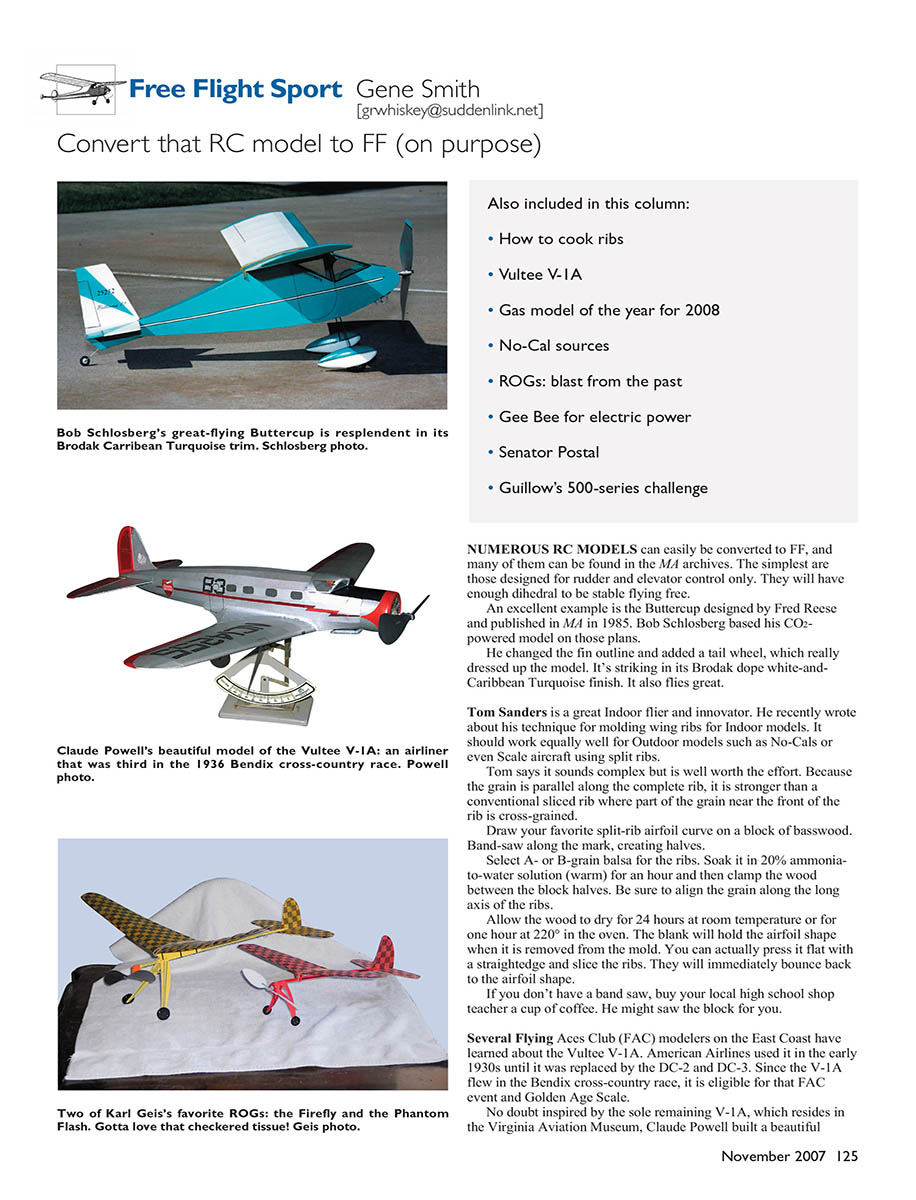
An excellent example is the Buttercup designed by Fred Reese and published in MA in 1985. Bob Schlosberg based his CO2-powered model on those plans. He changed the fin outline and added a tail wheel, which really dressed up the model. It's striking in its Brodak dope white-and-Caribbean turquoise finish and it flies great.
Molding wing ribs (Indoor and Outdoor)
Tom Sanders, a noted indoor flier and innovator, recently described his technique for molding wing ribs for indoor models. It should work equally well for outdoor models such as No-Cals or even scale aircraft using split ribs.
Tom says it sounds complex but is well worth the effort. Because the grain is parallel along the complete rib, it is stronger than a conventional sliced rib where part of the grain near the front of the rib is cross-grained.
Steps:
- Draw your favorite split-rib airfoil curve on a block of basswood. Bandsaw along the mark, creating halves.
- Select A- or B-grain balsa for the ribs. Soak it in a 20% ammonia-to-water solution (warm) for an hour and then clamp the wood between the block halves. Be sure to align the grain along the long axis of the ribs.
- Allow the wood to dry for 24 hours at room temperature or for one hour at 220°F in the oven. The blank will hold the airfoil shape when removed from the mold. You can press it flat with a straightedge and slice the ribs; they will immediately bounce back to the airfoil shape.
- If you don't have a bandsaw, ask your local high school shop teacher — they might saw the block for you.
Vultee V-1A (Golden Age Scale / FAC)
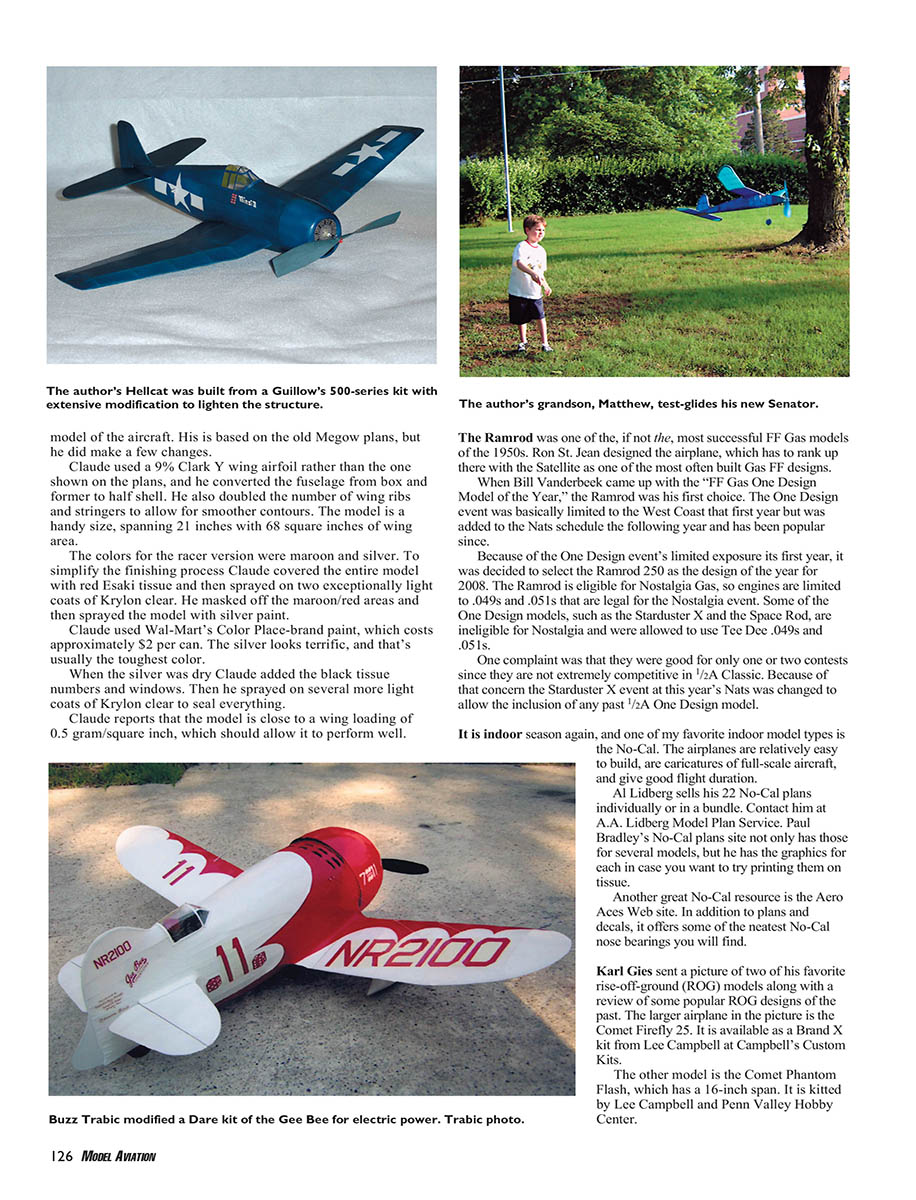
Several Flying Aces Club (FAC) modelers on the East Coast have taken an interest in the Vultee V-1A. American Airlines used it in the early 1930s until it was replaced by the DC-2 and DC-3. Since the V-1A flew in the Bendix cross-country race, it is eligible for that FAC event and for Golden Age Scale.
No doubt inspired by the sole remaining V-1A at the Virginia Aviation Museum, Claude Powell built a beautiful model based on the old Megow plans, with a few changes. Claude used a 9% Clark Y wing airfoil rather than the one shown on the plans, converted the fuselage from box-and-former to half shell, and doubled the number of wing ribs and stringers for smoother contours. The model spans 21 inches with 68 square inches of wing area.
For the racer version Claude used maroon and silver. To simplify finishing he covered the entire model with red Esaki tissue, sprayed two very light coats of Krylon clear, masked off the maroon/red areas, and sprayed silver (using Wal‑Mart’s ColorPlace brand paint, about $2 per can). After the silver dried he added black tissue numbers and windows, then sprayed several more light coats of Krylon clear to seal everything. Claude reports a wing loading close to 0.5 gram/square inch, which should allow good performance.
Ramrod and One Design
The Ramrod was one of the most successful FF gas models of the 1950s. Ron St. Jean designed the airplane, which ranks alongside the Satellite as one of the most often-built gas FF designs.
When Bill Vanderbeek created the "FF Gas One Design Model of the Year," the Ramrod was his first choice. The One Design event was basically West Coast-limited in its first year but was added to the Nats schedule the following year and has been popular since. Because the event's exposure was limited its first year, it was decided to select the Ramrod 250 as the design of the year for 2008.
The Ramrod is eligible for Nostalgia Gas, so engines are limited to .049s and .051s that are legal for the Nostalgia event. Some One Design models, such as the Starduster X and the Space Rod, are ineligible for Nostalgia and were allowed to use Tee Dee .049s and .051s. One complaint about some One Design models was that they were only competitive for a contest or two in 1/2A Classic. Because of that concern, the Starduster X event at this year's Nats was changed to allow the inclusion of any past 1/2A One Design model.
No-Cal models and resources (indoor season)
It is indoor season again, and one of my favorite indoor model types is the No-Cal. These airplanes are relatively easy to build, are caricatures of full-scale aircraft, and give good flight duration.
Resources:
- A.A. Liberg Model Plan Service — Al Liberg sells his No-Cal plans individually or in a bundle.
- Paul Bradley’s No-Cal plans site — plans for several models and graphics for printing on tissue.
- Aero Aces — plans, decals, and a selection of neat No-Cal nose bearings.
ROG models and Karl Geis
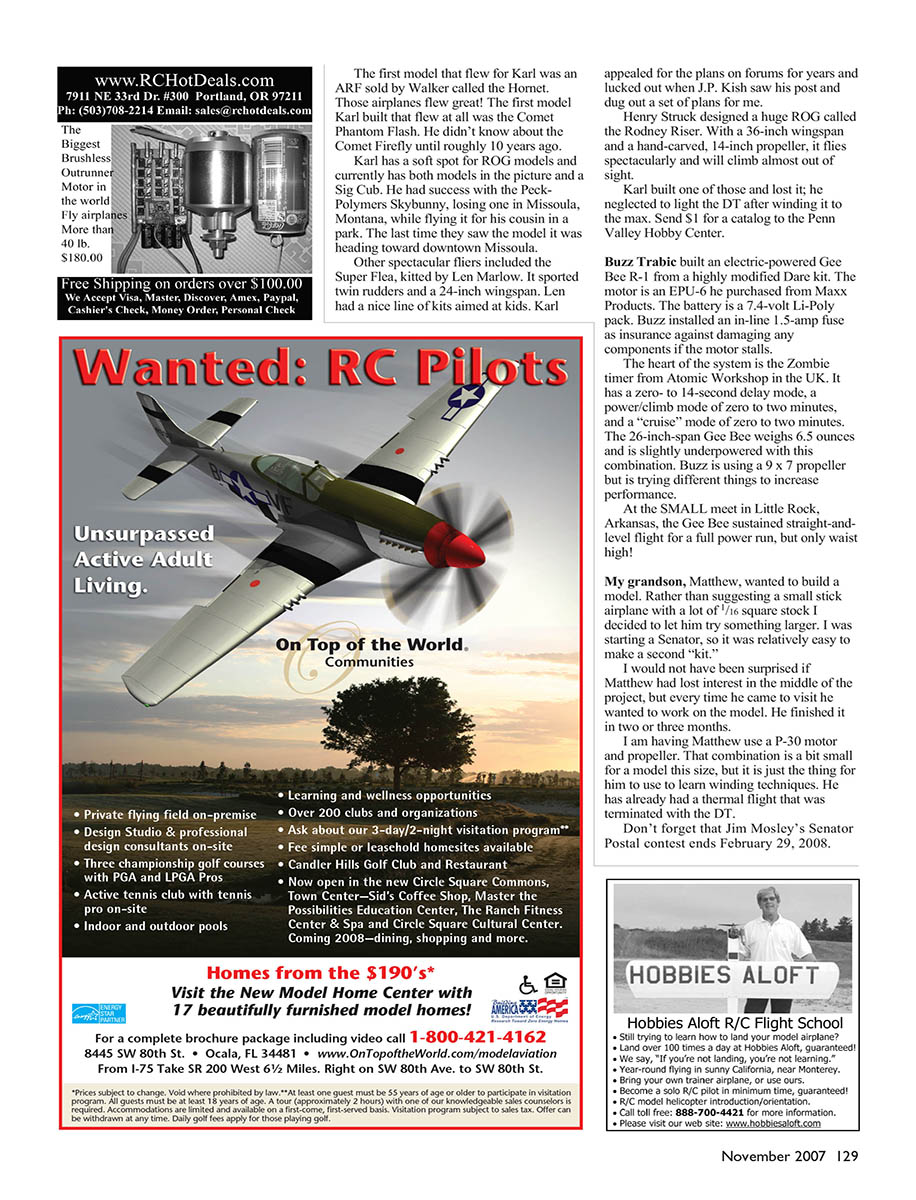
Karl Geis sent a picture of two of his favorite rise-off-ground (ROG) models and reviewed some popular ROG designs from the past. The larger airplane pictured is the Comet Firefly 25, available as a Brand X kit from Lee Campbell at Campbell's Custom Kits. The other model is the Comet Phantom Flash, with a 16-inch span, kitted by Lee Campbell and Penn Valley Hobby Center.
Karl’s first flown model was an ARF sold by Walker called the Hornet. The first model he built that actually flew was the Comet Phantom Flash; he didn’t find out about the Comet Firefly until about ten years ago. Karl currently keeps both models pictured plus a Sig Cub. He had success with the Peck-Polymers Skybunny, losing one in Missoula, Montana while flying it for his cousin; the last sighting was it heading toward downtown Missoula.
Other notable ROGs included the Super Flea (kitted by Len Marlow), which sported twin rudders and a 24-inch wingspan. Henry Struck designed a huge ROG called the Rodney Riser — with a 36-inch span and a hand-carved 14-inch propeller it climbs almost out of sight. Karl built one and lost it after neglecting to light the DT after winding to the max.
Send $1 for a catalog to Penn Valley Hobby Center.
Electric Gee Bee R-1 (Buzz Trabic)
Buzz Trabic built an electric-powered Gee Bee R-1 from a highly modified Dare kit. The motor is an EPU-6 purchased from Maxx Products. The battery is a 7.4-volt Li-Poly pack. Buzz installed an inline 1.5-amp fuse as insurance against component damage if the motor stalls.
The heart of the system is the Zombie timer from Atomic Workshop (UK). It has:
- delay mode: 0–14 seconds,
- power/climb mode: 0–2 minutes,
- "cruise" mode: 0–2 minutes.
The 26-inch-span Gee Bee weighs 6.5 ounces and is slightly underpowered with this combination. Buzz is using a 9 x 7 propeller but is experimenting to increase performance. At the SMALL meet in Little Rock, Arkansas, the Gee Bee sustained straight-and-level flight for a full power run, but only waist high.
Junior builder: Matthew
My grandson Matthew wanted to build a model. Rather than suggesting a small stick airplane with lots of 1/16" square stock, I let him try something larger. I was starting a Senator, so it was relatively easy to make a second "kit" for him.
I expected Matthew might lose interest mid-project, but every time he visited he wanted to work on the model and finished it in two or three months. I am having Matthew use a P-30 motor and propeller. That combination is a bit small for this size but is perfect for him to learn winding techniques. He has already had a thermal flight that was terminated with the DT.
Don't forget that Jim Mosley's Senator Postal contest ends February 29, 2008. Send your flight times to Jim at [email protected].
Guillow’s Challenge
This year's Guillow’s Challenge was to build and fly one of the 500-series kits using the kit wood. Wood could be thinned and parts reduced in width. The Hellcat and Avenger have been the most popular choices, although two beautiful Rufes have been built.
Even with some radical modifications my 16-inch-span Hellcat came out at 22 grams. That allowed two flights of nearly 40 seconds even though the model is not optimally trimmed yet. Join the group and check out the models — you may want to participate in the challenge for 2008.
MA
Sources:
- A.A. Liberg Model Plan Service
- (480) 839-8154 (evenings and weekends)
- www.aalamps.com
- Aero Aces
- www.aeroaces.com/aeroaceshome.htm
- Campbell’s Custom Kits
- (765) 683-1749
- www.campbellscustomkits.com
- Guillow’s Challenge
- http://groups.yahoo.com/group/guillows_g_challenge
- Paul Bradley’s No-Cal plans
- www.parmodels.com/Plans/nocals.htm
- Penn Valley Hobby Center
- (215) 855-1268
- (215) 368-0770
- www.pennvalleyhobbycenter.com
- Zombie timer (Atomic Workshop)
- +44 (0)1493 369317
- www.atomicworkshop.co.uk/catalog/index.php
Transcribed from original scans by AI. Minor OCR errors may remain.

