
Mike Stuart's Comper Swift racer
Gene Smith [email protected]
Many who enjoy stick-and-tissue modeling today (I am included) have been involved in many aspects of the model-airplane hobby, from CL to RC. I rediscovered stick-and-tissue almost 20 years ago and have enjoyed this aspect of the hobby immensely.
I still take a CL model around and around occasionally and have fun with some club RC pylon racing, but I always come back to stick and tissue. If you would like to try it again or for the first time, take a look at Mike Stuart's web site. He has a great tutorial for building a scale stick-and-tissue model of the Comper Swift racer.
Another great web site is Small Flying Arts. Join the fun. If you haven't gone digital yet, join the Flying Aces Club (FAC) for six issues of its great newsletter—send $15 to FAC GHQ.
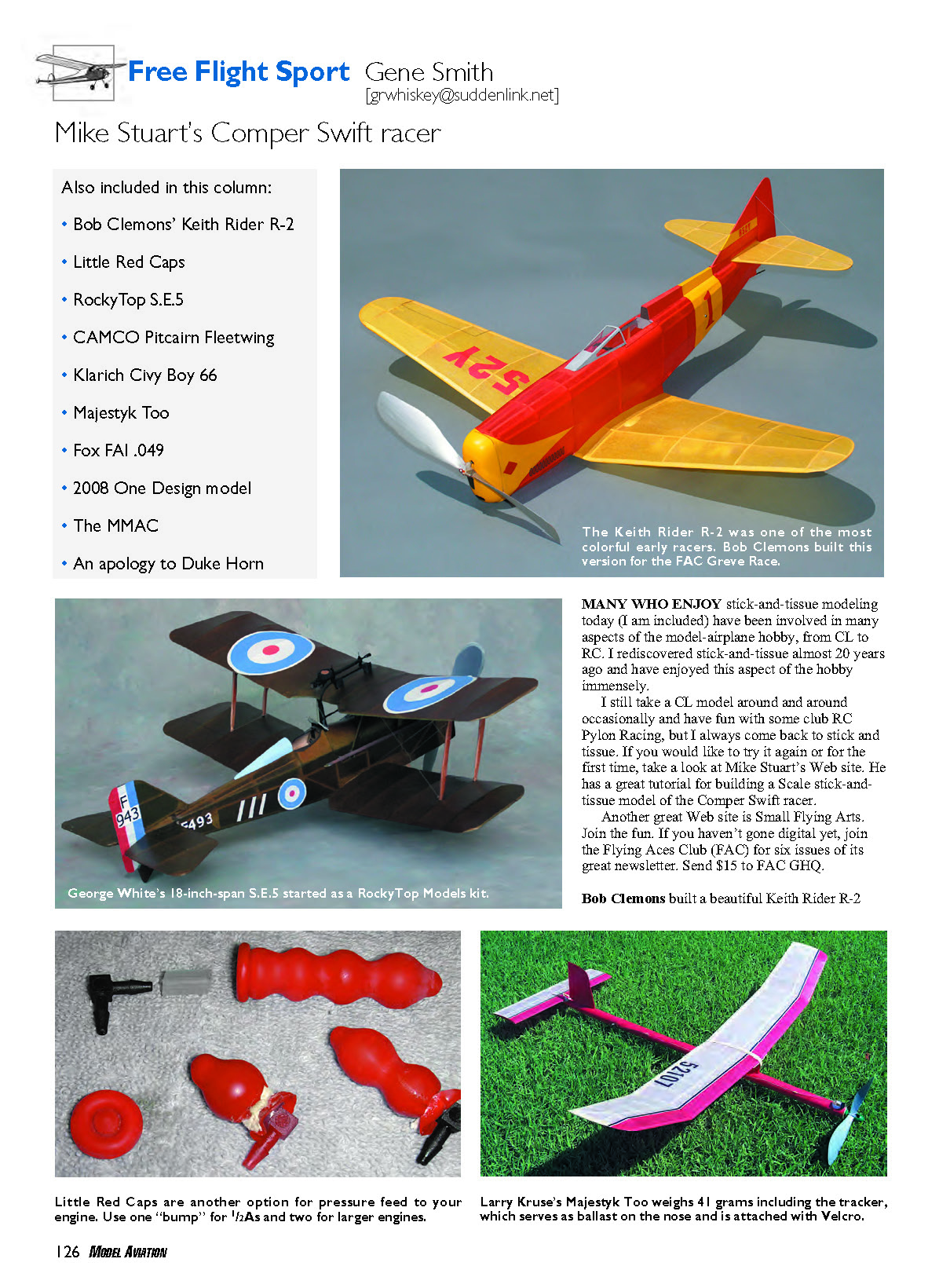
Bob Clemons' Keith Rider R-2 "Bumble Bee"
Bob Clemons built a beautiful Keith Rider R-2 "Bumble Bee" for the FAC Greve Race event. The R-2 is one of the most colorful Golden Age racers. The model has a wingspan of 18.75 inches and weighs 32.60 grams. The 7-inch plastic propeller is powered by four strands of 1/8-inch rubber. The fuselage is covered with red JCI tissue. Bob is a big fan of JCI tissue; it was unavailable for a time, but it is apparently being produced again.
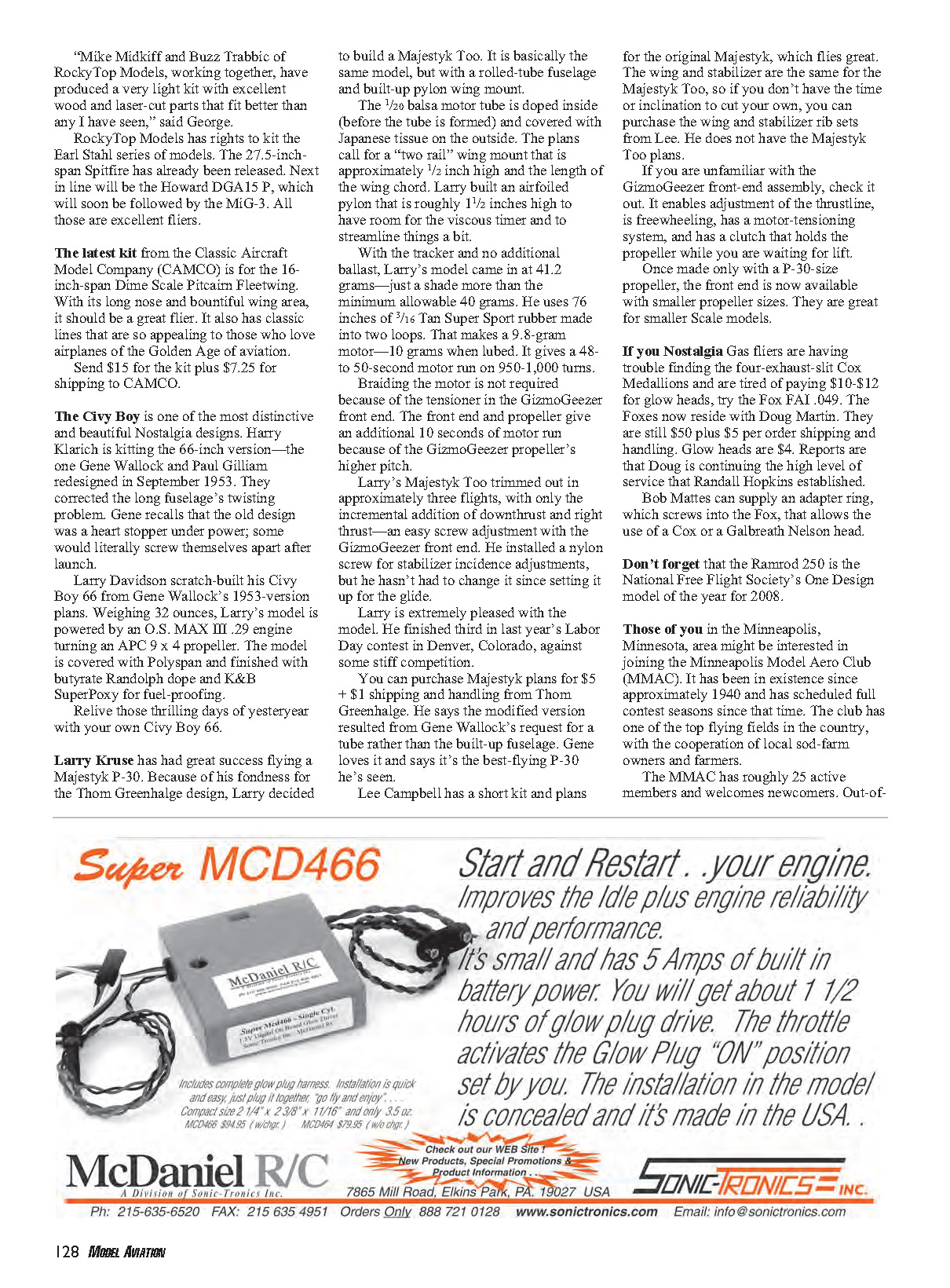
Little Red Caps fuel bladders
Dick Covalt and his flying buddy/model-engine machinist Bob Mattes have been using Little Red Caps for their fuel bladders for the last year and report good results. The caps provide plenty of fuel pressure to the engine but not so much that a special needle valve is required to get a good needle setting. If you have a TD .049 but no KK needle valve, you can get a good needle setting with the standard needle valve.
Dean McGinnes also reports that the pressure is similar to a single balloon tank. Their advantage is that unlike balloons, they are fuelproof and can be used for several contests. One "bump" is just right for 1/2As; use two for larger engines. They are Ace Hardware item 1202647.
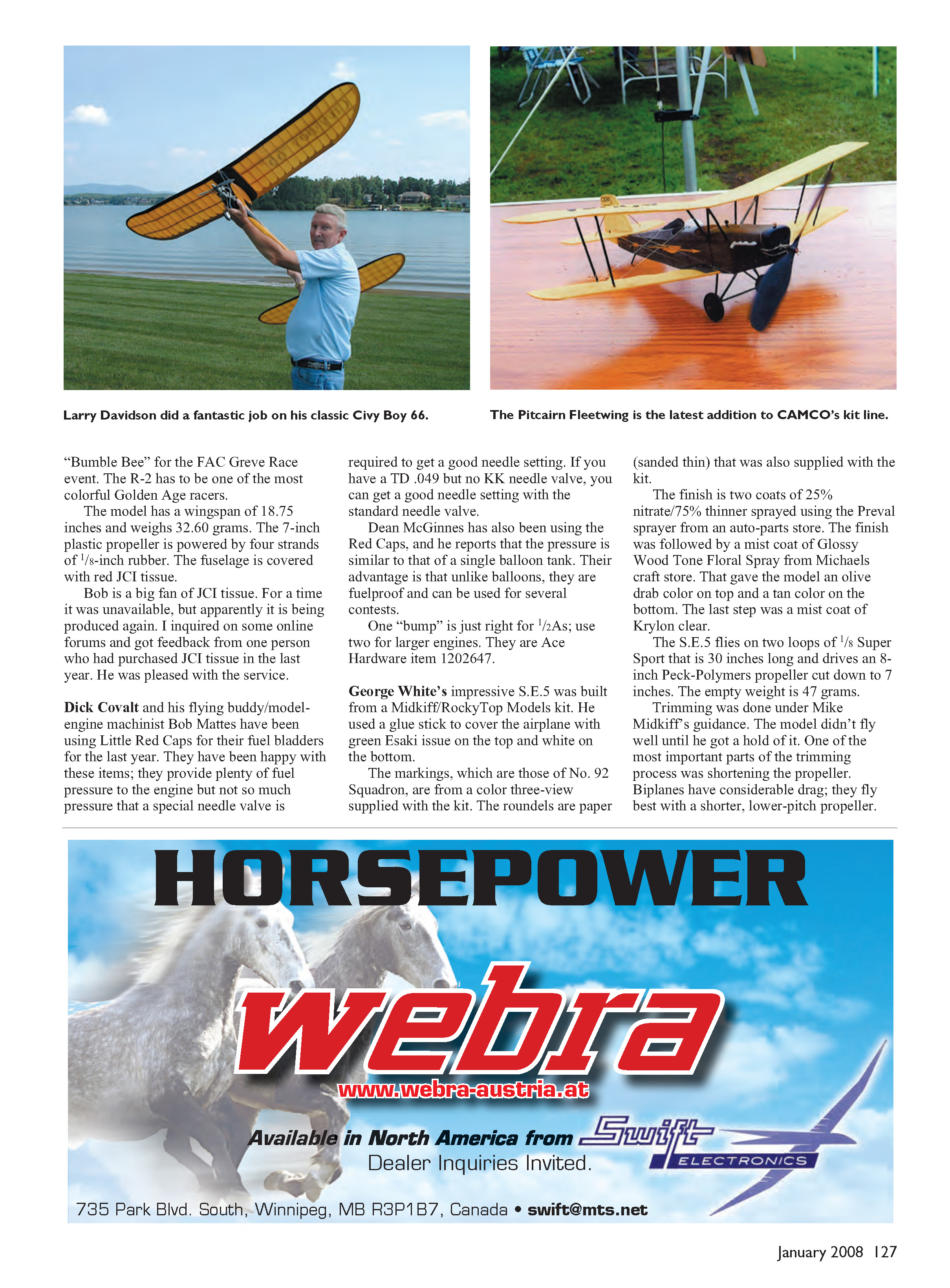
George White's S.E.5
George White’s impressive S.E.5 was built from a Midkiff/RockyTop Models kit. He covered the airplane with green Esaki tissue on top and white on the bottom using a glue stick. The markings (No. 92 Squadron) are from a color three-view supplied with the kit; the roundels are thin paper also supplied with the kit.
Finish steps:
- Two coats of 25% nitrate dope / 75% thinner sprayed with a Preval sprayer.
- A mist coat of Glossy Wood Tone floral spray (Michaels craft store) to get olive drab on top and tan on the bottom.
- A final mist coat of Krylon clear.
The S.E.5 flies on two loops of 1/8-inch Super Sport rubber, 30 inches long, and drives an 8-inch Peck-Polymers propeller cut down to 7 inches. The empty weight is 47 grams. Trimming was done under Mike Midkiff’s guidance; the model didn’t fly well until he worked on it. Shortening the propeller was an important part of trimming—biplanes have considerable drag and fly best with a shorter, lower-pitch propeller.
“Mike Midkiff and Buzz Trabbic of RockyTop Models, working together, have produced a very light kit with excellent wood and laser-cut parts that fit better than any I have seen,” said George.
RockyTop Models and CAMCO kits
RockyTop Models has rights to kit the Earl Stahl series of models. The 27.5-inch-span Spitfire has already been released; next will be the Howard DGA-15P, soon followed by the MiG-3. All are excellent fliers.
The latest kit from the Classic Aircraft Model Company (CAMCO) is a 16-inch-span Dime Scale Pitcairn Fleetwing. With its long nose and bountiful wing area, it should be a great flier with classic Golden Age lines. Send $15 for the kit plus $7.25 for shipping to CAMCO.
City Boy 66
The City Boy is one of the most distinctive and beautiful nostalgia designs. Harry Klarich is kitting the 66-inch version—the one Gene Wallock and Paul Gilliam redesigned in September 1953 to correct the long fuselage's twisting problem. Gene recalls that the old design could be a heart stopper under power; some would literally screw apart after launch.
Larry Davidson scratch-built his City Boy 66 from Gene Wallock's 1953-version plans. Weighing 32 ounces, Larry's model is powered by an O.S. MAX III .29 engine turning an APC 9x4 propeller. The model is covered with Polyspan and finished with butyrate Randolph dope and K&B SuperPoxy for fuel-proofing.
Relive those thrilling days of yesteryear with your own City Boy 66.
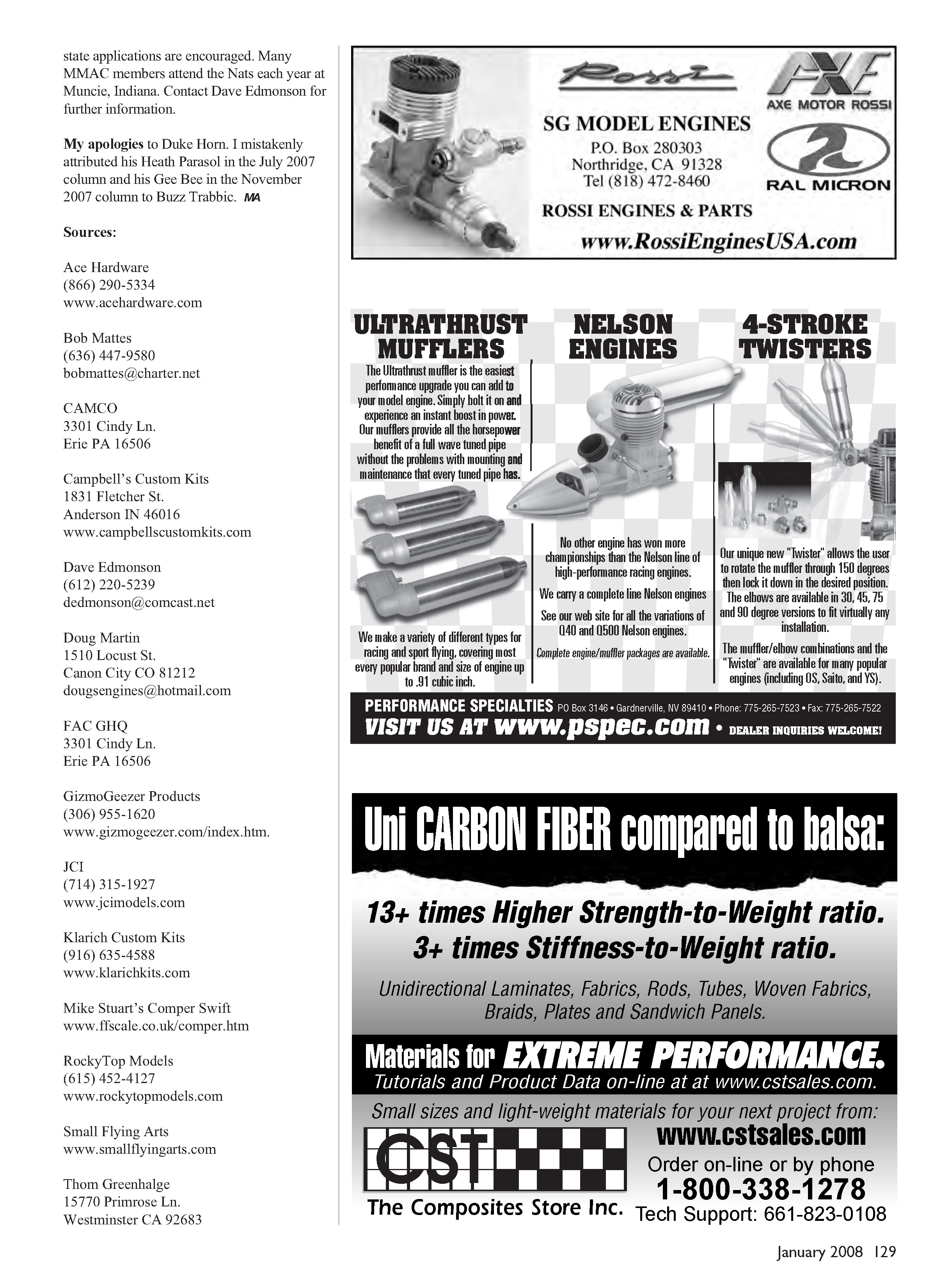
Majestyk P-30 and Majestyk Too
Larry Kruse has had great success flying a Majestyk P-30. Because of his fondness for the Thom Greenhalge design, Larry decided to build a Majestyk Too. The Majestyk Too is basically the same model but with a rolled-tube fuselage and a built-up pylon wing mount.
Construction notes:
- The 1/20 balsa motor tube is doped inside (before forming) and covered with Japanese tissue on the outside.
- The plans call for a "two rail" wing mount ~1/2 inch high and the length of the wing chord; Larry built an airfoiled pylon ~1.5 inches high for room for the viscous timer and to streamline the mount.
Performance and trim:
- With tracker and no additional ballast, Larry's model came in at 41.2 grams—just over the minimum allowable 40 grams.
- He uses 76 inches of 3/16-inch Tan Super Sport rubber made into two loops (9.8 grams motor—10 grams lubed). That gives a 48–50 second motor run on 950–1,000 turns.
- Braiding the motor is not required because of the tensioner in the GizmoGeezer front end.
- The front end and propeller give an additional ~10 seconds of motor run because of the GizmoGeezer propeller's higher pitch.
- The Majestyk Too trimmed out in approximately three flights with only incremental additions of downthrust and right thrust—an easy screw adjustment with the GizmoGeezer front end. Larry installed a nylon screw for stabilizer incidence adjustments but hasn't changed it since setting up the glide.
Larry finished third in last year's Labor Day contest in Denver, Colorado, against stiff competition.
Plans and kits:
- Majestyk plans: $5 + $1 shipping from Thom Greenhalge (15770 Primrose Ln., Westminster CA 92683). Gene Wallock requested the tube fuselage modification and says it's the best-flying P-30 he's seen.
- Lee Campbell has a short kit and plans for the original Majestyk (which flies great). The wing and stabilizer are the same for the Majestyk Too, so you can buy wing and stabilizer rib sets from Lee if you don't want to cut your own. Lee does not have Majestyk Too plans.
GizmoGeezer front-end assembly
If you are unfamiliar with the GizmoGeezer front-end assembly, check it out. It enables adjustment of the thrust line, is freewheeling, has a motor-tensioning system, and features a clutch that holds the propeller while you wait for lift. Once made only with a P-30-size propeller, the front end is now available with smaller propeller sizes and is great for smaller scale models.
Fox FAI .049 and Cox compatibility
If you Nostalgia Gas fliers are having trouble finding the four-exhaust-slit Cox Medallions and are tired of paying $10–$12 for glow heads, try the Fox FAI .049. The Foxes now reside with Doug Martin; they are $50 plus $5 per order shipping and handling. Glow heads are $4. Reports are that Doug is continuing the high level of service that Randall Hopkins established.
Bob Mattes can supply an adapter ring, which screws into the Fox, that allows the use of a Cox or a Galbreath Nelson head.
National Free Flight Society One Design
Don't forget that the Ramrod 250 is the National Free Flight Society's One Design model of the year for 2008.
Minneapolis Model Aero Club (MMAC)
Those of you in the Minneapolis, Minnesota, area might be interested in joining the Minneapolis Model Aero Club (MMAC). It has been in existence since approximately 1940 and has scheduled full contest seasons since that time. The club has one of the top flying fields in the country, thanks to the cooperation of local sod-farm owners and managers. The MMAC has roughly 25 active members and welcomes newcomers. Out-of-state applications are encouraged. Many MMAC members attend the Nats each year at Muncie, Indiana. Contact Dave Edmonson for further information.
Correction
My apologies to Duke Horn. I mistakenly attributed his Heath Parasol in the July 2007 column and his Gee Bee in the November 2007 column to Buzz Trabbic. MA
Sources
- Ace Hardware, (866) 290-5334, www.acehardware.com
- Bob Mattes, (636) 447-9580, [email protected]
- CAMCO, 3301 Cindy Ln., Erie PA 16506
- Campbell’s Custom Kits, 1831 Fletcher St., Anderson IN 46016, www.campbellscustomkits.com
- Dave Edmonson, (612) 220-5239, [email protected]
- Doug Martin, 1510 Locust St., Canon City CO 81212, [email protected]
- FAC GHQ, 3301 Cindy Ln., Erie PA 16506
- GizmoGeezer Products, (306) 955-1620, www.gizmogeezer.com/index.htm
- JCI, (714) 315-1927, www.jcimodels.com
- Klarich Custom Kits, (916) 635-4588, www.klarichkits.com
- Mike Stuart’s Comper Swift, www.ffscale.co.uk/comper.htm
- RockyTop Models, (615) 452-4127, www.rockytopmodels.com
- Small Flying Arts, www.smallflyingarts.com
- Thom Greenhalge, 15770 Primrose Ln., Westminster CA 92683
Transcribed from original scans by AI. Minor OCR errors may remain.

