
Gas model one design for 2009 Nats
Gene Smith [[email protected]]
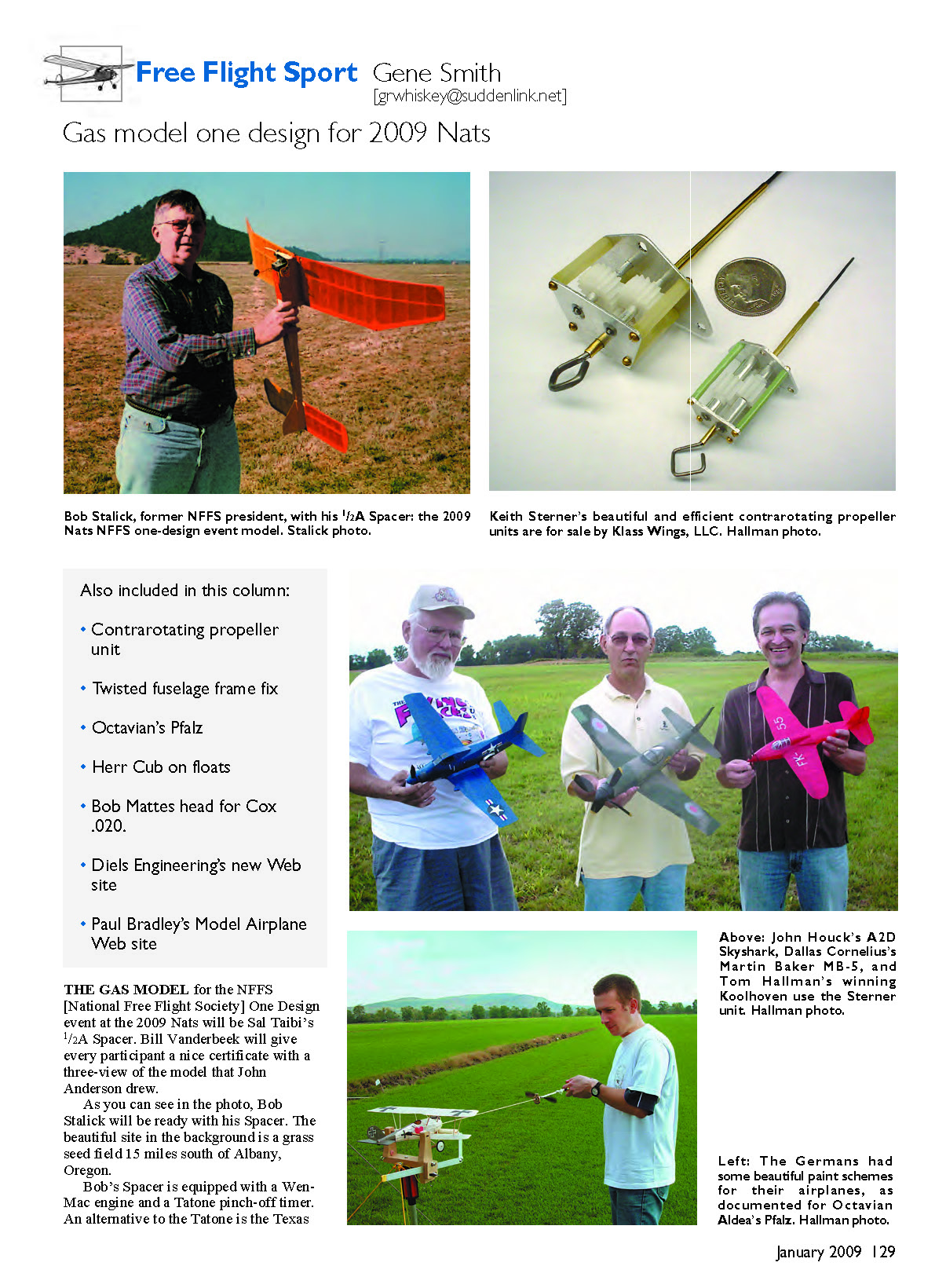
The gas model for the NFFS (National Free Flight Society) One Design event at the 2009 Nats will be Sal Taibi’s 1/2A Spacer. Bill Vanderbeek will give every participant a nice certificate with a three-view of the model that John Anderson drew.
As you can see in the photo, Bob Stalick will be ready with his Spacer. The beautiful site in the background is a grass-seed field 15 miles south of Albany, Oregon.
Bob’s Spacer is equipped with a Wen-Mac engine and a Tatone pinch-off timer. An alternative to the Tatone is the Texas MICRO I from Texas Timers. Bob feels the best engine choice is probably the Cox reed valve. He thinks the Cox Medallion’s additional power would make the Spacer more difficult to trim. He suggests that anyone planning to use a Medallion or similar engine use a small (1/8 x 1/8 inch) top spar placed roughly one-third of the way behind the wing leading edge. The event rules allow that type of modification, and it will give the wing more stiffness and strength.
Bob originally trimmed the Spacer to fly right under power and left in the glide. More recent trimming procedures have the model flying to the right for both power and glide. The current trim setup has 2° of downthrust and 2° of left thrust. The right wing main panel is washed in 1/16–3/32 inch. A bit of left rudder tab may be needed. Tilt the stabilizer with the right side high for a right turn in the glide. That should give you a starting point for trimming. Plans for the 1/2A Spacer are available from the NFFS Plans Service. Plans and short kits are available from Campbell’s Custom Kits. It’s not too soon to start your model. Nostalgia-legal .049 or .051 engines are required.
Contra-rotating Propeller Unit
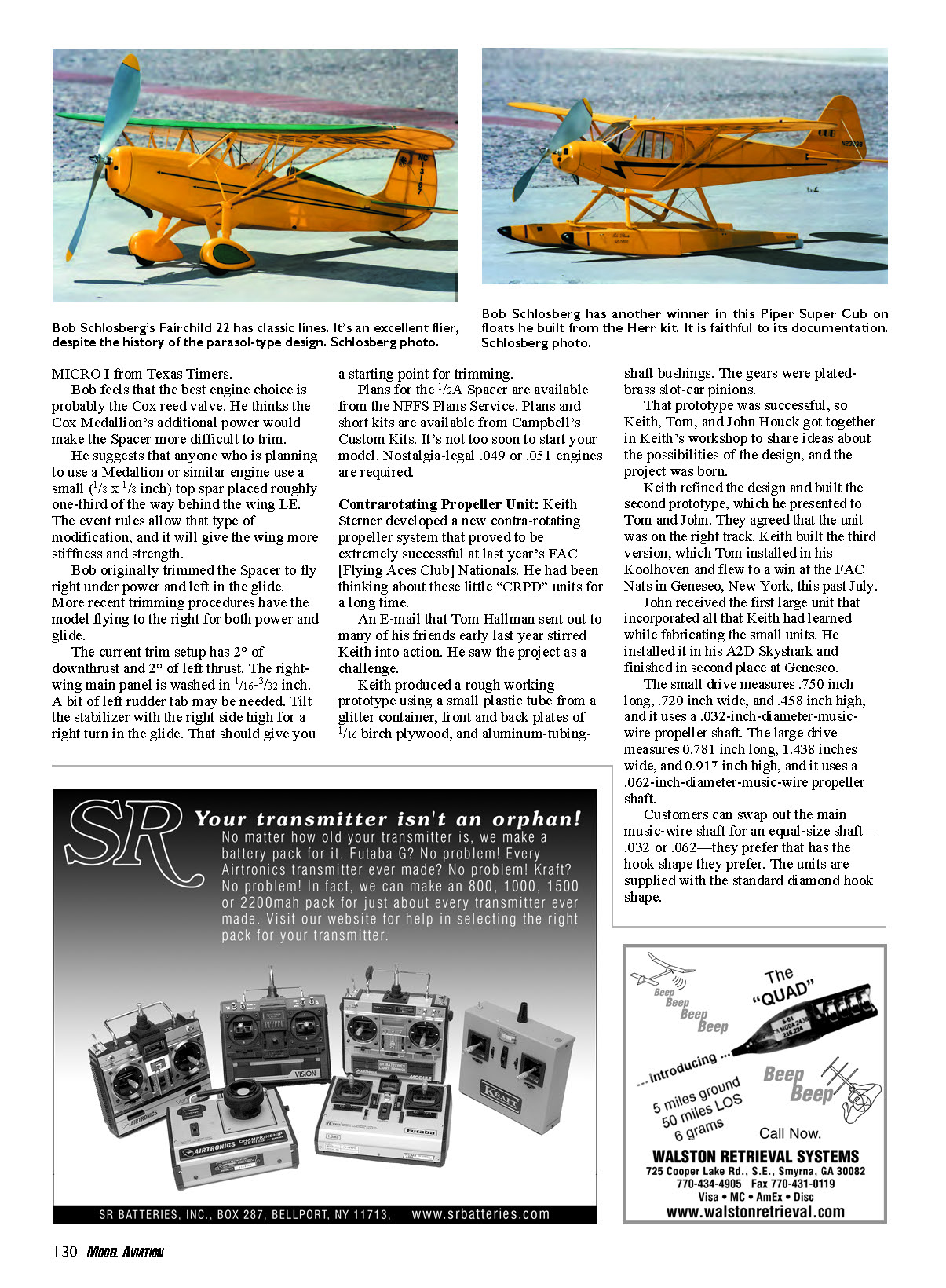
Keith Sterner developed a new contra-rotating propeller system that proved extremely successful at last year’s FAC (Flying Aces Club) Nationals. He had been thinking about these little “CRPD” units for a long time. An e-mail that Tom Hallman sent to many friends early last year stirred Keith into action. He saw the project as a challenge. Keith produced a rough working prototype using a small plastic tube from a glitter container, front and back plates of 1/16" birch plywood, and aluminum-tubing shaft bushings. The gears were plated-brass slot-car pinions. That prototype was successful, so Keith, Tom, and John Houck got together in Keith’s workshop to share ideas about the possibilities of the design, and the project was born.
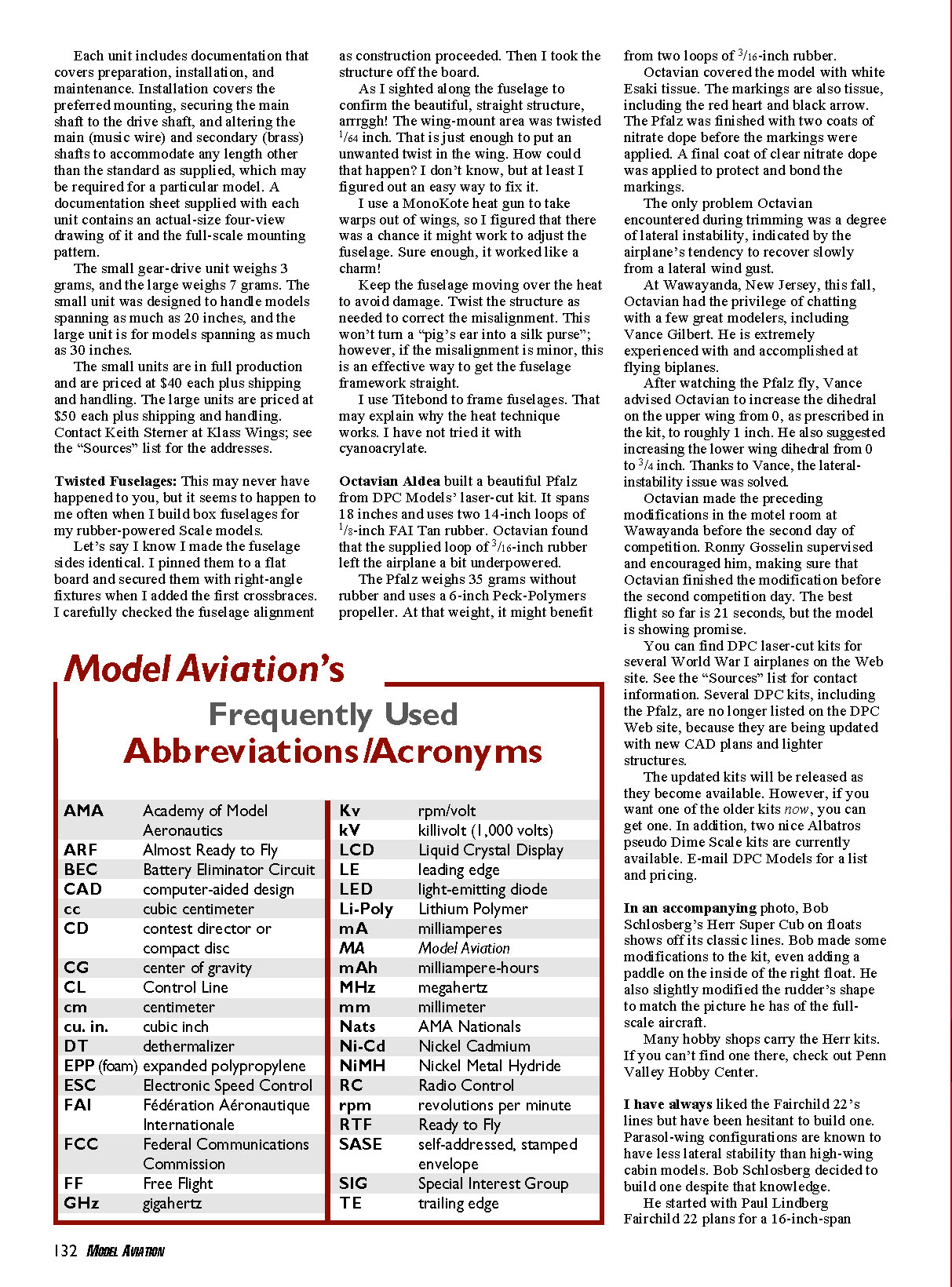
Keith refined the design and built the second prototype, which he presented to Tom and John. They agreed the unit was on the right track. Keith built the third version, which Tom installed in his Koolhoven and flew to a win at the FAC Nats in Geneseo, New York, last July. John received the first large unit that incorporated all that Keith had learned while fabricating the small units. He installed it in his A2D Skyshark and finished in second place at Geneseo.
- The small drive measures 0.750 inch long, 0.720 inch wide, and 0.458 inch high, and it uses a .032-inch-diameter music-wire propeller shaft.
- The large drive measures 0.781 inch long, 1.438 inches wide, and 0.917 inch high, and it uses a .062-inch-diameter music-wire propeller shaft.
Customers can swap out the main music-wire shaft for an equal-size shaft (.032 or .062) with the hook shape they prefer. The units are supplied with the standard diamond hook shape.
Each unit includes documentation that covers preparation, installation, and maintenance. Installation guidance covers the preferred mounting, securing the main shaft to the drive shaft, and altering the main (music-wire) and secondary (brass) shafts to accommodate any length other than the standard as supplied, which may be required for a particular model. A documentation sheet supplied with each unit contains an actual-size four-view drawing of the unit and the full-scale mounting pattern.
- The small gear-drive unit weighs 3 grams; it was designed to handle models spanning as much as 20 inches.
- The large unit weighs 7 grams and is for models spanning as much as 30 inches.
The small units are in full production and are priced at $40 each plus shipping and handling. The large units are priced at $50 each plus shipping and handling. Contact Keith Sterner at Klass Wings; see the “Sources” list for the addresses.
Twisted Fuselages
This may never have happened to you, but it seems to happen to me often when I build box fuselages for my rubber-powered scale models.
Let’s say I know I made the fuselage sides identical. I pin them to a flat board and secure them with right-angle fixtures when I add the first crossbraces. I carefully check the fuselage alignment as construction proceeds. Then I take the structure off the board.
As I sight along the fuselage to confirm the beautiful, straight structure—arrgh!—the wing-mount area is twisted 1/64 inch. That is just enough to put an unwanted twist in the wing. How could that happen? I don’t know, but at least I figured out an easy way to fix it.
I use a MonoKote heat gun to take warps out of wings, so I figured there was a chance it might work to adjust the fuselage. Sure enough, it worked like a charm!
Keep the fuselage moving over the heat to avoid damage. Twist the structure as needed to correct the misalignment. This won’t turn a “pig’s ear into a silk purse”; however, if the misalignment is minor, this is an effective way to get the fuselage framework straight.
I use Titebond to frame fuselages. That may explain why the heat technique works. I have not tried it with cyanoacrylate.
Octavian Aldea’s Pfalz
Octavian Aldea built a beautiful Pfalz from DPC Models’ laser-cut kit. It spans 18 inches and uses two 14-inch loops of 1/8-inch FAI Tan rubber. Octavian found that the supplied loop of 3/16-inch rubber left the airplane a bit underpowered.
The Pfalz weighs 35 grams without rubber and uses a 6-inch Peck-Polymers propeller. At that weight, it might benefit from two loops of 3/16-inch rubber.
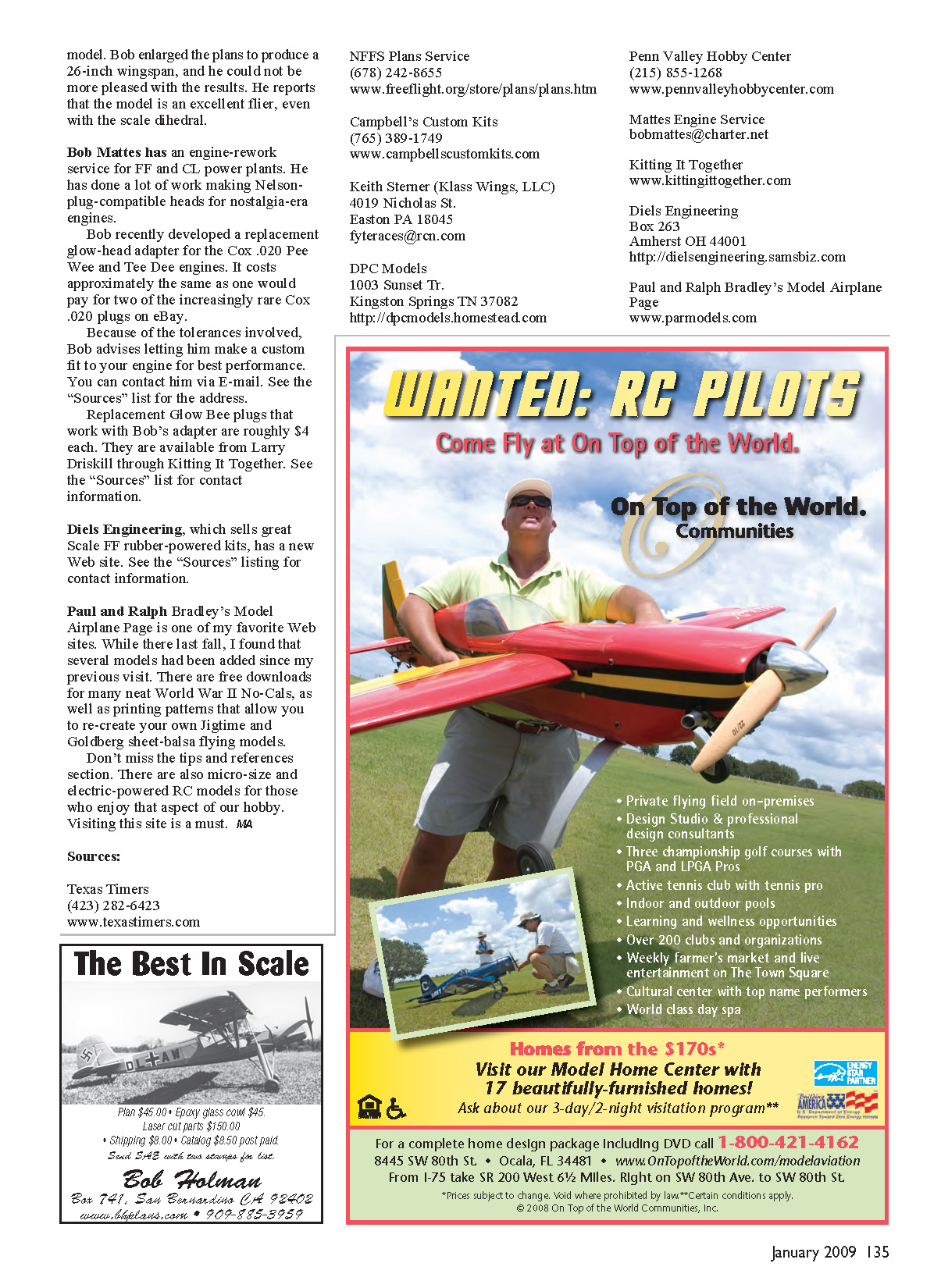
Octavian covered the model with white Esaki tissue. The markings are also tissue, including the red heart and black arrow. The Pfalz was finished with two coats of nitrate dope before the markings were applied. A final coat of clear nitrate dope was applied to protect and bond the markings.
The only problem Octavian encountered during trimming was a degree of lateral instability, indicated by the airplane’s tendency to recover slowly from a lateral wind gust.
At Wawayanda, New Jersey, this fall, Octavian had the privilege of chatting with a few great modelers, including Vance Gilbert, who is extremely experienced with and accomplished at flying biplanes.
After watching the Pfalz fly, Vance advised Octavian to increase the dihedral on the upper wing from 0 (as prescribed in the kit) to roughly 1 inch. He also suggested increasing the lower wing dihedral from 0 to 3/4 inch. Thanks to Vance, the lateral-instability issue was solved.
Octavian made the preceding modifications in the motel room at Wawayanda before the second day of competition. Ronny Gosselin supervised and encouraged him, making sure Octavian finished the modification before the second competition day. The best flight so far is 21 seconds, but the model is showing promise.
You can find DPC laser-cut kits for several World War I airplanes on the web; see the “Sources” list for contact information. Several DPC kits, including the Pfalz, are no longer listed on the DPC web site because they are being updated with new CAD plans and lighter structures. The updated kits will be released as they become available. However, if you want one of the older kits now, you can get one. In addition, two nice Albatros pseudo Dime Scale kits are currently available. E-mail DPC Models for a list and pricing.
Bob enlarged the plans to produce a 26-inch wingspan, and he could not be more pleased with the results. He reports the model is an excellent flier, even with the scale dihedral.
Bob Mattes has an engine-rework service for free flight and control-line power plants. He has done a lot of work making Nelson-plug-compatible heads for nostalgia-era engines.
Bob recently developed a replacement glow-head adapter for the Cox .020 Pee Wee and Tee Dee engines. It costs approximately the same as one would pay for two of the increasingly rare Cox .020 plugs on eBay.
Because of the tolerances involved, Bob advises letting him make a custom fit to your engine for best performance. You can contact him via e-mail; see the "Sources" list for the address.
Replacement Glow Bee plugs that work with Bob's adapter are roughly $4 each. They are available from Larry Driskill through Kitting It Together. See the "Sources" list for contact information.
Diels Engineering, which sells great scale free-flight rubber-powered kits, has a new web site. See the "Sources" listing for contact information.
Paul and Ralph Bradley's Model Airplane Page is one of my favorite web sites. While there last fall, I found several models had been added since my previous visit. There are free downloads for many neat World War II No-Cals, as well as printing patterns that allow you to recreate your own Jigtime and Goldberg sheet-balsa flying models.
Don't miss the tips and references section. There are also micro-size and electric-powered RC models for those who enjoy that aspect of our hobby. Visiting this site is a must.
Sources
- Texas Timers
(423) 282-6423 www.texastimers.com
- NFFS Plans Service
(678) 242-8655 www.freeflight.org/store/plans/plans.htm
- Campbell's Custom Kits
(765) 389-1749 www.campbellscustomkits.com
- Keith Sterner (Klass Wings, LLC)
4019 Nicholas St. Easton, PA 18045 [email protected]
- DPC Models
1003 Sunset Tr. Kingston Springs, TN 37082 http://dpcmodels.homestead.com
- Penn Valley Hobby Center
(215) 855-1268 www.pennvalleyhobbycenter.com
- Mattes Engine Service
- Kitting It Together
- Diels Engineering
Box 263 Amherst, OH 44001 http://dielsengineering.samsbiz.com
- Paul and Ralph Bradley's Model Airplane Page
Transcribed from original scans by AI. Minor OCR errors may remain.

