
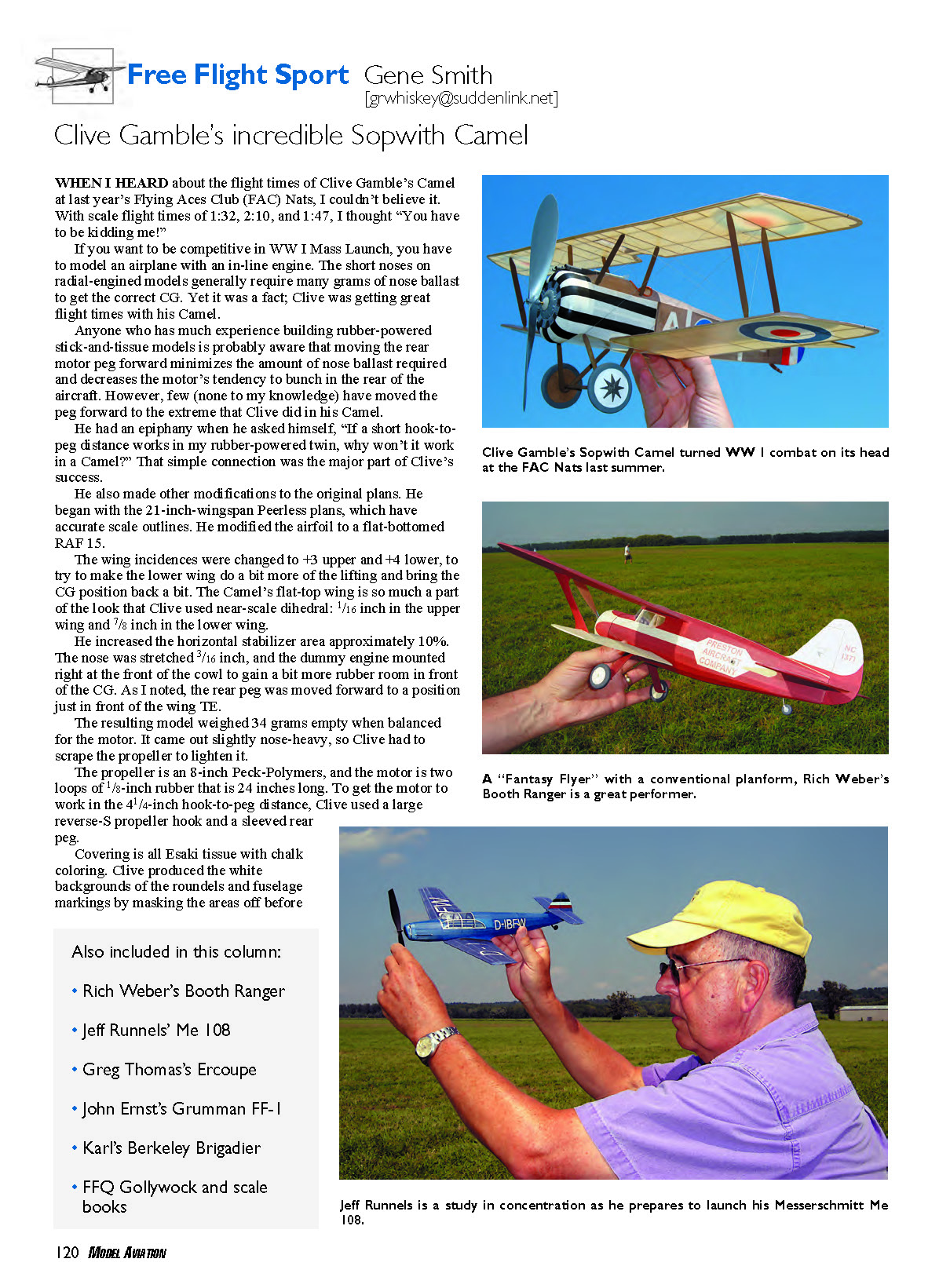
Clive Gamble's incredible Sopwith Camel
By Gene Smith [[email protected]]
When I heard about the flight times of Clive Gamble’s Camel at last year’s Flying Aces Club (FAC) Nats, I couldn’t believe it. With scale flight times of 1:32, 2:10, and 1:47, I thought, “You have to be kidding me!”
If you want to be competitive in WWI Mass Launch, you have to model an airplane with an in-line engine. The short noses on radial-engined models generally require many grams of nose ballast to get the correct CG. Yet it was a fact: Clive was getting great flight times with his Camel.
Anyone with experience building rubber-powered stick-and-tissue models knows that moving the rear motor peg forward minimizes the amount of nose ballast required and decreases the motor’s tendency to bunch in the rear of the aircraft. However, few — none to my knowledge — have moved the peg forward to the extreme that Clive did in his Camel.
He had an epiphany when he asked himself, “If a short hook-to-peg distance works in my rubber-powered twin, why won’t it work in a Camel?” That simple connection was the major part of Clive’s success.
He also made other modifications to the original plans. He began with the 21-inch-wingspan Peerless plans, which have accurate scale outlines, and modified the airfoil to a flat-bottomed RAF 15.
The wing incidences were changed to +3° upper and +4° lower to try to make the lower wing do a bit more of the lifting and bring the CG position back a bit. The Camel’s flat-top wing is so much a part of the look that Clive used near-scale dihedral: 1/16 inch in the upper wing and 7/8 inch in the lower wing.
He increased the horizontal stabilizer area by approximately 10%. The nose was stretched 3/16 inch, and the dummy engine was mounted right at the front of the cowl to gain a bit more rubber room in front of the CG. As noted, the rear peg was moved forward to a position just in front of the wing trailing edge.
The resulting model weighed 34 grams empty when balanced for the motor. It came out slightly nose-heavy, so Clive had to scrape the propeller to lighten it.
The propeller is an 8-inch Peck-Polymers, and the motor is two loops of 1/8-inch rubber that is 24 inches long. To get the motor to work in the 4-1/4-inch hook-to-peg distance, Clive used a large reverse-S propeller hook and a sleeved rear peg.
Covering is all Esaki tissue with chalk coloring. Clive produced the white backgrounds of the roundels and fuselage markings by masking the areas off before chalking the main tissue color, then adding white chalk afterward. Blue-and-red roundels and black stripes are cut tissue, chalked again to make the colors more solid. The polyester-thread rigging is important to the model’s strength; it is glued in place with cyanoacrylate.
The flight pattern is right–right. Adjustments include a significant amount of downthrust and right thrust, and a small amount of washout on the upper left wing. If you want to give a Camel a try, plans are available from Golden Age Reproductions as item 126. The company has a $3 catalog that lists many kits and plans. Clive credits Rich Weber with the advice and encouragement that led to the success of his Camel. See the “Sources” listing for a web address that leads to a flight video of the Camel.
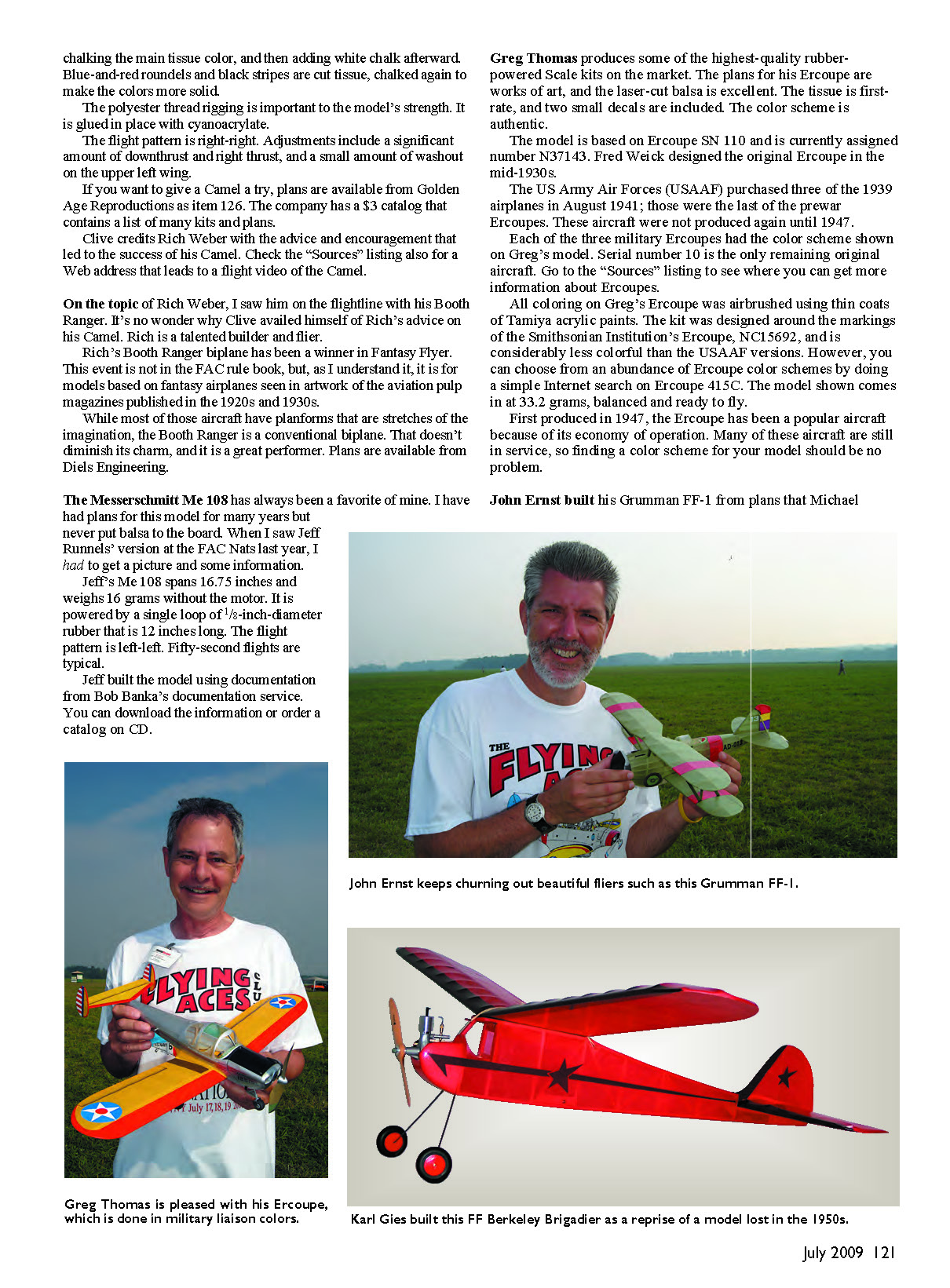
Rich Weber and the Booth Ranger
On the flightline I also saw Rich Weber with his Booth Ranger. It’s no wonder Clive availed himself of Rich’s advice — Rich is a talented builder and flier. Rich’s Booth Ranger biplane has been a winner in Fantasy Flyer. This event is not in the FAC rule book, but, as I understand it, it is for models based on fantasy airplanes seen in artwork from the aviation pulp magazines published in the 1920s and 1930s. While most of those aircraft have planforms that are stretches of the imagination, the Booth Ranger is a conventional biplane. That doesn’t diminish its charm, and it is a great performer. Plans are available from Diels Engineering.
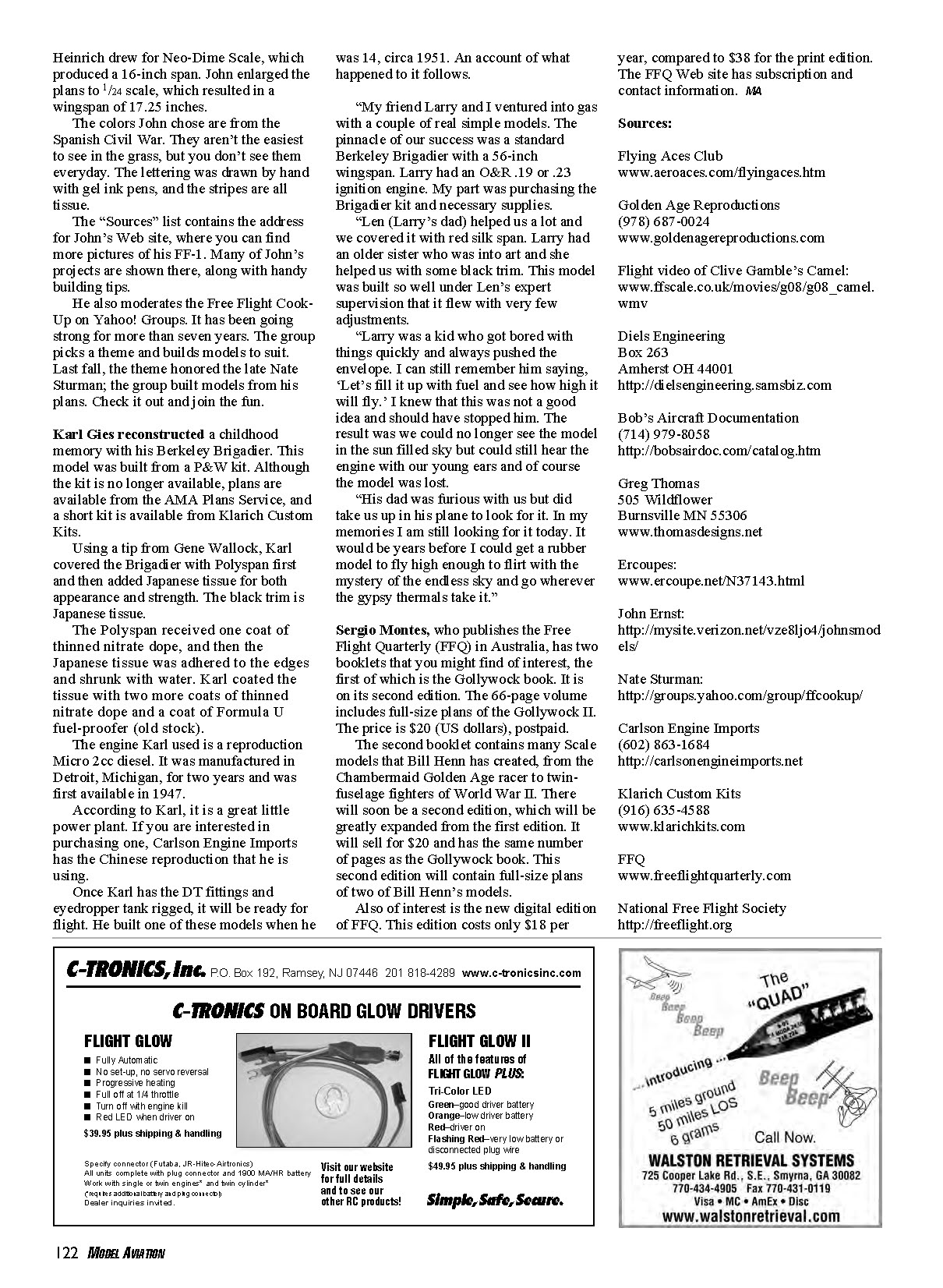
Messerschmitt Me 108
The Messerschmitt Me 108 has always been a favorite of mine. I had plans for this model for many years but never put balsa to the board. When I saw Jeff Runnels’ version at the FAC Nats last year, I had to get a picture and some information.
Jeff’s Me 108 spans 16.75 inches and weighs 16 grams without the motor. It is powered by a single loop of 1/8-inch-diameter rubber that is 12 inches long. The flight pattern is left–left. Fifty-second flights are typical.
Jeff built the model using documentation from Bob Banka’s documentation service. You can download the information or order a catalog on CD.
Greg Thomas’s Ercoupe
Greg Thomas produces some of the highest-quality rubber-powered scale kits on the market. The plans for his Ercoupe are works of art, and the laser-cut balsa is excellent. The tissue is first-rate, and two small decals are included. The color scheme is authentic.
The model is based on Ercoupe SN 110 and is currently assigned number N37143. Fred Weick designed the original Ercoupe in the mid-1930s.
The US Army Air Forces (USAAF) purchased three of the 1939 airplanes in August 1941; those were the last of the prewar Ercoupes. These aircraft were not produced again until 1947. Each of the three military Ercoupes had the color scheme shown on Greg’s model. Serial number 10 is the only remaining original aircraft. See the “Sources” listing for more information about Ercoupes.
All coloring on Greg’s Ercoupe was airbrushed using thin coats of Tamiya acrylic paints. The kit was designed around the markings of the Smithsonian Institution’s Ercoupe, NC15692, and is considerably less colorful than the USAAF versions. However, you can choose from an abundance of Ercoupe color schemes by doing a simple Internet search on “Ercoupe 415C.” The model shown comes in at 33.2 grams, balanced and ready to fly.
First produced in 1947, the Ercoupe has been a popular aircraft because of its economy of operation. Many of these aircraft are still in service, so finding a color scheme for your model should be no problem.
John Ernst’s Grumman FF-1
John Ernst built his Grumman FF-1 from plans that Michael Heinrich drew for Neo-Dime Scale, which produced a 16-inch span. John enlarged the plans to 1/24 scale, which resulted in a wingspan of 17.25 inches.
The colors John chose are from the Spanish Civil War. They aren't the easiest to see in the grass, but you don't see them every day. The lettering was drawn by hand with gel ink pens, and the stripes are all tissue.
The "Sources" list contains the address for John's website, where you can find more pictures of his FF-1. Many of John's projects are shown there, along with handy building tips. He also moderates the Free Flight Cook-Up on Yahoo! Groups. It has been going strong for more than seven years. The group picks a theme and builds models to suit. Last fall, the theme honored the late Nate Sturman; the group built models from his plans. Check it out and join the fun.
Berkeley Brigadier (Karl Gies)
Karl Gies reconstructed a childhood memory with his Berkeley Brigadier. This model was built from a P&W kit. Although the kit is no longer available, plans are available from the AMA Plans Service, and a short kit is available from Klarich Custom Kits.
Using a tip from Gene Wallock, Karl covered the Brigadier with Polyspan first and then added Japanese tissue for both appearance and strength. The black trim is Japanese tissue.
The Polyspan received one coat of thinned nitrate dope, and then the Japanese tissue was adhered to the edges and shrunk with water. Karl coated the tissue with two more coats of thinned nitrate dope and a coat of Formula U fuel-proofer (old stock).
The engine Karl used is a reproduction Micro 2 cc diesel. It was manufactured in Detroit, Michigan, for two years and was first available in 1947. According to Karl, it is a great little power plant. If you are interested in purchasing one, Carlson Engine Imports has the Chinese reproduction that he is using.
Once Karl has the DT fittings and eyedropper tank rigged, it will be ready for flight. He built one of these models when he was 14, circa 1951. An account of what happened to it follows:
"My friend Larry and I ventured into gas with a couple of real simple models. The pinnacle of our success was a standard Berkeley Brigadier with a 56-inch wingspan. Larry had an O&R .19 or .23 ignition engine. My part was purchasing the Brigadier kit and necessary supplies.
"Len (Larry's dad) helped us a lot and we covered it with red silkspan. Larry had an older sister who was into art and she helped us with some black trim. This model was built so well under Len's expert supervision that it flew with very few adjustments.
"Larry was a kid who got bored with things quickly and always pushed the envelope. I can still remember him saying, 'Let's fill it up with fuel and see how high it will fly.' I knew that this was not a good idea and should have stopped him. The result was we could no longer see the model in the sun-filled sky but could still hear the engine with our young ears and, of course, the model was lost.
"His dad was furious with us but did take us up in his plane to look for it. In my memory I am still looking for it today. It would be years before I could get a rubber model to fly high enough to flirt with the mystery of the endless sky and go wherever the gypsy thermals take it."
Free Flight Quarterly and Booklets (Sergio Montes)
Sergio Montes, who publishes Free Flight Quarterly (FFQ) in Australia, has two booklets you might find of interest.
- The Gollywock book is on its second edition. The 66-page volume includes full-size plans of the Gollywock II. Price: $20 (US), postpaid.
- The second booklet contains many scale models that Bill Henn has created, from the Chamberlain Golden Age racer to twin-fuselage fighters of World War II. A greatly expanded second edition is forthcoming; it will sell for $20 and will contain full-size plans of two of Bill Henn's models.
Also of interest is the new digital edition of FFQ. The digital edition costs only $18 per year, compared to $38 for the print edition. The FFQ website has subscription and contact information.
Sources
- Flying Aces Club — www.aeroaces.com/flyingaces.htm
- Golden Age Reproductions — (978) 687-0024, www.goldenagereproductions.com
- Flight video of Clive Gamble's Camel — www.ffscale.co.uk/movies/g08/g08_camel.wmv
- Diels Engineering — Box 263, Amherst OH 44001, http://dielsengineering.samsbiz.com
- Bob's Aircraft Documentation — (714) 979-8058, http://bobsairdoc.com/catalog.htm
- Greg Thomas — 505 Wildflower, Burnsville MN 55306, www.thomasdesigns.net
- Ercoupes — www.ercoupe.net/N37143.html
- John Ernst — http://mysite.verizon.net/vze8ljo4/johnsmodels/
- Nate Sturman / Free Flight Cook-Up (Yahoo! Group) — http://groups.yahoo.com/group/ffcookup/
- Carlson Engine Imports — (602) 863-1684, http://carlsonengineimports.net
- Klarich Custom Kits — (916) 635-4588, www.klarichkits.com
- Free Flight Quarterly — www.freeflightquarterly.com
- National Free Flight Society — http://freeflight.org
Transcribed from original scans by AI. Minor OCR errors may remain.

