
Free Flight World Championships
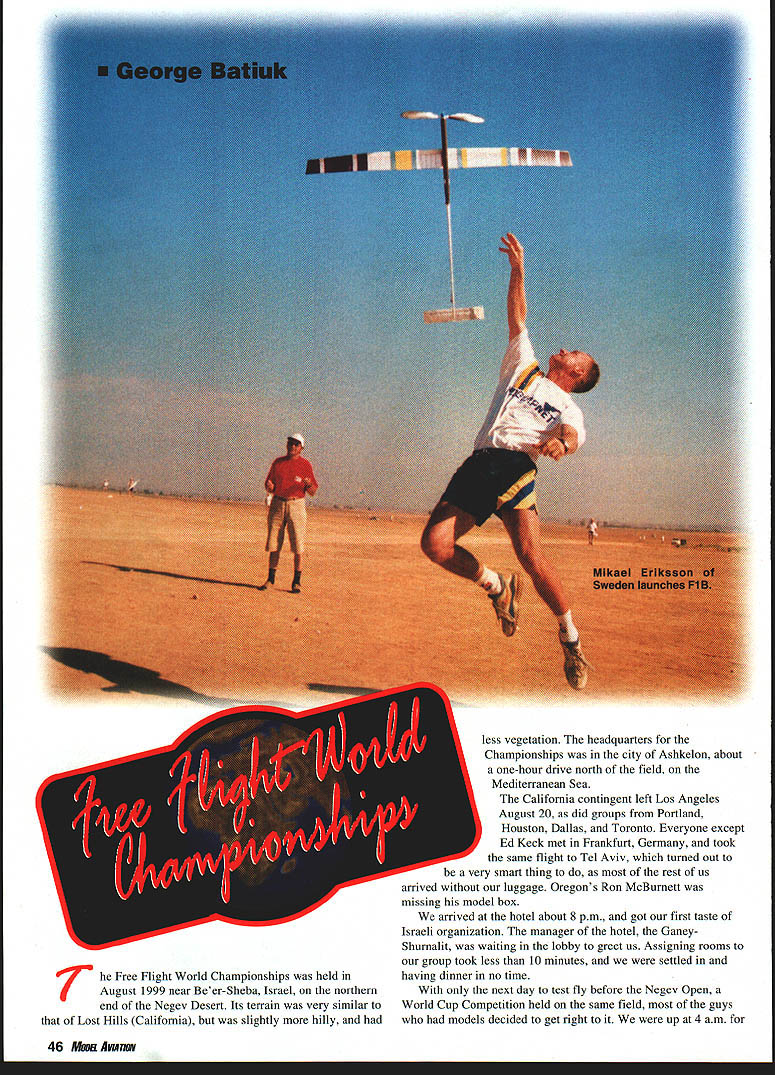
The Free Flight World Championships was held in August 1999 near Be'er-Sheba, Israel, on the northern end of the Negev Desert. Its terrain was very similar to that of Lost Hills (California), but was slightly more hilly, and had less vegetation. The headquarters for the Championships was in the city of Ashkelon, about a one-hour drive north of the field, on the Mediterranean Sea.
The California contingent left Los Angeles August 20, as did groups from Portland, Houston, Dallas, and Toronto. Everyone except Ed Keck met in Frankfurt, Germany, and took the same flight to Tel Aviv, which turned out to be a very smart thing to do, as most of the rest of us arrived without our luggage. Oregon's Ron McBurnett was missing his model box.
We arrived at the hotel about 8 p.m., and got our first taste of Israeli organization. The manager of the hotel, the Ganey-Shurnalit, was waiting in the lobby to greet us. Assigning rooms to our group took less than 10 minutes, and we were settled in and having dinner in no time.
With only the next day to test fly before the Negev Open, a World Cup Competition held on the same field, most of the guys who had models decided to get right to it. We were up at 4 a.m. for breakfast and the trip to the field for 6 a.m. flying, then off the field by 1 or 2 p.m. when the wind and thermals became intolerable. We used this routine for the duration of our stay.
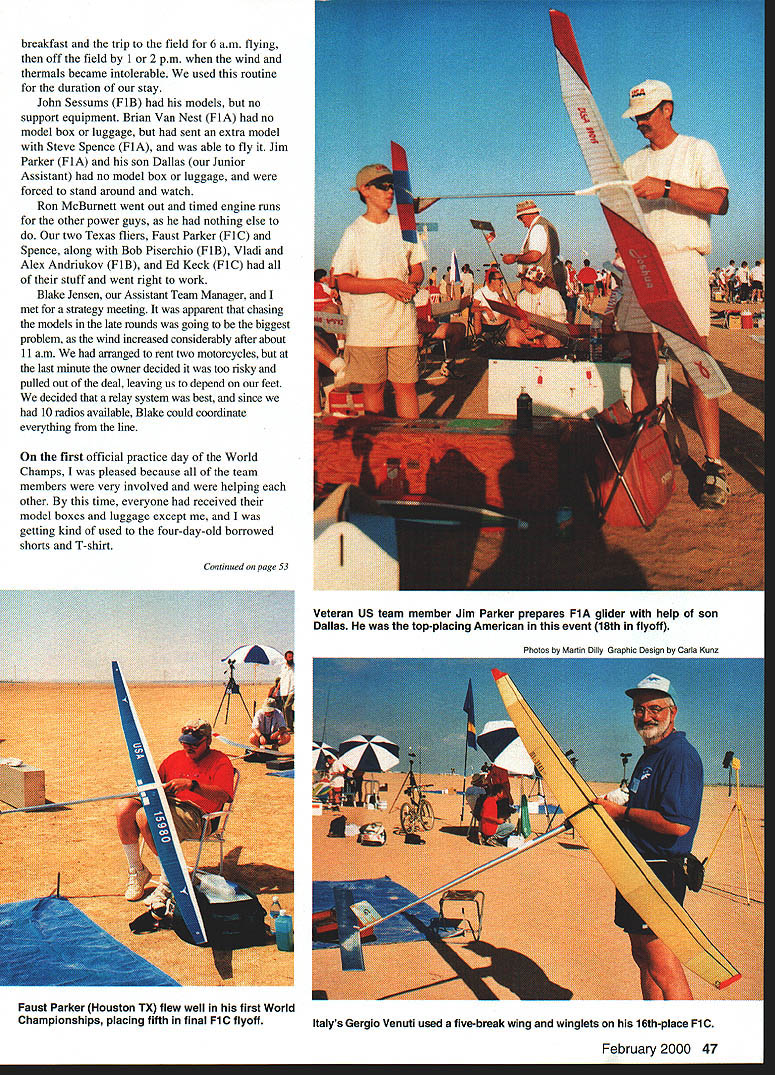
John Sessums (F1B) had his models, but no support equipment. Brian Van Nest (F1A) had no model box or luggage, but had sent an extra model with Steve Spence (F1A), and was able to fly it. Jim Parker (F1A) and his son Dallas (our Junior Assistant) had no model box or luggage, and were forced to stand around and watch.
Ron McBurnett went out and timed engine runs for the other power guys, as he had nothing else to do. Our two Texas fliers, Faust Parker (F1C) and Spence, along with Bob Piserchio (F1B), Vladi and Alex Andrjukov (F1B), and Ed Keck (F1C) had all of their stuff and went right to work.
Blake Jensen, our Assistant Team Manager, and I met for a strategy meeting. It was apparent that chasing the models in the late rounds was going to be the biggest problem, as the wind increased considerably after about 11 a.m. We had arranged to rent two motorcycles, but at the last minute the owner decided it was too risky and pulled out of the deal, leaving us to depend on our feet. We decided that a relay system was best, and since we had 10 radios available, Blake could coordinate everything from the line.
On the first official practice day of the World Champs, I was pleased because all of the team members were very involved and were helping each other. By this time, everyone had received their model boxes and luggage except me, and I was getting kind of used to the four-day-old borrowed shorts and T-shirt.
The competition itself had been slated to have a slightly unorthodox format. Because of the windy and turbulent conditions in the afternoon, the organizers had announced in advance that a 10-minute max flight the morning following the competition would determine the winner. At the Team Managers' meeting, several suggestions were made: shortening the rounds to 45 minutes, having extended first rounds, etc. But in the end the president of the Jury, Pierre Chaussebourg, answered with an emphatic no, and the format was left as advertised.
F1A
The morning started off cool (for Israel: 65°) with a slight breeze. The Jury decided that it was light enough to see at 6:15, so we were off and running.
Steve flew first, and his model stalled to the ground—the first dirty mechanism victim. He was disappointed, but rallied for six straight maxes. Brian dropped small amounts in the second and third rounds—the light lift being hard to detect—but finished strong. This lift-detection problem was very evident in the second round, when defending World Champion Victor Stamov missed the air for a disappointing 13.
Around 10 a.m. it got hot, with very turbulent thermals and huge dust devils, but still very calm. Some of the models went almost out of sight straight up. About an hour later, the wind increased considerably, and would carry the models up to a mile away. This would be the normal weather conditions for the duration.
Jim Parker had an absolutely fantastic day (with Dallas' help, of course) and was the only "clean" American after seven rounds.
By the end of the seventh round, we were all ready for the hotel and the air conditioning, anticipating the morning flyoff.
Day Two started with said flyoff, with a total of 39 fliers participating. Jim towed up at the horn and headed for our predetermined spot, to take advantage of the highs and lows of the field. His launch was spectacular, but the air was less than desirable, and his model glided in at 262 seconds for a sound 18th place—a very good effort by the "old pro" of our glider team.
Most of the fliers who placed at the top flew very late in the round, in obviously buoyant air. The winner, Dariusz Stezalski, had an impressive 329.
F1B
The first two rounds were no challenge for these high-performance models, most of which are capable of six-to-seven-minute "dead air" flights. The day looked like it was going to be a carbon copy of Day One, and, true to form, it went absolutely "dead" for the third round.
Vladi wound first, then waited 30 minutes, with no apparent sign of lift. With time running out, we decided to have John wind and be ready, in case Vladi decided that he needed a new motor. We felt that the air was buoyant and three minutes should be no problem, but we kept waiting for someone else to show us the way. Finally, Vladi flew and glided in for 3:30. John was in the air immediately. Bob wound his model and launched as soon as John's model dethermalized. We had managed to fly all three flights in less than 10 minutes, and to stay clean—something most of the other teams failed to do.
These dramatics were trivial compared to what unfolded in the fifth round.
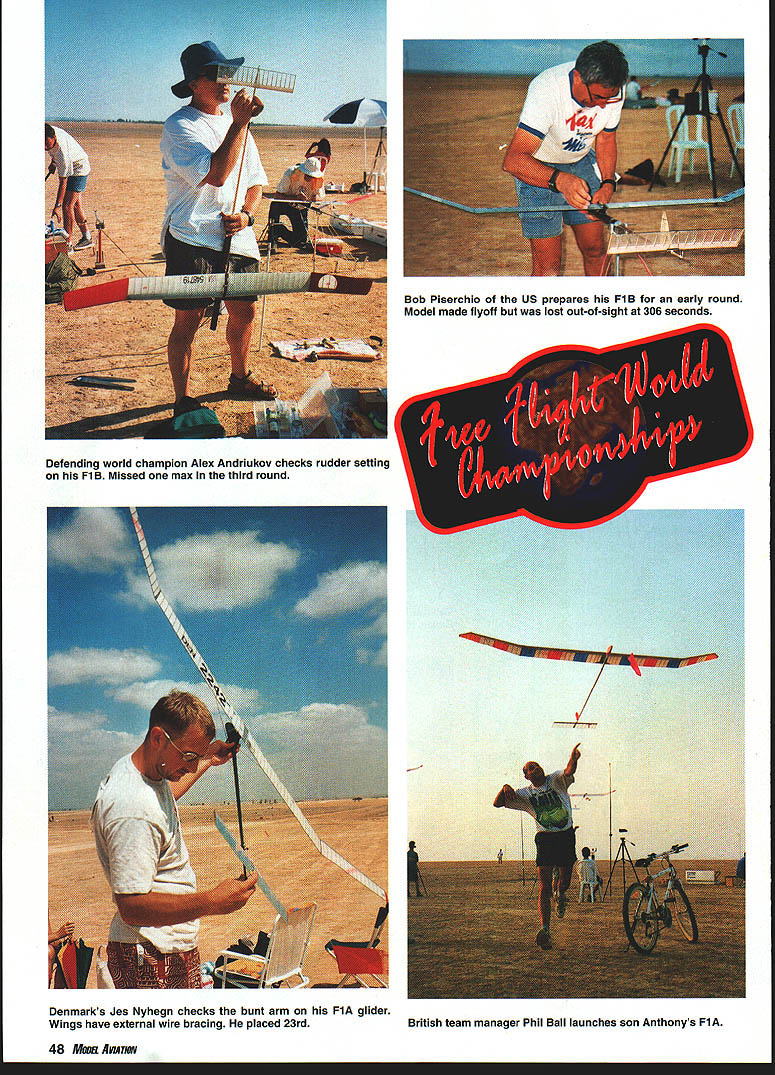
Our team flew and maxed with relative ease, but word came from Janna Van Nest at the other end of the flightline that Alex was in trouble, so we all hurried up to help. (Alex Andrjukov was flying as an individual; he was defending World Champion.)
It seems that the rubber was breaking, and he had already been through three motors by the time I got there. By the time it was over, he had been through six motors, and got the flight off, with less than full winds, with 20 seconds left in the round. At first it looked like it might have a chance, but the air was not there, and despite our best efforts, it landed 14 seconds short—ending his title defense.
The US was one of the teams still clean, with an excellent opportunity for a good team placing.
The flyoff started at 6:35 the next morning. Most of the 43 in the F1B flyoff went early in the round, to save time in case of motor trouble. We had decided to have someone with each flier to help in case of trouble, and to act as the backup (third) timer.
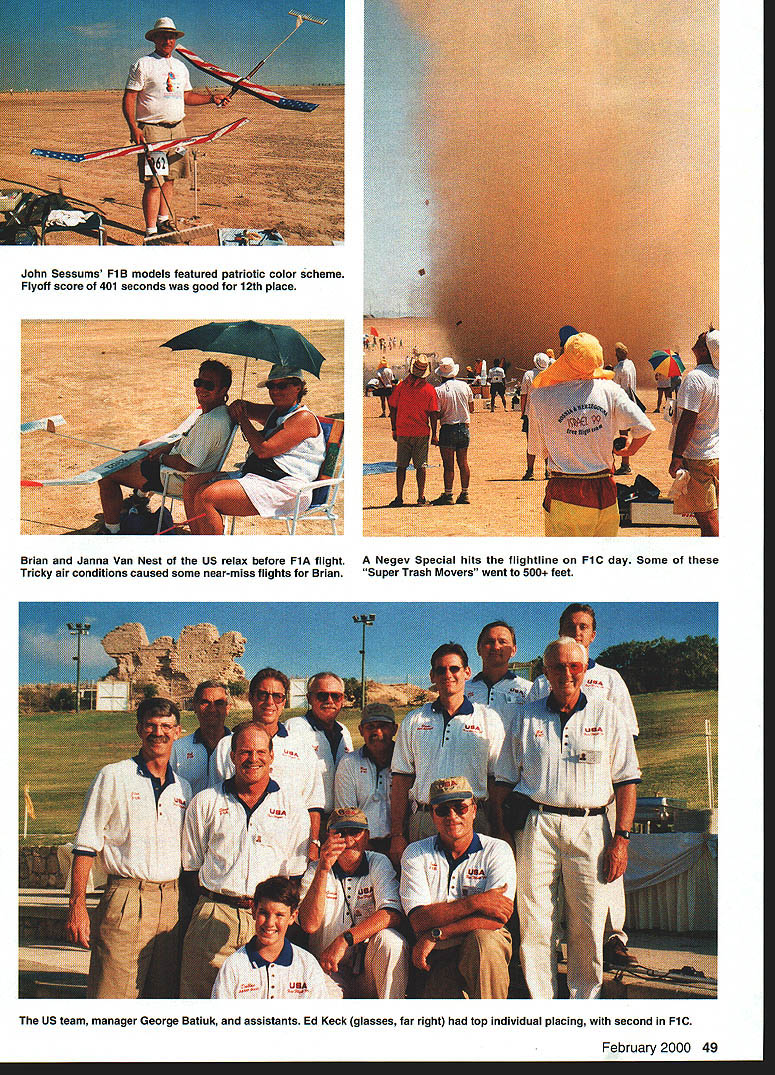
Vladi had a nice flight, and ended up being the top American. John was next, with a flight that disappeared in the haze at 401 seconds. The two timers and I lost the model at the same moment, so the time was justified. The same thing happened to Bob, although he perhaps got a bit greedy looking for the ultimate flight; the model's turn was too wide, and it disappeared downwind at 306 seconds. I do not fault Bob for this strategy, though, because in this situation I believe that you have to go for the ultimate; sometimes it works, sometimes it does not.
The team ended up in a very respectable third place—the best an F1B team has done in quite a while. The winner, Kulakovsky from Ukraine, flew very well all week, including a nice win in the Negev Open. He was followed very closely by perennial high placer Bror Einar from Sweden.
F1C
Ed, Faust, and Ron were ready, and put up very impressive first flights. In the second round, Ed and Faust maxed easily, but Ron had an overrun. He got the model back and checked everything closely, and decided to run it on the ground once. Everything worked perfectly, so he decided to use it; I concurred. But his next attempt was also an overrun, and the burnt mechanism did not kick out.
Ed looked very strong and confident, and Faust said it was just another day of flying down home in Texas, although he did scare us in the sixth round when his model got high in a dust devil, and we didn't think it would come down.
We were aided with our thermal picking in the afternoon by the Juniors, who were flying F1A this day. It made me think that perhaps this combination of events was not that good an idea. But the organizers allowed Dallas to fly F1A as a guest flier—an experience that I am sure he will not soon forget, and should be invaluable for him in the Junior World champs next summer in Czechoslovakia.
The next morning we were up and at it again for the final day: the F1C flyoff, which got underway at 6:35 a.m. Almost everyone flew fairly early in the round. Ed had one of the best flights I have seen from him: 349 seconds, for second place. Faust was down only slightly at 317 seconds, and ended up a very respectable fifth.
Eugene Verbitsky, the defending champ from Ukraine, crashed his number-one geared model while testing, was forced to use a backup model in the flyoff, and finished a disappointing ninth.
In the end, most thought that the heat, dust, and long drive to the field were a bit much, but all in all it was a very well-run championships, and the level of flying was better than normal.
The level of timekeeping was very high; all of the young fliers from Israel who participated are to be commended for their excellent work.
Thanks to the US supporters:
- Janna Van Nest
- Fred Keck
- Tanya Andrjukov
- Stan Spence
- Julie Parker
- Connie Piserchio
- Dave Thomson
- Tiffany O'Dell
Special thanks to Blake Jensen and Dallas Parker—excellent fliers and excellent assistants.
With this one behind us, we can now start to think about Australia in 2001.
MA George Batiuk 1759 Southwood Dr. San Luis Obispo CA 93401
Transcribed from original scans by AI. Minor OCR errors may remain.

