
Free Flight World Champs
by Louis Joyner
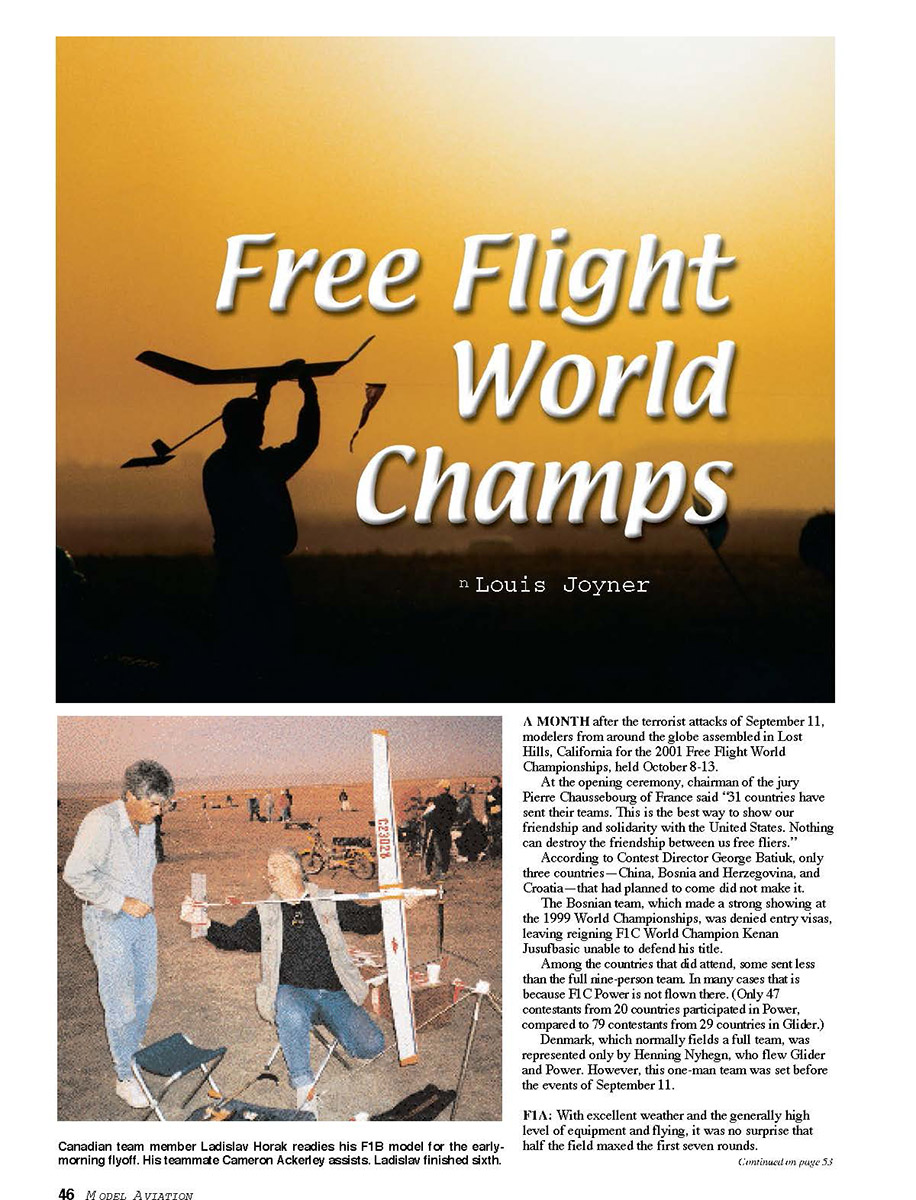
A MONTH after the terrorist attacks of September 11, modelers from around the globe assembled in Lost Hills, California for the 2001 Free Flight World Championships, held October 8-13.
At the opening ceremony, chairman of the jury Pierre Chaussebourg of France said “31 countries have sent their teams. This is the best way to show our friendship and solidarity with the United States. Nothing can destroy the friendship between us free fliers.”
According to Contest Director George Batiuk, only three countries — China, Bosnia and Herzegovina, and Croatia — that had planned to come did not make it.
The Bosnian team, which made a strong showing at the 1999 World Championships, was denied entry visas, leaving reigning F1C World Champion Kenan Jusufbasic unable to defend his title.
Among the countries that did attend, some sent less than the full nine-person team. In many cases that is because F1C Power is not flown there. (Only 47 contestants from 20 countries participated in Power, compared to 79 contestants from 29 countries in Glider.)
Denmark, which normally fields a full team, was represented only by Henning Nyhagen, who flew Glider and Power. However, this one-man team was set before the events of September 11.
F1A:
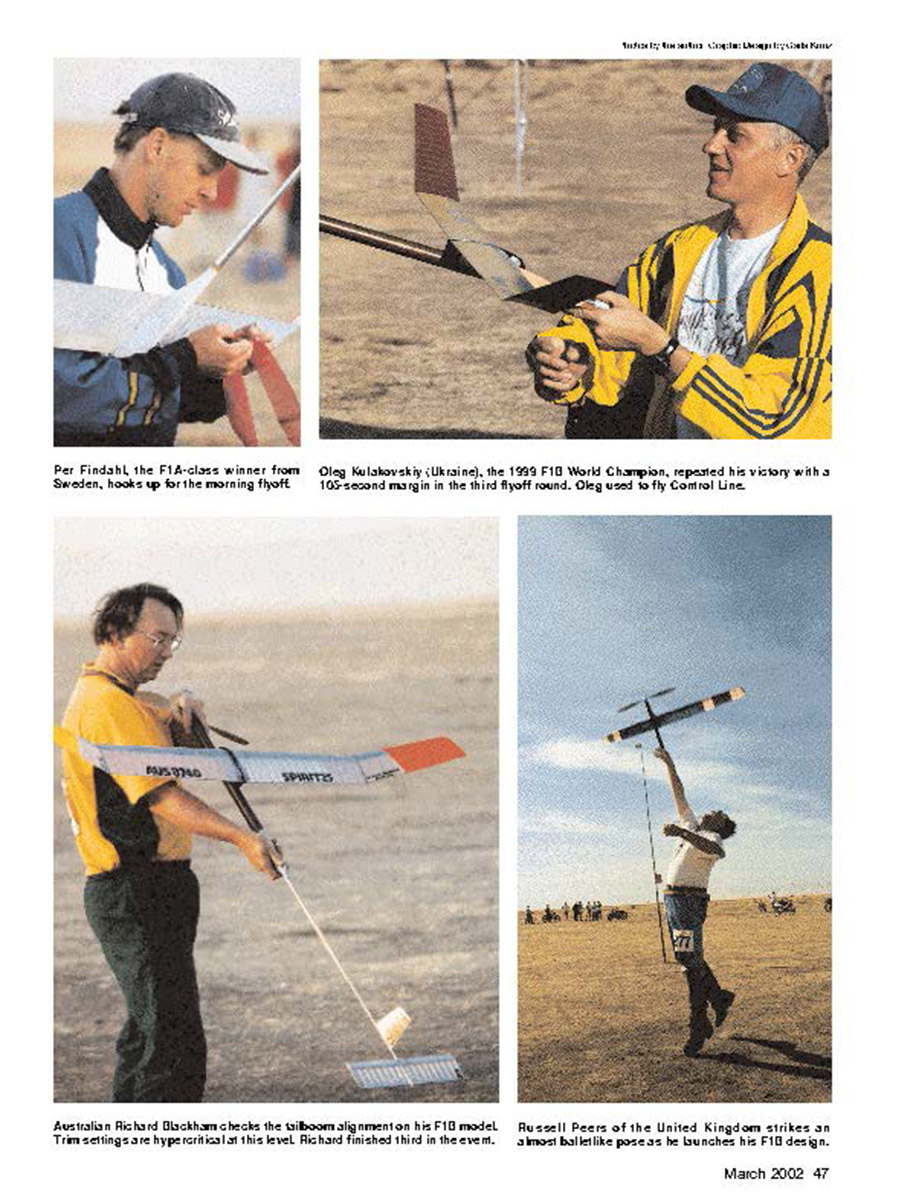
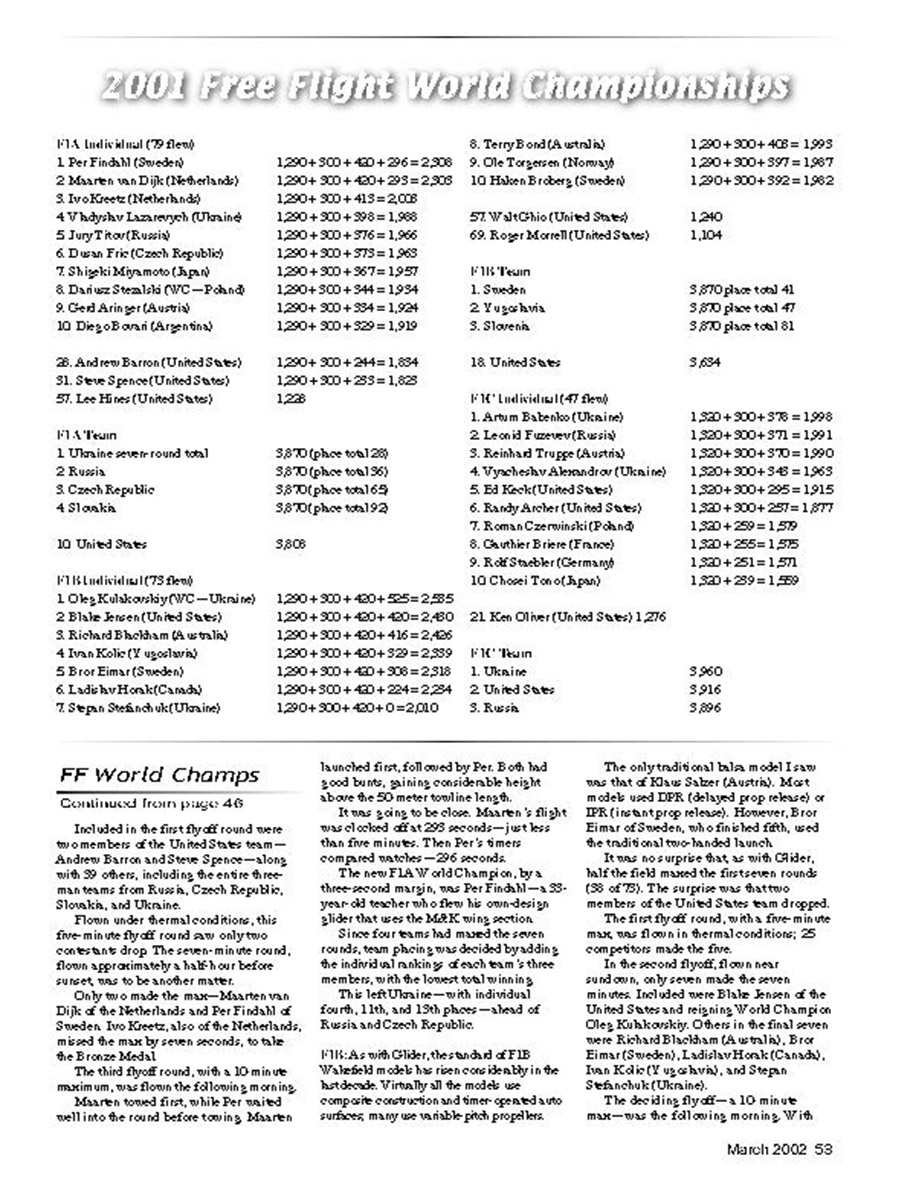
With excellent weather and the generally high level of equipment and flying, it was no surprise that half the field maxed the first seven rounds. Per Findahl, the F1A-class winner from Sweden, hooks up for the morning flyoff.
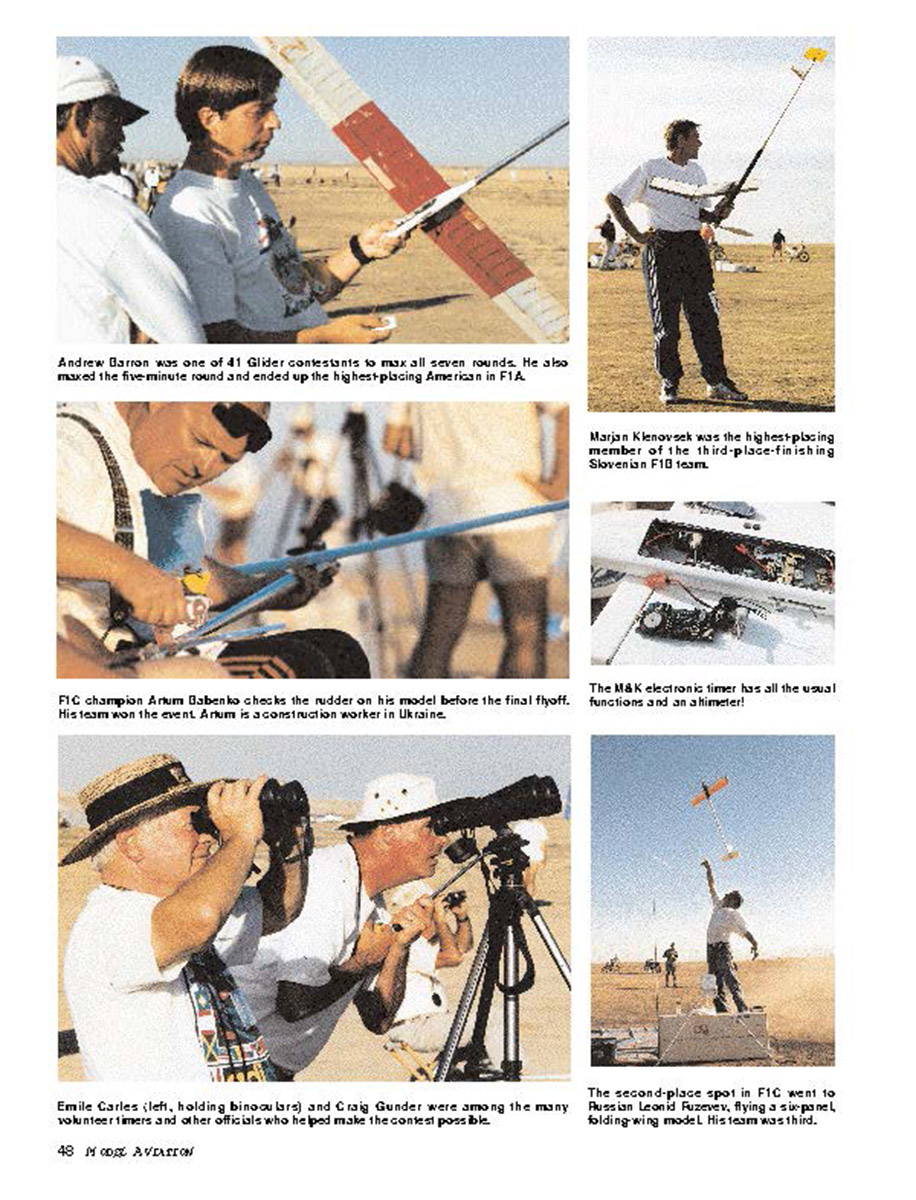
Oleg Kulakovskiy (Ukraine), the 1999 F1B World Champion, repeated his victory with a 105-second margin in the third flyoff round. Oleg used to fly Control Line.
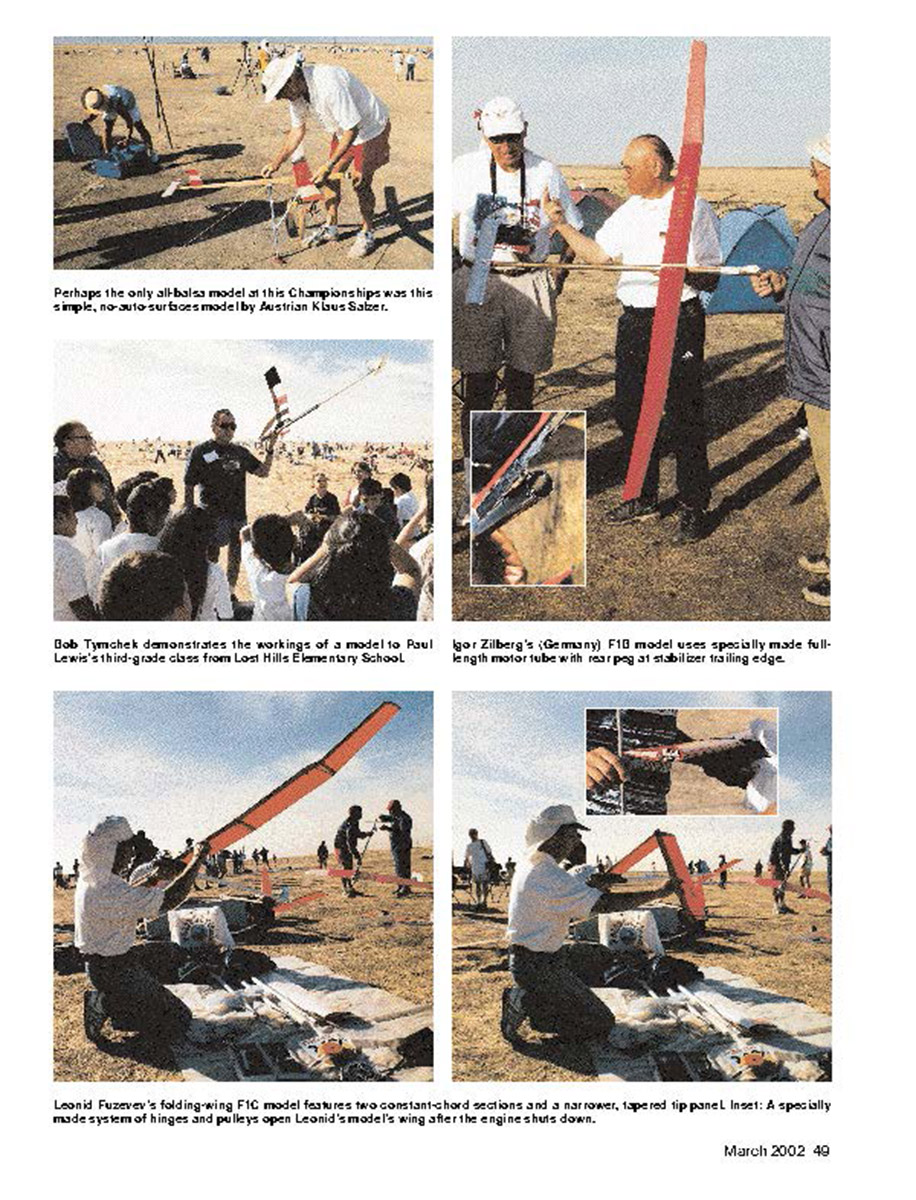
Australian Richard Blackham checks the tailboom alignment on his F1B model. Trim settings are hypercritical at this level. Richard finished third in the event.
FF World Champs
Continued from pages 4&5
Included in the first flyoff round were members of the United States team—Andrew Barron and Steve Spence—along with 39 others, including the entire three-man teams from Russia, Czech Republic, Slovakia, and Ukraine.
Flown under thermal conditions, this five-minute flyoff round saw only two contestants drop the seven-minute round. Flown approximately a half hour before sunset, it was to be another matter.
Only two made the max—Maarten van Dijk of the Netherlands and Per Findahl of Sweden. Ivo Kreetz, also of the Netherlands, missed the max by seven seconds to take the Bronze Medal.
The third flyoff round, with a 10-minute maximum, was flown the following morning. Maarten launched first, followed by Per. Both had good but varying considerable height above the 50 meter towline length.
It was going to be close. Maarten’s flight was clocked at 293 seconds—just less than five minutes. Then Per’s timers compared watches—296 seconds.
The new F1A World Champion, by a three-second margin, was Per Findahl—a senior teacher who flew his own-design glider with a new wing section.
Since four teams had maxed the seven rounds, team placing was decided by adding the individual rankings of each team’s three members, with the lowest total winning.
The left Ukraine team finished with individual places of fourth, 11th, and 18th—ahead of Russia and Czech Republic.
F1B:
As with Glider, the schools of F1B Wakefield models have been considerably influenced by the extensive use of composite construction and timer-operated auto-surfaces; many use variable-pitch propellers.
The only traditional balsa model I saw was that of Klaus Saben (Austria). Most models used DPR (delayed prop release) prop-release or IRC (instant prop release). However, Bror Einar of Sweden, who in Finland had flown the traditional two-handed launch, continued that technique.
It was no surprise that, as with Glider, half the field maxed the first seven rounds (38 of 75). The surprise was that two members of the United States team dropped.
The first flyoff round, with a five-minute max, was flown in thermal conditions; 25 competitors made the five.
In the second flyoff, flown near sundown, only seven made the seven minutes. Included were Blake Jensen of the United States and reigning World Champion Oleg Kulakovskiy. Others in the final seven were Richard Blackham (Australia), Bror Einar (Sweden), Ladislav Honak (Canada), Ivan Kolic (Yugoslavia), and Stepan Steshchuk (Ukraine).
The deciding flyoff—a 10-minute max—was flown the following morning. only a 10-minute launch window, strategy was important
If you wound and launched early, the air would be cool, with less chance of light thermal help. If you waited until near the end of the round, a blown motor could prevent getting a flight off at all.
Covering all bets, Blake Jensen and Richard Brockham wound their reserve models at the start of the round. That way each could wait to wind and fly his best model near the end of the round. In case of a blown motor, the reserve could be bunched in a matter of seconds.
Oleg Kulakovskiy and Stepan Steshchuk wound and blew motors. Rather than go to a backup model, each reloaded and wound
Oleg’s model got away in plenty of time. Stepan wound and was putting final hand turns on the propeller when the final horn sounded. Only six models were in the air.
The final scores saw Oleg repeat as World Champion with a time of 5:25 seconds (15 seconds short of nine minutes) Blake Jensen was second with a flight of exactly seven minutes. Richard Blackham was third—four seconds behind.
In the team competition, Slovenia, Sweden, and Yugoslavia had maxed the seven rounds. Ranking was decided by individual standings, with Sweden first, Yugoslavia second, and Slovenia third.
I was very pleased to see that my friend Marjan Klenovec finished in 11th place to lead the Slovenian team to Bronze Medal.
This was Marjan’s fourth World Championships, but health problems almost kept him away. His teammates Damjan Zulc and Tomasz Haina persuaded him to come to round out the team.
“At the moment we heard the medals was ours, we were in the heaven of heavens,” said Marjan. “But later in the evening as analyzed what we did in the flyoff, and Tomasz and Damjan were just happy that they did not do what they did prior to the flyoff. They were both for the first time in the flyoffs at the WC, and they were just too nervous and inexperienced”
F1C:
In Power, this was to be the year of the gears. Introduced by former World Champion Evgeny Verbitsky a few years ago, the geared engines—he calls his the Reductor—allow a larger, more efficient prop, while keeping the engine rpm in the area of maximum horsepower.
A crash program by 2001 team member Ed Keock and Doug Gilbreath to create a Nek-on-based geared engine resulted in the new GIK Hummel. (For more about geared engines, see this month’s Dissection column.)
This was also the year of the folder. Russian Power flier Leonid Fuzzev has been experimenting with folding-wing models for several years.
The concept is simple: fold the wing up to reduce drag during the climb, then unfold for the glide. Execution is not easy, although Leonid makes it look that way with flight after flawless flight.
Each wing half consists of two constantchord panels and a narrower, tapered tip panel. The tip folds under the middle panel, then both fold under the inboard panel. The result looks like the wing from a Control Line combat model grafted onto a long F1C fuselage.
There was considerable speculation about how many geared models would be in the flyoff (a number of fliers had conventional and geared models, and they held the geared model for the flyoff rounds).
But to get to the flyoff, you have to get through the first seven rounds.
Twelve competitors dropped the first round, which was flown in dead air with a four-minute max. Others dropped during the day, with many missing the max by only a few seconds.
Former World Champion Bernard Boutillier of France had one of those days best forgotten—seven rounds and not a single max.
Two more fliers were disqualified during spot checks by Alexander Andrievski’s processing crew. (Power models have a power loading, based on engine displacement, and a wing loading based on total projected wing area in stabilizer area.)
Of the 47 who started the day, only 15 made it to the first flyoff. Six made the fifteen max, including Randy Archer and Ed Keock of the United States team.
Evgeny Verbitsky was one of those to drop, but his teammate Artum Babenko, flying a similar low-pylon geared model,
was among the five remaining. So too was Leonid Fuzzev with his folder. He had switched to the version with the geared engine for the flyoffs.
Reinhard Truppe of Austria and Vacheslav Haczarov of Ukraine rounded out the field.
The air was cooling rapidly in the setting sun. The second flyoff round was to be deciding one. No one made the scene the minutes, but it was going to be a close contest.
Artem Babenkos’s time was 3:78 seconds— slightly more than six minutes off a five-second motor run. Leonid Fuzzev was seconds— seven seconds behind. Reinhard Truppe was third—again a second behind Leonid.
Ed Keock and Randy Archer finished fifth and sixth, clinching a Silver team medal for the United States behind Ukraine, which was the only team to max out Russia claimed the team Bronze.
With three individual and three team events, only two national anthems were heard at the awards banquet: Sweden won the individual title in Glider and the team award in Wakefield and the rest went to Ukraine, including the overall win.
This was the first time a flier from Sweden won the Swedish Cup for Individual Glider.
Leonid Fuzzev gained a rousing round of applause from the audience as he came forward to receive his second-place medal, unfolding and raising his arms in duplication of his model’s unfolding wings.
Running a World Championships involving several hundred contestants, more than a thousand flights, and hundreds of spectators is not an easy task. Pulling it off without a hitch takes a lot of effort from a whole lot of people.
Contest Director George Baziuk’s dedicated crew had obviously thought out even the smallest detail.
Technical Value:
In addition to watching the flying, attending a World Championship is the best way to examine the latest in Free Flight technology.
The three FAI (Federation Aeronautique Internationale) events flown at the Free Flight World Championships are among the most technologically advanced sports in the world This is not an event of balsa-and-tissue models with airfoils traced around a shoe.
Perhaps the following will, in some small measure, illustrate the level of development and commitment among the world’s Free Flight modelers.
Towline Glider seems to be such a simple event. At first glance the models seem sleek, uncluttered, and uncomplicated. But lifting the hatch cover on the side of the average F1A model reveals an intricate electromechanical system for controlling the flight—all based on line tension and preprogrammed timer settings.
Many models use an electronic timer that controls a servo connected to the stabilizer through a pull-pull cable system or a pushrod.
Linked in to a pivoting, latching towhook, the glider typically uses a variety of stabilizer settings to allow maximum line tension during tow, maximum height on the zoom launch, optimum recovery on the bunt, and the best glide setting for the given conditions.
Frequently, a fast glide setting is used for the first few seconds after the bunt to prevent a stall, then the timer cranks in just a bit more up for the rest of the glide.
Other controls include an auto rudder, operated off towhook tension, that provides settings for straight tow, circle tow, bunt, and glide. A wing wiggler is often used to vary the angle of one wing between tow and glide.
An advantage of the electronic timer is that a variety of settings can be stored in a PalmPilot™ or laptop and downloaded to fit the flying conditions.
Mikhail Kochkarev showed me an altimeter that he and Sergei Makarov have developed for their M&K gliders.
Accurate to a half meter (approximately 18 inches), the device can be set to sample the model’s altitude at two points during the flight: typically at the end of the bunt and at DT (dethermalization). The data is downloaded after the flight.
The altimeter is strictly for informational purposes; it has no control function. But it is very useful for training—especially in finding the optimum model settings and line angles for the maximum bunt altitude.
Mikhail quoted bunt altitudes in calm conditions of 73 to 75 meters (this is with a 50-meter towline). In strong wind or thermal conditions, the altitude at the end of the bunt can range from 80 to 90 meters (90 meters is roughly 295 feet).
The altimeter is $100. It is only compatible with the M&K electronic timer. A complete M&K model with electronic timer and altimeter will cost between $1,650 and $1,970, depending on wing length.
Jim Parker is the US dealer. Contact him at 9524 Ruffner Ave., North Hills CA 91343 or via E-mail at [email protected].
For most F1A models—indeed, for most international-class models—the preferred wing construction utilizes a vacuum-molded carbon-fiber D-box for torsional strength and a full-depth spar with carbon flanges top and bottom to handle the bending loads.
The rest of the structure is minimal, with carbon-capped balsa ribs connecting to a narrow carbon trailing edge. Covering is some type of plastic film.
In addition to improved strength, this type of construction does not change with humidity, as does a traditional balsa-and-tissue wing. However, it does take more time than traditional construction—especially the first few attempts.
Foam is one alternative that has a few advocates. Cutting a wing panel with a hot wire takes only a few minutes, and templates can be changed easily to allow for airfoil experimentation.
Lubos Slavicek (Czech Republic) was flying a model with a white foam core. A full-depth carbon-flanged spar was fitted, then two layers of carbon tows were laid over the wing at opposite 45° angles, spaced slightly less than an inch apart.
Then two layers of 30-grams-per-square-meter fiberglass cloth were added, also at a 45° angle. Epoxy resin was used to attach the cloth.
A somewhat similar approach was used for second-place finisher Maarten van Dijk’s model. Unlike most models, which use a two-piece wing, his uses a three-piece wing.
The flat center panel bolts to the top of the fuselage, then the tips attach with stub carbon rods. The center panel uses solid foam reinforced with carbon cloth top and bottom. The tips use a carbon D-box with ribs aft of the spar.
In F1B, the effort to wring the maximum performance from 35 grams of rubber has led to the widespread use of variable-pitch front ends fitted with a DPR or instant start.
By far the most popular is the Andriukov unit, which is being produced in Ukraine by reigning World Champion Oleg Kulakovskiy. Other units are being made and sold by Evgen Gorban, Yuri Blazhevych, and Igor Vivchar, all of Ukraine.
With the switch to 30-gram motors beginning in 2002, an efficient propeller/front end combination will be even more important.
With the rubber weight limited, every effort is made to wind the motor to the maximum. With the composite motor tubes in almost universal use, a blown motor won’t destroy a model. Just digging a knotted-up motor out of the tube can take time.
In flyoff, with only 10 minutes to wind and launch, it can be critical.
Surprisingly, few people were using winding tubes, which can reduce the shock of a blown motor and make removal faster and easier.
The German team was using an interesting variation of the cartridge loading system developed by German World Champions Lothar Doring and Reiner Hofsaess in the 1980s.
But instead of using the winding tube to insert the motor and protect the model during winding, Peter Moeninghoff and Bernd Silz wound the rubber motor in the aluminum tube then inserted it in the model, hooking up the rear peg and removing the tube.
Instead of a tube, teammate Igor Zilberg used a piece of stainless-steel channel measuring approximately ¾-inch wide and 3⁄8-inch high. This allowed the motor to be wound at an angle then fitted into the channel for insertion in the model.
Using channel instead of a tube reduces the binding and possible breakage of the motor, which can occur with a winding tube.
Igor flew perhaps the most unusual F1B model. Instead of the typical 26- to 32-strand motor that gives a 40- to 50-second prop run, his model uses 16 strands of ⅛-inch rubber.
The motor, which extends the full length of the model, can take upward of 1,200 turns and gives a motor run that well exceeds two minutes. minutes. The prop is a standard Andrieux variable-pitch unit. The climb was better than one might expect.
When a motor does break during winding, the shock can cause damage to the model, especially if it is held in a rigid winding stoge. Rudders can fall off and clockwork timers can fly apart.
Brice Burnet had an interesting and very simple method for reducing the shock. It was a box measuring roughly two inches square and five inches long. It was hinged halfway down along one of the long sides.
Both ends were cut away to fit the motor tube. Foam-rubber strips along the inside helped the box grip the tube. Thick metal weights were epoxied to the top and bottom of the box, giving a total weight of approximately 350 grams (approximately 12 ounces).
The box was strapped around the motor tube before winding then removed before the model was taken from the stoge. In case of a blown motor, the device would act as a mass-shock absorber to reduce damage to the model.
Watching Bruc prepare for the second flyoff round, it was obvious that he knew his model. With his number-one model in the stoge, he turned the glide adjustment screw down slightly.
Often the temptation is to turn the screw the other way to try to wring a few extra seconds from the glide.
Later Bruce explained that he speeded up the glide for safety. A slight stall, caused by raising the trailing edge, could do more damage than taking it down a bit.
“This model has a personality,” he said. “It likes being taken care of.”
Bruc had two servos assembled and loaded. He began winding the model he had chosen by the standard brake.
Rather than go to one of the backup models, he patiently unwound and removed the motor, wound again, and launched in a true vertical climb. He wanted to fly that model.
Blake Jensen had also spent a lot of time fine-tuning his models, including a trip down from Oregon to Lost Hills several weeks before to practice alone.
Blake was also tracking scores. For the seven-minute flyoff, he opened up the glide six full turns to give a glide circle of close to two minutes.
Many flyers feel that adjusting the diameter of the glide turn is a safer adjustment than moving the stabilizer trailing edge up or down.
On a Wakefield, the stabilizer glide setting will also affect the cruise portion of the prop run, so decreaseing decelage — the difference between wing and tail angles — can reduce the climb. Increasing decelage by raising the stabilizer trailing edge can lead to a stall that ruins the glide.
Electronic timers are slowly making inroads into F1B. The Black Magic timer developed by US team member Roger Mortell has been available for several years.
As do the F1A timers, it requires an external device for programming.
A new electronic timer shown for the first time was the e-Timer developed by Ralph Cooney and Dave Bushey. This five-function device is powered by two lithium batteries and uses a push-button remote mounted vertically to release the tow arm.
Timing sequences are set at the timer, without the need for extra ground equipment. A micro switch can be mounted on the left side of the motor tube under the thumb. When the model is launched, the timer starts.
The e-Timer weighs 19.8 grams — a bit heavier than the popular clockwork timers. The size is also slightly larger than the clockwork timers, so the fit in one of the ready-made ply pods might be tight.
The e-Timer is $150. For more information, contact Fourmost Products, 4012 24th Ave., Forest Grove OR 97116.
In addition to the geared engines and Fuzzev’s folder in F1C, Evgeny Vetlushky’s and Anton Babenko’s Ukrainian models were most interesting. The pylons were very low — roughly a inch high on Anton’s model and even less on Evgeny’s.
On Bruegny’s model, the cowling extended only partway to the engine; the main part of the cylinder exposed. The rear exhaust ducted through a short tube above the nose.
Both models used six-panel wings — increasingly popular in all three events. The idea behind the six-panel wing is to approximate the shape of an elliptical wing using easier-to-build straight-taper panels.
Likewise, the extra dihedral break on each side approximates elliptical dihedral with much easier construction.
Bruegny’s model used a carbon-D-box, but instead of thin, ribbed structure aft of the spar, he used an aluminum skin for the front inboard panels; the tips were open.
Anton’s model used a six-panel aluminum-skinned wing with distinctive swept back tips. (Widely used in the 1980s, aluminum wings are made by epoxying very thin, hard aluminum to balsa ribs. Ribs and spar form the internal framework for the stressed-skin structure. The result is a very smooth, clean surface, but the aluminum is very difficult to repair.)
The open carbon-fiber D-box construction is slightly stiffer, more durable, and easier to repair. But the slight sag, inevitable in any open structure, can be felt to reduce performance slightly.
In Power, setting high is the name of the game. Bob Hunt was using a large range-finder to measure climbs in F1C models. Some of the numbers were: Bruno Babenko, 115 meters; Randy Archer, 154 meters; Evgeny Vetlushky and Bob Keck, 150 meters. (150 meters equals 492 feet.)
Bruno noted that there seemed to be three groups of fliers at the top: ones getting roughly 150 meters, others near 135 meters, and the lowest group was getting roughly 120 meters, or about 390 feet.
Louis Joyner 283 Clawson St. Mt. Pleasant SC 29464
Transcribed from original scans by AI. Minor OCR errors may remain.

