
Frequently Asked Questions
Bob Aberle
Single Channel and Vintage RC website
Q574: I heard that there is a website dedicated to some of the original RC model aircraft and equipment dating back to the early 1950s. I know I could try a Google search, but I felt you might be able to direct me to a specific site?
A574: I did do a Google search requesting "single-channel model aircraft." This produced a long list of references, which I think you might want to peruse.
One of the references I found in the search was mentioned by my Canadian modeling friend, Chris Moes, in a construction article. I've listed Phil & Shaun's Single Channel & Vintage RC Page in the "Sources" section at the end of this column. It is one of the best that I have seen covering this subject.
I suspect it has already been mentioned in the Vintage RC Society newsletter. Phil Green and Shaun Garrity are the creators of this website.
Phil's email address is provided on the site if you want to contact him. He and Shaun are looking for photos of vintage RC equipment and airplanes.
A black menu border runs across the top of the opening page. Many categories are listed in that border, such as Early Days, Single Channel, Pulse and Galloping Ghost, Reeds, Proportional, Models, Kits, Engines, Archives, and more. Clicking on any of these categories will open a load of photos and detailed information. I spent hours perusing the site.
I think that this site should be made available on a laptop at AMA's National Model Aviation Museum's Vintage RC section in Muncie, Indiana. Take a look and let me know your thoughts on this website.
Questions About Foam Building Materials
Q575: Reader/member, Fran Jansen, has questions concerning the building of model aircraft with foam materials. He wanted information about three kinds of foam materials: Elapor, Expanded Polyolefin (EPO), and Z-Foam.
He wanted to know where he could purchase the material, where he could find the necessary tools and cements, and if there were any hobby books available about this subject.
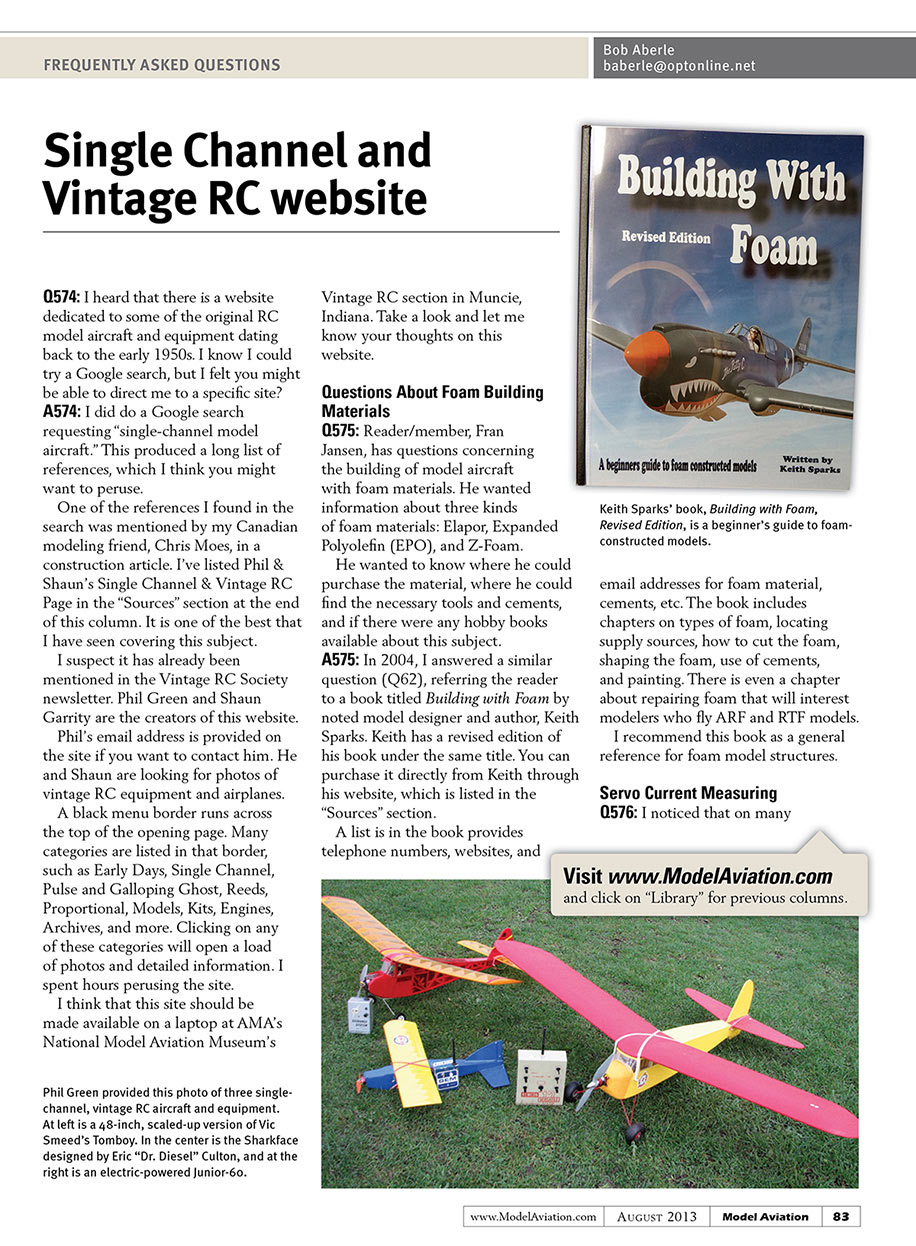
A575: In 2004, I answered a similar question (Q62), referring the reader to a book titled Building with Foam by noted model designer and author, Keith Sparks. Keith has a revised edition of his book under the same title. You can purchase it directly from Keith through his website, which is listed in the "Sources" section.
A list in the book provides telephone numbers, websites, and email addresses for foam material, cements, etc. The book includes chapters on types of foam, locating supply sources, how to cut the foam, shaping the foam, use of cements, and painting. There is even a chapter about repairing foam that will interest modelers who fly ARF and RTF models.
I recommend this book as a general reference for foam model structures.
Q576: The specifications for my servos don't tell me the operating current. What am I supposed to do?
A576: You need to measure the current needed to operate your receiver and all of your servos. In rough terms, a receiver might draw 20 mA of current. Each servo may idle (not moving) at roughly 50 mA. A receiver and four servos (at rest) might draw 220 mA current. But these same servos may draw much more current when moving.
Insert a current meter between your battery (or BEC) and your RC receiver. After doing that, operate your RC system by trying to simultaneously use as many servos as possible, moving the transmitter control sticks at the same time. By doing that, you may find that you have exceeded the current for that particular ESC/BEC.
Many modern ESCs now use a switching circuit that allows for much higher current ratings.
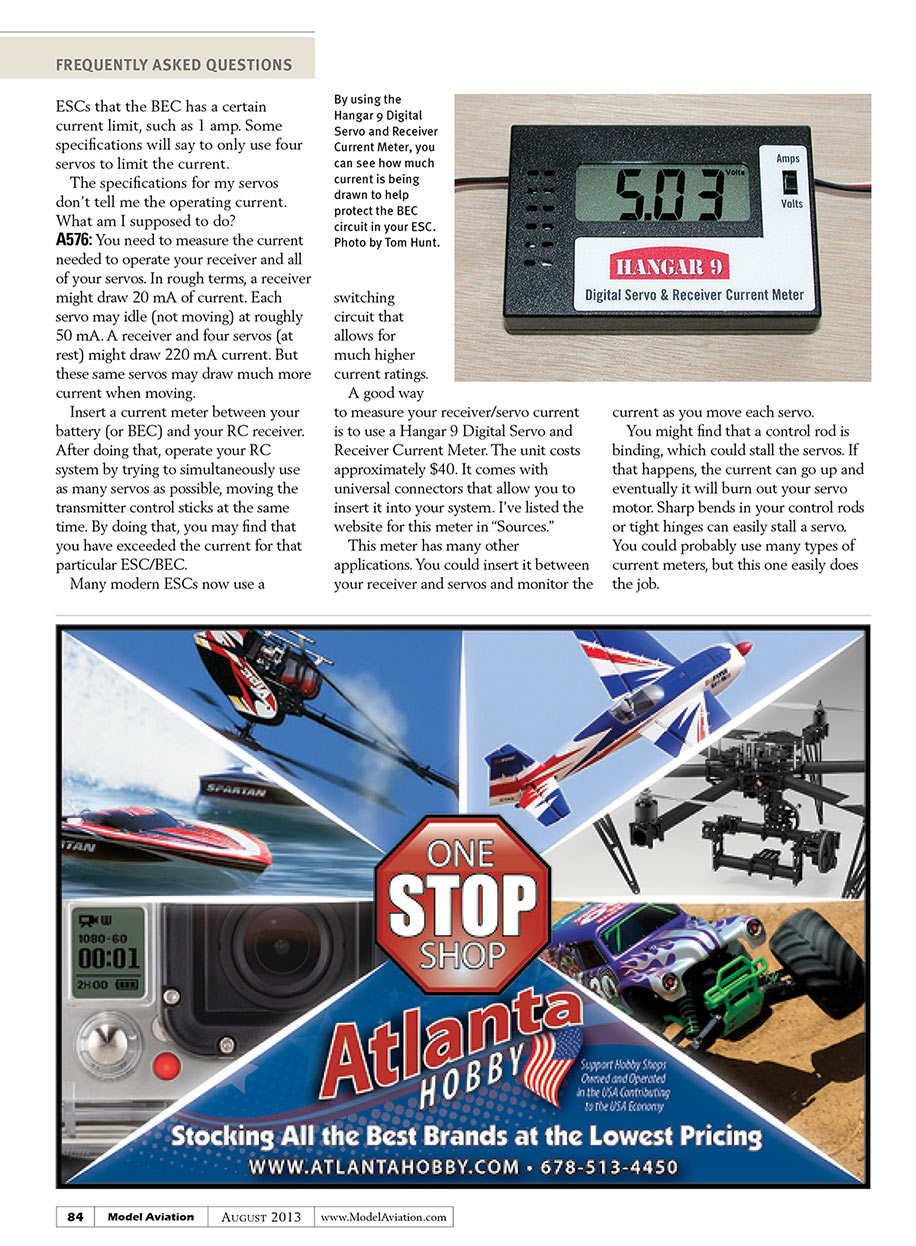
A good way to measure your receiver/servo current is to use a Hangar 9 Digital Servo and Receiver Current Meter. The unit costs approximately $40. It comes with universal connectors that allow you to insert it into your system. I've listed the website for this meter in "Sources."
This meter has many other applications. You could insert it between your receiver and servos and monitor the current as you move each servo.
You might find that a control rod is binding, which could stall the servos. If that happens, the current can go up and eventually it will burn out your servo motor. Sharp bends in your control rods or tight hinges can easily stall a servo. You could probably use many types of current meters, but this one easily does the job.
Q577: I could purchase one, but I couldn't see it well enough. Can you provide details?
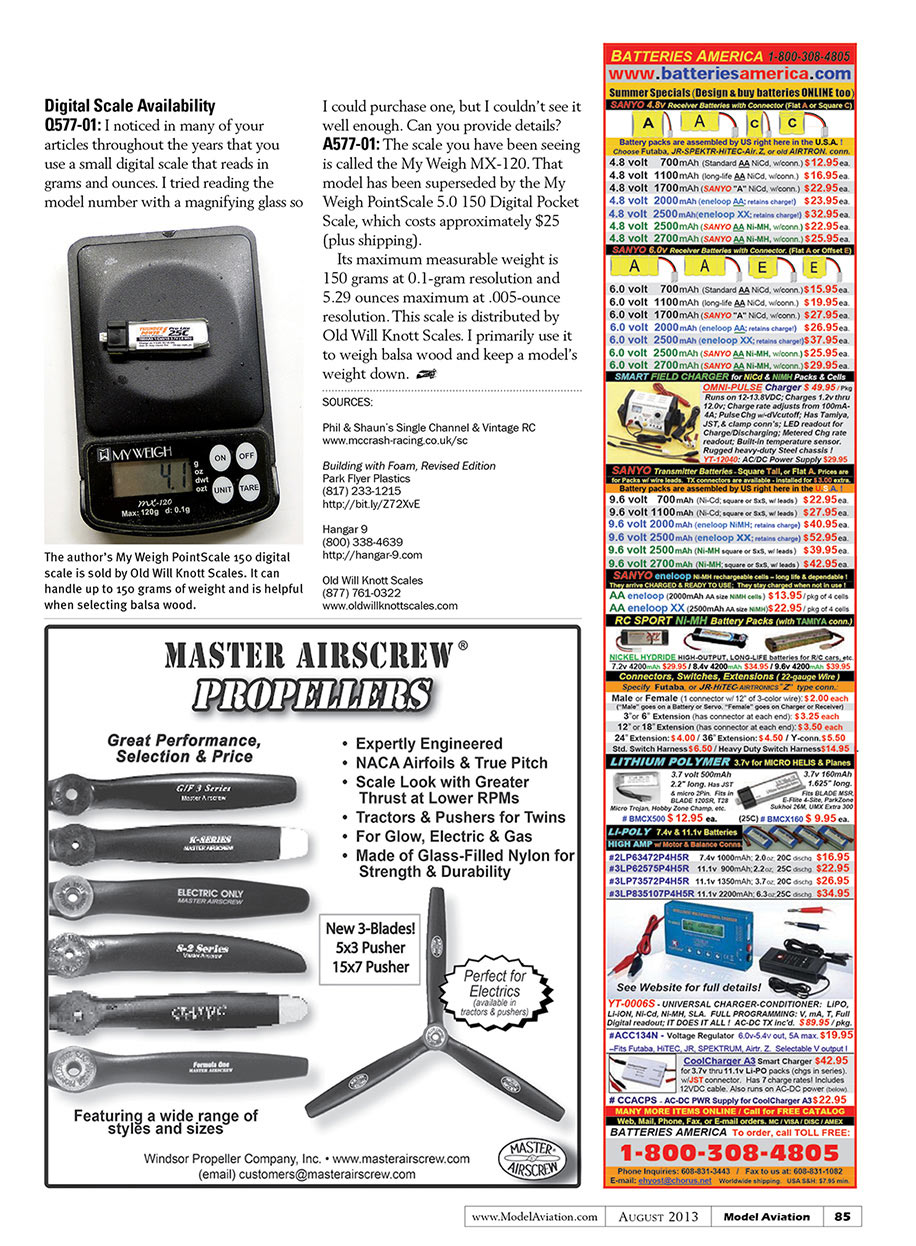
A577-01: The scale you have been seeing is called the My Weigh MX-120. That model has been superseded by the My Weigh PointScale 5.0 150 Digital Pocket Scale, which costs approximately $25 (plus shipping).
Its maximum measurable weight is 150 grams at 0.1-gram resolution and 5.29 ounces maximum at .005-ounce resolution. This scale is distributed by Old Will Knott Scales. I primarily use it to weigh balsa wood and keep a model's weight down.
SOURCES:
- Phil & Shaun's Single Channel & Vintage RC
- Building with Foam, Revised Edition
Park Flyer Plastics (817) 233-1215 http://bit.ly/ZZvXlE
- Hangar 9
(800) 338-4639 http://hangar9.com
- Old Will Knott Scales
(877) 761-0322 www.oldwillknottscales.com
Transcribed from original scans by AI. Minor OCR errors may remain.

