
Frequently Asked Questions - 2004/09
Bob Aberle
E-mail: [email protected]
This is the fifth monthly column in which I try to give the best answers to questions you have written in or e-mailed. I'll make this introduction in a few more columns for those who are not yet familiar with the routine. Each question is given a sequential number for identification purposes. Because publication space is limited, these and additional questions and answers will be posted on the AMA Web site. Let's start!
Q38: "After discharging my batteries (either by flying or when simply discharge testing them), should I recharge them before storing or just leave them in a discharged state?"
A38: Believe it or not, you can store Ni-Cd or NiMH cells either way. I recharge them when I return from a flying session and usually recharge them every month or so until I fly again. If I perform a discharge capacity check (also called cycling), I also recharge the battery when the test is concluded.
Since Ni-Cd and especially NiMH cells lose much of their charge in just a month's time, these cells are never exactly topped off at "full." Keeping the cells close to full charge while storing them has worked for me for many years.
On the other hand, my flying partner Tom Hunt has always stored his batteries discharged and only recharges them just before a flying session (or the night before). However, he does make sure that the pack has more than 1.0 volt per cell (at rest, with no load) before leaving it dormant for any length of time. If the pack has too low a potential, it could damage the cells if the voltage drops too low during self-discharge. He has had no problems using this technique for many years.
So it seems that either way is acceptable and is apparently not critical. The important point is that the batteries are at or close to full charge potential just before flying. Regardless of how you store your batteries, it will take a few "cycles" to wake up the pack to full capacity after it has been dormant for some period of time.
With respect to Li-Poly batteries, the jury is not in yet. Most experts say that you should store them charged. Li-Poly batteries lose very little charge—only about 1% or 2% over six months—so it's easy to store them at full or near-full charge for long periods. You could conceivably store a charged Li-Poly pack and fly with it six months later with a perfectly normal motor run time. By the way, you should not trickle-charge Li-Poly batteries.
An interesting suggestion has come up recently concerning Li-Poly battery charging. When you first connect your Li-Poly battery to the charger, you could initially set the charge current to a low value, such as 100 mA (assuming your charger has variable current and an LCD to monitor current and voltage). Observe the battery's voltage at that initial charge level. Allow it to reach approximately 3.5 volts per cell. That should happen quickly, depending on how discharged the battery was to start. Once it reaches about 3.5 volts per cell, adjust the current upward to the normal recommended current of 1C (one times the rated capacity of the battery). Allow charging to continue until the charger cuts off near full capacity, about 4.2 volts per cell. This is a suggested technique; the need for it has not been proven. Would any Li-Poly battery experts out there like to comment on this charging technique?
Q39: "I have an 'onboard' glow-driver battery for my twin-cylinder engine that requires two cells in series. Can I, without damage, charge this battery on the receiver side of a regular transmitter/receiver charger? What about the receiver side of a Sirius charger?"
A39: When you write in, please mention the size (or type) and the capacity of the batteries you are referring to. That information helps me provide the best possible answer.
I'd guess you are using 1 or 2 amp-hour (Ah) Ni-Cd or NiMH cells. Most dual-output RC-system chargers provide only about 50 mA for an eight-cell transmitter pack or a four-cell receiver pack. That low a charge current will not properly charge a 1 Ah (1000 mAh) cell; an overnight (C/10) rate would be about 100 mA.
For fast charging:
- Ni-Cd fast charge: about 3C (e.g., 3 amps for roughly 20 minutes for a 1 Ah cell).
- NiMH fast charge: about 2C (e.g., 2 amps for roughly 30 minutes for a 1 Ah cell).
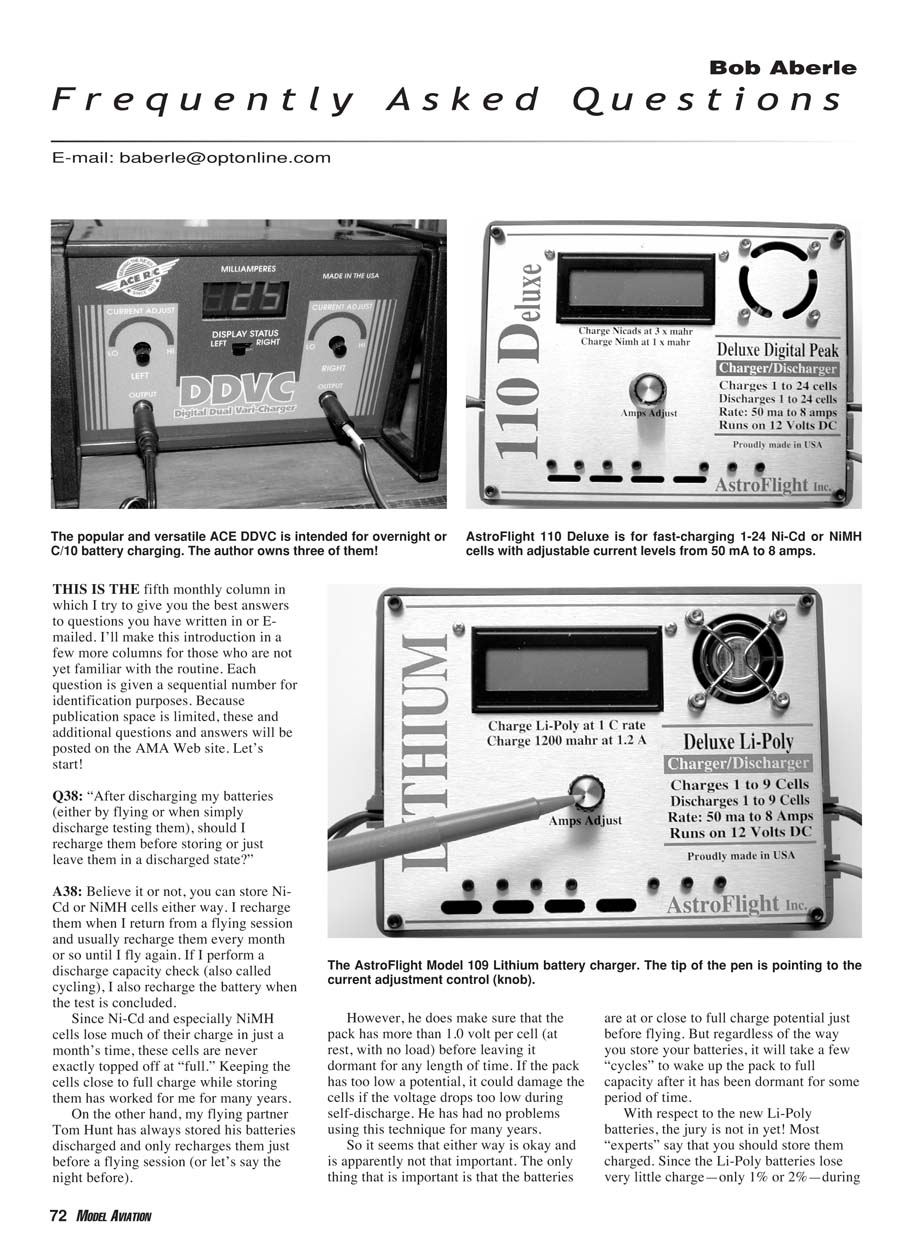
If you want a variable dual-output unit that can handle receiver/transmitter style charging at reasonable currents, I recommend the ACE Dual Digital Variable Charger (DDVC), which has two variable outputs and can handle one to at least ten cells at currents from 0 up to well more than 300 mA.
For fast, higher-current charging of larger packs, the Sirius chargers are typically intended for four or eight cells and usually won't handle a two-cell battery as you describe. For fast charging of a variety of pack sizes, I recommend the AstroFlight 110 Deluxe; it can handle one to 24 Ni-Cd or NiMH cells with continuous current from 50 mA up to 8 amps.
Q40: "What happens if you attempt to use an electric motor speed controller that's either too big or too small (in amps)? How do you know which one to use? It seems each local hobby dealer has a different explanation."
A40: To select the proper ESC, you must know the current draw (in amps) of your motor in the particular setup you plan to use. Current draw varies with motor type, voltage (number of battery cells), propeller size, and whether you use direct drive or reduction.
I recommend using an accurate digital meter (such as the AstroFlight digital meter) to measure motor current, voltage, and power. Once you know the motor current, selecting the proper ESC is straightforward.
Example:
- If your Speed 400 direct-drive motor draws 10 amps, an ESC rated for 10 amps is acceptable. Most ESCs are rated for maximum continuous current. Any ESC rated higher than the measured current is fine.
- Avoid using an ESC with a current rating below the motor's draw; it may overheat and burn out. The lower the rating relative to the motor current, the quicker the failure will occur.
Keep in mind:
- Higher-rated ESCs tend to weigh more and cost more. You don't need a 40-amp ESC for a motor that only draws 10 amps.
- With many people switching to Li-Poly batteries, check the ESC's voltage cutoff point. In my "Introduction to Lithium-Polymer Batteries" article (May 2004 MA), I noted that I used a Jeti JES-110 ESC in a trainer, whose cutoff is 5.5 volts.
- Normally, Li-Poly cells should not be taken lower than about 3.0 volts per cell (6.0 volts for two cells). A 5.5 volt cutoff equals 2.75 volts per cell—slightly lower than ideal but still acceptable.
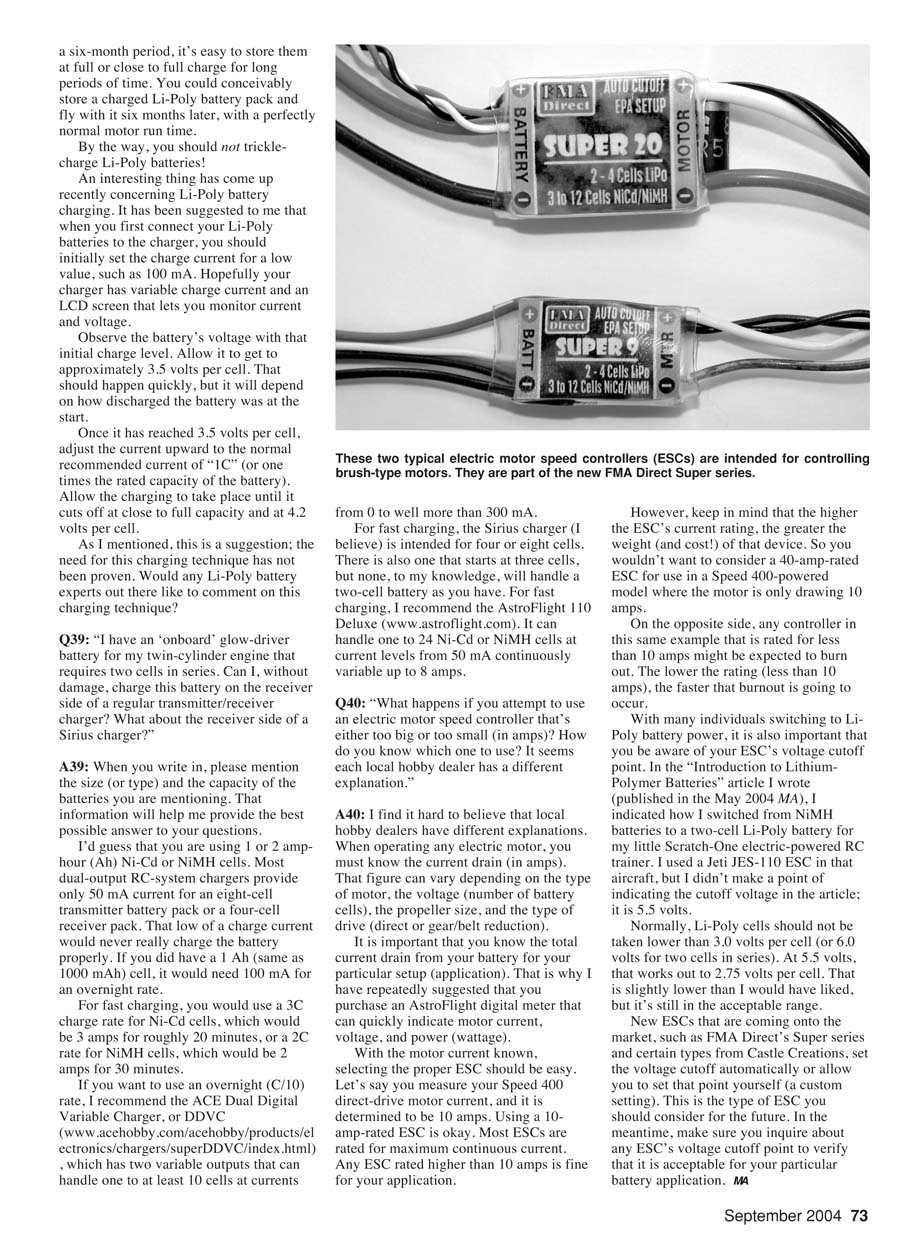
- Newer ESCs (for example, FMA Direct's Super series and certain models from Castle Creations) allow you to set the voltage cutoff automatically or choose a custom cutoff. These adjustable-cutoff ESCs are a good choice going forward.
Make sure to inquire about an ESC's voltage cutoff and ensure it is suitable for your battery type and application.
Transcribed from original scans by AI. Minor OCR errors may remain.

